
Step 1: Define What You Are Controlling
Relative humidity is the amount of water vapour in air relative to the maximum it can hold at that temperature. Dew point is the temperature at which air becomes saturated and water starts to condense. Rated dehumidification capacity is the water removal figure measured at a stated entering-air condition.
"Keep the humidity down" is not a specification. Four distinct objectives appear in commercial work, and they lead to different equipment.
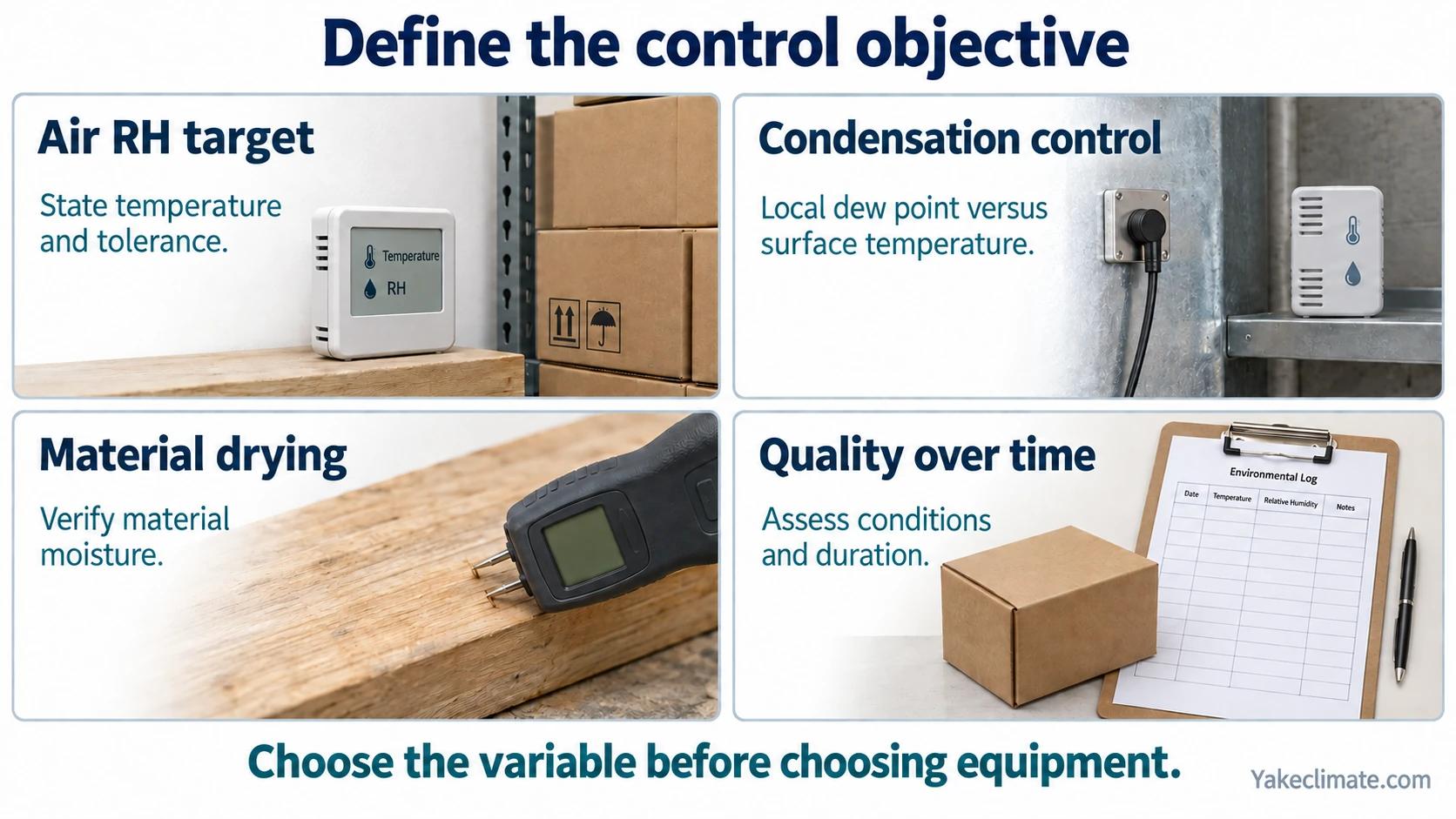
- A relative humidity target. Appropriate where the requirement genuinely depends on RH: occupant comfort, many material and process specifications, some storage requirements. The setpoint applies at a stated temperature; without that temperature, the specification is incomplete.
- A dew point target. Appropriate where condensation on a surface is the risk. A dew point specification directly answers whether a given surface will wet, which relative humidity cannot. The reasoning is set out in condensation risk and dew point. Electrical enclosures, cold surfaces, chilled process equipment, and battery installations belong here.
- A material moisture target. Appropriate where the objective is the condition of a material rather than of the air: drying a slab, drying a structure after water damage, holding a product at a specified moisture content. Here the air condition is a means, and the material's equilibrium moisture content determines what air condition is needed. See evaporation, drying rate and dehumidification load.
- A biological or quality outcome. Mould prevention, disease pressure, product shelf life. These depend on surface conditions and duration rather than on an air reading, which is why a single RH setpoint is usually the wrong specification, treated in dehumidifier settings for mould prevention.
Getting this wrong is expensive because it can lead to correctly sized equipment controlling the wrong variable. A project that specifies 50 % RH when its actual concern is condensation on a chilled surface may hold 50 % RH perfectly and still condense.
Also define the tolerance and the period. Must the target hold continuously, during occupied hours, or during a specific process? Is a brief excursion acceptable? These determine control strategy and redundancy as much as the setpoint does.
Step 2: Quantify the Moisture Load
Estimate the net moisture-removal duty for each operating case, including water entering through ventilation, infiltration, people, processes and materials, any other removal routes and changes in stored moisture. Floor area alone cannot establish the load or the required dehumidifier capacity.
A ventilation-load example
Example (illustrative): a ventilated warehouse draws 2,000 m³/h of outdoor air at 25 °C and 70 % RH, with a humidity ratio of about 13.9 g/kg. The room target is 20 °C and 60 % RH, about 8.7 g/kg. Each kilogram of incoming air carries about 5.2 g of water above the target. At roughly 2,400 kg/h of air flow, that is about 12.5 kg/h, or roughly 300 kg per day, before any internal sources are added.
Two practical notes:
- Collected condensate is one measured removal term, not the entire load. Over a defined interval, account for ventilation and infiltration, process or material moisture, other removal paths, storage change and whether the target was held. A short collection record alone cannot replace the project moisture balance.
- Size for the demanding period, not the average. Loads vary by season, shift, production schedule, and occupancy. The design case is the combination that must still be held, not the annual mean.
Check pull-down separately. If the space must be brought from an initial wet condition to target within a defined time, that requirement may size the equipment rather than the steady-state load. Pull-down and steady-state are different calculations, and the larger governs.
Step 3: Establish the Design Operating Condition
This is the step most often skipped, and it is why projects end up short.
Dehumidifier capacity depends on the temperature and humidity of the air entering the machine. The design operating condition is the entering-air condition at which the equipment must deliver its required capacity, and it is usually not the most favourable condition the space sees.
Evaluate coincident cases rather than assuming the coolest, driest condition always governs. A cooler, drier inlet may reduce refrigerant removal, while a warmer period can bring a larger ventilation or process load. Compare delivered capacity and required removal for normal, peak and recovery cases within the selected unit's operating envelope.
Once the condition is defined, capacity must be read at that condition. Catalogue figures are measured at standard conditions that differ between markets and product categories, and the differences are large. The rating conditions in common use, and how to compare across them, are set out in what a daily water removal rating really means. The single most useful step a buyer can take is to request capacity data at the project's own condition.
Step 4: Refrigerant or Desiccant
The two technologies remove moisture by different mechanisms and suit different conditions.
| Condition | Typical evaluation route | What must be checked |
|---|---|---|
| Warm, humid air; moderate RH target | Evaluate refrigerant and alternative options | Compare delivered removal and total energy at the actual inlet state |
| Cold space or low target dew point | Evaluate desiccant and cold-duty options | Check coil/defrost behaviour, regeneration energy and target outlet moisture |
| Frost-sensitive or winter operation | Evaluate the selected operating envelope | Verify capacity and frost or regeneration limits for each configuration |
| Low inlet humidity, very low dew point | Evaluate suitable low-dew-point configurations | Check demonstrated outlet dew point, process airflow and complete energy boundary |
A refrigerant route may suit a warm or moderate-temperature duty when the selected unit delivers enough removal at the required inlet conditions. Confirm coil or defrost behaviour, airflow, drainage and whole-system energy rather than selecting from an application label alone.
A desiccant route may suit a low-dew-point or cold-duty requirement when the selected configuration can meet the target. Include regeneration heat, moist-air exhaust, process airflow, controls and total system energy in the comparison; temperature alone is not a universal switching rule.
Regeneration is a major planning input for a desiccant system. The required heat source, regeneration temperature, airflow and moist-air exhaust arrangement depend on the selected media and equipment configuration. Request these values for the project condition rather than applying a universal regeneration-temperature range. Compare regeneration, process fans and any aftercooling within the agreed system energy boundary; the water-removal figure alone does not describe operating cost.
Step 5: Choose the Format
Format is determined by the space, not by capacity. Several formats exist at similar capacities.
- Ceiling-mounted preserves floor area and keeps equipment out of the working or growing space. Requires structural support, and service access has to be designed in rather than assumed. Covered in commercial ceiling dehumidifiers.
- Floor-standing is straightforward to install and service, and suits spaces with available floor area and no ceiling structure to hang from.
- Ducted allows one machine to serve multiple zones or to be located in a plant room away from the conditioned space. Requires duct design, pressure allowance, and coordination with existing HVAC. Covered in ducted dehumidifier systems.
- Portable suits temporary requirements, drying work, and situations where the load moves. It is not a permanent installation by default. The limits are set out in commercial portable dehumidifiers.
Step 6: Decide Unit Count From Air Distribution
Both delivered capacity and air distribution constrain the unit count. Compare each operating case with the removal duty, then verify airflow to the required zones and agreed redundancy.
Water is removed from air that reaches the equipment. Obstructions and recirculation paths can leave local moisture risk even when installed capacity looks sufficient; evaluate the layout and measured distribution before choosing more or larger units.
Three practical rules:
- Several smaller units may improve distribution or staged control in some long, subdivided or obstructed spaces. Verify that option against delivered capacity at project conditions, air paths, service access and redundancy; one well-distributed larger system can also meet duty.
- Return air location matters as much as supply. Equipment that draws from the space it has just conditioned reports excellent performance while the rest of the space stays humid.
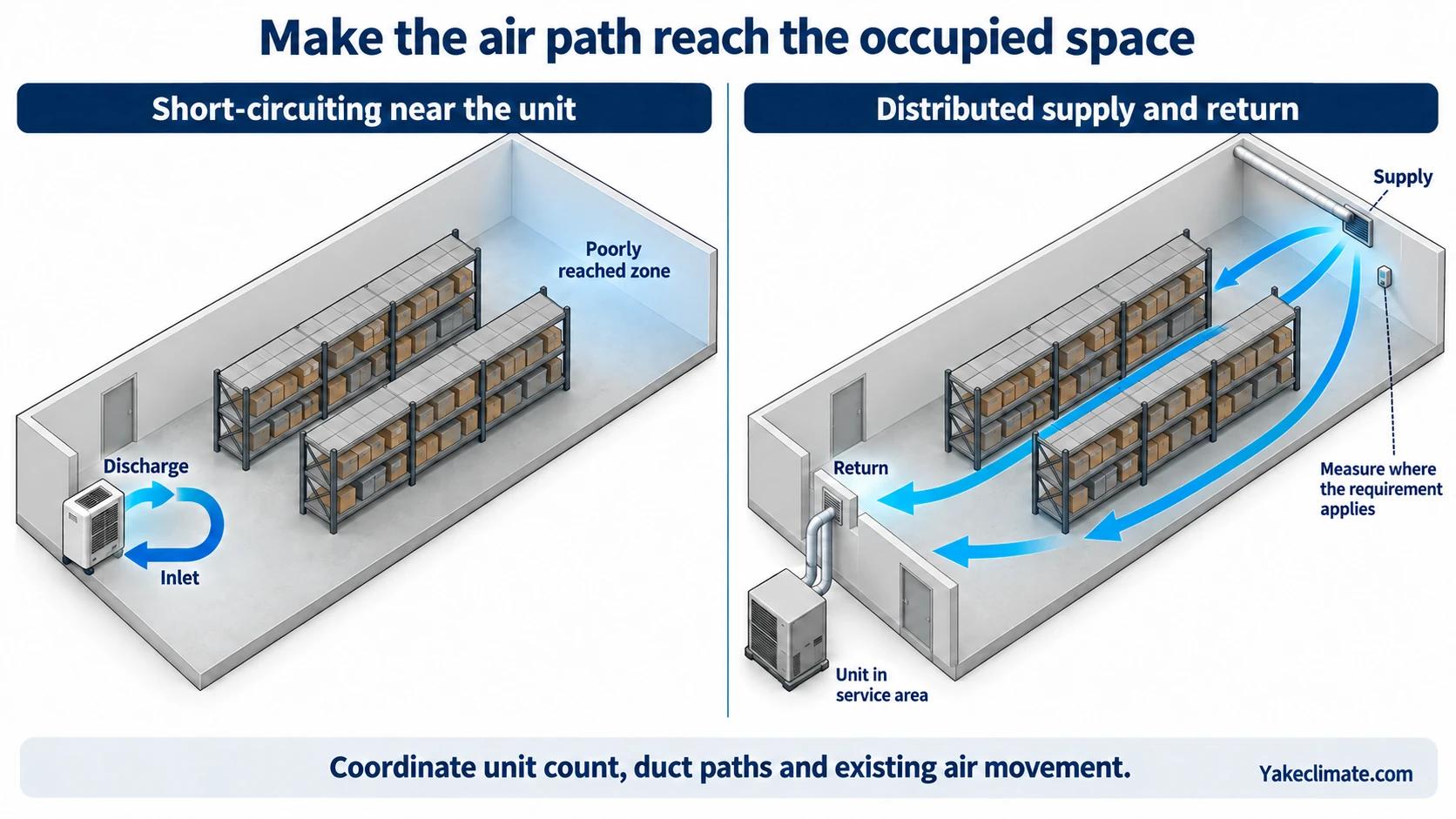
- Coordinate with existing air movement. Introducing equipment without reference to the existing pattern can reinforce dead zones.
Sensor placement follows the same logic: measure where the requirement applies, not where mounting was convenient.
Step 7: Installation Requirements
- Drainage. Confirm a continuous gravity route or a suitable pump where unattended duty requires it. If a tank is proposed, check its fill interval, the service plan and stop/overflow response. Design the discharge path, trapping and freeze protection for the actual installation.
- Power supply. Voltage, phase, and available capacity. Larger equipment in this catalogue is three-phase, which may require distribution work.
- Structural support for ceiling-mounted equipment, including vibration isolation.
- Service access. Filters, coils, drain pans, and controls all need to be reachable. Access clearance omitted at design stage becomes a permanent maintenance cost, see commercial dehumidifier maintenance.
- Noise. Check the stated sound level against the requirement for the space and the distance involved.
- Air path. Inlet and outlet clearances, and confirmation that discharge is not short-circuiting to the return.
Step 8: Controls and Monitoring
- Control variable. The equipment must control on whatever the project defined in Step 1. Equipment with only a built-in humidistat cannot serve a dew point strategy.
- Integration. Where a building or facility control system exists, the available signals, protocol, and control granularity should be established at design stage rather than discovered at commissioning.
- Coordination with cooling and heating. A refrigerant dehumidifier adds sensible heat to the space. Systems that do not know about each other will oscillate. The underlying interaction is described in temperature and humidity control in HVAC.
- Alarms. Failure to run and failure to reach setpoint are different conditions, and both should be annunciated. Equipment that fails silently is discovered through its consequences.
- Logging. Temperature and humidity logged together at sufficient resolution is what makes later diagnosis possible.
Step 9: Acceptance and Verification
Agreeing how performance will be judged, before ordering, prevents most disputes.
- Define the acceptance condition. Which parameter, measured where, over what period, under what load. "The room shall be at 50 % RH" is ambiguous; "50 % RH ± 5 % measured at the process position, sustained over 72 hours with the process running and ventilation at design rate" is testable.
- Record a commissioning baseline. Capacity achieved, power drawn, entering and leaving air conditions, and airflow, all at a recorded operating condition. This baseline is what later maintenance is compared against, and without it a future capacity complaint cannot be assessed.
- Verify with logged data, not spot readings. A single reading cannot distinguish a system that is adequate from one that is cycling badly.
- Confirm the load estimate. Commissioning condensate is one observed removal term. Compare it with the predicted inputs, storage change, any other removal routes, inlet conditions and whether the target was held before attributing a difference to the original load calculation.
Information to Prepare
- Space use, dimensions, construction, and whether it is sealed or ventilated.
- Control objective, target value, tolerance, and the period over which it applies.
- All moisture sources, quantified where possible.
- Ventilation rate and its basis; outdoor design conditions with coincident humidity.
- Design entering-air condition for the equipment.
- Any pull-down requirement, with the time allowed.
- Existing HVAC, air movement equipment, and control system with available interfaces.
- Physical constraints: mounting positions, clearances, structural capacity, power supply, drain route, noise limit.
- Operating pattern: continuous or scheduled, occupied or unoccupied, seasonal variation.
- Acceptance criteria and how they will be measured.
- Whether the design will be repeated at other sites.
Discussing a Project
Industrial Dehumidification for Complex Climate Applications
Yakeclimate designs and manufactures industrial dehumidification equipment for complex climate applications, with a focus on agriculture and energy projects.
We co-develop application-specific dehumidification equipment around the operating conditions, interfaces, and integration requirements of the wider project or system.
Explore industrial dehumidifiers, review desiccant rotor dehumidifiers, review industrial ceiling dehumidifiers, or contact Yakeclimate to review the operating conditions for your project.
FAQ
Frequently Asked Questions
How do I size a commercial dehumidifier?
Quantify ventilation, infiltration, people, processes, wet materials and other moisture inputs for each relevant operating case. Account for existing removal paths and storage change, then request delivered capacity at the coincident inlet conditions. Check peak and pull-down duties separately. Choose unit count from both capacity and air distribution, with the required service and redundancy margin.
When do I choose refrigerant, and when desiccant?
Refrigerant and desiccant equipment must be compared at the required inlet temperature, humidity and target dew point. For a refrigerant unit, check the operating envelope and effective capacity including defrost. For a desiccant unit, check process-air performance, regeneration heat and moist-air exhaust requirements. Low-temperature or low-dew-point duty can favour a desiccant design, but there is no universal room-temperature switching threshold; compare the selected configurations and total system energy.
Can I size from floor area?
No. Floor area alone does not account for ventilation, infiltration, processes, materials, people or the required target. Two rooms of the same size can have different duties; calculate the moisture balance at the project conditions and verify delivered capacity and distribution.
Why can I not compare catalogue capacities directly?
A dehumidifier's capacity is stated at a test entering-air condition, not as a constant for every site. US consumer procedures distinguish portable and whole-home test conditions, and their scope does not define every industrial unit. Industrial catalogue figures may use different conditions, such as 30 °C / 80 % RH. Compare the selected machines at the same project inlet conditions and confirm the test or calculation method.
Should I install one large unit or several small ones?
There is no default winner. Confirm delivered capacity at project conditions, airflow to each affected zone, service access and redundancy. Several smaller units may improve distribution or staged control in some layouts; one larger system may be suitable where the air path is engineered and its duty is verified.
How should acceptance be defined?
State which parameter is measured, at which location, over what period, and under what load and ventilation condition. "50 % RH ± 5 % at the process position, sustained over 72 hours with the process running and ventilation at design rate" is testable; "the room shall be at 50 % RH" is not. Record a commissioning baseline of capacity, power, entering and leaving air conditions, and airflow, since later maintenance and any capacity complaint will be assessed against it.
References
- ASHRAE Handbook—Fundamentals, psychrometrics and moisture load calculation
- AHAM DH-1, Dehumidifiers, capacity rating standard (US)
- Parametric studies of silica gel and molecular sieve desiccant wheels: experimental and modeling approaches — ScienceDirect


