
For cold room dehumidification near 0 °C (32 °F) or below, choose a desiccant unit rated for the actual inlet conditions. Ordinary refrigerant coils collect frost and spend more time defrosting. Reduce door leakage first, then size moisture removal from incoming air and internal loads.
Quick answer
- At 0–5 °C, start with desiccant selection; consider purpose-built refrigerant equipment when its net removal capacity includes defrost at the required conditions.
- With the door-opening assumptions below, moisture ingress reaches 15.1 kg/h while the door is open but averages 1.26 kg/h across the hour.
- A −18 °C freezer needs equipment selected for its actual air circuit; moving the cabinet into a warm room leaves cold return air to address.
Compare equipment and submit operating conditions through Yakeclimate's cold storage dehumidifier selection page.
Which technology works for cold room dehumidification?
Use desiccant drying as the starting choice below 5 °C when persistent moisture requires dedicated removal. A refrigerated coil has to become colder than the entering air's dew point to collect water. Near freezing, that water accumulates as frost, restricting airflow and requiring defrost. Ordinary portable machines can spend repeated cycles running with little water removal. ENERGY STAR, Operating Temperature.
| Air condition and duty | Starting choice | What makes the choice workable |
|---|---|---|
| 5–15 °C chilled space, moderate moisture target | Compare low-temperature refrigerant and desiccant units | Obtain net removal at the specified inlet temperature and RH, including defrost time and drainage requirements |
| 0–5 °C cold room with persistent condensation | Desiccant | Specify the required outlet moisture content, actual removal rate and regeneration exhaust |
| Below 0 °C freezer | Desiccant equipment expressly rated for the cold air circuit | Check both inlet and ambient limits, duct insulation, controls and moisture disposal |
| Existing purpose-designed refrigeration system already meeting the moisture target | Retain and optimise that system | Review coil temperature, defrost, drainage and humidity control together |
Compare net moisture removal at the required conditions, using 5 °C as a screening point and each machine’s specified operating limits for final selection. Desiccant equipment removes water vapour with a sorbent and discharges it through a regeneration air stream. Dedicated refrigeration equipment can also handle cold duty with suitable coils and defrost. ASHRAE, Dehumidifiers.
How much moisture enters through an open cold-room door?
For the assumptions below, the door introduces 1.26 kg of water per hour on average, with a 15.1 kg/h rate while open. Calculate the moisture carried by the entering dry-air mass, then apply the fraction of time the door is open.
| Example input | Assumed condition |
|---|---|
| Air outside the cold-room door | 25 °C / 60% RH |
| Cold-room air | 2 °C / 80% RH |
| Atmospheric pressure | 101.325 kPa |
| Dry-air ingress while the door is open | 0.50 kg/s, assumed constant during each opening |
| Door usage | 10 openings/h, each lasting 30 s |
| Closed-door leakage | Negligible for this example |
At these temperatures and pressure, humidity ratio is approximately 11.9 g/kg dry air outside and 3.5 g/kg dry air inside. Using water-vapour pressure pᵥ and total pressure P in the same units:
w = 0.621945 × pᵥ / (P − pᵥ)          [kg water/kg dry air]
Moisture difference = (11.9 − 3.5)/1000 = 0.0084 kg/kg
Open-door load = 0.50 × 3600 × 0.0084 = 15.12 kg/h
Open-time fraction = 10 × 30/3600 = 0.0833
Hourly average = 15.12 × 0.0833 = 1.26 kg/h
Humidity ratios use the water saturation-pressure and ideal-gas relationships in ASHRAE Psychrometrics, equations (5) and (21).
The assumed 0.50 kg/s describes air entering through the doorway, separate from the dehumidifier's recirculation airflow. For a real door, obtain ingress from a measurement or a calculation incorporating opening size, temperature difference, pressure, traffic and protective devices. Include closed-door leakage separately where significant. ASHRAE Refrigerated-Facility Loads, Section 4.
If the same example also has 0.30 kg/h of internal moisture, and the selected capacity allowance is 25%, the average-duty requirement becomes:
(1.26 + 0.30) × 1.25 = 1.95 kg/h → select at least 2.0 kg/hSpecify that 2.0 kg/h at 2 °C / 80% RH inlet, with an agreed recovery time after openings. The internal load and allowance are assumptions to replace with project inputs. This selection assigns the full calculated moisture duty to the dehumidifier; credit any existing refrigeration removal only after assessing its actual contribution.
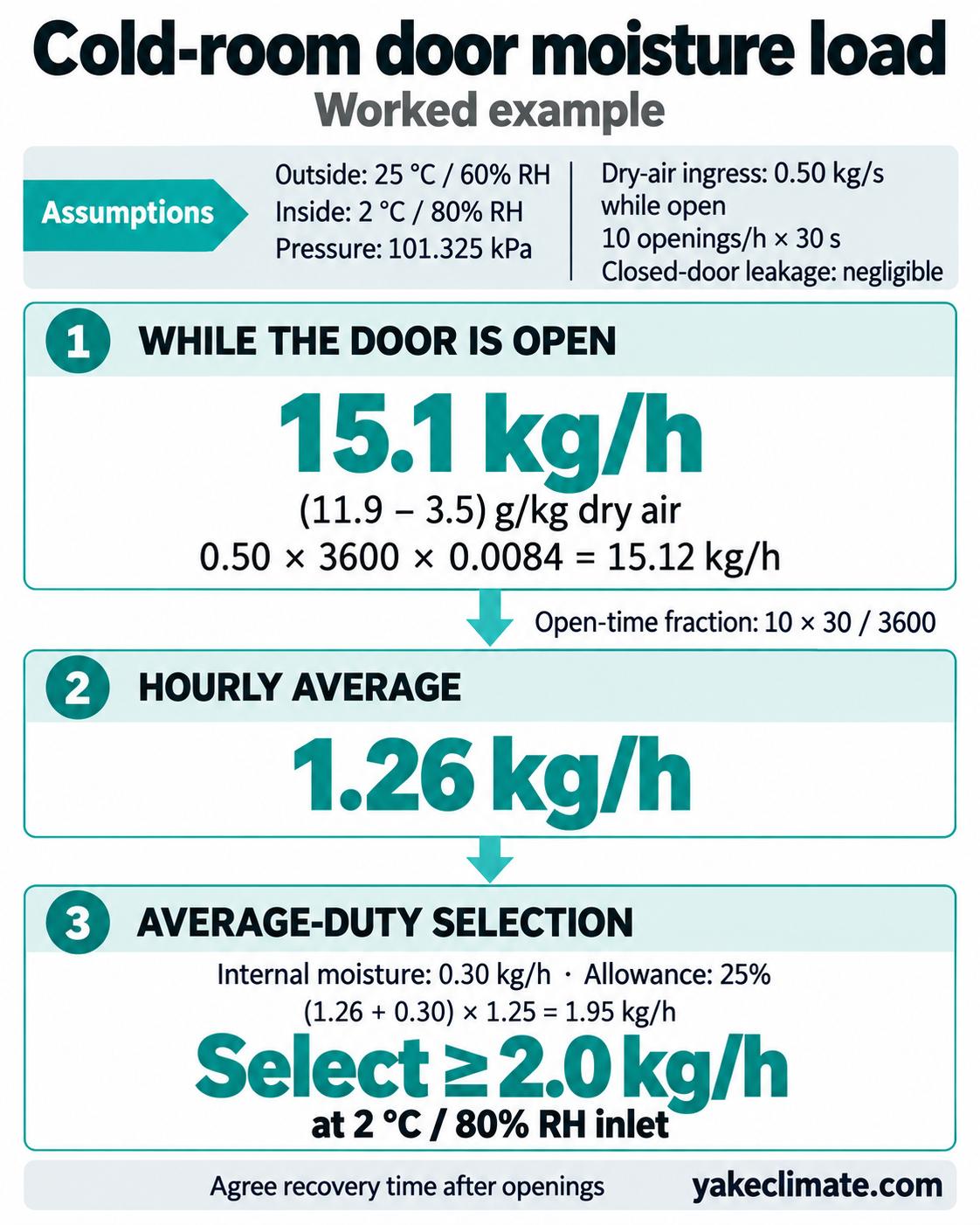
Immediate protection during an opening requires control of the 15.1 kg/h incoming rate through a drier anteroom, better door separation or sufficient local dry-air delivery. An hourly-average machine selection allows a temporary humidity rise. With the other assumptions unchanged, reducing each opening from 30 s to 15 s halves the average doorway load to 0.63 kg/h.
Does a dry cold room still need evaporator defrost?
Yes, retain the refrigeration system's defrost function and adjust its operation from measured coil conditions. A room can have dry walls while its colder evaporator continues collecting frost.
Above freezing, condensation begins when a surface falls below the surrounding air's dew point. Below freezing, compare the surface with the frost point, the saturation temperature over ice. Instruments reporting a water-based dew point require conversion to the ice basis for that comparison. ASHRAE Psychrometrics, Humidity Parameters and equation (6).
For example, air with a −20 °C frost point has a margin against vapour deposition on a −18 °C wall, while a −25 °C coil is cold enough to collect frost. Use the local air condition at each surface, especially near an opening where wetter air arrives before mixing.
A fully dry coil would require the air reaching it to stay below its frost threshold through door openings, loading and other operating states. In an existing store, reduce defrost frequency only after the refrigeration designer reviews frost accumulation, airflow, temperatures and drainage. Keep freezer drain pans and lines protected against refreezing. ASHRAE Refrigerated-Facility Design, Defrosting and Condensate Drains.
Should the dehumidifier serve the anteroom or the cold room?
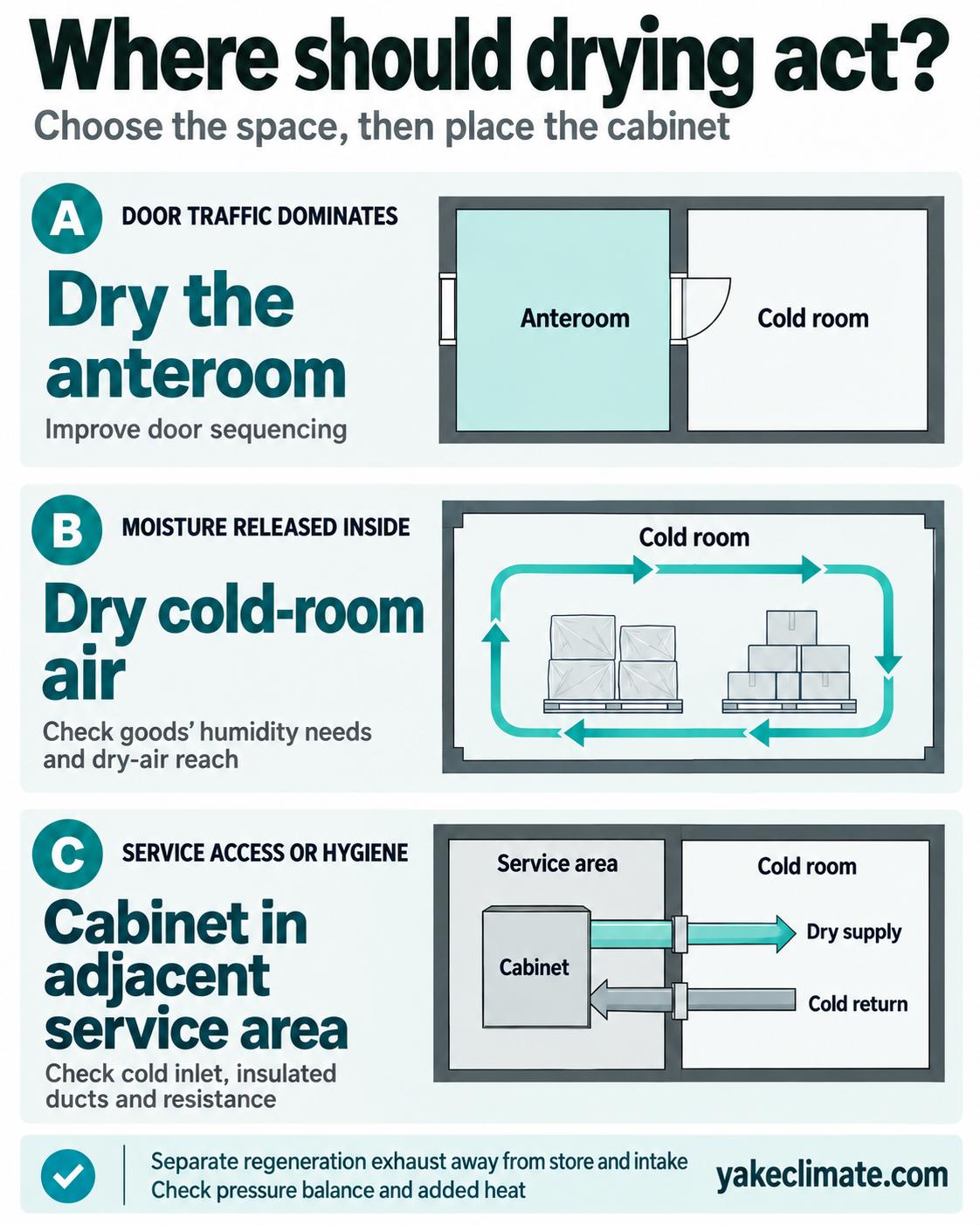
Treat the anteroom first when door traffic is the dominant moisture source; serve the cold room directly when moisture is released inside it. Separate the space being dried from the physical position of the machine.
| Moisture pattern | Preferred arrangement | Design checks |
|---|---|---|
| Ice concentrates around a busy entrance; a controllable anteroom is available | Dry the anteroom and improve door sequencing | Both doors opening together, humidity at the freezer entrance, pressure balance and distribution |
| Wet packaging, goods or cleaning introduce moisture inside | Recirculate and dry cold-room air | Actual process inlet, local moisture release, goods' humidity requirements and dry-air reach |
| Service access or hygiene makes an indoor machine inconvenient | Put the cabinet in an adjacent service area and duct the process air | Cold return temperature, insulated ducts, external condensation, duct resistance and service access |
Use a separate regeneration exhaust to discharge removed moisture away from the store and process intake. Check the exhaust path for condensation, and include process-air heat added by drying in the refrigeration load. Balance the air circuits: exhaust-induced negative pressure can pull extra warm, humid air through openings. ASHRAE Refrigerated-Facility Loads, Infiltration by Direct Flow Through Doorways.
What do Yakeclimate rotor ratings mean for a cold room?
Use Yakeclimate's catalogue values to compare equipment, then request capacity at the actual cold-room inlet and outlet target. Two recorded RY examples show why temperature, electrical supply and air routing belong in the same selection.
| Catalogue item | RY-1500M | RY-3000M |
|---|---|---|
| Removal at 20 °C / 60% RH | 240 L/24h | 456 L/24h |
| Process airflow | 1,550 m³/h | 3,000 m³/h |
| Reactivation airflow | 580 m³/h | 1,100 m³/h |
| Rated power | 15 kW | 30 kW |
| Supply | 380 V / 3-phase / 50 Hz | 380 V / 3-phase / 50 Hz |
| Listed applicable temperature | −10 to +55 °C | −10 to +55 °C |
For a −18 °C freezer, that temperature lies below the listed range. A cabinet placed in a 20 °C service room can still receive −18 °C return air through its duct. Select equipment expressly suitable for that inlet, or design a separate, conditioned air circuit and obtain its performance selection. Confirm the manufacturer's ambient and process-inlet limits individually.
For the 2 °C example, request the required 2.0 kg/h duty at that inlet and the specified outlet dryness; use the 20 °C catalogue removal only at its stated rating condition. Smaller-duty selection should follow that requirement and the installed duct resistance.
The 15 kW and 30 kW values are rated electrical power. Establish expected operating consumption from heater control and duty cycle, and calculate the heat actually carried into the cold room separately. For US projects, match the site's voltage and frequency with an offered equipment configuration before ordering; the listed supply is 380 V / 50 Hz.
What information should you collect before selecting equipment?
Record conditions during the busiest loading period so the selection captures both sustained moisture and short peaks.
- Room volume, operating temperature, stored goods, packaging and required RH or moisture specification.
- Door dimensions, openings per hour, time per opening, anteroom temperature and RH, and any simultaneous openings.
- Moisture from goods, people, washing and infiltration; existing refrigeration removal and defrost behaviour.
- Ice or condensation locations, surface temperatures, sensor positions and acceptable recovery time.
- Available power, process and regeneration duct routes, pressure balance and service access.
Submit those measurements through the cold storage equipment selection page to discuss the required removal rate, inlet conditions and installation arrangement.
FAQ
Frequently Asked Questions
Can I use an ordinary basement dehumidifier in a walk-in freezer?
No, an ordinary basement refrigerant dehumidifier is unsuitable as the default choice below 0 °C. Select equipment designed for the actual cold inlet and required moisture removal. A purpose-built refrigeration dehumidifier with suitable defrost is a separate option; compare its net capacity over the complete operating cycle.
How should I set humidity for a farm cold room?
Set RH to the stored commodity's temperature-specific storage requirement, then address condensation using surface temperatures and incoming-air moisture. For exposed goods, drying the entrance area can reduce incoming water while preserving the required storage humidity. Include packaging and product moisture loss when deciding whether to dry the room directly.
Is a litre-per-day rating enough to size a cold-room dehumidifier?
No, the rating needs its temperature and RH, plus your calculated moisture load. In the worked example, specify at least 2.0 kg/h at 2 °C / 80% RH for the assumed average duty and allowance. Also state the required outlet moisture level and recovery time after door openings.
Can one dehumidifier serve several cold rooms?
Yes, when a designed duct network can deliver each room's required dry air and maintain suitable pressure balance. Add simultaneous moisture loads and check the coldest return condition, duct resistance, hygiene separation and controls. Rooms with different goods or humidity requirements need individual control of their conditions.


