
A commercial dehumidifier sizing calculator is only as useful as its inputs. Before you use a calculator or ask for equipment selection, define the moisture sources, operating temperatures, target RH or dew point, airflow path and safety assumptions.
The Minimum Input Set
Define the controlled zone and calculation period first. For every input, record its value, unit, measurement or estimate basis, time window and uncertainty. Keep peak operation and initial drying separate from steady holding duty.
| Input | Unit or format | Why it matters |
|---|---|---|
| Room or zone volume | m3 or ft3 | Sets the air volume and circulation context. |
| Operating temperature | °C or °F; day/night or process range | Changes saturation moisture capacity and equipment performance. |
| Current humidity | RH with temperature, or dew point; pressure for humidity-ratio conversion | A humidity-ratio calculation needs a consistent air-state basis. |
| Target RH or dew point | RH with temperature, or dew point, allowed band and duration | Defines the controlled condition. |
| Moisture generation | kg/h or lb/h; state density and period if using L/day | Captures crop, process, people, washdown or product load. |
| Outdoor air or leakage | Ventilation rate, door schedule or pressure condition | Airflow and indoor/outdoor moisture difference determine whether incoming air adds moisture. |
| Air distribution limit | Ducted, open discharge or air tubes | Defines fan static pressure and unit placement. |
| Uncertainty and reserve | Documented scenarios and separate reserve basis | Does not replace missing data or justify a universal multiplier. |
ASHRAE describes mechanical dehumidification as cooling air below its dew point to condense water. Check capacity at the proposed air conditions; a catalogue rating is not a moisture-source estimate. ASHRAE mechanical dehumidifiers. Source
Separate Load Types Before Calculating
Inventory each water source once: process evaporation, people, cleaning, product release and incoming-air moisture. Product release already included in a process mass balance must not be added again. Liquid water supplied to a process is not automatically water evaporated into room air; account for liquid drainage and retained water.

| Moisture source | Examples | How to estimate |
|---|---|---|
| Process or crop load | Greenhouse transpiration, drying process, open tanks. | Water balance, production rate or measured moisture release. |
| Infiltration load | Dock doors, greenhouse vents, building leakage. | Airflow plus indoor/outdoor humidity-ratio conditions on the same time basis. |
| Product load | Wet pallets, packaging, washed parts, incoming goods. | Water actually released over the stated interval; specify wet- or dry-basis moisture content. |
| Occupancy and cleaning | People, washdown and open drains. | Schedule-based allowance. |
For industrial room sizing fundamentals, use the broader industrial dehumidifier sizing guide. For greenhouse-specific loads, compare the greenhouse sizing input guide.
Hypothetical Worksheet: Keep the Time Basis Visible
Assume a process releases 18 kg of water into a room over six hours, uniformly for this example. A separately estimated incoming-air contribution is 2 kg/h over the same six hours. These invented inputs illustrate a worksheet, not a Yakeclimate project, recommended design condition or equipment performance.
| Input or calculation | Hypothetical value and boundary |
|---|---|
| Process release | 18 kg ÷ 6 h = 3 kg/h during the process period. |
| Incoming-air contribution | 2 kg/h, assumed separately estimated and not included in process release. |
| Combined source rate | 3 kg/h + 2 kg/h = 5 kg/h over those six hours. |
| Water over that period | 5 kg/h × 6 h = 30 kg. A 24-hour average would hide this six-hour duty. |
| Other periods and reserve | Not specified. Obtain off-period loads, startup recovery and reserve requirements before sizing equipment. |
A cold surface below the nearby air dew point is a separate condensation-control check, not an extra water-generation rate. Condensation transfers existing airborne water to a surface; counting it again as a new source duplicates that water. Do not assume uncontrolled surface condensation is an acceptable substitute for the required humidity control.
Convert the Result Into Equipment Questions
Put source rates on matching time intervals before summing them. Dividing a daily water total by 24 gives a daily average, not a peak rate. Translate the required removal into equipment performance at the actual inlet conditions, with recovery time and any reserve stated separately.
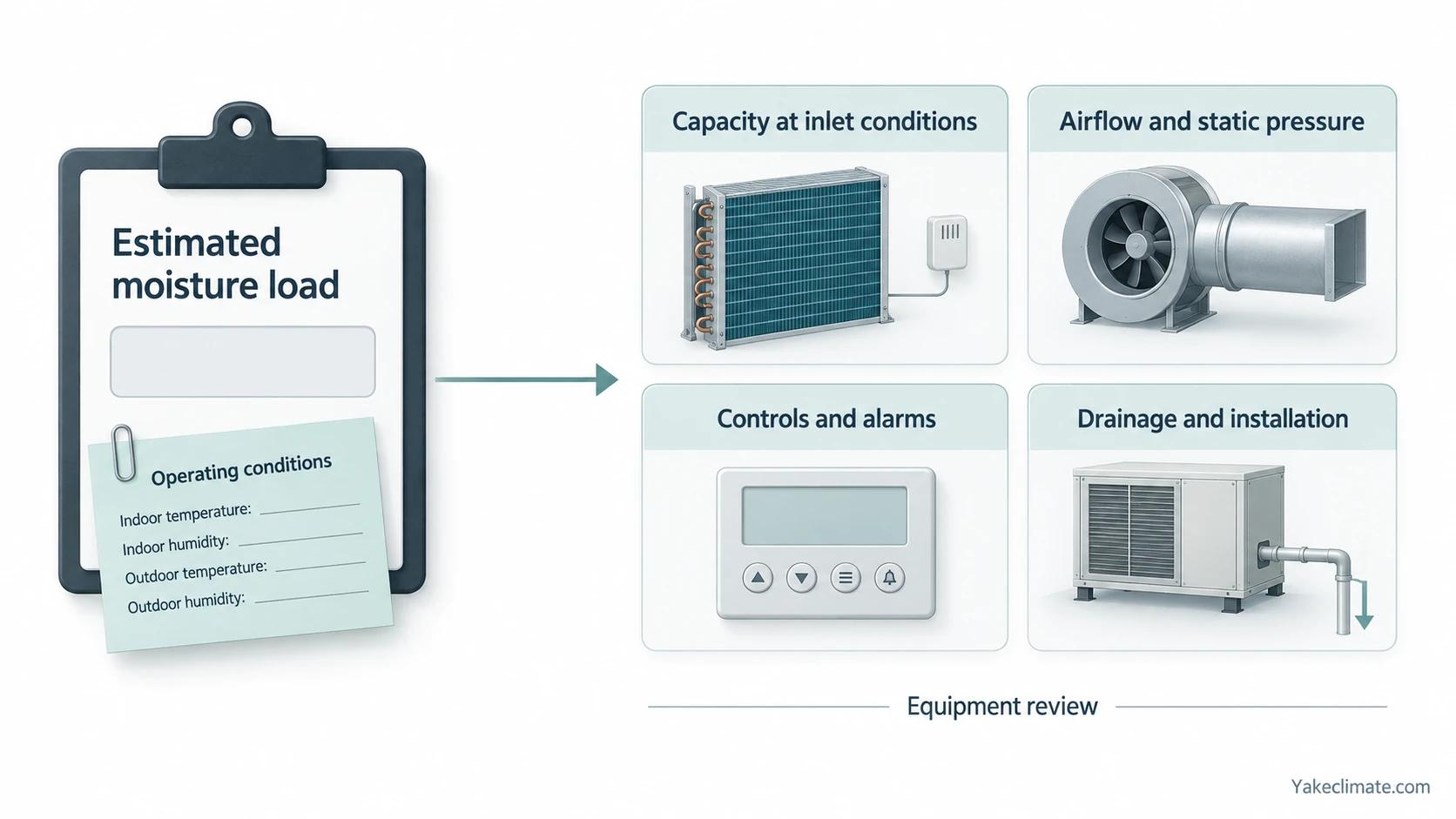
Ask suppliers:
- What water-removal rate does the unit provide at my inlet temperature and RH?
- What is the airflow at my required external static pressure?
- Which humidity variable is controlled, where is it measured, and what variation and recovery time can the proposed controls support?
- What happens at the lowest expected room temperature?
- How should condensate, reactivation air or exhaust be handled?
- What alarms and control interfaces are available?
Avoid These Calculator Mistakes
| Mistake | Why it causes wrong sizing |
|---|---|
| Sizing by square meters only | Ignores moisture generation and leakage. |
| Using catalog capacity at a different condition | May misstate removal at the project condition; obtain matching performance data. |
| Ignoring door openings | Misses an air-exchange pathway; its moisture effect depends on indoor/outdoor conditions. |
| Averaging a daily crop load across 24 hours | Can hide short-duration peaks or transitions. |
| Treating RH target as a dew point target | An RH target needs temperature; compare local dew point with cold-surface temperature. |
| Forgetting airflow | Load, distribution and equipment airflow/pressure must all be checked. |
Application-Specific Input Notes
| Application | Extra input to collect |
|---|---|
| Greenhouse | Crop, water use, curtain schedule, ventilation and CO2 limits. |
| Warehouse | Door schedule, stored material, racking layout and seasonal temperature. |
| Battery or dry room | Required dew point, leakage class, gowning or material-transfer openings. |
| Food or powder room | Washdown, sanitation requirement and process moisture release. |
| Electrical enclosure room | Outdoor air, heat load, corrosion risk and target dew point. |
Use the dehumidification technology comparison tool when the calculator result could be served by either refrigerant or desiccant equipment.
FAQ
Frequently Asked Questions
Can a sizing calculator replace engineering review?
No. It can organize the load assumptions, but final equipment selection still needs rating conditions, airflow, controls and installation limits.
Should I use RH or dew point in the calculator?
Record RH together with air temperature, or record dew point. Include pressure when converting to humidity ratio. For condensation control, also record the relevant surface temperature and compare it with nearby air dew point. A single RH value does not define the complete air state.
What if I do not know the moisture generation rate?
Use a documented process water balance or measured release over a stated period. Water supplied is not necessarily water evaporated; condensate collected by one unit is not automatically the full room load. If the rate remains unknown, compare explicitly labelled scenarios and identify the measurements needed before final selection.


