
1. Capacity Is a Measurement, Not a Property
Dehumidifier capacity is a water-removal rate expressed per 24 hours at stated entering-air conditions. Dew point is the temperature at which air becomes saturated and water starts to condense. Both terms matter because the machine's output changes with the air it processes.
A refrigerant dehumidifier removes water by cooling air below its dew point on a cold coil, condensing vapour, and returning the drier air to the space. The removal rate depends on how much water the incoming air contains and how far below the dew point the coil can bring it.
Warm, humid entering air produces a high removal rate. Cool, drier entering air produces a low one, on the same machine, with no change to the equipment at all.
Any capacity figure is therefore meaningless without its test condition. A datasheet that states a capacity without the entering-air temperature and humidity has omitted half of the specification.
2. The Rating Conditions in Common Use
For a practical comparison, separate the older US portable condition, the DOE X1 portable condition, and the DOE X1 whole-home condition.
| Rating condition | Product category and scope | How to use it |
|---|---|---|
| 80 °F (26.7 °C) / 60 % RH | Older US portable procedure | Compare only with ratings made under the same older condition. |
| 65 °F (18.3 °C) / 60 % RH | DOE X1 portable refrigeration condition (X1 §4.1.1) | Check the product category, procedure edition and supplier documentation. |
| 73 °F (22.8 °C) / 60 % RH | DOE X1 whole-home refrigeration condition (X1 §4.1.1) | Check ducting, external static pressure and the supplier's test documentation. |
| 30 °C / 80 % RH | Example stated condition | Check the supplier's test documentation. |
The US comparison needs a category and procedure. Portable-unit compliance with the lower-temperature DOE procedure began in June 2019. Older and newer ratings may describe the same physical unit under different procedures, but there is no general conversion percentage. Check the model, procedure edition, entering condition, airflow and any applicable static-pressure requirement in the supplier's documentation.
A 30 °C / 80 % RH rating describes warm, humid entering air. Compare it with another rating only after checking the test conditions and method. It does not establish the machine’s maximum or average performance across its operating range.
Our RYDZ-10S and RYDZ-22S catalogue ratings are 240 and 480 L/24h respectively at 30 °C / 80 % RH. For operation at 20 °C and 60 % RH, request the capacity at those conditions rather than using either headline value.
This is not a defect in the machine or in the rating. It is what the rating means. Taking any supplier's headline number and applying it to a cooler project condition is how installations end up short. Ask for the figure at your condition before you compare anything.
3. Why Capacity Falls at Cooler, Drier Conditions
Three effects compound as entering-air conditions become less favourable.
Humidity ratio describes the water vapor carried per kilogram of dry air. The illustrative values below use approximately standard atmospheric pressure. They describe the entering air; removal also depends on the leaving-air condition and dry-air flow.
| Entering-air condition | Humidity ratio (water per kg dry air) | Entering water-vapor content relative to 30 °C / 80 % RH |
|---|---|---|
| 30 °C / 80 % RH | about 21.6 g/kg | 100 % baseline |
| 20 °C / 60 % RH | about 8.7 g/kg | about 40 % |
| 15 °C / 70 % RH | about 7.4 g/kg | about 34 % |
| 10 °C / 80 % RH | about 6.1 g/kg | about 28 % |
The table compares entering-air water-vapor content, not equipment capacity. It cannot supply a capacity correction factor; use the selected machine’s performance data at the required condition.
Condensation requires a coil surface below the air dew point. The achievable leaving-air condition, air flow and coil condition affect water removal, so entering-air moisture content alone does not determine capacity.
Coil frosting can limit operation when the coil is below freezing and moisture deposits on it. Defrost behavior and its effect on average water removal depend on the machine and entering conditions. Check the permitted range and the supplier’s capacity data, including how defrost is accounted for.
The operating range and the capacity rating answer different questions. A permitted inlet-temperature range does not establish a constant removal rate throughout that range. For cold operation, compare candidates at the required inlet and target conditions, including any defrost or regeneration requirements.
4. How to Compare Two Machines Honestly
A general multiplier cannot reliably convert between arbitrary rating conditions. The relationship depends on the machine, airflow and controls. Use a model-specific value supported by the supplier’s stated method.
Read the model data at the required condition
Use the listed value when the model table includes the target condition. Otherwise, request the supplier’s value and calculation or test basis. Confirm the current model and configuration before purchase. A rated L/24h figure does not guarantee the water collected in your installation over a full day.
What can be done is straightforward, and it is the single most useful thing a buyer can do:
Ask for capacity at your condition, not at the rating condition.
Request a capacity table or curve across the relevant entering-air conditions, together with its basis. A curve may contain measured points, calculated values or both; the plot alone does not prove testing. Ask which points were tested, which were calculated and which configuration they describe.
The request itself is simple: "What is the water removal rate at X °C and Y % RH, and how was that figure obtained, measured or calculated?"
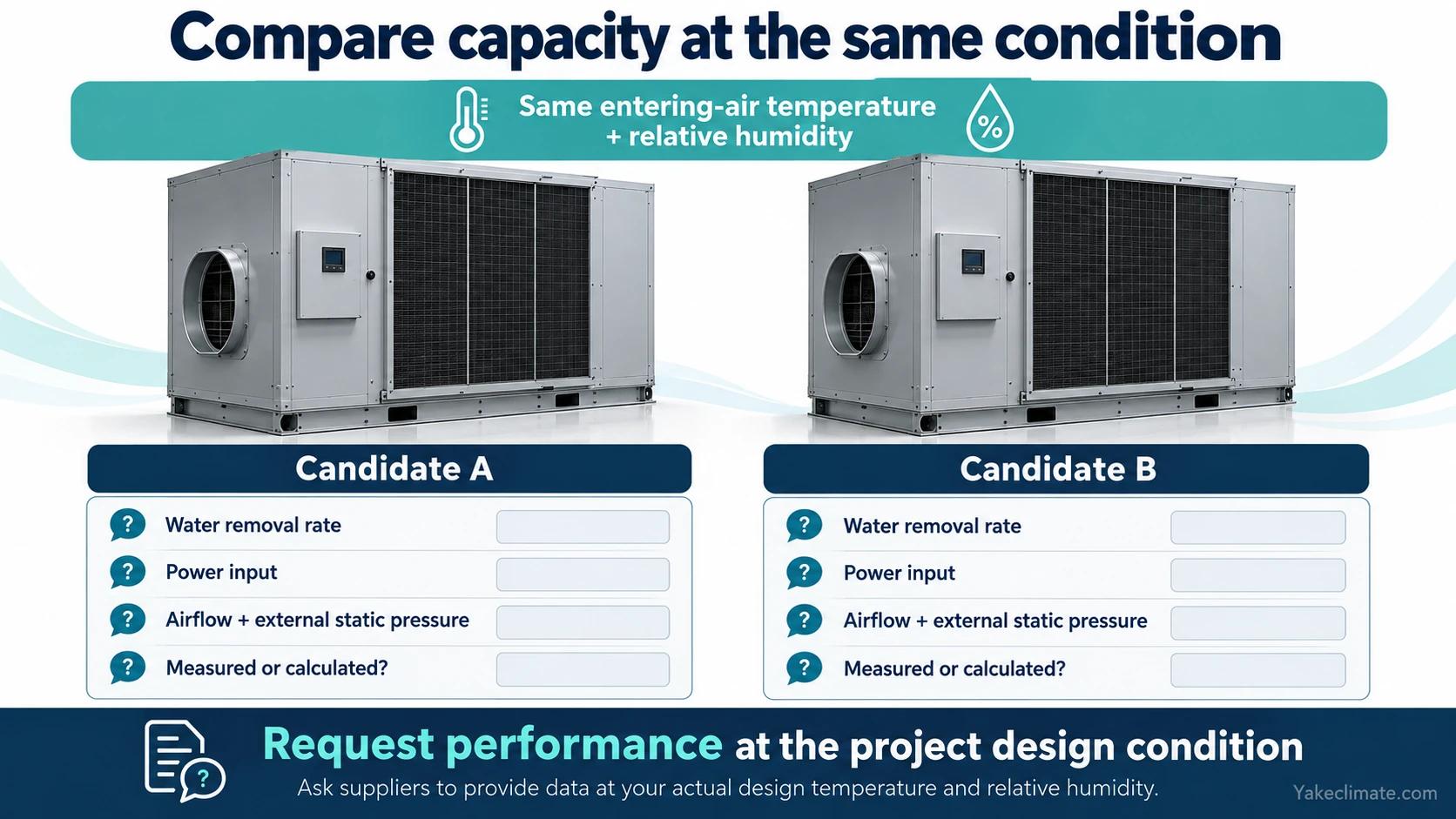
Then compare like with like:
- Establish the design condition for the project, the temperature and humidity at which the equipment must actually deliver.
- Obtain each candidate's capacity at that condition.
- Compare those figures, not the catalogue headlines.
- Check power consumption at the same condition, since efficiency also varies with condition.
- Confirm the airflow and external static pressure at which capacity was measured.
5. Tank Volume Is Not Capacity
A recurring confusion in smaller equipment: the collection tank's volume has no relationship to the daily removal rate.
A unit that removes 20 litres per day with a 5-litre tank fills that tank four times a day. Tank size determines how often someone empties it, nothing else.
Tank operation is an availability decision, not a universal prohibition. For the required unattended duty, calculate the fill interval at realistic removal rates, who can empty the tank, the stop/overflow response and the cost of downtime. Where that cannot meet the duty, design a continuous gravity drain or a suitable condensate pump before selecting the unit.
6. Why Real Removal Differs From Rated Removal
Even at the rating condition, the water actually collected in service will differ from the rated figure, for reasons that are not equipment faults.
- Collected water can come from ongoing moisture inputs and from water already stored in the room air or materials. Interpret the total with the starting condition, moisture sources, operating time and changes in stored moisture.
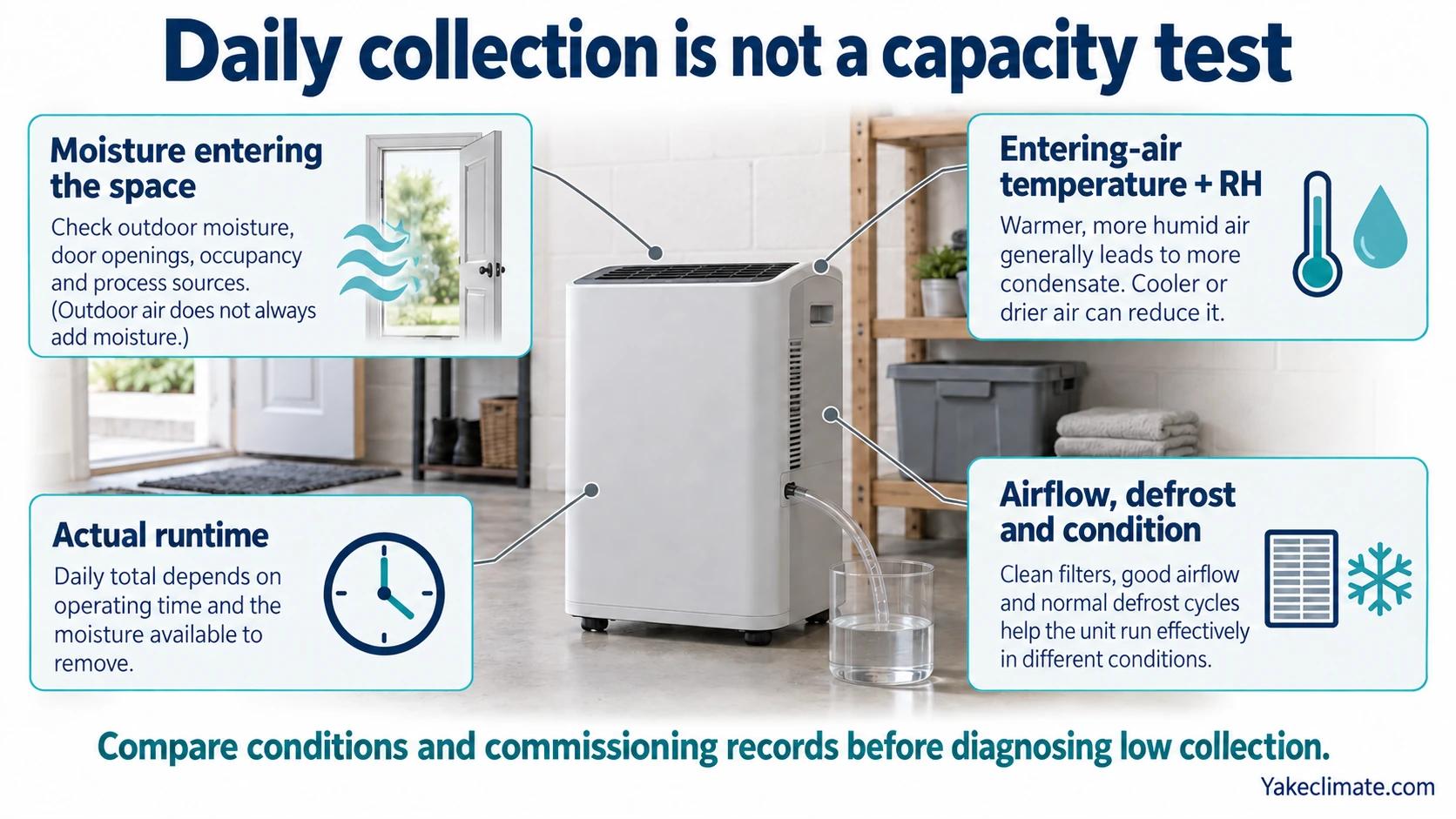
- Runtime and inlet conditions affect the daily total. A daily collection record shows water removed by this unit during the logged interval, not its rated capability or the space's complete moisture load. Initial water stored in materials, ventilation, other removal paths, changing air conditions and control cycling all affect the balance; compare capacity only at matched conditions.
- Conditions change through the day. Entering-air conditions vary, and so does instantaneous capacity. A daily total is an average over a range of conditions.
- Air has to reach the machine. Water is removed only from air that passes through the equipment. A space with poor circulation can be humid in the corners while the unit reports satisfied conditions at its own inlet.
- Defrost costs time. At cooler conditions, time spent defrosting is time not dehumidifying.
- Filters and coils degrade. Restricted airflow reduces capacity progressively. Baseline records matter: a comparison against commissioning data distinguishes a fouled machine from a changed load.
7. How Industrial Sizing Actually Works
This page compares rating claims. For complete project sizing, calculate coincident moisture input, target and recovery duty, check each candidate at the relevant inlet condition, then assess distribution and redundancy. Use the dedicated commercial selection guide.
- For source-specific evaporation estimates, use the dedicated evaporation, drying rate and dehumidification load.
- For cold-surface risk, compare dew point with surface temperature using condensation risk and dew point.
8. A Comparison Checklist
Before comparing any two capacity figures, confirm for each:
- Entering-air temperature and relative humidity at which capacity was measured.
- Which standard or test method was used, and its edition.
- Airflow and external static pressure at the measurement point.
- Power input at the same condition.
- The stated operating range, and capacity at the ends of it, not only at the rating point.
- Whether the figure is measured or calculated.
- Defrost behaviour, if the application runs cool.
- Drainage arrangement assumed.
- For desiccant equipment: regeneration energy source, temperature, and quantity, since these are a substantial part of the operating cost and do not appear in the removal figure.
If a supplier cannot answer the first three for their own product, the headline number should not be used for selection.
9. Discussing Capacity on a Project
Industrial Dehumidification for Complex Climate Applications
Yakeclimate designs and manufactures industrial dehumidification equipment for complex climate applications, with a focus on agriculture and energy projects.
We co-develop application-specific dehumidification equipment around the operating conditions, interfaces, and integration requirements of the wider project or system.
To review capacity for a project, the useful starting inputs are the space and its moisture sources, the target condition, the design entering-air condition, the ventilation arrangement, and any pull-down requirement.
Explore industrial dehumidifiers, review desiccant rotor dehumidifiers, or contact Yakeclimate to review the operating conditions for your project.
FAQ
Frequently Asked Questions
Why do old and newer capacity ratings differ?
Because the test conditions or procedure may differ. Compare the same product category, procedure edition, entering-air condition and configuration before deciding whether the physical unit changed; do not apply a general multiplier.
What does a 30 °C / 80 % RH rating mean?
It means the capacity is stated for entering air at 30 °C and 80 % RH. Check whether the value is measured or calculated and which test method applies. For a cooler or drier project, obtain performance data at that condition rather than treating this rating as an average or maximum.
Can I convert capacity between rating conditions with a formula?
Not with a general formula. The relationship depends on coil design, airflow, refrigerant circuit, and control strategy, and it is not linear. Ask the manufacturer for capacity at your design condition, ideally as a table or curve across a range of entering-air temperatures and humidities, and ask whether those figures are measured or calculated.
Why does capacity fall so much in cooler conditions?
Entering-air moisture content, coil and leaving-air conditions, airflow, controls and any defrost periods can affect removal. Their combined effect is model-specific. Compare capacity at the relevant conditions rather than applying a universal temperature threshold or percentage reduction.
If my unit collects little water, is it underperforming?
A low collected-water total alone cannot distinguish a low moisture load from reduced equipment performance. Check inlet conditions, operating time, setpoint, airflow, defrost or protection state, drainage and the initial moisture condition. Compare with commissioning records at comparable conditions before assigning a cause.
Does a bigger tank mean a bigger dehumidifier?
No. Tank volume describes water storage between emptying events, not moisture-removal capacity. A unit collecting 20 litres per day into a 5-litre tank would need four tank volumes of storage or emptying. Where uninterrupted operation is required, review a suitable drain or pump route and overflow response.
References
- DOE Appendix X1 for dehumidifiers, which incorporates selected provisions of AHAM DH-1-2022 and defines applicable portable and whole-home test conditions.
- ENERGY STAR: Dehumidifier Testing and Capacity explains normalized capacity and category comparisons; the DOE 2023 final rule records the X1 update and its compliance timeline. Check the applicable procedure rather than treating a marketing product label as a legal category.
- ASHRAE Handbook—Fundamentals (psychrometric data used in the moisture-availability table)
RY-600M — Desiccant Rotor Dehumidifier — 72 L/24h at 20 °C / 60 % RH · −10 to +55 °C Check the rating condition, operating limits and regeneration requirements against the project duty. A lower or higher headline L/24h value does not establish which technology will perform better at the required condition.

