
Choose a dehumidifier for pharmaceutical industry use by the required supply-air dew point: below 5 °C, favour desiccant drying. Set room limits separately for each product and process. Tableting typically requires below 40% RH at 20 °C; stored products follow their labelled temperature and moisture requirements.
Quick answer
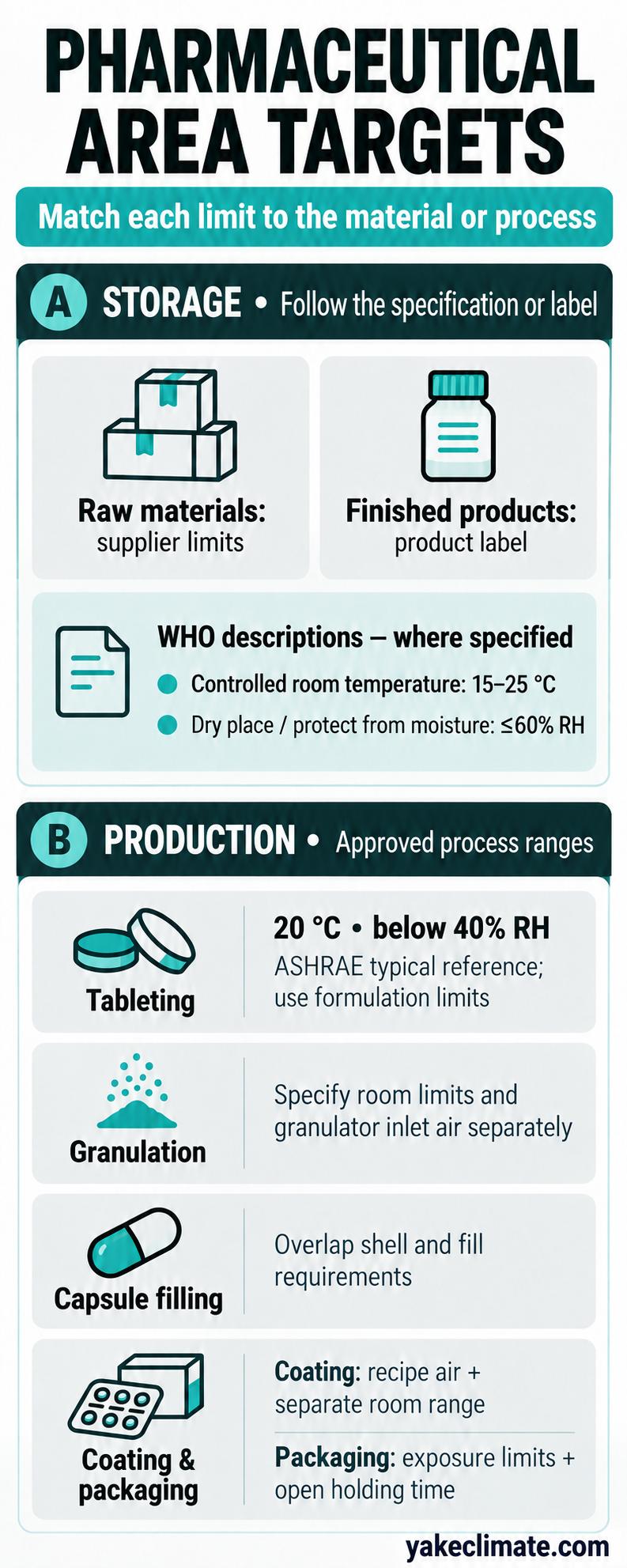
- Use 20 °C and below 40% RH as the ASHRAE reference for tableting, then apply the formulation's approved operating range.
- WHO storage descriptions mean 15–25 °C for controlled room temperature and ≤60% RH for a dry place; apply each to the corresponding product requirement.
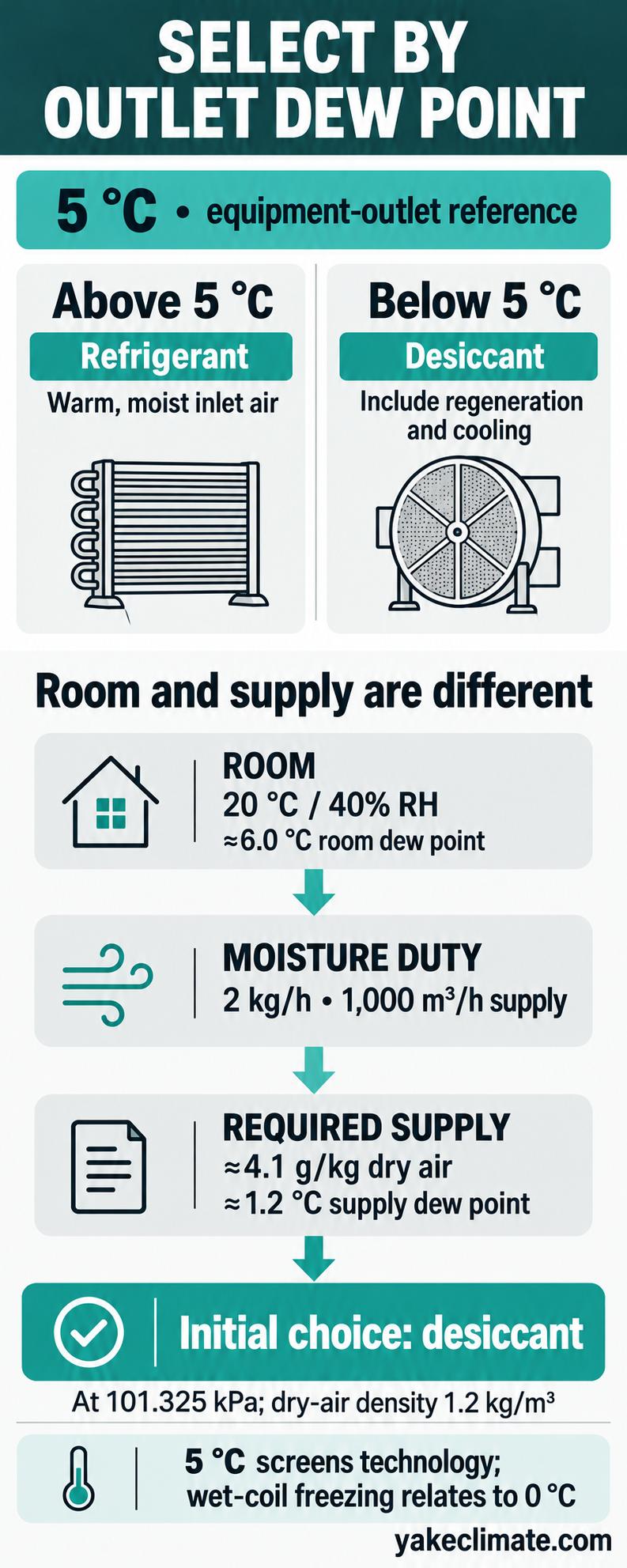
- Compare refrigerant drying above 5 °C required outlet dew point with desiccant drying below that level, allowing for the room's moisture load.
For lower-dew-point duties, compare Yakeclimate desiccant rotor dehumidifiers at the specified inlet condition, process airflow and required dry-air outlet.
What RH and temperature should each pharmaceutical area use?
Set separate limits for storage, exposed product and process air: the material and manufacturing step determine the acceptable temperature and RH. WHO requires appropriate minimum and maximum room conditions, with control, monitoring and records where relevant. WHO HVAC guidance, §8.1–8.4.
| Area | Temperature and RH to specify | Basis and practical decision |
|---|---|---|
| Raw-material store | Use the supplier's material storage limits. Where the specification calls for controlled room temperature and a dry place, the WHO descriptions correspond to 15–25 °C and ≤60% RH. | Keep temperature and moisture requirements tied to the individual material. Use a separate dry enclosure or zone for materials with tighter limits. WHO storage guidance, Appendix 1 |
| Granulation and tableting | For tableting, ASHRAE gives 20 °C and below 40% RH as typical. For granulation, use the approved process specification to define separate room limits and granulator inlet-air conditions. | Treat the tableting value as a design reference; select the operating band from formulation requirements. Track granule moisture separately from room RH. ASHRAE, Product Formability |
| Capsule filling | Specify a temperature/RH range compatible with both the capsule-shell specification and the fill formulation. | Use their overlapping permitted ranges. If the requirements conflict, evaluate local conditioning of the fill and exposure time with the process team. WHO HVAC guidance, §8 |
| Coating | Specify the coating recipe's process-air temperature, humidity and airflow, plus the room's separate operating range. | For sugar coating, cooling and drying too slowly produces a rough coating; cooling and drying too quickly can cause chipping. Control the drying rate as well as RH. ASHRAE, Rate of Crystallization |
| Packaging | Use the product's approved exposure temperature/RH and maximum open holding time until the protective package is sealed. | Apply local dry air where only the exposed-product section needs a lower dew point. Treat primary packaging conditions separately from finished-carton storage. WHO HVAC guidance, §5 and §8 |
| Finished-product store | Follow the product label. Under WHO terminology, controlled room temperature is 15–25 °C; dry place/protect from moisture is ≤60% RH. | Apply the temperature and moisture descriptions only where specified. Set operating controls inside the permitted range and map the occupied storage volume. WHO, §12.34–12.37 and Table A7.1 |
For granulation, capsule filling, coating and open packaging, start with the approved material and process ranges before selecting a humidity setpoint. Keep each room's operating target, alarm limits and process-air conditions on the same specification sheet. This gives the equipment supplier a defined duty and keeps local process drying separate from general room conditioning.
Are ICH stability conditions warehouse setpoints?
Use ICH Q1A(R2) conditions for the specified stability study, and use the product label for daily storage.
| ICH Q1A(R2), drug-product general case | Study condition | Intended use |
|---|---|---|
| Long-term option | 25 ± 2 °C / 60 ± 5% RH | Controlled stability testing |
| Alternative long-term option | 30 ± 2 °C / 65 ± 5% RH | Controlled stability testing |
| Accelerated | 40 ± 2 °C / 75 ± 5% RH | Accelerated stability testing |
These values describe exposure conditions used to evaluate product stability. A warehouse serving the Indian market still needs the actual products' labelled storage limits; the long-term study selected for a product belongs in its stability programme. Likewise, assign a tablet room's temperature and RH from manufacturing requirements. Keep stability chambers on their own specified control conditions.
Where is the refrigerant-to-desiccant dew-point boundary?
Use 5 °C required equipment-outlet dew point as a first screening value: favour refrigerant drying above it with warm, moist inlet air, and desiccant drying below it. ASHRAE identifies the former conditions as favourable for refrigeration-based drying. ASHRAE, Methods of Dehumidification—Cooling.
| Required duty | First choice | Reason and selection check |
|---|---|---|
| Warm, humid inlet; required outlet dew point comfortably above 5 °C | Refrigerant dehumidification | Condense bulk moisture on a cooling coil; check removal at the actual inlet condition and during low sensible-cooling demand. |
| Required outlet dew point below 5 °C | Desiccant rotor | Removes water by adsorption; include regeneration heat, wet exhaust and process-air cooling. |
| Required outlet dew point below 0 °C | Desiccant rotor; compare specialist refrigeration where appropriate | A wet coil below freezing accumulates ice. Any refrigeration alternative needs a suitable frost/defrost design and sustained drying capacity. |
| Large warm, humid outdoor-air load plus a low final dew point | Cooling followed by desiccant drying | Remove bulk water by condensation, then use the rotor for the remaining drying duty; include downstream temperature control. |
The 5 °C value is a technology-selection reference. Ice formation relates to a wet coil surface falling below 0 °C. Coil temperature, outlet-air dew point and room-air dew point are three different quantities. A specifically designed refrigeration system remains an option when its complete operating cycle meets the required duty. ASHRAE, Desiccant Dehumidification.
At a fixed 20 °C room temperature, the calculated dew points are:
| Room RH, used here for comparison | Room dew point |
|---|---|
| 60% RH | 12.0 °C |
| 40% RH | 6.0 °C |
| 30% RH | 1.9 °C |
NOAA temperature/RH relation, equation 1.
The supply air must carry less water than the room air to absorb the room's moisture load. For an illustrative room at 20 °C / 40% RH, use 101.325 kPa, a 2 kg/h moisture load, 1,000 m³/h supply airflow and an assumed dry-air density of 1.2 kg/m³. Room humidity ratio is approximately 5.8 g/kg dry air. The required supply humidity ratio is:
w_supply = w_room − moisture load / (dry-air density × supply airflow)
         = 0.0058 − 2 / (1.2 × 1000)
         ≈ 0.0041 kg/kg = 4.1 g/kg dry air
That supply condition corresponds to approximately 1.2 °C dew point. Choose desiccant drying as the initial selection even though the room dew point is about 6.0 °C. Use the full equipment-inlet condition when selecting the rotor, and allow for any moisture added between the unit and the room. ASHRAE moisture balance, NWS vapour-pressure equation.
How do you size a dehumidifier for pharmaceutical industry use?
Size removal capacity from the design moisture load, then compare equipment at the same inlet temperature, inlet humidity and required outlet condition.
Calculate outdoor-air and leakage loads from their airflow and humidity-ratio difference relative to the room. Add people, exposed process moisture and cleaning recovery where relevant. Use the treated outdoor-air condition when upstream cooling has already removed water, and include simultaneous peak operation. ASHRAE, Space Heat Absorption and Moist Air Moisture Gains.
Two Yakeclimate catalogue models illustrate why the rating condition matters:
| Catalogue field | RY-1500M, desiccant | RYCF-10S, refrigerant |
|---|---|---|
| Listed moisture removal | 240 L/day at 20 °C / 60% RH | 240 L/day at 30 °C / 80% RH |
| Listed process airflow / airflow | 1,550 m³/h | 2,800 m³/h |
| Power field | 15 kW rated power | 4.25 kW maximum power |
| Listed electrical supply | 380 V / 3-phase / 50 Hz | 380 V / 3-phase / 50 Hz |
Compare both models using a selection at the intended room or mixed-air inlet condition. Request the corresponding moisture removal, outlet humidity and airflow at the installed duct resistance. The catalogue power fields use different labels; compare operating energy using duty-specific power and operating hours, including the rotor's regeneration and any additional cooling. Confirm the site's voltage and frequency when specifying the electrical configuration.
For the 2 kg/h example, require the selected equipment to meet the moisture duty and the 4.1 g/kg supply target together. The calculation defines a performance requirement; the catalogue table supplies candidates for that performance review.
What should the installation and control plan include?
Coordinate humidity control with filtration, pressure control, drainage and process heat so that drying supports the room's production conditions. WHO HVAC guidance, §5–§9.
- Separate process air from room air. Granulator and coater inlet-air requirements belong alongside their process specifications; room temperature and RH need their own sensors and limits.
- Preserve the air balance. Include local extraction, supply/return air and any regeneration-air intake in the room-pressure calculation. Keep wet regeneration exhaust clear of air intakes.
- Control condensate and contamination. Provide effective drainage, accessible cleaning and filtration appropriate to the room. Capture production dust at source.
- Include heat and utilities. Allow for heating of the process air during desiccant drying, any required post-cooling, and available electrical capacity. ASHRAE desiccant equipment.
- Measure under operating loads. Record room temperature/RH and supply dew point through door openings, production and cleaning recovery. In storage areas, locate monitoring points using temperature mapping and humidity mapping where appropriate. WHO storage guidance, §12.36–12.37.
FAQ
Frequently asked questions
Can a portable refrigerant dehumidifier serve a pharmaceutical warehouse?
Yes, if it maintains the labelled storage conditions at the warehouse's actual temperature and moisture load. Check drainage, cleaning access, air distribution and monitoring across the stored stock. For a production room, assess its airflow, filtration and effect on room pressure against the facility's requirements before choosing the installation.
Should tablet rooms always be made as dry as possible?
No, select the humidity range established for the formulation and process. ASHRAE's typical tableting reference is below 40% RH at 20 °C. Set an operating band with appropriate limits, then check granule moisture and tablet quality alongside room conditions during production and changes in outdoor weather.
Which three moisture figures should an equipment enquiry contain?
Three essential figures are the design moisture load in kg/h, the entering-air temperature/RH, and the required leaving-air dew point or humidity ratio. Add process airflow, room operating limits, duct resistance, regeneration arrangements and electrical supply. These inputs let the supplier compare equipment at the duty the room actually needs.
Is room RH alone enough for acceptance?
No, record temperature with RH and check the room under its expected operating loads. Verify supply-air dryness, air distribution and recovery after moisture disturbances. Storage areas also need suitable monitoring locations, calibrated instruments and retained records, with the site quality team defining acceptance criteria and review procedures.
What should you send for pharmaceutical equipment selection?
Send each area's approved temperature/RH range, inlet-air condition, moisture load, airflow, pressure requirements and available power through the desiccant equipment project enquiry, including the proposed regeneration intake and exhaust routes for low-dew-point areas.


