
A commercial desiccant dehumidifier should be selected from a stated dry-air duty. The useful starting point is the outlet dew point or frost point, inlet condition, process airflow and operating boundary—not the word “desiccant” or a catalog model.
Use the desiccant rotor product family for equipment context, the refrigerant-versus-desiccant selection guide for the technology boundary and the rotor working-principle guide for process and reactivation terminology. For the broader equipment range, see the industrial dehumidifier family.
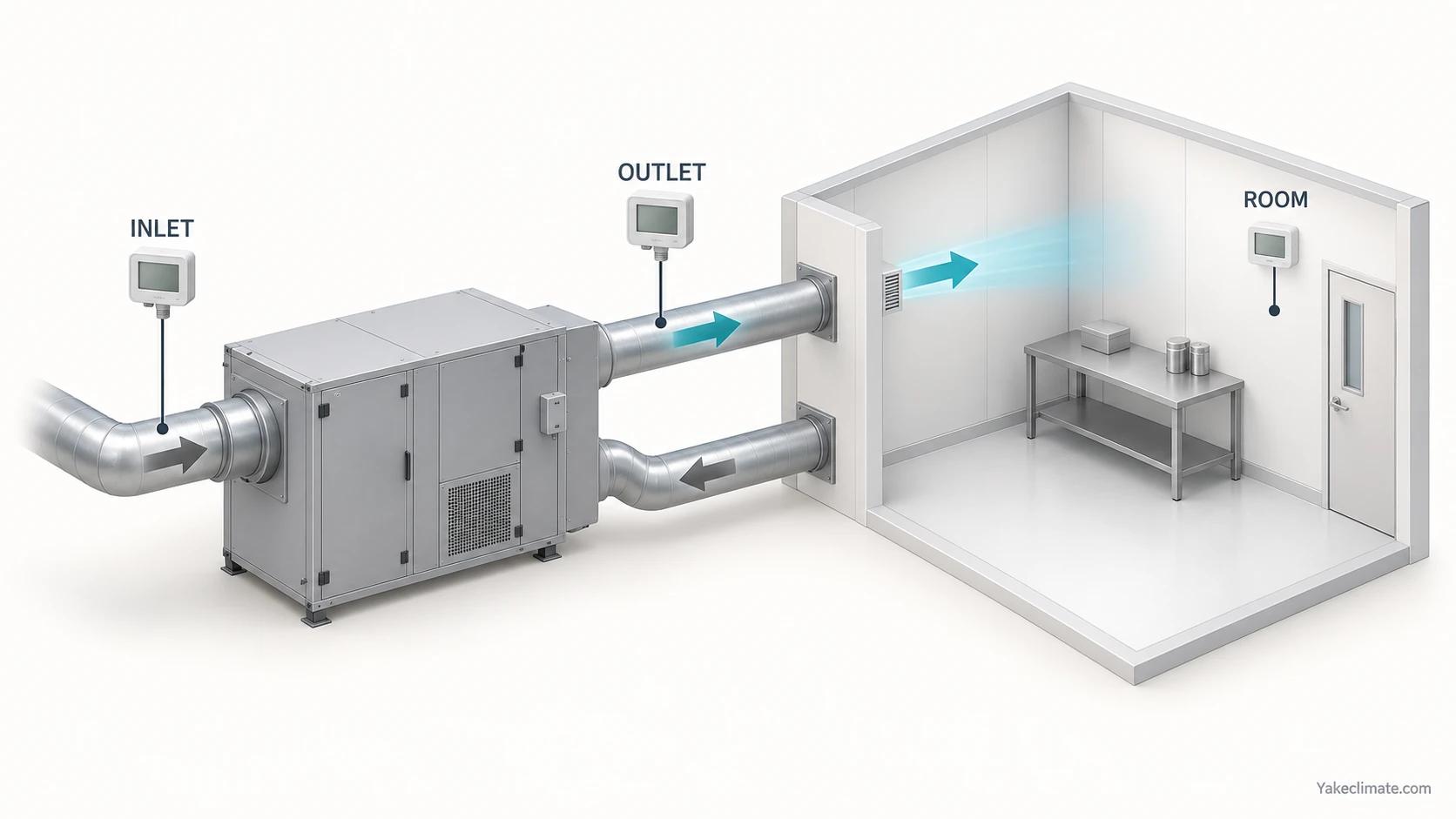
Decide Whether the Duty Needs Desiccant
Desiccant technology is a candidate when the project needs a dry-air condition that is difficult to maintain with the selected refrigerant arrangement, when the process is cold, or when a stable low-moisture supply is required. A warm space with a moderate humidity target may have other suitable arrangements. Do not turn an illustrative dew point into a universal technology threshold.
Start with the project psychrometric boundary, then compare options using the industrial dehumidification resource page and the selected equipment data.
Define the Duty in Measurable Terms
Low-dew-point selection needs two sides of the air path: what enters the process section and what must leave it. State whether the target is dew point or frost point, record the measurement location, and identify the pressure basis (absolute, gauge or reference pressure) used by the instrument and proposal. Relative humidity without temperature can hide a different moisture condition.
| Input | Why it matters |
|---|---|
| Process inlet temperature and humidity or dew point | Defines the moisture entering the rotor. |
| Outlet dew point or frost point | Defines the dry-air acceptance target; state whether dew or frost point is intended and where it is measured. |
| Process airflow and pressure | Sets the air quantity and fan or duct boundary; state the flow condition, pressure reference and expected operating range. |
| Reactivation heat source and available conditions | Determines regeneration method, utility scope and operating boundary. |
| Exhaust route and makeup-air condition | Provides a path for desorbed moisture and affects the balance. |
| Operating schedule and control sequence | Separates peak duty, normal duty, standby and transient behavior. |
| Measurement and acceptance | Names sensor location, calibration status, uncertainty or tolerance and stabilization rule. |
Review the Rotor and Air-Separation Boundary
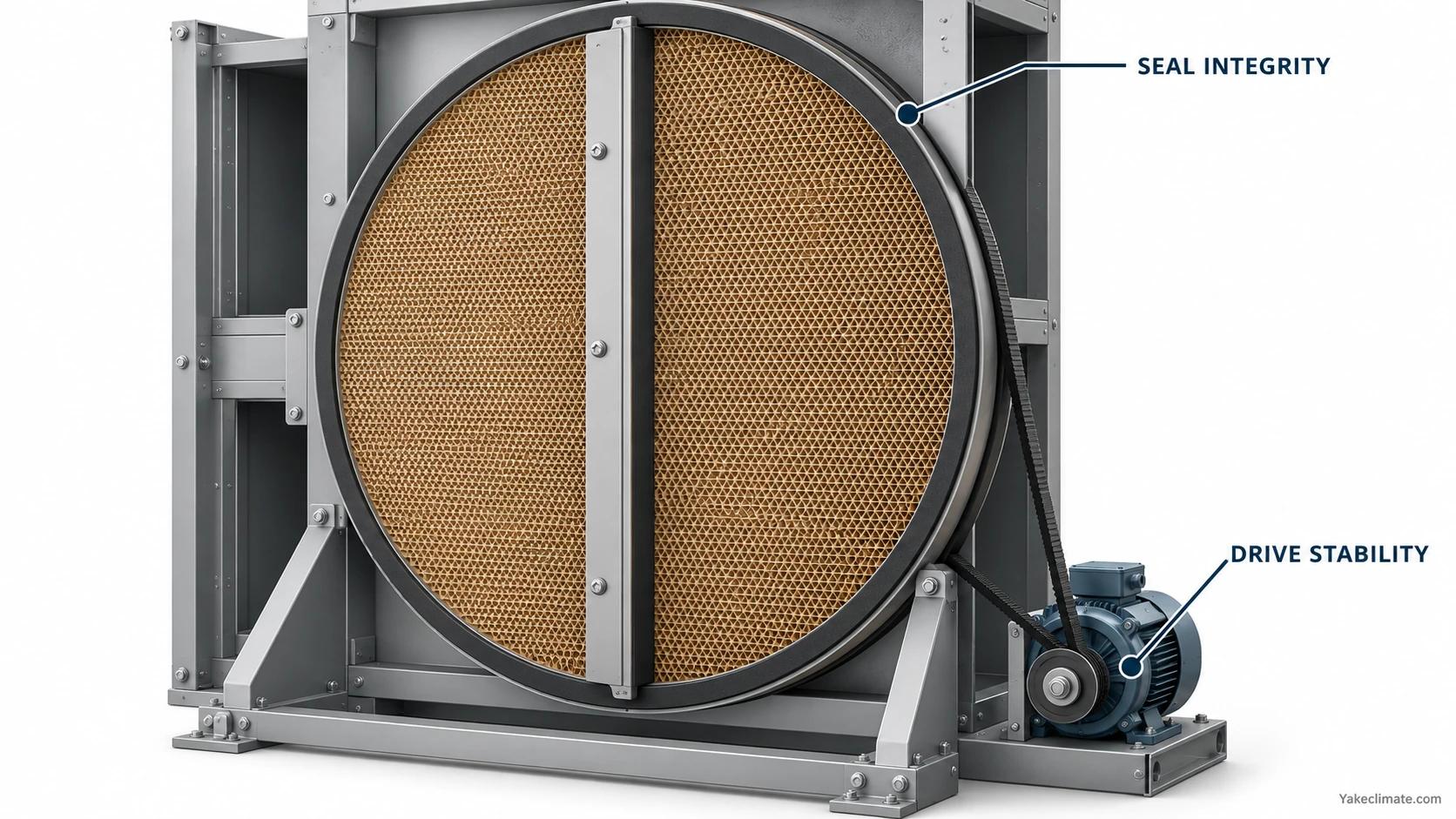
Rotor media, perimeter seals, process/reactivation separation and drive stability affect whether the selected arrangement can maintain its stated condition. As the target becomes stricter, leakage, bypass, sensor placement and regeneration control deserve explicit review.
Use the rotary desiccant rotor structure guide to structure the review.
Check Reactivation Energy Before Comparing Cost
A desiccant rotor adsorbs moisture on one air path and is regenerated with heat on another. Electric, steam, gas, hot-water or recovered-heat arrangements change the equipment boundary, exhaust design, controls and operating cost. Ask the supplier to identify the heat input, entering reactivation condition, exhaust condition and measurement basis. Do not claim a universal energy saving from selecting desiccant equipment.
Compare the reactivation-energy boundary before accepting a purchase or operating-cost comparison.
Use a Selection Matrix
| Check | Record for each proposal | Open question before acceptance |
|---|---|---|
| Dry-air target | Dew/frost point, temperature, measurement location and tolerance | Is the target a room, supply or product requirement? |
| Moisture duty | Inlet state, airflow, load basis and operating schedule | Which values are measured and which are assumptions? |
| Rotor and leakage | Media, seal concept, bypass and process/reactivation separation | What test or inspection verifies the stated boundary? |
| Reactivation | Heat source, input condition, exhaust route and controls | Who supplies utilities, exhaust and safety interlocks? |
| Air delivery | Fan duty, pressure drop, duct route and zone distribution | Where will the acceptance sensor be located? |
| Service and acceptance | Filters, seals, drive, calibration, alarms and test record | Who owns commissioning and future maintenance? |
Turn the Matrix into an RFQ Filter
Do not ask for a model number before describing the duty. Put confirmed inputs in one column and open assumptions in another. Ask each bidder to return rated conditions, airflow, reactivation input, exhaust requirements, electrical data, controls interface, exclusions and acceptance method.
- Keep equipment, ductwork, utilities, controls, commissioning and maintenance responsibilities separate.
- Keep the design basis attached when temperature, load, airflow, power or control assumptions change.
- Require a test record that identifies instruments, locations, stabilization time and acceptance condition.
Use the industrial dehumidifier project-data checklist for the initial inquiry.
Evidence and Claim Boundary
This page explains a selection method. It does not establish a site-specific capacity, a guaranteed dew point, a health outcome, an energy saving, a payback period or a project result. If a vendor test, pilot or enterprise measurement is used, identify its conditions and owner; do not present it as an independent or Yakeclimate-wide result. For a dew/frost-point acceptance record, identify the measured quantity, sensor location, pressure basis, calibration status, stated tolerance and stabilization rule; NIST SP 250-83r1 is measurement guidance, not an equipment threshold.
The useful output of this selection is a traceable duty and acceptance plan: inlet state, outlet target, airflow, reactivation, exhaust, utilities, controls and measurement location. Once those fields are confirmed, proposals can be compared on the same engineering boundary. For a project-specific review, send the completed duty sheet to Yakeclimate.
FAQ
Frequently Asked Questions
Is a desiccant dehumidifier always better than a refrigerant system?
No. Desiccant equipment can suit some low-dew-point, cold or stable dry-air duties, but technology choice depends on the target condition, load, airflow, utilities and operating schedule.
What dew point requires a commercial desiccant dehumidifier?
There is no universal threshold. State the outlet dew or frost point, temperature, process airflow and acceptance location, then compare technologies against that duty.
Why does reactivation energy matter?
The rotor must be regenerated with heat. The heat source, entering condition, exhaust route and controls affect equipment scope and operating cost.
What should a low-dew-point RFQ include?
Include inlet temperature and humidity or dew point, outlet dew or frost point, airflow and pressure condition, schedule, reactivation source, exhaust route, power, controls, measurement locations, calibration status, tolerance, service boundary and acceptance method.


