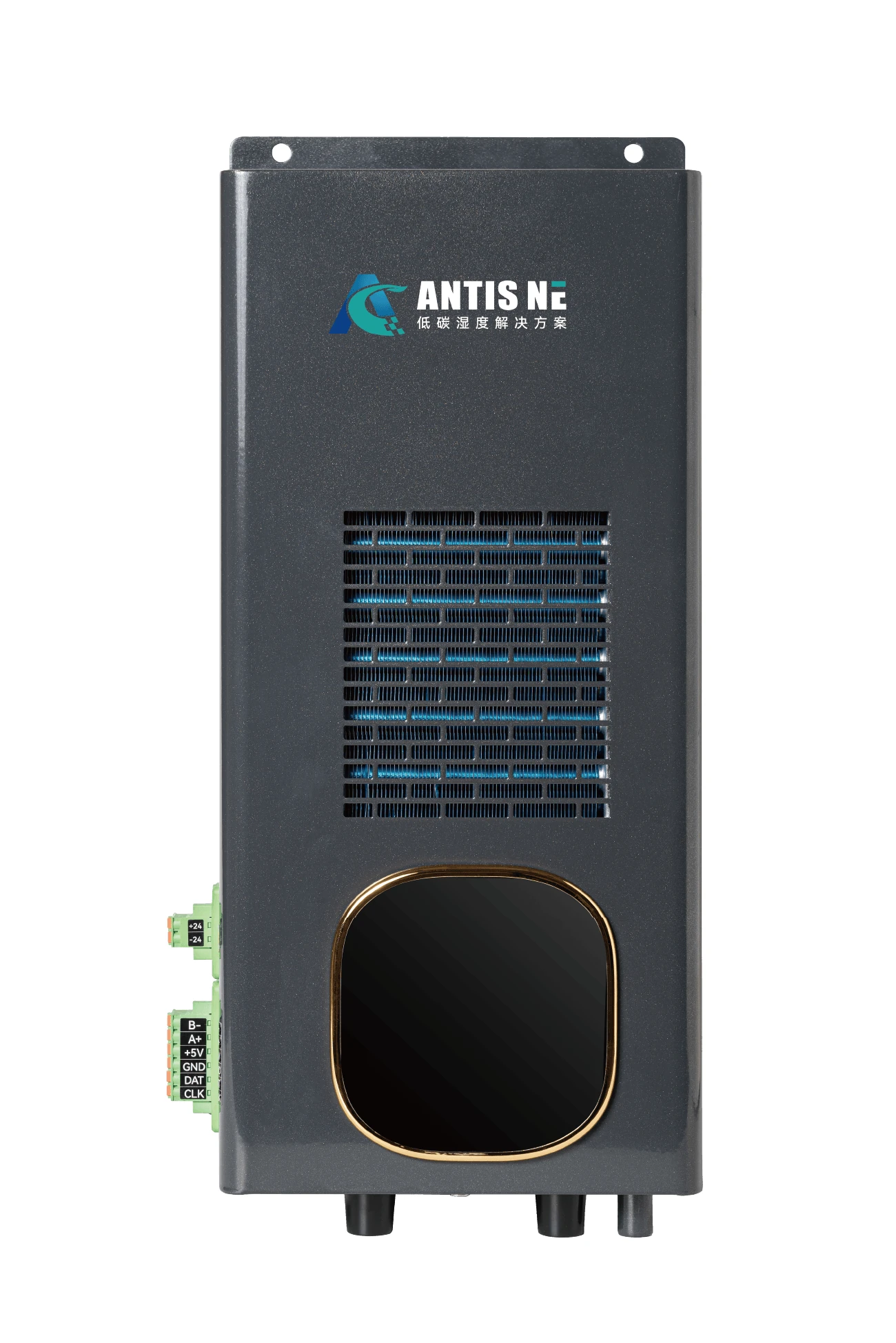
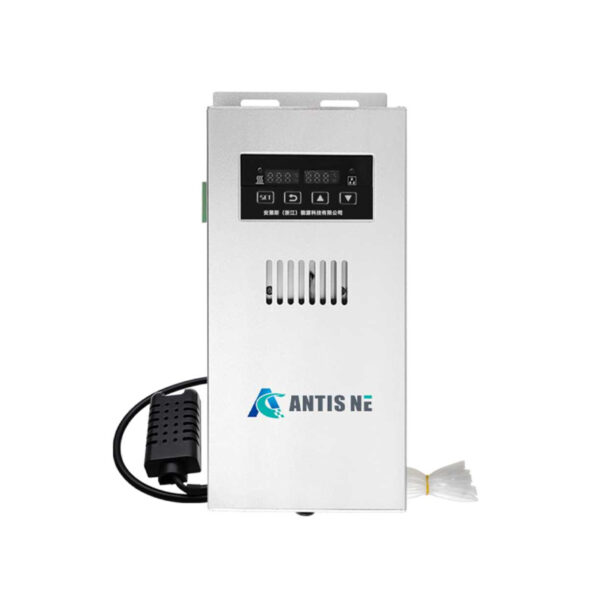
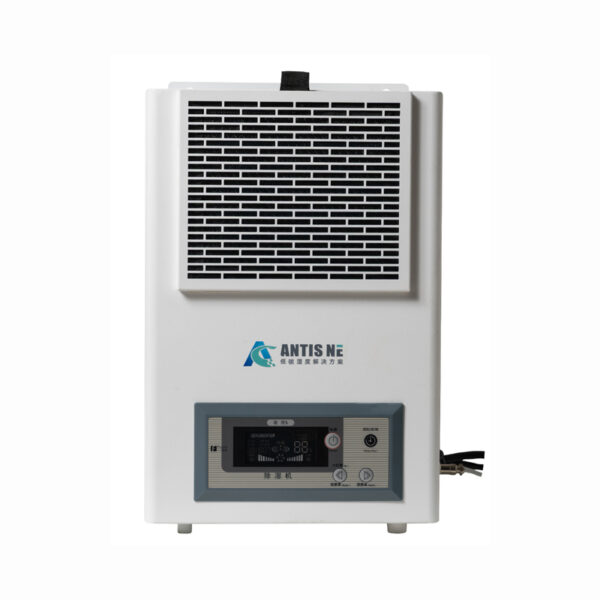
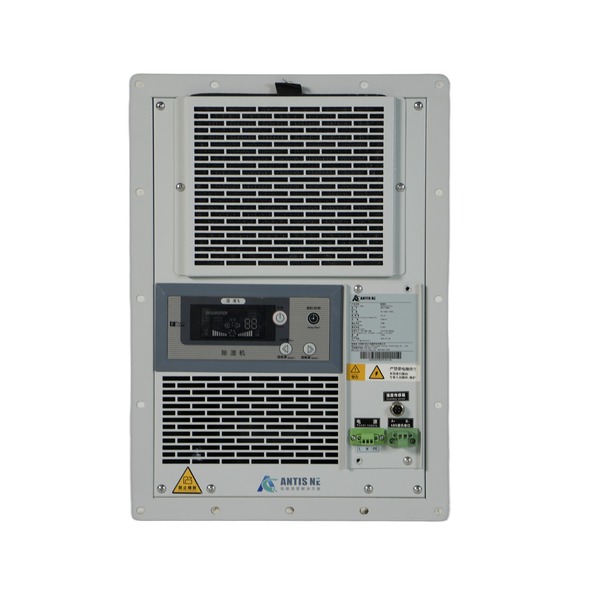
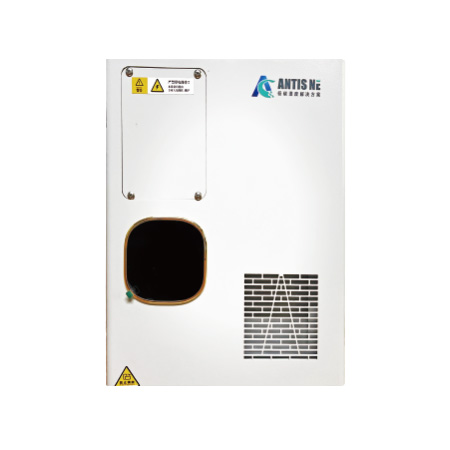
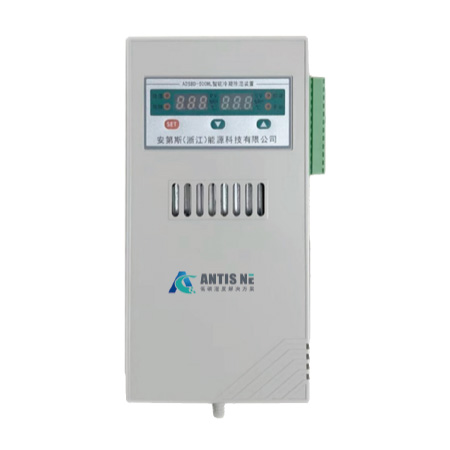
Compact refrigerant and semiconductor dehumidification products for battery cabinets, electrical enclosures and technical spaces. Compare published ratings with their test conditions, then confirm the project duty from dew point, minimum surface temperature, moisture entry, power, drainage and installation limits.
Compare compact semiconductor and refrigerant dehumidifiers for electrical and energy-storage cabinets, with rated conditions, power and drainage shown by model.
Product selection should be confirmed against temperature, target humidity, airflow, drainage, power supply, and installation conditions.
DEFINITION
What is a cabinet dehumidifier?
A cabinet dehumidifier removes moisture from air inside electrical or energy-storage enclosures. This range includes compact refrigerant and semiconductor models with external continuous drainage; selection depends on the cabinet's air dew point, cold surfaces, moisture entry, power and installation conditions.
Yakeclimate designs and manufactures industrial dehumidification equipment for complex climate applications, with a focus on agriculture and energy projects.
Product overview
How this product family supports a project
Compact refrigerant and semiconductor dehumidification products for battery cabinets, electrical enclosures and technical spaces. Compare published ratings with their test conditions, then confirm the project duty from dew point, minimum surface temperature, moisture entry, power, drainage and installation limits.
01
Six compact refrigerant and semiconductor base models in the current public catalogue.
02
Every removal value is shown with its rated temperature and relative humidity.
03
Continuous external drainage is listed across the current family; power options vary by model.
04
Project review starts from dew point, cold-surface temperature, moisture entry, heat load, airflow, power and installation limits.
Selection decision path
Define the risk and operating condition before comparing models.
A battery cabinet, electrical enclosure, switchgear room and container are not the same humidity application. Selection needs one project brief covering condensation risk, enclosure boundary, entering-air condition, internal heat load, door opening and leakage, power, drainage and controls.
State whether the protected boundary is one sealed cabinet, connected cabinets, an equipment room or a container. Acceptable room air does not prove that the coldest enclosure surface is safe.
02
Use dew point
Record air temperature/RH and minimum surface temperature. Condensation becomes possible when a surface reaches or falls below air dew point; one RH value does not describe rapid temperature changes.
03
Quantify moisture entry
Confirm ventilation, leakage, service-door opening, adjacent spaces and cleaning. An IP/NEMA rating describes defined protection tests; it does not automatically mean zero internal condensation.
04
Compare one condition
Read removal capacity with its rated temperature and RH. When rating conditions differ, L/day or mL/day cannot be ranked as condition-independent values.
BESS / MOISTURE DUTY
Separate three container moisture duties
Record each separate air zone. Scroll horizontally on small screens.
Duty
Moisture source to record
Sizing and recovery inputs
01 / Initial drying
Moisture retained in air and materials after assembly, storage, transport or cleaning; locate and address liquid-water ingress first.
Starting temperature/RH, materials to dry and the time allowed to reach target, separately from steady operation.
02 / Continuous ingress
Moisture through seals, ventilation and connected spaces.
Inside/outside conditions, air exchange and pressure, zoned air paths and HVAC sequence.
03 / Door-opening recovery
Service-door opening frequency, duration and incoming outdoor air.
Allowable recovery time after closing, coldest surface, drainage and alarms.
Diagnostic articles identify causes, compare control routes and prepare inputs. This product page compares available models and rating boundaries. Commissioning guidance defines how to verify the result. The product family therefore does not replace diagnosis, and the articles do not act as model-sales pages.
Dehumidifiers for electrical cabinets and enclosures
Define the cabinet boundary before selecting equipment: cold surfaces, moisture entering through seals or ventilation, service-door openings and the drainage route. Heating changes surface temperature and relative humidity; active dehumidification removes water from the air. Record the coldest surface and air dew point to assess the duty.
Yakeclimate cabinet dehumidifier range
MODEL SELECTION
Cabinet dehumidifier model range
ADS-500ML and ADS-1000ML use semiconductor (Peltier) cooling and are rated at 35°C/85% RH. The four refrigerant models are rated at 30°C/80% RH. Compare within each rating group; the capacity numbers alone do not rank efficiency.
Rated data by model. Scroll horizontally to review all columns.
PPD means US pints per day, converted as L/day × 2.113 and rounded to the nearest whole number. L/day retains the original rated precision. Conversion is not an AHAM/DOE test result; ratings at different conditions cannot be ranked directly.
TECHNOLOGY & DUTY
Peltier or compact refrigerant models
Start with moisture load, internal heat, available power, installation space and drainage. The two Peltier models publish 0.5 and 1 L/day at 35°C/85% RH; refrigerant candidates publish 4, 6 or 10 L/day at 30°C/80% RH. Confirm removal at the cabinet's actual conditions before deciding. Semiconductor models are thinner and more compact; both technologies list external continuous drainage. Compare installation depth, minimum surface temperature, failure consequence and recovery time as well as moisture load.
ADS-1000ML semiconductor dehumidifier
Peltier heat and water paths · principle schematic, not an installation drawing · scroll horizontally on small screens
Path
What happens
Installation check
01 / Cold side
Moist air → surface below air dew point → condensed water.
Keep the intended air path open; confirm performance at actual temperature/RH.
02 / Hot side
Heat absorbed at the cold side plus electrical input → heat rejected through the hot-side heat sink.
Confirm where heat is released and keep heat-rejection airflow clear in the cabinet layout.
Confirm orientation, drain route and blockage/freezing checks for the chosen model.
01
Peltier candidates
Compare ADS-500ML and ADS-1000ML for a compact installation. Retain each model's voltage and enclosure-specific power and dimensions in the review.
02
Refrigerant candidates
Compare ADS-100WB-01, ADS-100WB-06, ADS-10D and ADS-10DW2 when reviewing a greater moisture load. Check the operating condition and drain route for the proposed installation.
03
Enclosure integration
Provide a cabinet layout and required controls. Equipment dimensions do not establish the completed enclosure's IP/NEMA rating or electrical clearances.
POWER & INTEGRATION
Power, drainage and enclosure integration
ADS-500ML lists AC 220–240V 50/60Hz / DC 24V. ADS-1000ML lists AC 220V / DC 24V without an AC frequency: confirm it for the project. Its ABS and aluminium configurations have separate power and dimension entries. Check the external drain path and cabinet manufacturer's integration requirements before fixing the unit.
Model-specific supply options
AC / DC
ADS-1000ML enclosure configurations
ABS / Aluminium
RANGE ≠ RATED REMOVAL
Operating range and rated removal are different
The semiconductor models list an operating range of -30–+55°C, while their removal ratings are measured at 35°C/85% RH. That range does not mean 0.5 or 1 L/day is available at -30°C. Review the target dew point, minimum cold-surface temperature, moisture entry and heat load together.
Cabinet, room or container dimensions, connections, sealing and ventilation paths
02
Normal, peak and rapid-temperature-change cases; ambient and internal temperature/RH
03
Target RH/dew point and minimum cold-surface temperature
04
Moisture entry, leakage, service-door opening frequency and pressure relationships
05
Internal heat load and the existing HVAC operating sequence
06
Available voltage, phase, frequency, power and starting constraints
07
Installation drawings or photos, orientation, clearances and internal air path
08
Drain point and route, blockage/freezing risk and alarms
09
Required enable, status, alarm and communication points; candidate configuration and quantity
10
Redundancy, allowable downtime and the acceptance method
Standard configuration and OEM interface review
Confirm the selected platform before requesting changes · scroll horizontally on small screens
Interface
Standard configuration to confirm
Changes requiring review
Electrical supply
Use the selected model's catalogue supply and power data.
Alternative voltage/frequency, connection and starting constraints.
Mechanical and drainage
Use the model-specific dimensions, enclosure option and external drainage data.
Mounting, orientation, service access, drain routing and enclosure clearances.
Controls and signals
Request the supplied control and wiring description; unlisted signals are not assumed to be included.
Required enable, status, alarms, communication protocol and HVAC/BMS sequence.
For a prototype, agree the duty-point test, heat rejection, drain operation, signal/fault checks and acceptance criteria before testing. Confirm the sample configuration, quantity and schedule with the engineering team; platform compatibility remains subject to that review.
The Energy Storage Dehumidifier on this page is part of the Energy Storage Dehumidifier range; compare the rated values in each model specification table with the working principles below.
Technology route
How it works
Typical applications
Refrigerant dehumidification
Cools air below dew point to condense and separate water vapor
Conventional dehumidification duty in commercial and industrial spaces
Desiccant rotor dehumidification
Adsorbs moisture onto a rotating wheel and regenerates it continuously
Lower-temperature or lower-humidity targets in storage and process environments
Ultrasonic humidification
Adds fine water mist to raise or compensate relative humidity
Humidity compensation in agriculture and process areas
Application fit
Where this product can be evaluated
Application fit depends on the moisture load, operating temperature, room volume, airflow path, and installation constraints.
Step 1 — define the operating conditions. Record the temperature range, current and target relative humidity, moisture load, and the volume of the room or enclosure to be protected.
Step 2 — confirm the site constraints. Check the available power supply, drainage method, airflow or static-pressure requirement, and installation space; for ceiling, cabinet, or portable mounting confirm the fixing method and service access.
Step 3 — review the rated data and confirm the configuration. Compare the rated capacity in l/24h and the surrounding specification values in the table against the recorded conditions, then confirm the configuration with Yakeclimate before ordering.
FAQ
Frequently Asked Questions
Is the Energy Storage Dehumidifier capacity rating based on standard testing conditions?
Rated capacity is published under the named condition in the specification table (for example 30°C/80% RH, in l/24h). Actual moisture removal depends on operating temperature, humidity, airflow, and installation conditions.
Which applications can the Energy Storage Dehumidifier support?
The applications listed on this page are evaluation starting points. Final suitability depends on the moisture load, temperature, airflow, and installation limits of the project.
How does Yakeclimate support project configuration?
We co-develop application-specific dehumidification equipment around the operating conditions, interfaces, and integration requirements of the wider project or system.
How do I choose an electrical cabinet dehumidifier?
Define the cabinet boundary, moisture entry, internal temperature/RH and coldest surface. Compare model capacity at the relevant condition, then verify power, heat, dimensions, drainage and controls.
Can a dehumidifier be installed in a switchgear cabinet?
The cabinet manufacturer must review space, electrical clearances, power, heat load and drainage for the chosen model. This model table does not certify the protection rating of the completed cabinet.
Which Peltier models are available?
ADS-500ML and ADS-1000ML are the semiconductor models, rated at 0.5 and 1 L/day respectively at 35°C/85% RH. Their model pages show the individual power and enclosure configurations.
Do semiconductor and refrigerant ratings use the same test condition?
No. These semiconductor models use 35°C/85% RH; the cabinet refrigerant models use 30°C/80% RH. Request a comparison at the actual project condition before drawing capacity or efficiency conclusions.
Should an enclosure use a heater or a dehumidifier?
A heater raises temperature; a dehumidifier removes water. Assess moisture sources, ventilation, air dew point and cold surfaces to select the control method and any combined operation.
Project support
Confirm the right configuration for your operating conditions.
Share the operating temperature, current and target humidity, room dimensions, airflow, power supply, drainage method, and installation limits. Yakeclimate can use these details to recommend a suitable next step.