
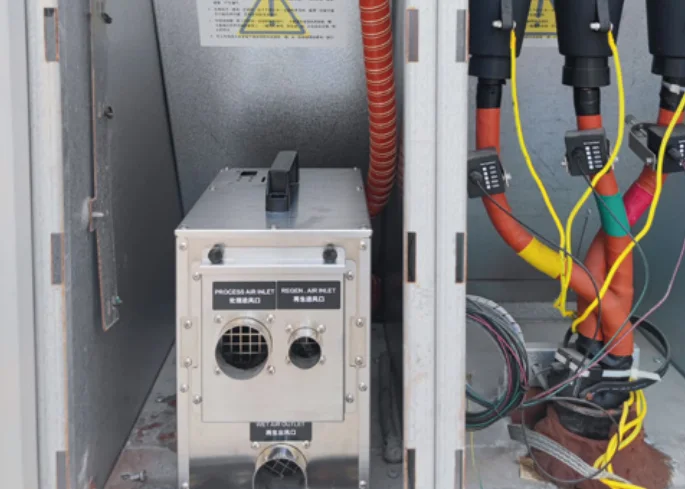
INDUSTRIAL STORAGE / EQUIPMENT SELECTION
Cold Storage Dehumidifiers
Select rotary desiccant equipment for low-temperature storage, with a model review based on inlet conditions, door-opening load and the required humidity or dew point.
RY catalogue capacity is rated at 20°C/60% RH; the listed operating range is −10 to +55°C. Request low-temperature performance curves and a laboratory test review for your project.
Choose from measured conditions. Equipment testing facilities. Cold-store duty requires model-specific data.
01 / TECHNOLOGY CHOICE
Why cold stores use desiccant dehumidifiers
A desiccant rotor removes water vapour by adsorption, so it can continue drying air below 0°C without relying on moisture condensing on a cold coil. Conventional refrigerant dehumidifiers lose capacity as the inlet gets colder and their coils can frost. For cold-storage selection, start with the lowest operating temperature and required dew point.

Cold and sub-zero duty
Review the RY desiccant range against the actual inlet condition. Below its listed operating range, request an engineering assessment before selecting equipment.
Warmer storage areas
Refrigerant equipment can suit warmer stores when the required removal is verified at the operating temperature and condensate can drain reliably.
Different rating conditions
RY ratings use 20°C/60% RH. A temperature range is not a low-temperature capacity curve. Request the curve for your project instead of extrapolating the table.
02 / MODEL SELECTION
RY desiccant models for project review
All capacities below are catalogue ratings at 20°C/60% RH, not removal rates inside a cold store. Review both airflows and the supply before requesting a low-temperature curve.
| Model | L/day | PPD | Rating condition | Process / circulation airflow | Reactivation airflow | Supply (V / phase / Hz) | Operating range |
|---|---|---|---|---|---|---|---|
| RY-100MDesiccant | 12 | 25 | 20°C/60% RH | 93 m³/h | 30 m³/h | 220/1ph/50 | -10~+55 °C |
| RY-200MDesiccant | 15 | 32 | 20°C/60% RH | 198 m³/h | 60 m³/h | 220/1ph/50 | -10~+55 °C |
| RY-300MDesiccant | 48 | 101 | 20°C/60% RH | 320 m³/h | 110 m³/h | 220/1ph/50 | -10~+55 °C |
| RY-600MDesiccant | 72 | 152 | 20°C/60% RH | 580 m³/h | 200 m³/h | 220/1ph/50 | -10~+55 °C |
| RY-750MDesiccant | 108 | 228 | 20°C/60% RH | 750 m³/h | 250 m³/h | 380/3ph/50 | -10~+55 °C |
| RY-1000MDesiccant | 180 | 380 | 20°C/60% RH | 1000 m³/h | 400 m³/h | 380/3ph/50 | -10~+55 °C |
| RY-1500MDesiccant | 240 | 507 | 20°C/60% RH | 1550 m³/h | 580 m³/h | 380/3ph/50 | -10~+55 °C |
| RY-3000MDesiccant | 456 | 964 | 20°C/60% RH | 3000 m³/h | 1100 m³/h | 380/3ph/50 | -10~+55 °C |
PPD = US pints/day, converted from L/day × 2.113 and rounded. This is not an AHAM/DOE test rating. Capacity must be confirmed at the actual inlet temperature and humidity; operating range is a separate specification.
03 / LOAD & INSTALLATION
Control the incoming moisture. Plan both air paths.
Door openings and leakage bring warmer, wetter air toward cold surfaces. Record how the store operates before sizing the unit. A dehumidifier supports moisture control alongside sound doors, seals and refrigeration maintenance.
Door-opening load
Provide opening size, openings per hour, time open, vestibule conditions and nearby loading activity. Frequent access and sealed storage require different load assessments.
Frost and cold surfaces
Record surface temperatures and where condensation or ice forms. Review the air moisture level against those surfaces; retain the refrigeration system's required defrost and maintenance procedures.
Reactivation exhaust
Route moisture-laden regeneration air away from the store and process-air intake. Confirm duct pressure, discharge location, insulation and condensate management for the exhaust route.
Installation position
Review an outside-the-room position with dry-air ducting where suitable. Confirm return-air routing, heat entering the store, penetrations and the unit's actual ambient conditions.
Service access
Keep filters, rotor and heater service points accessible. Agree isolation, cleaning access and inspection intervals for the selected installation.
Power and controls
Match the listed voltage, phase and 50Hz supply. Confirm 60Hz needs separately, along with sensor position, alarms and refrigeration interfaces.
04 / STORAGE CONDITIONS
Match the air target to what you store
Set the storage conditions from the goods and packaging requirements, then confirm the equipment duty. Each space needs its own temperature, moisture and air-distribution review.
Seed storage
For seeds suited to dry storage, provide species, moisture specification, packaging and storage temperature. Room humidity control does not by itself verify seed moisture or germination performance.
Low-temperature warehousing
Review condensation on goods, racks and packaging against the minimum surface temperature. Confirm whether exposed goods tolerate the proposed humidity level.
Cold-chain anterooms
Assess the buffer space separately from the cold store. Identify door sequence, incoming air and air distribution before deciding where dry air is needed.
05 / MODEL VALIDATION
Request performance at your cold-room condition
Low-temperature performance can be tested in our laboratory against your project conditions. Request a project-specific performance curve and agree the test scope: inlet temperature/RH, target RH or dew point, process airflow and operating schedule. Confirm model-specific removal, outlet temperature and reactivation requirements from the resulting data before ordering.

06 / FAQ
Equipment selection FAQ
Can a desiccant dehumidifier work below freezing?
Adsorption can remove moisture below 0°C. The listed RY operating range starts at −10°C; actual removal and installation conditions still need confirmation. Do not assume suitability for colder freezers.
How much water will a model remove in my cold store?
Request low-temperature performance curves for your inlet condition and humidity target. The 20°C/60% RH catalogue rating cannot be used as the cold-room removal rate.
Will one unit eliminate all frost?
That depends on incoming moisture, air distribution, cold surfaces and refrigeration operation. Define the load and acceptance criteria before specifying the number and position of units.
Can the dehumidifier sit outside the cold room?
An external position with ducted dry air can be reviewed. Confirm process return air, duct resistance, insulation, heat input and a separate reactivation exhaust route.
- 01
Stored goods, packaging, room volume and storage temperature
- 02
Inlet RH, target RH/dew point, coldest surfaces and observed frost
- 03
Door size, opening frequency/duration and anteroom conditions
- 04
Power, process/regen ducts, service space and required schedule