
The refrigerant-versus-desiccant decision should start with the required air condition. Refrigerant dehumidifiers are often practical for warm spaces with moderate humidity targets. Desiccant dehumidifiers become important when the room is cold, the required dew point is low, or the process needs dry supply air rather than simple RH control.
The Core Difference
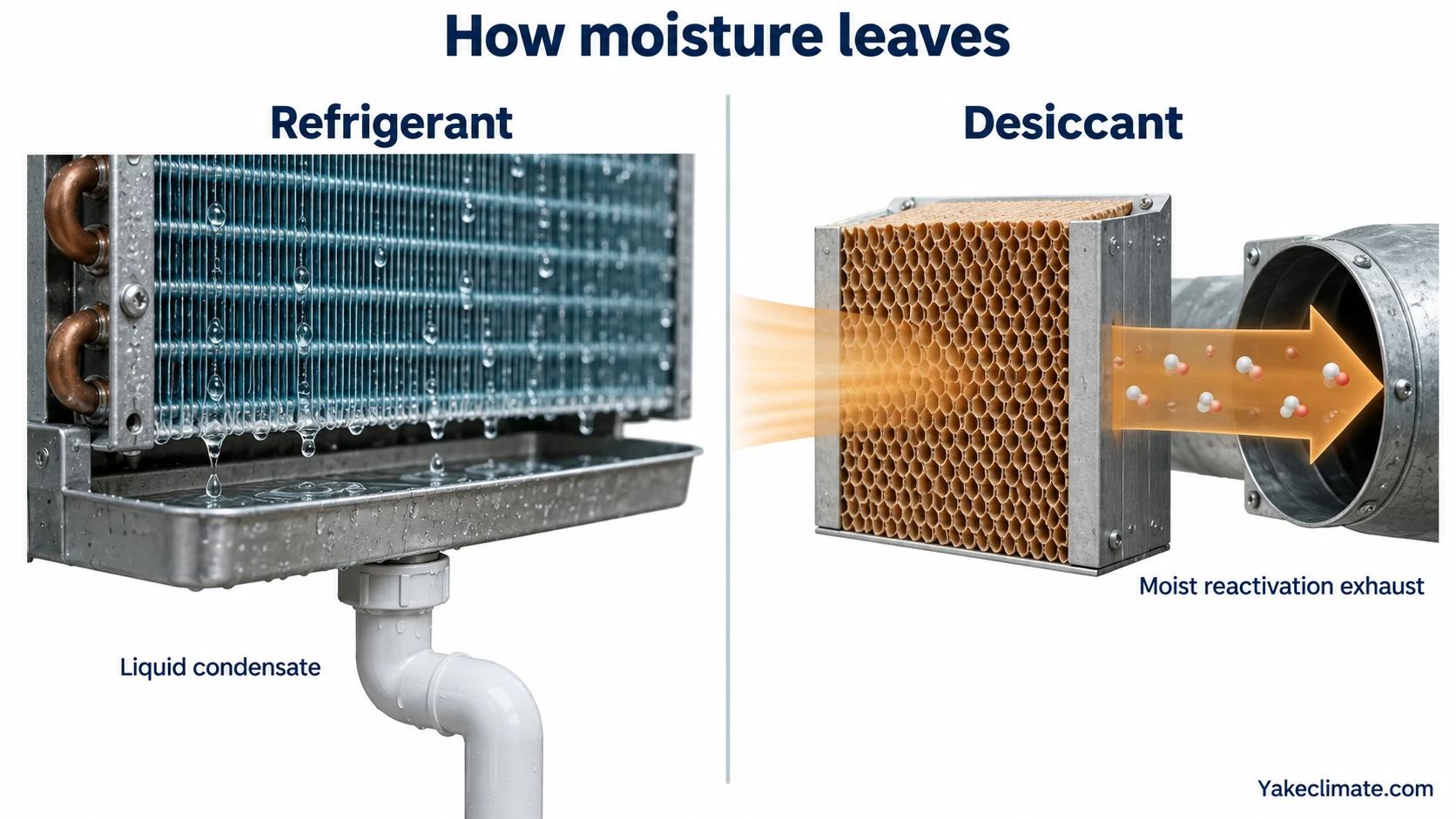
Refrigerant dehumidifiers use a cold coil. Moist air passes over the evaporator, water condenses, and the condensate drains away. This can work well in warm rooms where the target is moderate humidity control.
Desiccant dehumidifiers use a moisture-attracting material. In most industrial rotary units, the process air passes through one part of the rotor while a separate heated reactivation air stream dries another part of the rotor. ASHRAE's technical committee scope for desiccant equipment distinguishes these systems as equipment that dehumidifies air, not pressurized gases or liquids (ASHRAE TC 8.12).
| Question | Refrigerant dehumidifier | Rotary desiccant dehumidifier |
|---|---|---|
| How is moisture removed? | Air is cooled below dew point and water condenses. | Water vapor is adsorbed by desiccant material. |
| What leaves the system? | Liquid condensate. | Moist reactivation exhaust air. |
| Main utility need | Electrical power and drainage. | Electrical power plus reactivation heat and exhaust path. |
| Typical strength | Warm, moderate humidity applications. | Cold or low-dew-point applications. |
Why Dew Point Matters
ASHRAE's public discussion of dehumidification notes a practical limit of cold-coil systems: if water freezes on the coil, airflow and moisture removal are reduced (ASHRAE Journal Podcast Episode 39). Desiccant systems avoid the same cold-coil condensation limit because the drying process is adsorption based.
That does not mean desiccant is always better. It means the required dew point and inlet condition should decide the technology.
| Project condition | Likely starting point |
|---|---|
| Warm greenhouse with moderate RH target | Compare ventilation and refrigerant dehumidification first. |
| Warehouse with seasonal humidity and door openings | Refrigerant dehumidifier often fits, but check low-temperature periods. |
| A non-battery process requiring low-dew-point supply air | Assess whether a documented desiccant configuration can meet the required condition. |
| Cold storage or unheated utility space | Desiccant or low-temperature design review is needed. |
| Commercial building comfort humidity | Refrigerant or HVAC-integrated dehumidification often fits. |
For the working principle, read how desiccant dehumidifiers work. For rotor details, read rotary desiccant dehumidifier rotor structure.
Selection Inputs Before Comparing Models
Do not ask only for liters per day or pints per day. The supplier needs the conditions attached to that capacity.
| Input | Why it matters |
|---|---|
| Inlet dry-bulb temperature | Changes refrigerant capacity and frost risk. |
| Inlet RH or dew point | Defines the starting humidity ratio. |
| Required room or supply dew point | Determines whether refrigerant is enough. |
| Moisture generation rate | Prevents room-volume-only sizing. |
| Available utilities | Desiccant reactivation may need electric, steam, hot water or gas heat. |
| Condensate or exhaust path | Refrigerant needs drainage; desiccant needs reactivation exhaust. |
| Airflow and static pressure | Determines fan selection and duct suitability. |
| Control interface | Affects staging, alarms and BMS or greenhouse-computer integration. |
Use the commercial dehumidifier sizing calculator inputs guide to organize these values before comparing equipment.
Energy Comparison Needs a Boundary
Energy comparison is often oversimplified. Refrigerant units can be efficient in warm humid conditions because they remove liquid water through a cooling cycle. Desiccant systems consume heat for reactivation, but can be the only practical route for low dew point or cold operation.

Compare the complete system:
- water removal at the actual inlet condition,
- fan power at the required static pressure,
- reactivation heat source and exhaust losses,
- defrost or low-temperature penalties,
- whether post-cooling or reheating is required,
- seasonal operating hours.
The lower-energy choice can change by season and control objective. Compare each application at its own entering conditions, required air condition and complete energy boundary.
Practical Decision Rule
Use this simple screening logic before requesting a quotation.
| If the project needs... | Start with... |
|---|---|
| Moderate RH control in a warm room | Refrigerant dehumidifier. |
| Very low dew point or dry supply air | Desiccant dehumidifier. |
| Cold room operation with frost concern | Desiccant or low-temperature specialist review. |
| Seasonal greenhouse humidity control | Ventilation plus refrigerant comparison, then desiccant only if conditions require it. |
| Repeated OEM deployment | Freeze the design condition, controls, utilities and documentation requirements. |
For product families, compare industrial dehumidifiers and desiccant rotor dehumidifiers after the design condition is clear.
FAQ
Frequently Asked Questions
Is a desiccant dehumidifier always more powerful than a refrigerant unit?
No. It is different. Desiccant equipment is stronger for low dew point and cold-operation cases. Refrigerant equipment can be simpler and more efficient in warm moderate-humidity spaces.
Which type is better for greenhouses?
Many warm greenhouse projects start with ventilation and refrigerant dehumidification. Desiccant equipment becomes relevant for low-temperature operation, strict dew point targets or special dry-air zones.
What should I send to compare both technologies?
Send inlet temperature, inlet RH or dew point, required room or supply condition, moisture load, airflow, installation layout, utilities, drainage or exhaust limits, and control interface.


