
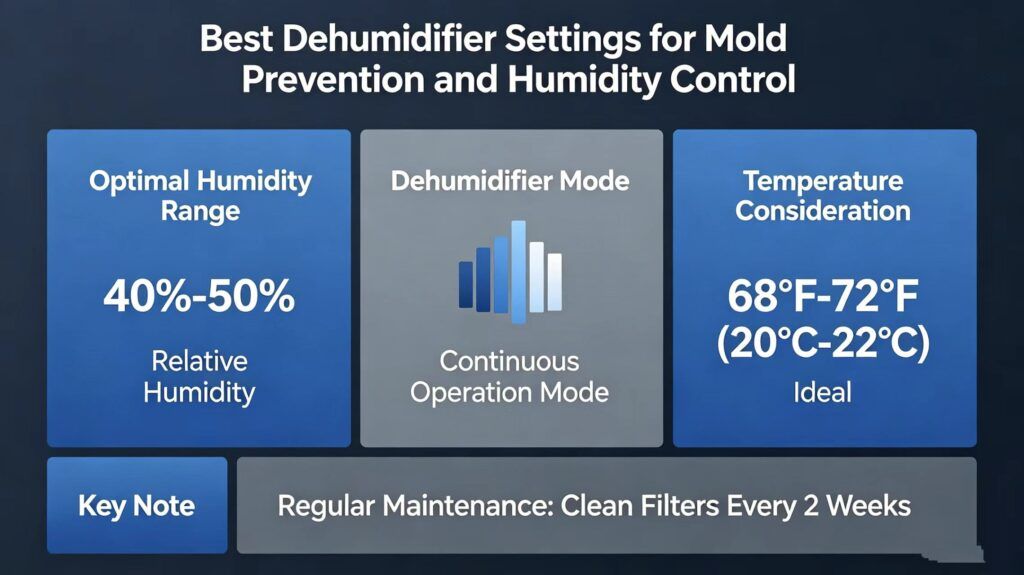
A room RH reading is not a mould-control guarantee. Set dehumidifier controls from the moisture source, the coldest relevant surface, the material risk and the equipment's actual operating condition.
Key Takeaways
- Room RH and surface RH are different measurements. A cold surface can be much closer to saturation than the room sensor suggests.
- The often-quoted 80 % surface-RH and 30-day wording is historical context from an earlier Standard 160 formulation. Do not present it as the current universal pass/fail method.
- Current mould-risk assessment should use the applicable Standard 160 edition or addendum, a material-sensitive mould-index time series where required, and qualified hygrothermal review.
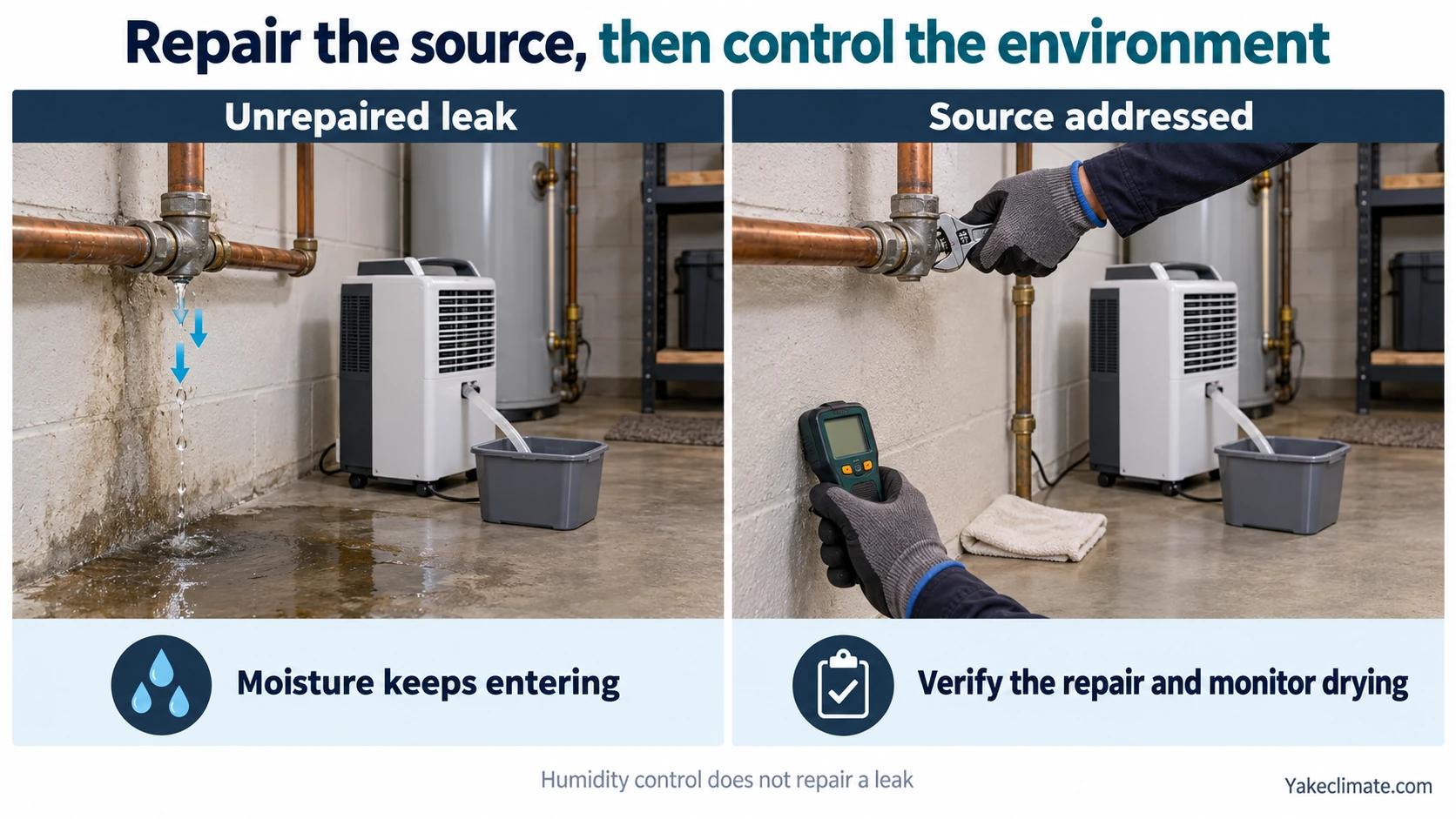
- A dehumidifier manages a moisture load; it does not repair leaks, remove water intrusion, or remediate existing mould.
- Do not switch refrigerant and desiccant equipment at a universal 15–18 °C threshold. Compare the selected unit's envelope, inlet RH, defrost behaviour and effective capacity at the project condition.
Room Humidity Is Not Surface Humidity
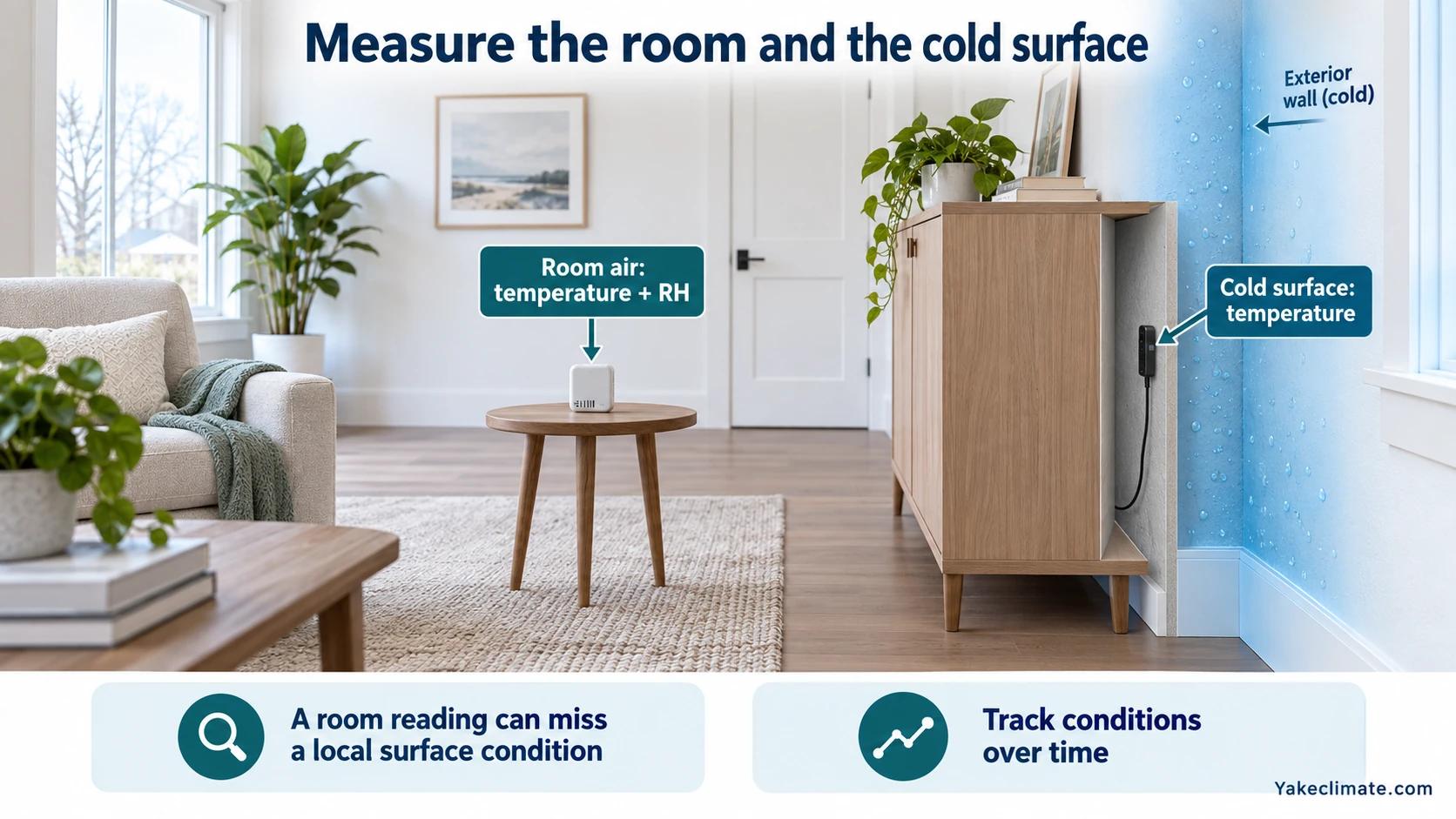
Mould risk is evaluated where moisture and material meet. Room temperature and RH describe the air at the sensor; they do not directly describe a cold exterior corner, a wall behind furniture, a thermal bridge or a material inside a cupboard.
For an illustrative calculation, air at 20 °C and 50 % RH has a vapour pressure of about 1.17 kPa. If the relevant surface is 12 °C, its saturation vapour pressure is about 1.40 kPa, so the surface RH is about 83 %. That example explains why a comfortable room reading does not clear every surface.
The calculation is a diagnostic illustration, not a universal mould threshold. Use measured surface temperature, the actual room condition and the applicable assessment method for the building and material.
What the Standard 160 Reference Does—and Does Not—Mean
The 80 % surface-RH / 30-day average wording is useful historical context for understanding why surface condition and duration matter. The source text is an earlier formulation; it must be labelled by edition and must not be presented as the current universal criterion.
Later Standard 160 material uses an empirical mould-index approach that accounts for material sensitivity, surface temperature and surface relative humidity over time. The applicable edition, boundary conditions and assessment responsibility should be stated in a project calculation or specialist review.
A single room RH target cannot establish compliance, predict growth, or guarantee prevention. If the project has a contractual, regulatory or preservation requirement, use the specified method and retain its assumptions, inputs and review record.
Find the Moisture Source First
A humidity setpoint manages the consequence of a moisture load. It does not stop a leaking pipe, rising moisture, rain penetration, ventilation from a wetter space or moisture released by occupants, processes or stored materials.
Separate the investigation into source, air condition, surface condition and material. Correlation with rainfall points toward the envelope; correlation with occupancy or process operation points toward internal generation; a persistent problem without either correlation warrants defect investigation.
Derive the Control Target from the Risk
There is no responsible universal room-RH number for every building and material. First identify the surface or product condition that matters, then identify the demanding operating period and measure the relevant temperature and moisture variables.
- Identify the coldest relevant surface, the material or stored product, and the moisture mechanism being controlled.
- Log room temperature and RH through the demanding period; add surface-temperature or material-moisture measurements where the risk is local.
- Use the applicable standard, material data and qualified review to derive the target and any margin for sensor tolerance and spatial variation.
- Verify the result at the location that matters, not only at the thermostat or in the middle of a well-mixed room.
Lowering RH below what the risk requires has a cost in energy and runtime and can create an unnecessarily dry environment. The target should follow the risk assessment, not a slogan.
Placement and Air Movement
Dead zones can remain humid while a dehumidifier reports a satisfied condition at its own inlet. Keep measurement and airflow questions tied to the locations of concern: corners, behind furniture, cupboards, thermal bridges and other poorly mixed spaces.
Provide the selected equipment with the clearance, airflow path, drainage and power its documentation requires. A unit against a wall or behind furniture may recirculate its discharge without changing the cold surface that created the risk.
When the Setpoint Cannot Be Reached
Check the moisture load, unaddressed source, air exchange, sensor location, setpoint basis, filter and coil condition, drainage and operating time before adding capacity.
At lower entering-air temperatures, refrigerant capacity can fall and coil frosting or defrost can reduce average removal. There is no universal 15–18 °C switch point that applies to every machine or project. Check the selected model's permitted inlet range, entering RH, coil and defrost behaviour, and effective capacity at the required condition.
A desiccant unit also has a process-air and regeneration duty. Compare the whole operating requirement, including regeneration energy, airflow, discharge condition and controls, rather than treating desiccant as an automatic answer for any cold room.
Read the condensation and dew-point background before choosing the control variable.
Review the dehumidifier operating guidance alongside the selected model data.
Product Data Must Keep the Rating Condition
The published capacity is 60 L/24h at 30 °C / 80 % RH. It is not an average or guaranteed removal rate across the stated 5–38 °C operating range. Confirm capacity at the actual entering temperature and RH before using the unit for a project decision.
The published capacity is 48 L/24h at 20 °C / 60 % RH. The −10 to +55 °C operating range does not establish capacity, dew point, regeneration energy or suitability at every condition; request model data for the project duty.
Verify at the Surface and at the Equipment Inlet
Log room temperature and RH continuously enough to represent the assessment period. Measure surface temperature at the locations of concern and retain sensor location, calibration or tolerance information and the time window represented.
For equipment, record entering temperature and RH, leaving condition where relevant, airflow, power, runtime, defrost or protection state, drainage and water removal. A catalogue rating is not a commissioning baseline.
Existing mould growth, building defects and remediation are separate specialist questions. Humidity control may reduce a contributing condition; it does not diagnose or remediate existing growth.
Information to Prepare for a Project
- Space dimensions, construction, insulation, heating, occupancy and process operation.
- Moisture sources, ventilation and infiltration, drainage, power and equipment position.
- Target variable and its basis: room RH, dew point, surface condition, material moisture or another documented requirement.
- Logged air and surface conditions across the demanding period, plus photos and dates for affected locations.
- Required capacity and power at the design entering condition, with measured or calculated basis and any defrost or regeneration assumptions.
Discussing a Project
Yakeclimate designs and manufactures industrial dehumidification equipment for complex climate applications, with a focus on agriculture and energy projects.
We co-develop application-specific dehumidification equipment around the operating conditions, interfaces and integration requirements of the wider project or system.
Building-fabric investigation, defect diagnosis and assessment or remediation of existing mould remain with the appropriate building and remediation specialists. Our scope is the dehumidification equipment used to control the environment.
Explore industrial dehumidifiers,
review desiccant rotor dehumidifiers, or
contact Yakeclimate with the space, moisture sources, target condition and operating range.
FAQ
Frequently Asked Questions
Is keeping the room below 50 % RH enough to prevent mould?
No. Room RH does not equal the condition at every surface, and no single room number is a universal prevention guarantee. A 20 °C room at 50 % RH can produce about 83 % RH at a 12 °C surface in the illustrative calculation above. Use the applicable material and surface assessment method for the project.
What should replace the old 80 % / 30-day statement?
Treat the old wording as edition-labelled historical context. For current work, identify the applicable Standard 160 edition or addendum and use its material-sensitive mould-index or other specified assessment, with qualified review of inputs and assumptions. Do not turn the old line into a universal pass/fail guarantee.
How do I choose a dehumidifier setpoint?
Derive it from the relevant surface, material or product condition, moisture source and demanding period. Then verify the result at the location that matters. A lower target costs more energy and runtime and may still fail to control a leak or cold surface.
Should I switch to desiccant below 15–18 °C?
Not as a universal rule. Refrigerant capacity, frosting and defrost depend on the model and entering condition; desiccant equipment has regeneration and process-air requirements. Compare both technologies at the project's inlet temperature, RH, dew-point target, airflow and energy basis.
Will a dehumidifier fix mould caused by a leak?
No. Repair the moisture source and assess affected materials with the appropriate specialist. A dehumidifier can manage residual or ongoing environmental moisture only within its operating envelope.
What should the product card rating tell me?
It should state the capacity together with its inlet temperature and RH, plus the relevant operating range where verified. A 60 L/24h or 48 L/24h headline cannot be used as a project capacity without confirming the actual condition, model configuration and test or calculation basis.
References
ASHRAE Standard 160—2021 addendum a; check the applicable edition and assessment method.
ASHRAE Standard 160—2009 addendum a complete document; retained as historical context, not current blanket criteria.
USDA Forest Service mould-growth analysis; use as supporting technical context, not as a site-specific guarantee.


