
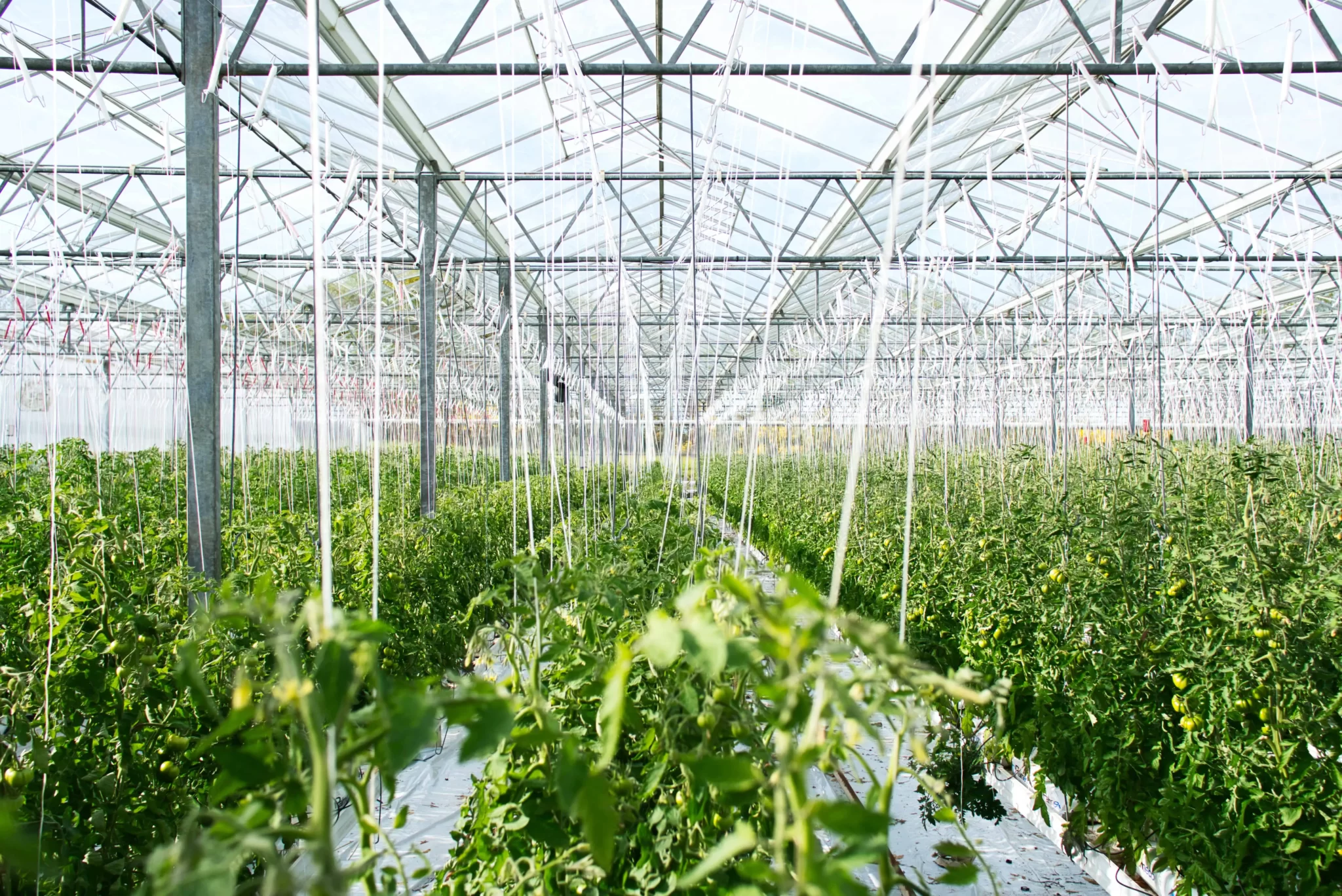

YAKE / COMMERCIAL GREENHOUSES
Greenhouse Dehumidifiers for Commercial Growers
Remove excess moisture when closed vents and thermal screens limit drying. Compare ceiling, floor-standing and portable dehumidifiers for tomato, cucumber, flower and propagation greenhouses.
Fixed-installation models: 168–960 L/24h at 30°C/80% RH. Portable models: 60–138 L/24h at the same rating conditions. Select against your actual night-time temperature and moisture load.
Keep crop space productive. Plan equipment around crop rows, airflow, drainage and access for maintenance.
01 / NIGHT-TIME MOISTURE
When a greenhouse needs a dehumidifier
Review the hours after vents close, thermal screens are drawn and air cools toward the dew point. During winter heating, retaining heat can also retain moisture released by crops and wet surfaces.
Ventilation can be enough
If outdoor dew point is below the target indoor dew point, outdoor air can carry moisture away. Confirm that the air-exchange rate handles the crop load and that heating can maintain the crop temperature.
Outdoor air cannot reach the target
At comparable air pressure, an outdoor dew point at or above the target indoor dew point means ventilation alone cannot dry the greenhouse to that target. Outdoor RH alone is not a useful pass/fail test.
Closed-house moisture accumulates
Consider mechanical dehumidification when closing vents or screens leaves insufficient moisture removal, or when the required ventilation would lose too much heat. Keep circulation running so wet crop zones can reach the equipment.
02 / MODEL COMPARISON
Model range for greenhouses
Choose an installation family first, then compare capacity at your design conditions. RYDZ suits suspended layouts; RYCF suits floor positions with service access; RYCM suits smaller zones or movable supplementary duty. None is selected by floor area alone.
On a small screen, scroll the table sideways to compare all specifications.
| Model / product details | L/24h | Pints/day (converted) | Rated conditions | Installation | Airflow | Maximum power |
|---|---|---|---|---|---|---|
| RYDZ-7S | 168 | 355 | 30°C/80% RH | Ceiling | 1800 m³/h | 2.8 kW |
| RYDZ-10S | 240 | 507 | 30°C/80% RH | Ceiling | 2500 m³/h | 4.25 kW |
| RYDZ-12S | 288 | 609 | 30°C/80% RH | Ceiling | 3000 m³/h | 4.65 kW |
| RYDZ-22S | 480 | 1014 | 30°C/80% RH | Ceiling | 5600 m³/h | 8.4 kW |
| RYDZ-30S | 720 | 1521 | 30°C/80% RH | Ceiling | 7400 m³/h | 12 kW |
| RYDZ-40S | 960 | 2028 | 30°C/80% RH | Ceiling | 10000 m³/h | 15 kW |
| RYCF-10S | 240 | 507 | 30°C/80% RH | Floor-standing | 2800 m³/h | 4.25 kW |
| RYCF-12S | 288 | 609 | 30°C/80% RH | Floor-standing | 3000 m³/h | 4.65 kW |
| RYCF-16S | 384 | 811 | 30°C/80% RH | Floor-standing | 5000 m³/h | 6.3 kW |
| RYCF-22S | 480 | 1014 | 30°C/80% RH | Floor-standing | 5600 m³/h | 8.4 kW |
| RYCF-30S | 720 | 1521 | 30°C/80% RH | Floor-standing | 7400 m³/h | 12 kW |
| RYCF-40S | 960 | 2028 | 30°C/80% RH | Floor-standing | 10000 m³/h | 15 kW |
| RYCM-60C | 60 | 127 | 30°C/80% RH | Portable | 480 m³/h | 0.78 kW |
| RYCM-90C | 90 | 190 | 30°C/80% RH | Portable | 1000 m³/h | 1.35 kW |
| RYCM-138C | 138 | 292 | 30°C/80% RH | Portable | 1300 m³/h | 1.68 kW |
Pints/day are converted from L/24h × 2.113 and rounded to the nearest integer. They are not a separate AHAM rating. Maximum power is not average consumption; compare duty-point performance before estimating running cost.
03 / EQUIPMENT LAYOUT
Ceiling vs floor-standing vs ducted
Ceiling-mounted · RYDZ
Free up floor space around crop rows. Check roof structure, suspended weight, shading beneath the unit and safe lifting access. Route condensate drainage and keep supply and return paths clear.
Floor-standing · RYCF
Provide a stable location outside traffic and irrigation routes. Service access is easier at floor level, but the footprint uses growing space. Distribute units to avoid short-circuiting air around nearby rows.
Ducted distribution · project review
Move air to selected zones where the fan and available external pressure allow it. Check duct losses, condensation, shading and access to filters. A duct connection does not establish capacity for an arbitrary duct network.
For a small compartment or supplementary duty, compare RYCM portable models. Plan drainage and power at each operating position; a movable unit still needs an unobstructed air path.
04 / SIZE FROM THE LOAD
How to size a greenhouse dehumidifier
Start with planted area, then quantify moisture released per hour. Our preliminary tomato-greenhouse evaluation separates crop transpiration, air exchange and wet-surface evaporation before choosing equipment. Confirm whether the night-time peak is brief or sustained.
- Record planted area, crop stage, irrigation, day/night temperature and RH, screen position and ventilation schedule.
- Estimate crop moisture release from measured water balance or a crop model. Add wet-surface evaporation and the signed moisture contribution from air exchange: dry outdoor air removes moisture; wetter air adds it.
- Choose capacity at the actual temperature and RH, allowing for defrost and available operating hours. Divide the net design load by that capacity, round up, then review zoning and standby needs.
Required operating units = round up (net design moisture load in L/h ÷ verified unit capacity in L/h at the design conditions)
Area is an input to the crop-load calculation, not a fixed units-per-hectare rule. Request a project calculation with its assumptions before ordering.
Read the dehumidifier sizing guide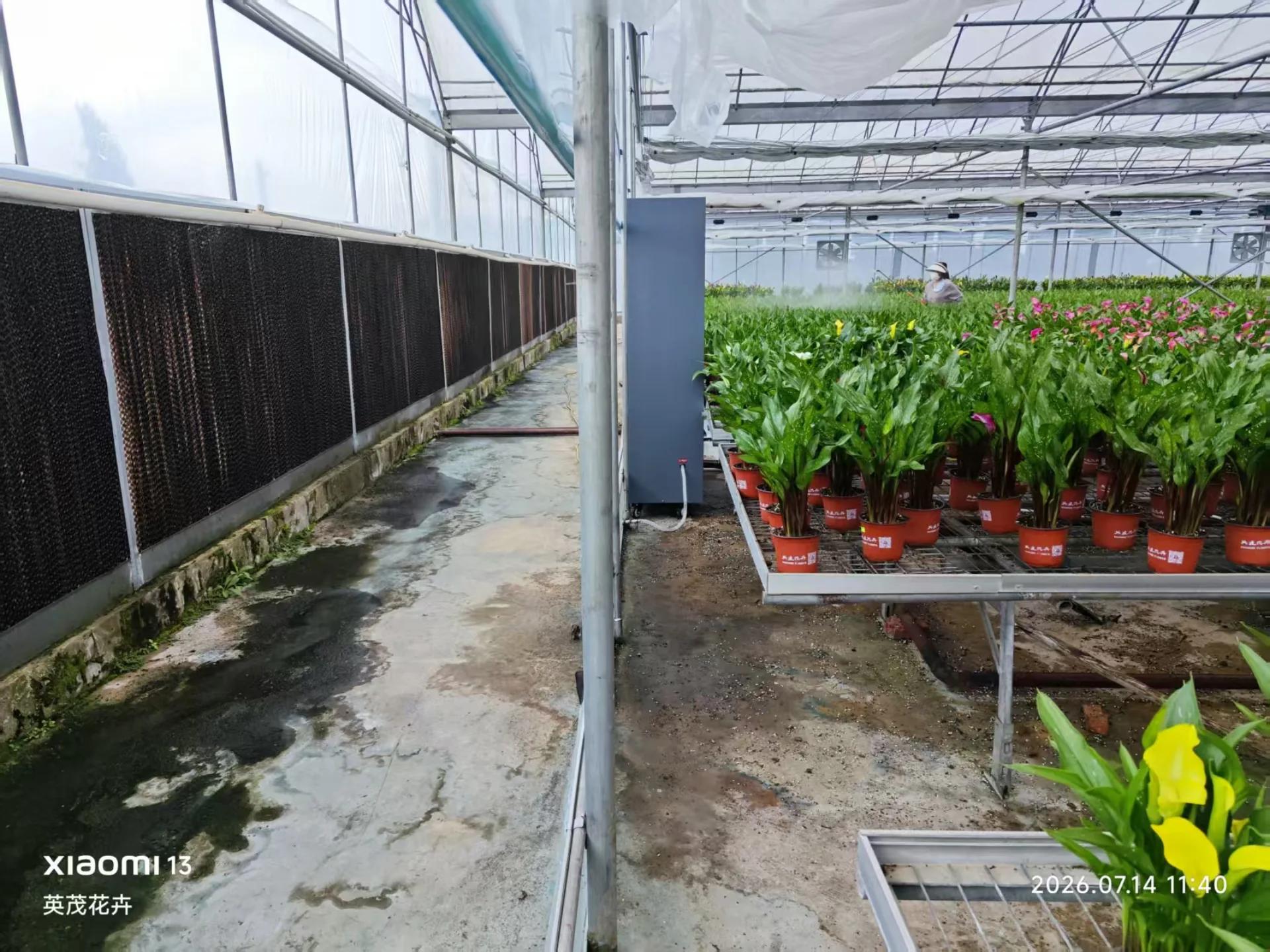
05 / ACTUAL OPERATING CONDITIONS
Low-temperature performance
A greenhouse operating at 10–18°C at night needs a different capacity check from the 30°C/80% RH catalogue rating. Refrigerant dehumidification capacity generally falls as air becomes cooler or drier, and defrost can reduce the time available for moisture removal.
Ask us for the derating curve or duty-point test data for the proposed model at your night-time temperature and target RH. We do not publish a low-temperature capacity estimate here without those data.
Request duty-point performance data06 / MANUFACTURER SUPPORT
Factory & OEM project support
Yakeclimate designs and manufactures industrial dehumidification equipment for complex climate applications, with a focus on agriculture and energy projects.
We co-develop application-specific dehumidification equipment around the operating conditions, interfaces, and integration requirements of the wider project or system.
For an OEM enquiry, send the destination market, installation limits, required controls, documentation and expected quantity. We will review the equipment scope with you before a quotation.
Explore manufacturing and testing
07 / FAQ
Greenhouse dehumidifier FAQs
Can I use a household dehumidifier in a greenhouse?
A household unit may help in a small enclosed space if its operating range, drainage and electrical installation suit the environment. Commercial crop loads and continuous duty need a capacity check at actual conditions. Compare RYCM for smaller zones and RYDZ or RYCF for fixed installations.
How many dehumidifiers does a greenhouse need?
Divide the net hourly moisture load by the verified hourly removal of one unit at the intended temperature and RH, then round up. Review airflow zones, maintenance and standby requirements. Area alone cannot determine the count.
Refrigerant or desiccant for greenhouses?
Compare refrigerant equipment for moderate-temperature humidity control. For colder or lower-dew-point requirements, assess desiccant equipment alongside its regeneration energy and heat discharge. The required duty point determines the choice; request performance data for each option.
Will ventilation remove enough greenhouse humidity?
It can when outdoor air is dry enough in absolute terms and the airflow can carry away the crop moisture load. If outdoor dew point is at or above the target indoor dew point, ventilation alone cannot reach the target. Heating can support venting but does not itself remove water.
Is the listed pints-per-day capacity a low-temperature rating?
No. Pints/day in this table are converted from the published litres-per-day value at the same stated rating conditions. Request data at your greenhouse operating temperature and target RH before sizing equipment.
Bring your greenhouse conditions to the quotation
Send crop and planted area, layout, night-time temperature/RH records, target RH, ventilation and heating arrangements, power supply and preferred installation. We can then discuss models, quantity and the information needed to confirm performance.
Request a Greenhouse Quote