
About Yakeclimate
A Manufacturing Partner for Complex Climate Applications
Yakeclimate designs and manufactures industrial dehumidification equipment for complex climate applications.
We co-develop application-specific dehumidification equipment around the operating conditions, interfaces, and integration requirements of the wider project or system.
WHAT IS AN INDUSTRIAL DEHUMIDIFIER
What is an industrial dehumidifier?
An industrial dehumidifier is a humidity-control unit that removes moisture from the air inside an enclosed space, helping a facility hold temperature, humidity, and condensation risk within its operating limits. Equipment selection refers to the operating environment, moisture sources, airflow, power, installation space, and interface requirements of the project, not to a nominal data-sheet rating alone. Yakeclimate designs and manufactures industrial dehumidification equipment for complex climate applications, with a focus on agriculture and energy projects.
COMPANY PROFILE
A manufacturing base built around humidity-control equipment
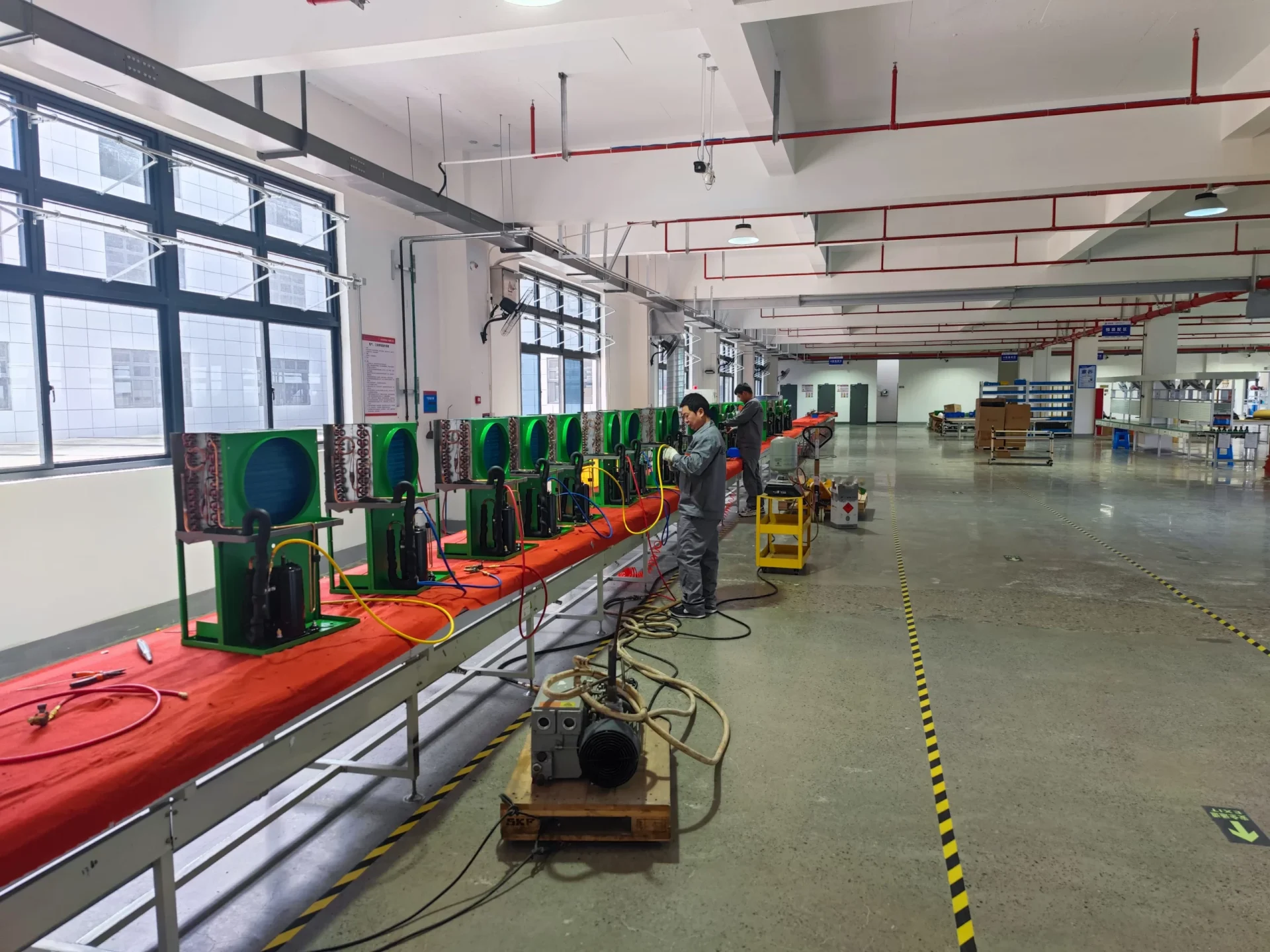
Founded in 2010, Yakeclimate has developed its manufacturing experience through standard equipment and project-oriented humidity-control applications. Our role is the equipment itself — helping your project manage humidity, condensation, and climate-related operating risk.
We work alongside project teams to define dehumidification equipment around the operating conditions, installation constraints, interfaces, controls, validation needs, and documentation requirements for the final product configuration.
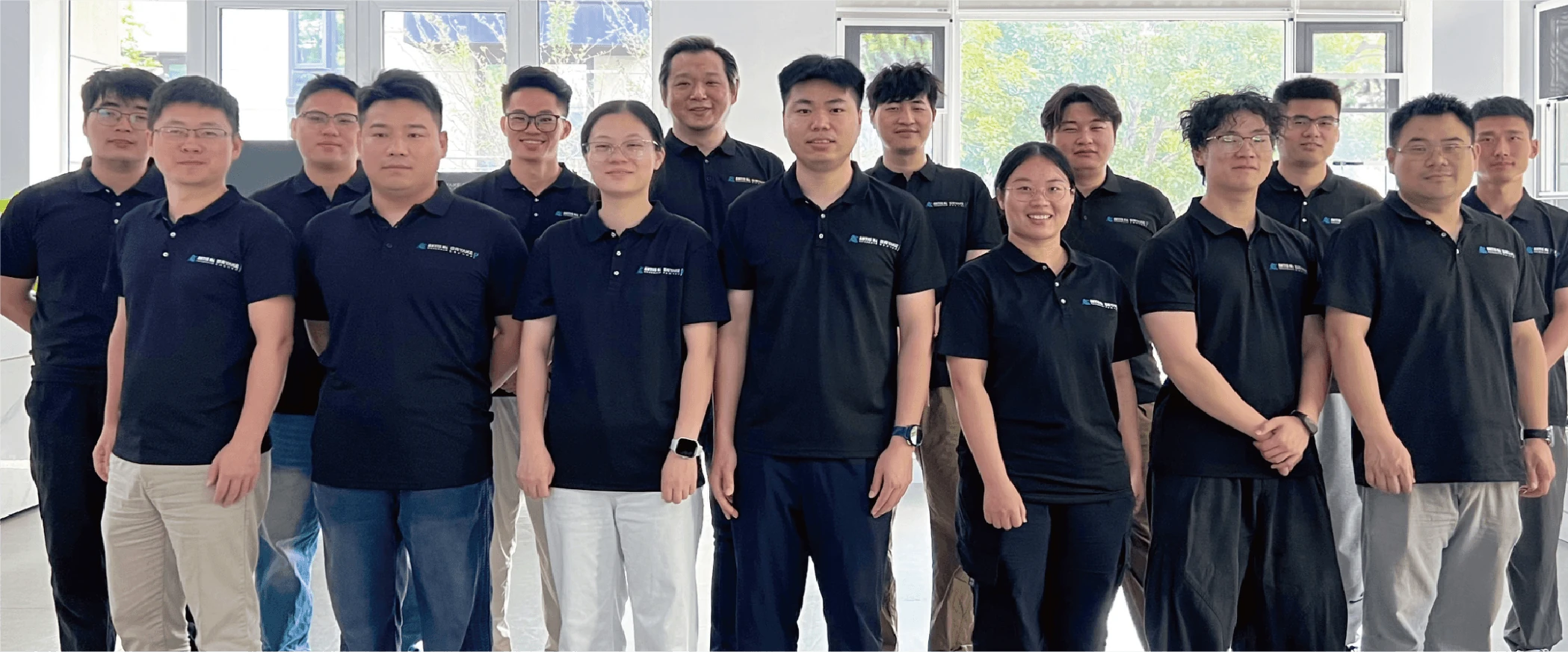
Equipment development with an application focus
46+ patents support ongoing product and application development across humidity-control equipment.
National-level laboratory capability
Controlled laboratory capability supports product-development, test planning, and performance evaluation work.
International manufacturing context
Supply experience across 50+ countries and regions informs project documentation and market-facing requirements.
YAKE & ANTIS
Two focused brands for different operating environments
YAKE focuses on agriculture and controlled environments while also covering general industrial dehumidification and humidification equipment. ANTIS focuses on energy storage, wind power, power-grid and substation installations, electrical enclosures, and technical rooms. The two brands make it easier to enter the product range from the operating environment that defines the equipment decision.
Yakeclimate develops and manufactures humidity-control equipment with in-house engineering, production, testing, documentation, and application support. Project discussions start with operating conditions, installation interfaces, control requirements, and validation needs before a model or adapted configuration is confirmed.
YAKE — Agriculture
Cultivation, greenhouse, indoor growing, post-harvest, and agricultural storage
Crop response, ventilation, condensation on surfaces and glazing, air distribution across large volumes, and seasonal changes in the operating pattern.
ANTIS — Energy
Battery energy storage, electrical enclosures, switchgear, power grid, and wind power
Enclosure limits, dew-point margin inside sealed equipment, internal heat load, compact installation, control interfaces, and repeat deployment across sites.
EQUIPMENT ROUTES AT A GLANCE
Compare equipment routes: refrigerant vs desiccant rotor vs ultrasonic
The table below summarizes the three equipment routes that cover most plant-wide humidity requirements. The right route depends on temperature, humidity target, and the application behind the requirement.
| Aspect | Refrigerant dehumidifier | Desiccant rotor dehumidifier | Ultrasonic humidifier |
|---|---|---|---|
| Moisture path | Condenses water vapour on a cold coil and drains it away | Absorbs moisture onto a desiccant rotor and regenerates with heated air | Atomizes water into a fine mist to raise humidity |
| Typical fit | General industrial moisture removal at moderate temperatures | Lower-temperature or lower-humidity applications | Humidification for dry environments and controlled processes |
| Rated conditions | Capacity in l/24h at 30°C/80% RH | Moisture removal at defined air conditions and dew-point targets | Output in kg/h at defined air conditions |
| Control approach | Humidity setpoint based on % RH | % RH or dew-point control targets | % RH setpoint with return-air sensing |
For a single project, compare the specification table of the specific model with the operating conditions, available space, power, and interface requirements before confirming the equipment decision.
ENGINEERING & CO-DEVELOPMENT
Select equipment based on real project requirements
A project may begin with a standard model, an agreed configuration, or a more detailed technical review. The right equipment option depends on the actual environment, installation constraints, and equipment interfaces—not capacity alone.
- Application and operating environment
- Temperature, current humidity, and target conditions
- Moisture load, airflow, and operating cycle
- Installation space, power, drainage, and controls
- Documentation, validation, and deployment requirements
HOW WE WORK
How a project moves from requirement to validation
The same sequence applies to agriculture and energy projects.
- Step 1: Share the operating environment
Describe the facility, enclosure, crop, process, or equipment the humidity condition must protect, including size and layout where available.
- Step 2: Confirm conditions and interfaces
List current temperature and humidity, target conditions, moisture sources, airflow, space, power, drainage, controls, and the operating cycle.
- Step 3: Validate before manufacturing
Agree test planning, documentation, project-specific checks, and delivery requirements so the selected configuration can be manufactured and delivered consistently.
MANUFACTURING & VALIDATION
Take the agreed equipment plan into manufacturing and validation
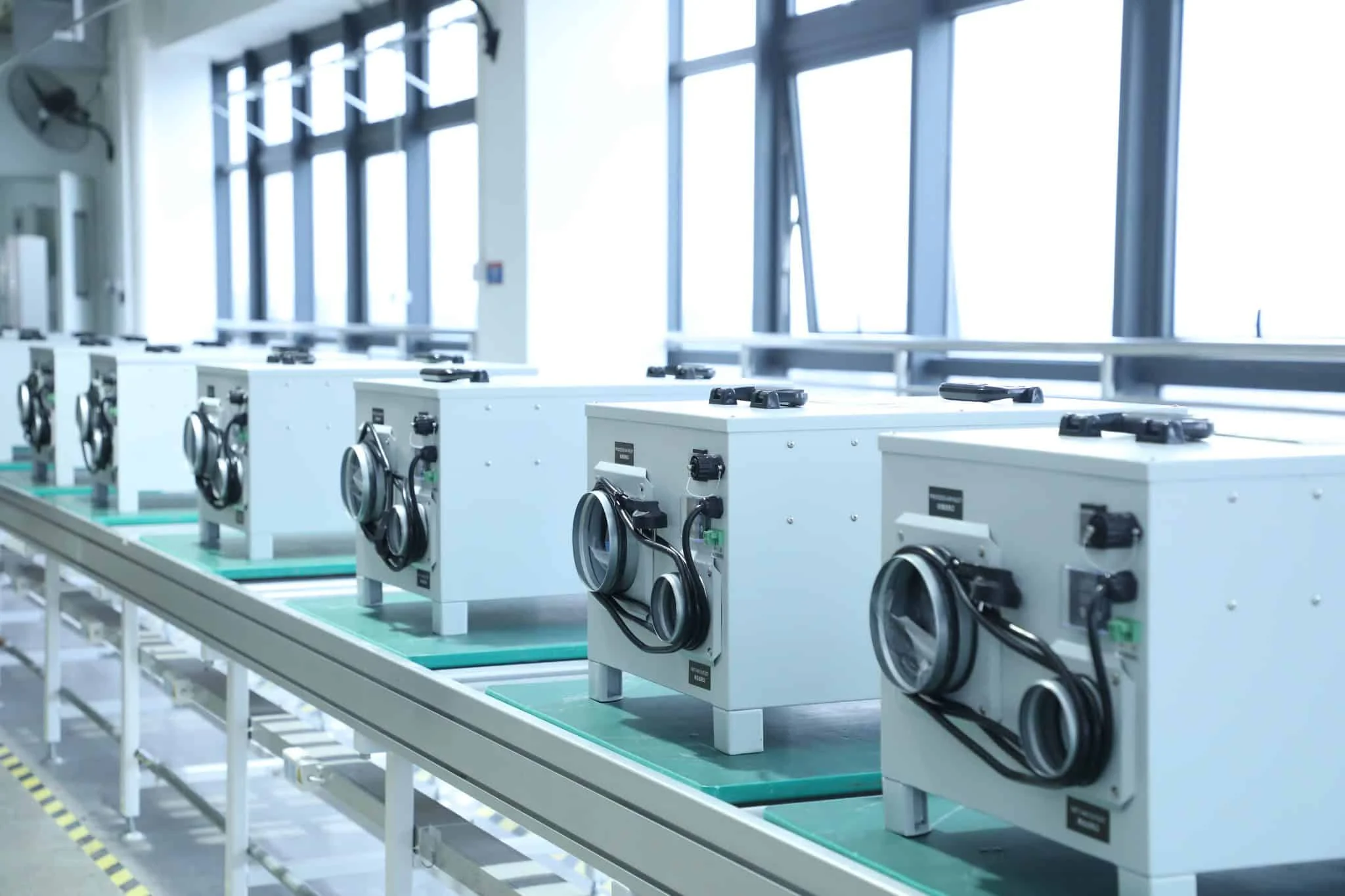
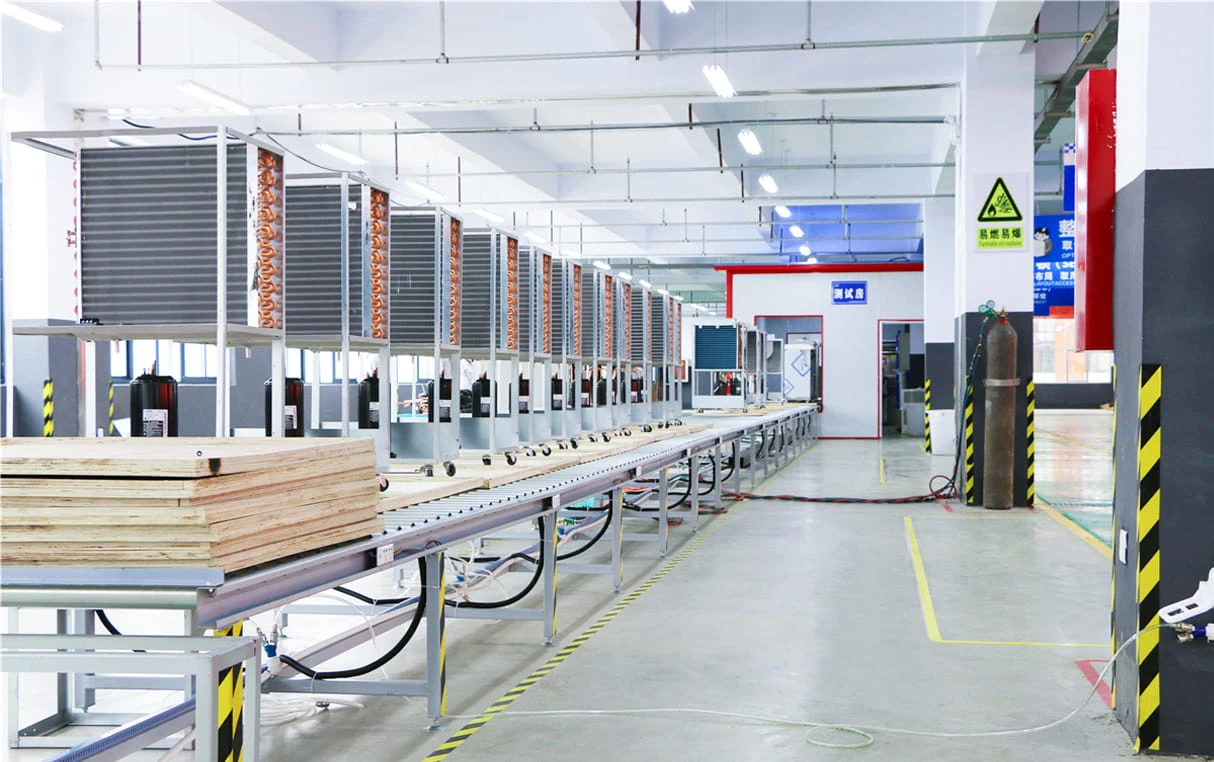
Product configuration, assembly, component selection, controls, documentation, and project-specific checks all influence whether the selected equipment can be manufactured and delivered consistently.
QUALITY & COMPLIANCE RECORDS
Prepare documentation around the selected equipment and project scope
These are selected quality-system and product certification records from our current documentation library. For each project, we confirm the exact document package against the selected model and the destination market.
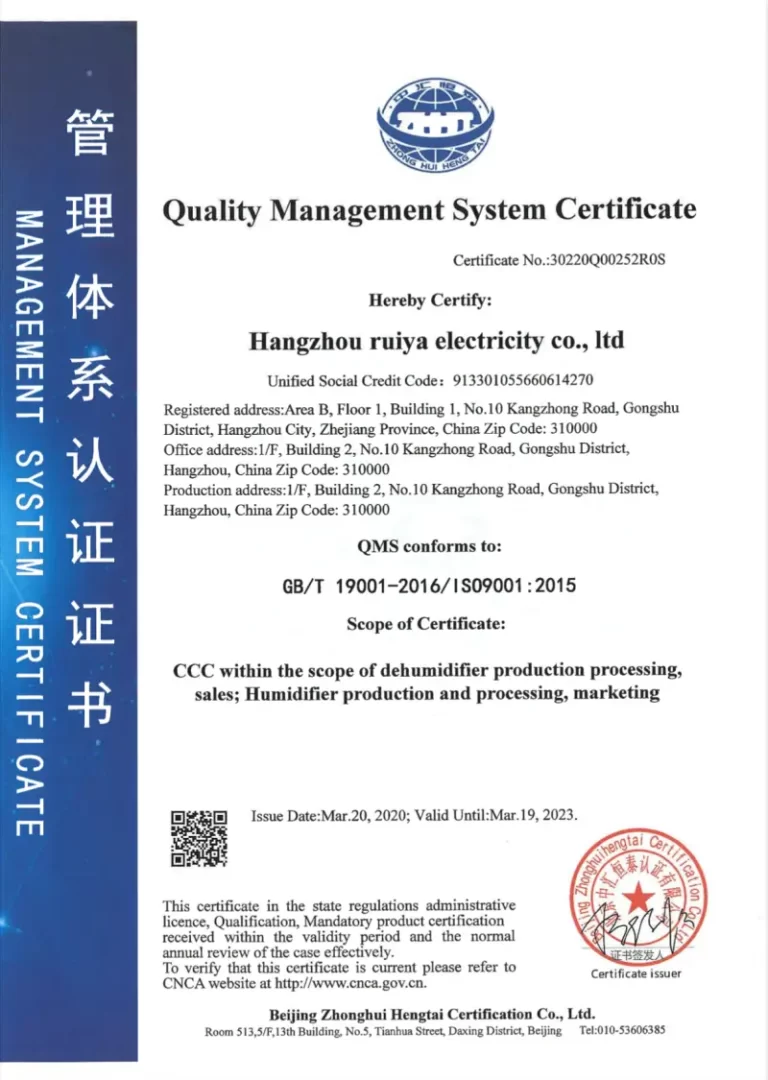
ISO 9001
Quality management system record
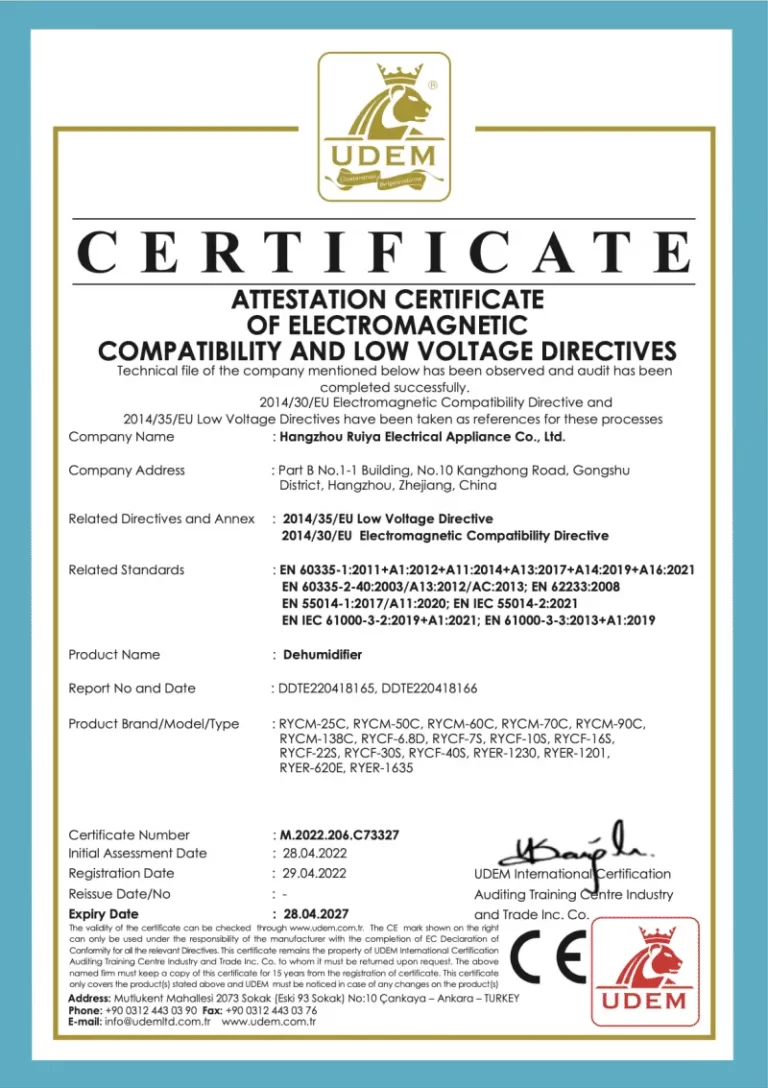
CE
Floor-standing refrigerant dehumidifier record
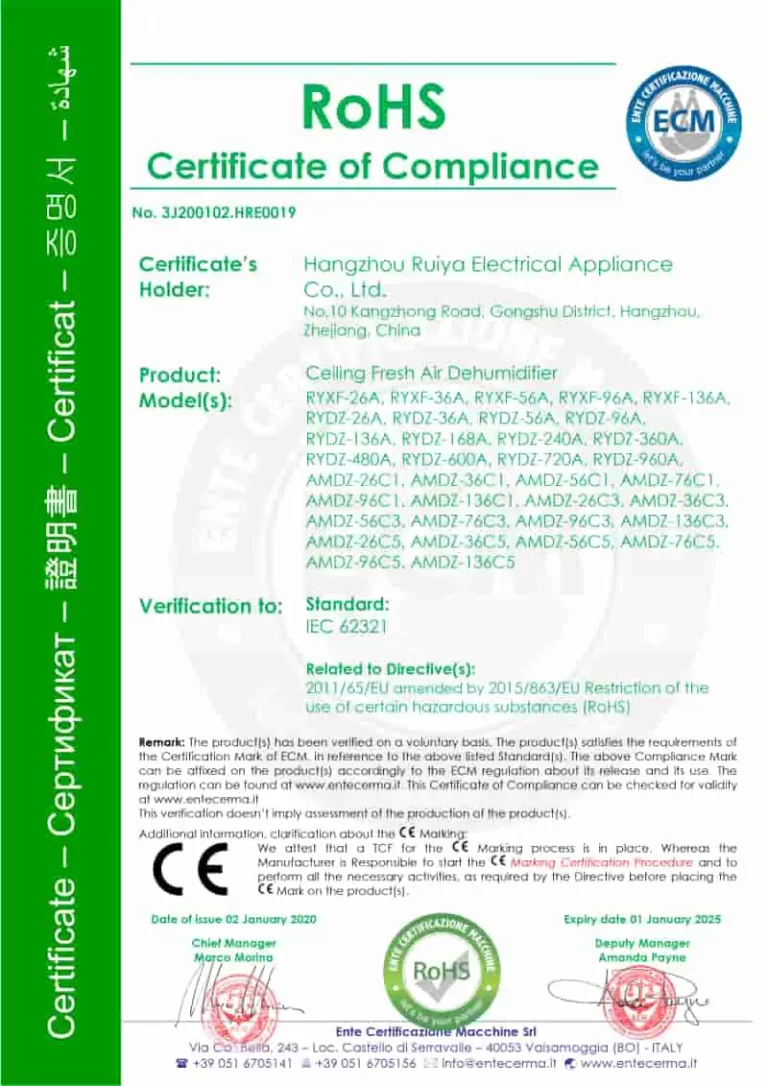
RoHS
Ceiling dehumidifier record
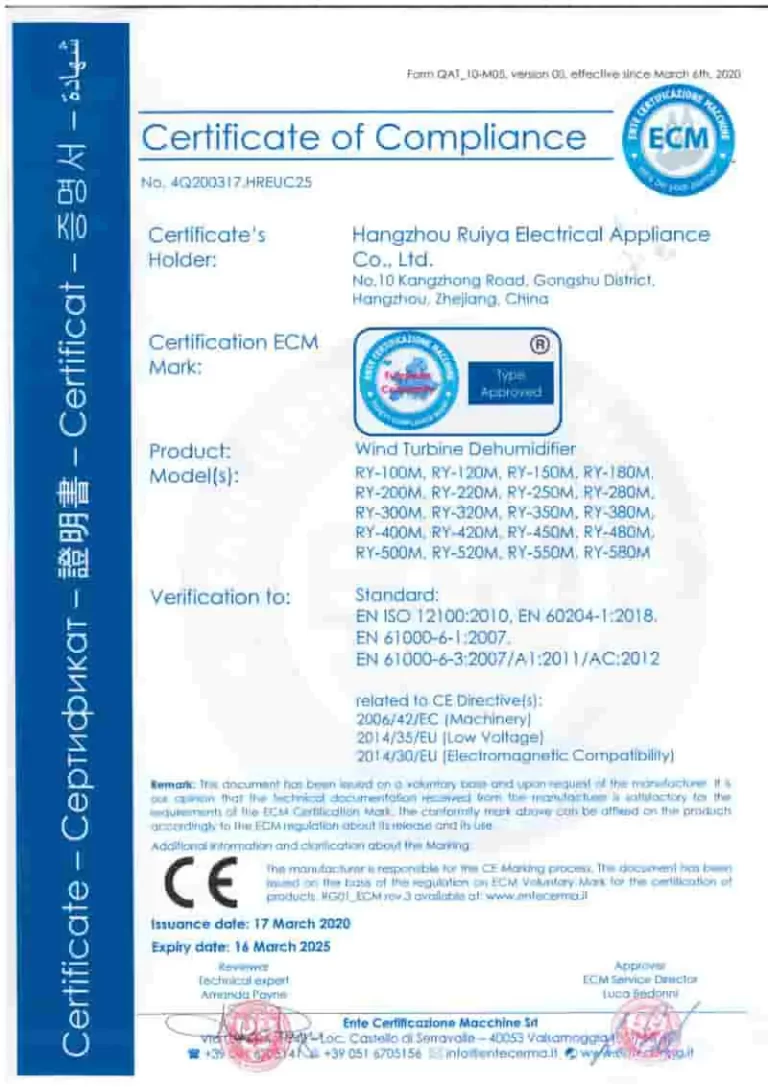
CE
Desiccant dehumidifier record
If you need certificates, test records, or a document list for a specific model, share the product, destination market, and application requirements with the project team.
Discuss Documentation RequirementsFAQ
Frequently Asked Questions
How is dehumidification capacity rated?
Rated capacity follows the product specification table published for each model, for example l/24h measured at 30°C/80% RH. The rated value describes performance under defined test conditions and should be compared with the real temperature, humidity target, airflow, and installation limits of the project.
Which equipment families are manufactured?
The range covers refrigerant dehumidifiers, ceiling-mounted units, desiccant rotor systems, ultrasonic humidifiers, and compact equipment for energy-storage and electrical environments, developed around the operating conditions and interfaces of each project.
How is a configuration decided when conditions vary?
We start from the operating environment, target conditions, installation constraints, and interface requirements, then select a standard model or an adapted configuration. The agreed plan is confirmed through documentation, test planning, and project-specific checks before manufacturing.
PROJECT START
Bring the application and equipment requirements into the same discussion
Share the operating environment, target conditions, installation limits, interfaces, and project schedule.
Discuss a Project