
Start with the area to be treated, its moisture sources and the ventilation that must remain in service. A portable dehumidifier fits only if its capacity and operating limits match that duty.
Uncontrolled air exchange can add moisture to a drying zone. Reducing avoidable exchange may help, but does not replace a load assessment or permission to alter building ventilation.
Where Portable Equipment Genuinely Fits
Common uses include temporary drying, mobile duties, contingency capacity and assessment. Long-term use needs a separate check of continuous-duty suitability, drainage and site services.
Drying work. Water-damage restoration, post-construction drying or drying after a leak. Stop continuing water entry and verify the material drying endpoint before removing equipment.
Loads that move. Maintenance work in different areas, seasonal operations, or a process that runs in different parts of a facility at different times.
Contingency and cover. Temporary capacity while permanent equipment is out of service, or during a period of unusually high load.
Assessment before committing. Condensate records show water collected by the unit, not total moisture load. Interpretation requires ventilation, material storage and other removal; near a stable target, a known moisture balance can support sizing.
Check each proposed duty against the selected model and site constraints rather than treating portability alone as proof of suitability.
Read the Capacity at Your Condition
Portable equipment is where rating-condition confusion causes the most damage, because units from different markets and categories sit side by side in the same comparison.
The two Yakeclimate product cards below state capacity at 30 °C / 80 % RH. US consumer portable and whole-home test categories have their own conditions. ENERGY STAR explains that a change in portable test temperature changed reported capacity; it does not establish a universal percentage conversion for commercial or industrial equipment.
Compare capacity using the applicable test method and entering-air conditions, not a fixed conversion. See what a daily water removal rating really means.
For a cool drying space, check the selected model’s operating envelope and capacity at the actual entering temperature and humidity, including defrost. There is no universal temperature at which every refrigerant unit must be replaced by desiccant equipment. Compare desiccant process and regeneration requirements for the duty; see desiccant dehumidifiers for water-damage restoration.
Define a Safe Treatment Zone
Agree the treatment boundary with the responsible facilities or restoration team before changing doors, barriers or air paths.
Air entering from adjoining spaces can carry moisture into the zone. Include the required air exchange when assessing the duty.
Creating a controlled zone:
Close approved openings. Agree barriers and door use with the responsible team; preserve required access, emergency egress and fire protection.
Coordinate HVAC changes. Only the qualified responsible team should approve isolation of a treatment zone. Maintain required ventilation, containment and occupied-space safety; do not shut off the building supply simply to improve drying.
Plan circulation within the approved zone. Do not defeat required exhaust or containment arrangements to retain dry air.
Confirm pressure requirements. The responsible team must set pressure and exhaust arrangements for the site hazards and adjacent occupants; moisture control alone does not determine them.
A defined boundary makes the duty easier to assess. Meeting the target still depends on available capacity, moisture sources and operating conditions.
Placement
Within the zone, position determines whether the capacity is usable.
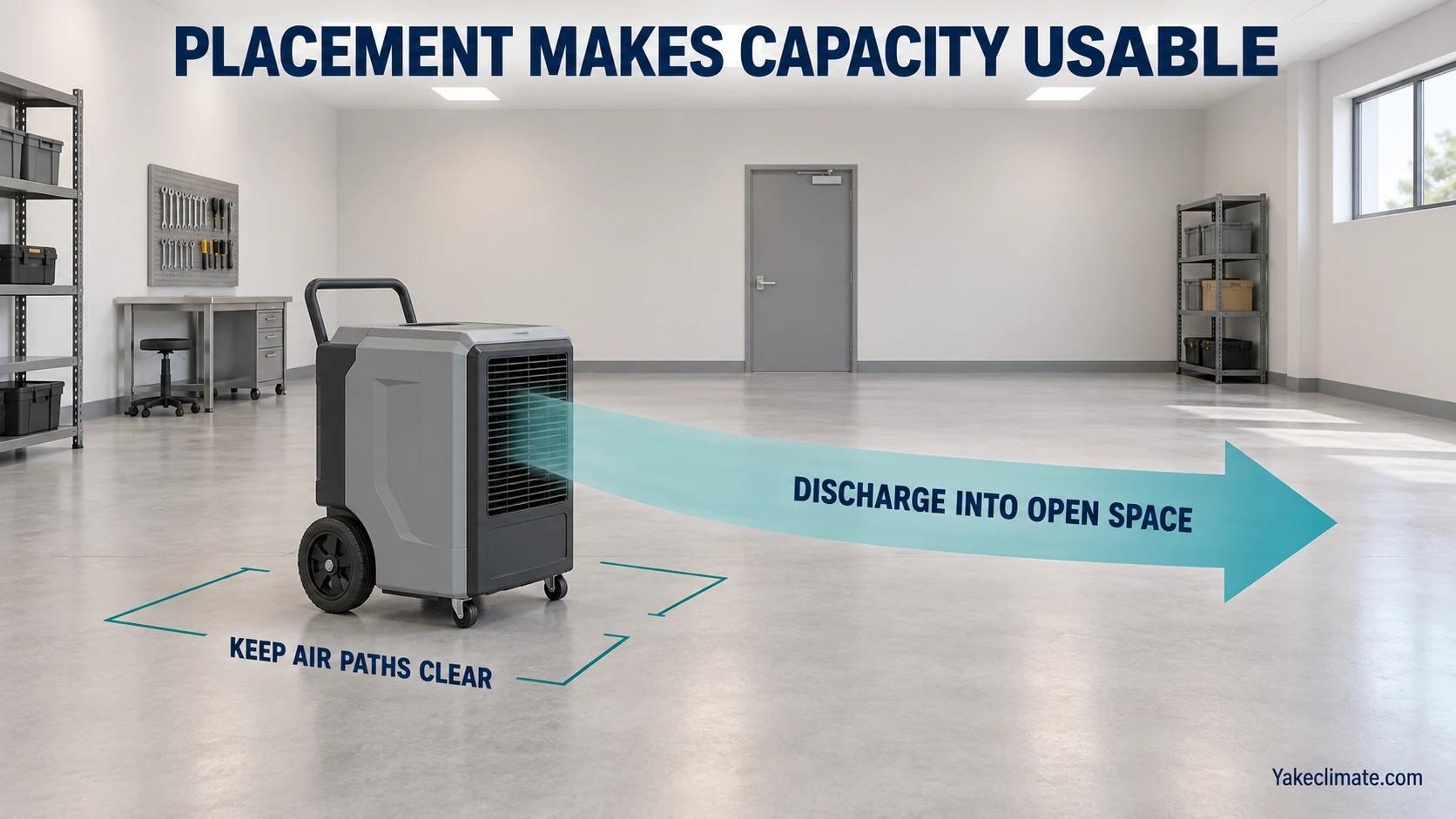
Give the inlet and outlet clearance. Equipment pushed into a corner or against stored material recirculates its own discharge and is starved of return air. Manufacturer's clearance requirements should be observed.
Aim the discharge along the space, not into a wall. The discharge air stream provides the circulation that brings moisture-laden air back to the machine.
Treat air movers and dehumidifiers as one system. Circulation can help moisture reach the unit, but air movers do not collect water. Their use must suit the materials and any contamination controls.
Do not place the unit where its discharge blows directly onto the control sensor, if the sensor is separate, or onto a wet surface you are trying to assess.
Drainage and Unattended Operation
Check the selected model’s tank, drain and full-tank controls. A tank can suit attended work; longer unattended operation needs a drainage plan that remains effective for the intended period.
For illustration, a constant collection rate of 60 L/day is 2.5 L/hour. An initially empty 6 L tank would fill in 2.4 hours. A unit with full-tank shutoff can run until then; it is not automatically unavailable all night. Actual fill time depends on collection rate and starting tank level.
Continuous drainage to a floor drain, a sink, or a suitable receptacle, with the hose routed so it maintains fall and does not become a trip hazard or get crushed.
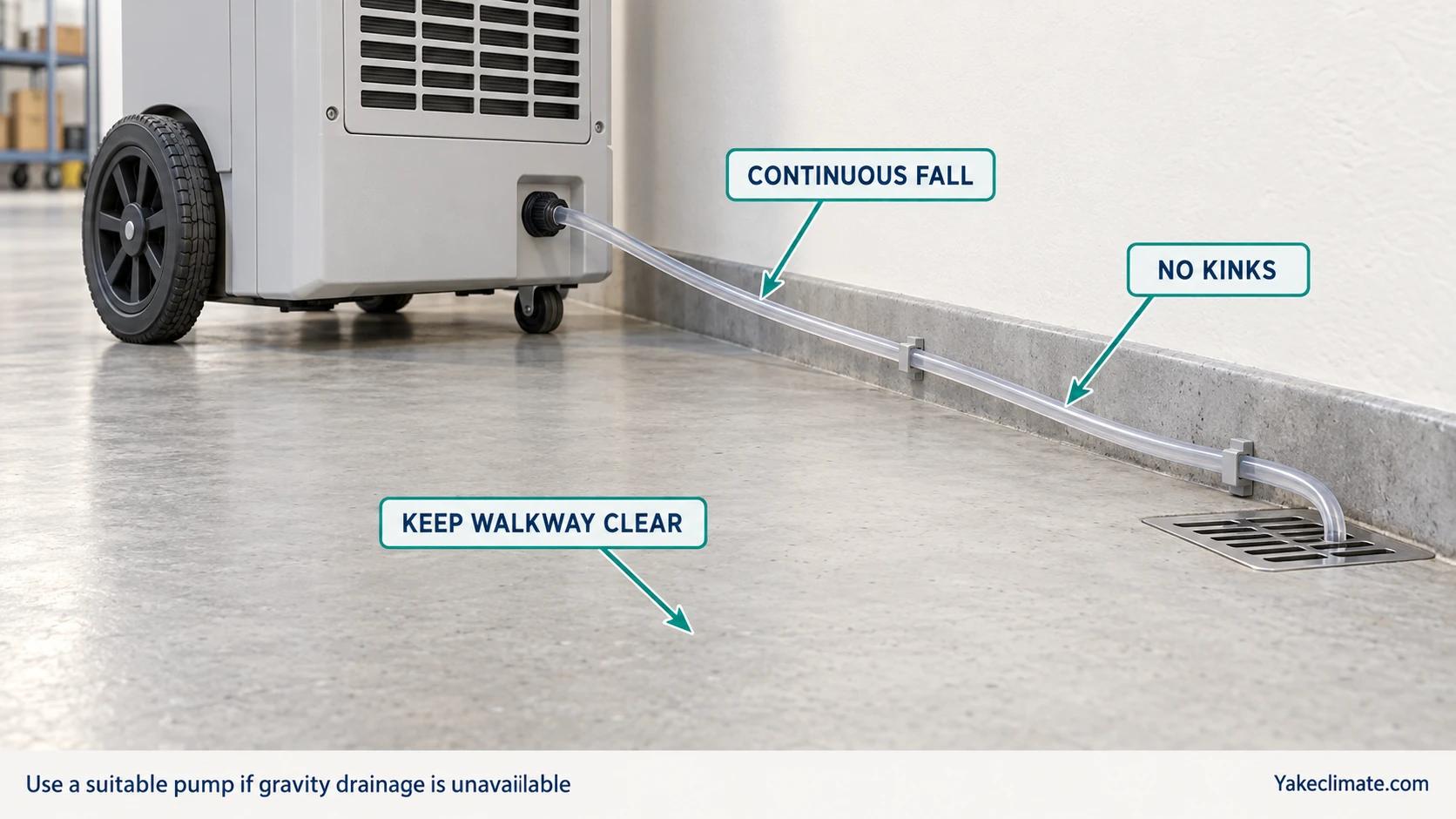
A condensate pump where no gravity route exists, with the discharge line secured.
Check the hose route daily on a running job. A kinked or lifted hose stops drainage as effectively as a full tank.
Electrical and Site Safety
Circuit capacity. Several units on one circuit is a common cause of nuisance tripping on drying jobs. Confirm the load against the available circuits before deploying, and distribute across circuits.
Residual current protection. Portable equipment in wet environments should be supplied through appropriate residual current or ground-fault protection, in accordance with the local electrical requirements for that situation.
Cable management. Extension leads sized for the load and length, uncoiled in use, routed to avoid water and traffic.
Ingress protection. Confirm the equipment's rating is appropriate for the environment, particularly in washdown areas or active restoration sites.
Stability and handling. Units are heavy; check the route, floor loading and any lifting required.
Electrical installation and safety requirements are set by the applicable local regulations and the competent person on site.
Heat Is Part of the Output
A standalone refrigerant unit with its condenser returning heat to the treated room delivers warmer discharge air. Assess this heat alongside moisture removal; a contained zone is not necessarily small, and its temperature rise depends on the full heat balance.
In drying work this is generally helpful: warmer material surfaces have a higher saturation vapour pressure, which increases the evaporation rate. The mechanism is set out in evaporation, drying rate and dehumidification load.
For occupied or temperature-sensitive duties, check the added cooling requirement and permitted room temperature before selecting equipment.
Verify With Data, Not Impression
A drying or dehumidification job without measurement cannot be shown to have finished, and cannot be diagnosed when it stalls.
Log temperature and relative humidity in the zone and outside it, at a sufficient interval to see the trend rather than a daily spot reading.
Record condensate volume. A change in collection is not, by itself, proof that materials are dry or equipment has failed; compare it with conditions, operation and material readings.
Measure the material, not just the air, where the objective is a dried material. Air can reach target while the material is still wet, because the material dries from the surface inward. The three-phase drying behaviour that causes this is explained in evaporation, drying rate and dehumidification load.
Define the end point before starting, with the test method that will confirm it.
When Portable Equipment Is the Wrong Answer
Long-term portable use warrants review when drainage, access, supervision or capacity no longer suit the duty. Warning signs include:
- Units have been in place for months and no removal date exists.
- The number of units has grown incrementally without the load ever being calculated.
- Someone is emptying tanks as a routine task.
- Extension leads are a permanent feature.
- The units are on all the time and the space still misses target during the demanding season.
- Capacity is being added rather than the cause being investigated.
Review the load and long-term duty using commercial dehumidifier selection. Condensate is one removal measurement; account for ventilation, storage changes and other removal before sizing.
Information to Prepare
- Purpose: drying job, temporary cover, mobile load, or load assessment.
- Zone volume and whether it can be contained; the boundary condition available.
- Current and target conditions, and how the end point will be verified.
- Expected duration and whether operation will be unattended.
- Entering-air temperature and humidity, required target, model operating limits and delivered capacity with defrost where applicable.
- Available drainage: gravity route, or the need for a pump.
- Available electrical supply: circuits, capacity, and protection.
- What is being dried, if applicable — material, thickness and extent.
- Site conditions: occupancy, washdown, contamination, access and noise limits.
Discussing a Project
Yakeclimate designs and manufactures industrial dehumidification equipment for complex climate applications, with a focus on agriculture and energy projects.
We co-develop application-specific dehumidification equipment around the operating conditions, interfaces, and integration requirements of the wider project or system.
Site electrical installation and safety arrangements remain with the competent person on site and the applicable local regulations.
Explore industrial dehumidifiers or contact Yakeclimate to review the operating conditions for your project.
FAQ
Frequently Asked Questions
How do I choose the size of a portable dehumidifier?
Define the approved treatment zone and required ventilation, then compare capacity at the expected entering temperature and humidity. Check the actual model’s rating method and operating envelope; do not convert consumer and industrial ratings using a universal percentage.
Why isn't my portable dehumidifier drying the space?
Check water entry, operating conditions, capacity, airflow and drainage. Have the responsible team assess air exchange while maintaining required ventilation and containment. A cool space requires model-specific performance and defrost checks, not an automatic technology switch.
Should I use the tank or a drain hose?
A tank may suit attended work. At an illustrative constant 60 L/day, an empty 6 L tank fills in 2.4 hours; a full-tank-shutoff unit operates until it fills. For longer unattended periods, assess an approved drain or pump route and its failure response.
Do air movers dry things, or does the dehumidifier?
They have different roles: air movement can assist evaporation and circulation, while the dehumidifier collects moisture. Select airflow for the materials and contamination controls, and verify material dryness rather than assuming either device alone proves completion.
Does a portable dehumidifier heat the room?
A standalone refrigerant unit rejecting heat into the treated room delivers warmer air. The room temperature change depends on the heat balance, ventilation and cooling, so include those conditions in the equipment assessment.
When should I replace portable units with a permanent system?
Review permanent equipment when long-term portable operation no longer meets capacity, drainage or site-service needs. Condensate is not total load: use a moisture balance covering ventilation, material storage and other removal, ideally near a stable target.
References
- AHAM DH-1, Dehumidifiers — capacity rating standard (US)
- IICRC S500, Standard for Professional Water Damage Restoration


