
AGRICULTURE / LOW-TEMPERATURE DRYING
Drying Room Dehumidifiers
Equipment for stable temperature, humidity and dew-point air conditions in low-temperature agricultural drying rooms.
Compare desiccant and refrigerant routes around your process. We review the air duty and temperature-control interfaces; your process team defines the moisture endpoint and drying curve.
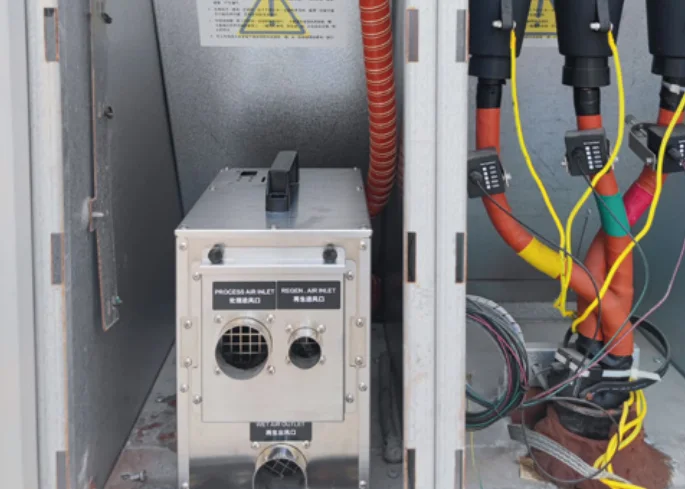
Dry the air. Follow your process. Equipment testing facilities. This image does not document a crop-drying or 15°C performance trial.
01 / AIR CONDITIONS & EQUIPMENT
Three duties. Start with the air conditions.
Seed drying, low-temperature rack drying and storage after drying need different air targets. The conditions below guide equipment review; your process team defines the material endpoint and confirms each setpoint.
Seed drying · about 15°C / 10–15% RH
A reference condition used in genebank drying for seeds that tolerate desiccation, not a prescription for every species. Review the RY desiccant route, starting with RY-300M or RY-1000M. Their listed range is −10 to +55°C; outlet RH and dew point at a 15°C inlet require project testing.
Reference: Plants, People, Planet — review of genebank drying conditions
Low-temperature air drying · 15–35°C / 45–60% RH
For herb, flower, tea or hop projects whose process owner specifies low-temperature rack or tray drying, review RYCM-138C portable, RYCF-10S floor-standing or RYDZ-7S ceiling equipment. Their listed range is 5–38°C. Confirm actual removal at the chosen temperature/RH and coordinate cooling for the heat released.
Basis: Yakeclimate project-review envelope; confirm with your crop-specific process specification. This is not a universal drying standard.
After drying · control moisture regain
Use the storage temperature and RH specified for the dried goods, packaging and holding time. Review RYCM-138C or RYCF-10S for moderate conditions, and RY-300M or RY-1000M for lower humidity or colder duty. Keep storage loads separate from the initial drying load.
Condition source: your material and packaging storage specification; no single RH target applies to all dried goods.
02 / MODEL SELECTION
Compare candidate drying-room equipment
RY is rated at 20°C/60% RH; RYCM, RYCF and RYDZ at 30°C/80% RH. These are catalogue ratings, not water removal from a crop or performance at 15°C. All listed supplies are 50Hz; confirm 60Hz, refrigerant and destination requirements before ordering.
| Model | L/day | PPD | Rating condition | Process / circulation airflow | Reactivation airflow | Supply (V / phase / Hz) | Operating range |
|---|---|---|---|---|---|---|---|
| RY-300MDesiccant | 48 | 101 | 20°C/60% RH | 320 m³/h | 110 m³/h | 220/1ph/50 | -10~+55 °C |
| RY-1000MDesiccant | 180 | 380 | 20°C/60% RH | 1000 m³/h | 400 m³/h | 380/3ph/50 | -10~+55 °C |
| RYCM-138CRefrigerant | 138 | 292 | 30°C/80% RH | 1300 m³/h | Not applicable | 220/1ph/50 | 5-38 °C |
| RYCF-10SRefrigerant | 240 | 507 | 30°C/80% RH | 2800 m³/h | Not applicable | 380/3ph/50 | 5-38 °C |
| RYDZ-7SRefrigerant | 168 | 355 | 30°C/80% RH | 1800 m³/h | Not applicable | 380/3ph/50 | 5-38 °C |
PPD = US pints/day, converted from L/day × 2.113 and rounded. This is not an AHAM/DOE test rating. Capacity must be confirmed at the actual inlet temperature and humidity; operating range is a separate specification.
03 / PROCESS & INTERFACES
You define the drying curve. We review the air duty.
A room RH reading does not measure product moisture. Agree the material process and the equipment acceptance conditions separately, then coordinate dehumidification with the room's temperature control and air distribution.

Customer / process specialist
Provide the crop, batch mass, starting and final moisture contents with wet/dry basis, drying curve, allowable temperature, rack arrangement and hygiene requirements. Verify material quality and drying completion.
Yakeclimate equipment review
Review the inlet air, target supply temperature/RH/dew point, removal load and airflow. Confirm the model, controls, operating limits and agreed air-condition test before supply.
Site / HVAC coordination
Coordinate cooling or heating, rack airflow, sensor positions and service access. Refrigerant units need condensate drainage; RY units need a separate reactivation exhaust. Check duct resistance, power frequency and the specified refrigerant for the destination.
04 / APPLICATION SCOPE
Check the process boundary before choosing a unit
This range supports low-temperature agricultural air-condition projects. For a different process, submit the operating conditions for a scope review before specifying equipment.
Hot-air drying above 40°C
The listed refrigerant units have a 38°C upper operating limit. An RY temperature limit alone does not establish a hot-air dryer duty. This page specifies no heat-pump dryer or high-temperature material process.
Clothes and workwear drying rooms
Laundry and workwear duties need their own load, lint, airflow and drying-time assessment. They are outside this agricultural equipment selection.
Lithium-battery dry rooms
Battery manufacturing requires a separately engineered ultra-low-dew-point process. The RY ratings here do not qualify that duty; we do not offer a complete battery dry-room system through this range.
05 / PROJECT-CONDITION TESTING
Test the 15°C duty before specifying performance
Performance can be tested in our laboratory against your project conditions. For a 15°C inlet, request an RY-300M or RY-1000M review with inlet RH, airflow and the required supply-air target. Agree measurements of outlet temperature, RH and dew point, removal and power. No measured 15°C outlet values are published here. Refrigerant performance at 15°C also needs confirmation; its 30°C/80% RH rating is not the drying-room duty.

06 / FAQ
Equipment selection FAQ
Can one unit hold temperature, RH and dew point independently?
These air properties are linked. Dehumidification also changes air temperature, so the cooling/heating system and controls must be coordinated with the selected unit. Agree the supply condition and tolerance before confirming the configuration.
Does RY guarantee 10–15% RH at a 15°C inlet?
The seed-room condition is a process target, not an RY test result. Outlet RH and dew point depend on inlet moisture, airflow and regeneration. Request a project-condition laboratory test before specifying a guaranteed value.
How do I size a drying room dehumidifier?
Provide batch mass, starting and final moisture with its basis, the water-release curve, operating hours, ventilation and door-opening loads. Equipment capacity must cover the required load at the actual air condition; floor area alone is insufficient.
Will you specify drying time or guarantee crop quality?
Your process specialist sets the drying curve, material endpoint and quality tests. Yakeclimate reviews and supplies the dehumidification equipment against agreed air conditions. Room humidity alone does not establish material moisture or quality.
Can I use the same unit for storage after drying?
Possibly, after checking the new temperature/RH target, packaging, infiltration and lower moisture load. Confirm control stability and airflow in storage mode instead of carrying over the drying settings unchanged.
- 01
Crop, batch mass, moisture endpoint and process-owner drying curve
- 02
Room volume, rack/tray layout, inlet conditions and target supply temperature/RH/dew point
- 03
Water-release rate, operating hours, ventilation, door openings and cooling capacity
- 04
Voltage/phase/frequency, drainage or regeneration exhaust, hygiene and test requirements