
1. Define What You Are Controlling
Dew point is the temperature at which air becomes saturated and water starts to condense. Moisture load is the rate of water vapour entering a space from ventilation, processes, materials, and people.
Choose the objective first. A relative humidity target suits comfort, material, and process requirements. A dew point target suits condensation risk on surfaces. A material moisture target suits drying. A biological or quality outcome, such as mould prevention, depends on surface conditions and duration.
The full reasoning for each objective is set out in commercial dehumidifier selection.
2. Quantify the Moisture Load
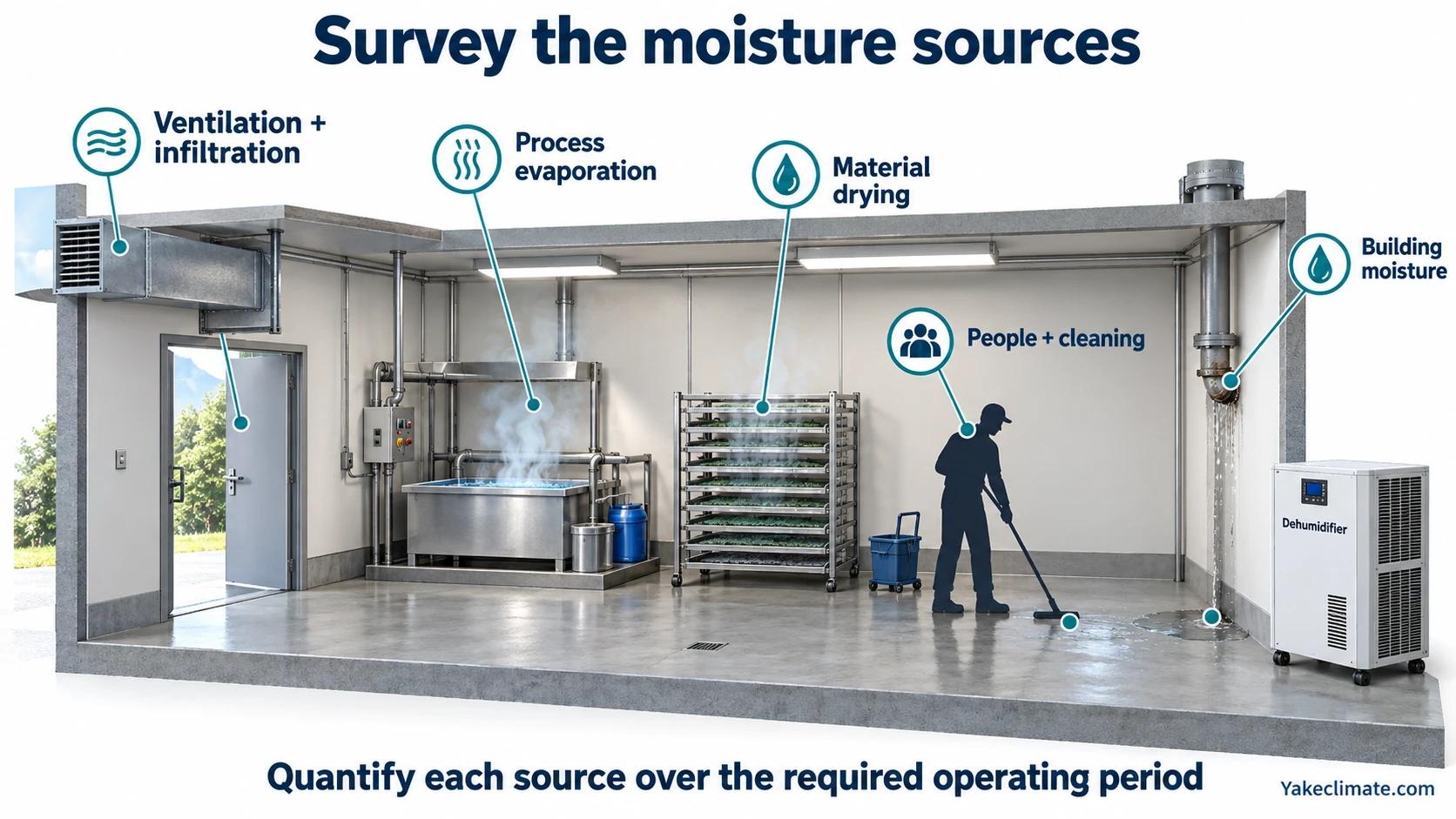
Estimate the net moisture-removal duty for each operating case. Include ventilation, infiltration, processes, materials and occupants, while accounting for other removal paths and water stored or released by air and materials. Floor area alone cannot provide an industrial moisture balance.
| Source | What to quantify |
|---|---|
| Ventilation and infiltration | Outdoor air flow and its humidity ratio above the target |
| Process moisture | Steam, evaporation, wet materials, product respiration |
| Drying material | Batch mass, initial and final moisture, process time |
| People and activity | Occupancy, cleaning, washdown |
| Building | Leakage, wet floors, open water surfaces |
Collected condensate is one observed removal term, not the entire space moisture load by itself. Interpret it over a defined interval alongside ventilation and infiltration, process inputs, other removal routes, storage change in materials and air, and whether the target was actually maintained. Check peak and pull-down duties separately.
3. Set the Design Operating Condition
Capacity depends on the temperature and humidity of air entering the unit. Test several coincident operating cases: normal, peak moisture input, low-temperature capacity, and recovery from a wet start where required. The governing case is the one with the smallest adequate margin between delivered removal and duty, not automatically the coolest or driest condition.
Read capacity at that condition. Rating conditions differ between markets, and catalogue headlines are not comparable. The single most useful step is to request capacity data at your condition, as explained in what a daily water removal rating really means.
4. Choose Refrigerant or Desiccant
| Operating condition | Preferred technology |
|---|---|
| Warm, humid air; moderate RH target | Refrigerant |
| Cold space or low target dew point | Desiccant |
| Frost-sensitive or winter operation | Desiccant |
| Low inlet humidity, very low dew point | Desiccant with molecular sieve media |
Refrigerant and desiccant systems have different operating envelopes. Compare delivered moisture removal, target dew point, airflow, defrost or low-temperature behaviour, regeneration heat and exhaust at the project's actual conditions. Do not select either technology from a universal temperature threshold alone.
5. Check the Full Package
Capacity is one input. The equipment also has to fit the project:
- Format. Ceiling-mounted, floor-standing, ducted, or portable; decided by the space and service access.
- Power. Voltage, phase, and available capacity; larger equipment is often three-phase.
- Drainage. Choose continuous gravity discharge, a suitable condensate pump or a serviced tank against the required unattended duty. For a tank, check fill interval, stop/overflow response and service availability; no drainage mode is universally acceptable for every project.
- Controls. Specify the actual control variable, sensor location, setpoint and deadband, alarms, protocol, and integration with the facility system. A protocol name alone does not establish the required control sequence.
- Air distribution and capacity both constrain unit count. Compare delivered removal at each operating case with the moisture duty, then check whether airflow reaches the affected zones, service access and redundancy. Several smaller units may help an obstructed space, but are not automatically superior to a correctly distributed larger system.
- Service. Filter and coil access, spare parts, and service capability in your market.
- Refrigerant. Refrigerant type, GWP, and the regulatory timetable in the destination market.
The detailed checklist is in commercial dehumidifier selection.
6. Verify at Acceptance
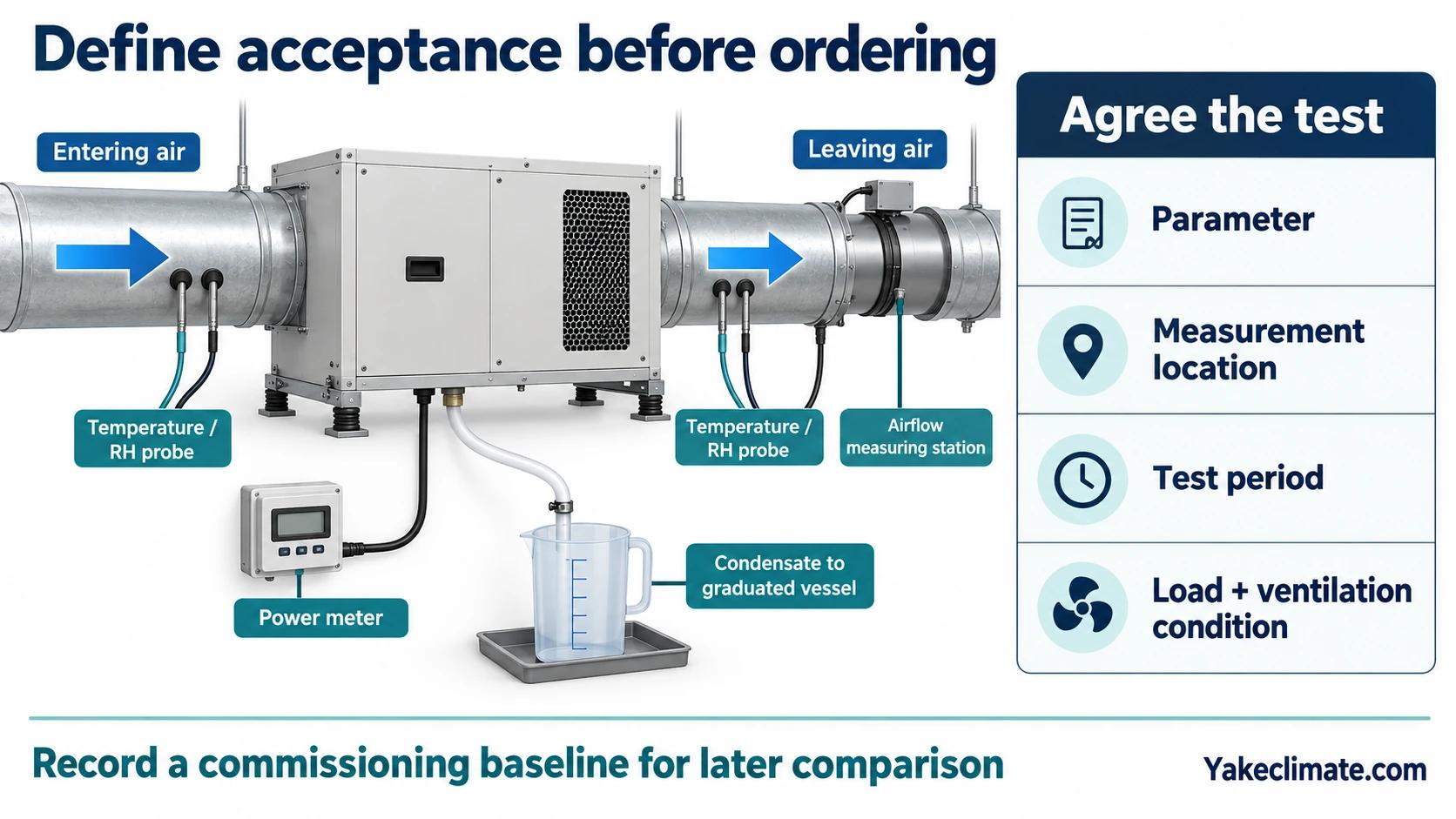
Agree acceptance criteria before ordering: which parameter, measured where, over what period, under what load. Record a commissioning baseline of capacity, power, entering and leaving air conditions, and airflow. That baseline is what later maintenance and any capacity complaint are compared against, as developed in commercial dehumidifier maintenance.
7. Discussing a Project
Industrial Dehumidification for Complex Climate Applications
Yakeclimate designs and manufactures industrial dehumidification equipment for complex climate applications, with a focus on agriculture and energy projects.
We co-develop application-specific dehumidification equipment around the operating conditions, interfaces, and integration requirements of the wider project or system.
Explore industrial dehumidifiers, review desiccant rotor dehumidifiers, or contact Yakeclimate with the space, moisture sources, target condition, and design operating range.
FAQ
Frequently Asked Questions
What is the first step in choosing an industrial dehumidifier?
Define the control objective: relative humidity, dew point, material moisture, or a biological outcome. Each leads to different equipment and different sizing logic. Sizing before the objective is defined produces correctly sized equipment controlling the wrong variable.
How do I calculate the required capacity?
Quantify the moisture load from its sources, not from floor area. Add ventilation, infiltration, process moisture, drying material, and people. Size for the demanding period, check pull-down separately, and read each candidate's capacity at your design condition.
When should I choose desiccant over refrigerant?
Consider desiccant equipment when the required low dew point, cold operating condition or frost sensitivity makes a refrigerant route inadequate at the actual duty. Compare delivered moisture removal, regeneration heat, exhaust, airflow, controls and total system energy for the selected configurations; low temperature alone does not settle the choice.
Why can I not compare catalogue capacities directly?
Because capacity is stated at a particular test condition and configuration. A figure at 30 °C / 80 % RH cannot be treated as delivered capacity at a different inlet condition. Ask every supplier for project-condition capacity and whether the figure is measured or calculated.
How many units do I need?
Both delivered capacity and air distribution determine the number of units. Check the moisture duty at each coincident case, the airflow paths to affected zones, service access and any agreed redundancy. Multiple smaller units can help in long or subdivided spaces, but do not assume a better result without an actual layout and load check.
What makes a good acceptance test?
A testable statement: which parameter, measured where, over what period, under what load and ventilation condition. Record a commissioning baseline of capacity, power, airflow, and entering and leaving conditions, and compare future performance against it.
References
- ASHRAE Handbook—Fundamentals, psychrometrics and moisture load calculation
- AHAM DH-1, Dehumidifiers, capacity rating standard (US)
- Commercial dehumidifier selection


