
Warehouse humidity control is an equipment selection problem, not only a building-size problem. The right dehumidifier depends on stored materials, leakage, door openings, temperature, airflow distribution and the humidity limit the inventory actually needs.
Start With What the Warehouse Protects
The same floor area can have very different humidity requirements. A warehouse holding sealed plastic goods, machined metal parts, kraft paper, electronics or powder ingredients should not be sized from square meters alone.
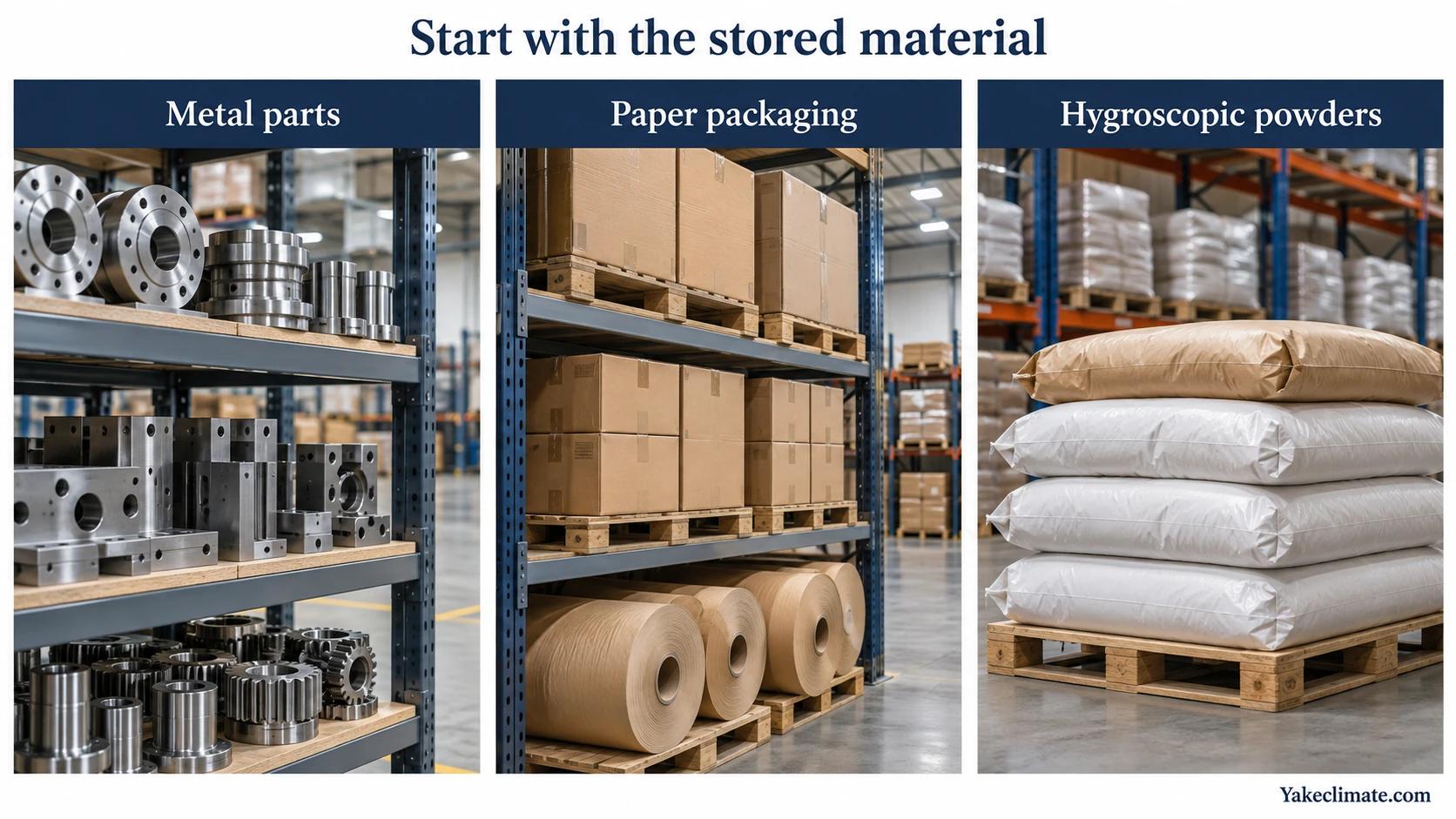
| Stored item | Moisture risk | Practical selection focus |
| Metal parts and tooling | Corrosion, flash rust, contact oxidation. | Lower RH target, stable dew point, good air movement around racks. |
| Paper and corrugated packaging | Moisture absorption, softening, reduced stacking strength. | RH stability, air distribution and door-control strategy. |
| Electronics and electrical assemblies | Corrosion, condensation and insulation risk. | Dew point control, filtration and storage-zone separation. |
| Food powders or hygroscopic materials | Clumping, caking and quality loss. | Dry-air supply, local enclosure control and sanitation needs. |
| General logistics goods | Mold, odor, label damage and seasonal condensation. | Moderate RH control and high-bay circulation. |
The Canadian Conservation Institute notes that stable metal artifacts are commonly stored in the 35% to 55% RH range and that RH above 55% should trigger consideration of better humidity-controlled storage (CCI Notes 9/2). Industrial warehouses are not museums, but the principle transfers: define the material risk first.
Identify Moisture Sources Before Sizing Equipment
A warehouse can look dry and still carry a large latent load. The main inputs are usually air leakage and door openings, not the volume of air inside the building.
| Moisture source | What to check |
| Dock doors | Open time, air curtain use, vestibules and seasonal outdoor humidity. |
| Building leakage | Roof, wall penetrations, loading bays and negative pressure from exhaust fans. |
| Wet goods or pallets | Incoming product moisture, washdown, rain exposure and drying area separation. |
| Slab and floor | Vapor barrier, floor sweating and spring condensation patterns. |
| People and forklifts | Occupancy, combustion byproducts and ventilation requirements. |
For a deeper discussion of floor sweating and air-side strategy, see the existing guide to warehouse humidity control systems.
Choose Refrigerant or Desiccant by Temperature and Dew Point
Warm warehouses normally favor industrial refrigerant dehumidifiers because they remove moisture efficiently at moderate temperature and RH targets. Unheated storage, cold rooms and very dry process zones may push the design toward desiccant rotor dehumidifiers.
| Condition | Better starting point | Why |
| Heated warehouse above typical comfort temperatures | Refrigerant dehumidifier | Simpler installation and strong efficiency at moderate RH targets. |
| Seasonal unheated warehouse | Compare both technologies | Coil frost, low moisture content and door leakage can change the answer. |
| Cold storage anteroom | Desiccant or hybrid | The target may be dew point control rather than RH control. |
| Packaging or paper storage | Refrigerant or desiccant depending on temperature | Stability may matter more than a very low target. |
| Metal parts preservation | Depends on target RH and temperature | Keep dew point below surface temperature to avoid condensation. |
Industrial packaging guidance from FEFPEB warns that corrosion can begin at moderate RH and accelerates above higher humidity levels, especially for sensitive goods in transport and storage (FEFPEB Industrial Packaging Preservation Guidelines). Treat that as a risk signal, not a universal warehouse setpoint.
Air Distribution Is Part of the Dehumidifier
A dehumidifier only controls the air it reaches. High-bay warehouses can have dry air near the unit and humid pockets behind racks, near roof steel or around cold exterior walls.
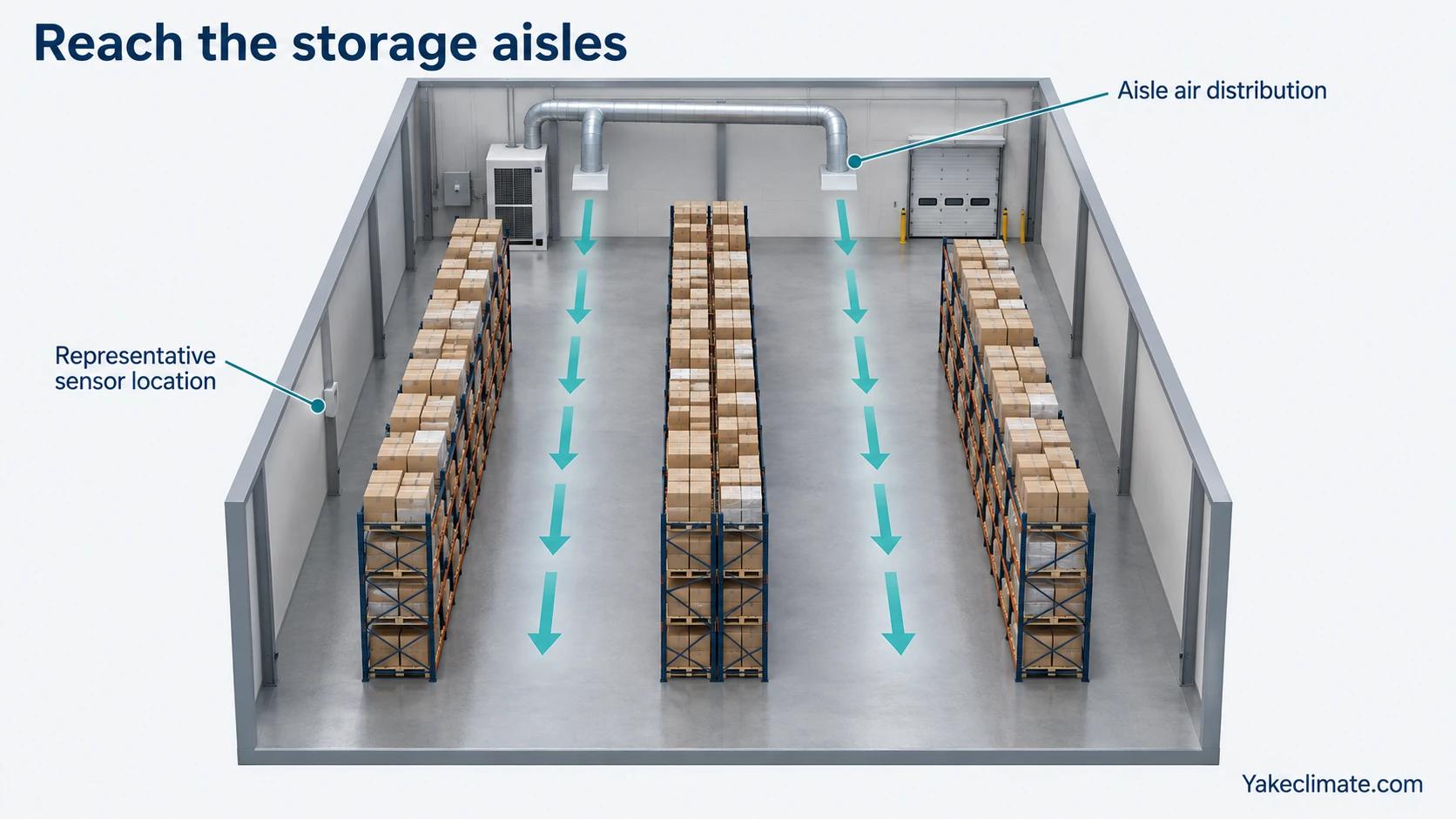
Plan the air path:
- Supply dry air along aisles, not only into open space.
- Avoid short-circuiting dry supply air straight back to the unit.
- Use destratification or ducted supply when the roof zone holds moisture.
- Keep return air representative of the storage zone.
- Place sensors away from discharge air, doors and direct sunlight.
A Practical RFQ Checklist
Send these inputs before asking for model selection:
| RFQ input | Reason |
| Building dimensions and storage layout | Shows air volume, racking and circulation constraints. |
| Stored material and acceptable RH or dew point | Defines the actual protection target. |
| Temperature range by season | Determines whether refrigerant operation is suitable. |
| Door count and open schedule | Captures the dominant moisture source in many warehouses. |
| Ventilation and exhaust rate | Separates code ventilation from uncontrolled infiltration. |
| Available power and drainage | Confirms installation feasibility. |
| Control interface | Defines local controller, alarms or BMS connection. |
If the project includes agriculture or crop storage rather than general logistics, start from the agriculture application overview because transpiration and biological risk change the moisture profile.
FAQ
Frequently Asked Questions
What RH should a warehouse maintain?
There is no single RH target for every warehouse. General storage, metal parts, paper packaging and hygroscopic materials have different limits. Define the stored-material risk first, then select equipment.
Can one dehumidifier control a large warehouse?
Sometimes, but only when airflow distribution is designed with the unit. Long aisles, high racks and cold surfaces often require ducting, circulation fans or multiple zones.
Should warehouse dehumidifiers run all day?
Continuous operation is common during humid seasons, but the control should respond to RH or dew point with a sensible deadband. Door schedules and outside dew point often explain most runtime changes.


