
Industrial dehumidifier specifications should describe the job the equipment must do, not only the size of the machine. A useful specification connects the moisture source, indoor target, inlet air condition, airflow route, electrical supply, drainage, controls and service access.
Use this checklist with the industrial dehumidifier product family, the industrial dehumidification resource page and the broader commercial dehumidifier selection guide before comparing model numbers.
Start With the Controlled Condition
The first specification item is the controlled condition. For most industrial projects, the useful target is not a vague phrase such as "dry room" or "humidity control." State the dry-bulb temperature, relative humidity, dew point or humidity ratio that the process needs to maintain.
ASHRAE treats psychrometrics as the basis for moist-air properties, temperature change, moisture change, enthalpy and air-conditioning processes. That matters because two rooms with the same relative humidity can contain different amounts of water vapor when their temperatures differ.
| Specification field | Better format | Why it matters |
| Indoor target | 20 degC / 45% RH, or dew point below 8 degC | Defines the actual air state. |
| Allowable range | Normal, alarm and shutdown limits | Shows how tightly the room must be controlled. |
| Operating periods | Production, storage, washdown, door-open, standby | Prevents a daily average from hiding the peak load. |
| Outdoor or makeup air | Design condition and airflow volume | Determines ventilation moisture load. |
| Process source | Product drying, open water, people, crop, washdown or infiltration | Identifies where the water comes from. |
If the site cannot provide all values, label the unknowns. A clear assumption is better than a polished specification that hides missing data.
Do Not Compare Capacity Without Rated Conditions
"Liters per day" or "kg per hour" is not a complete specification. The same dehumidifier removes different amounts of water at different inlet air temperatures and humidity levels. Warm, humid inlet air normally gives a higher capacity number than cool, moderately humid inlet air.
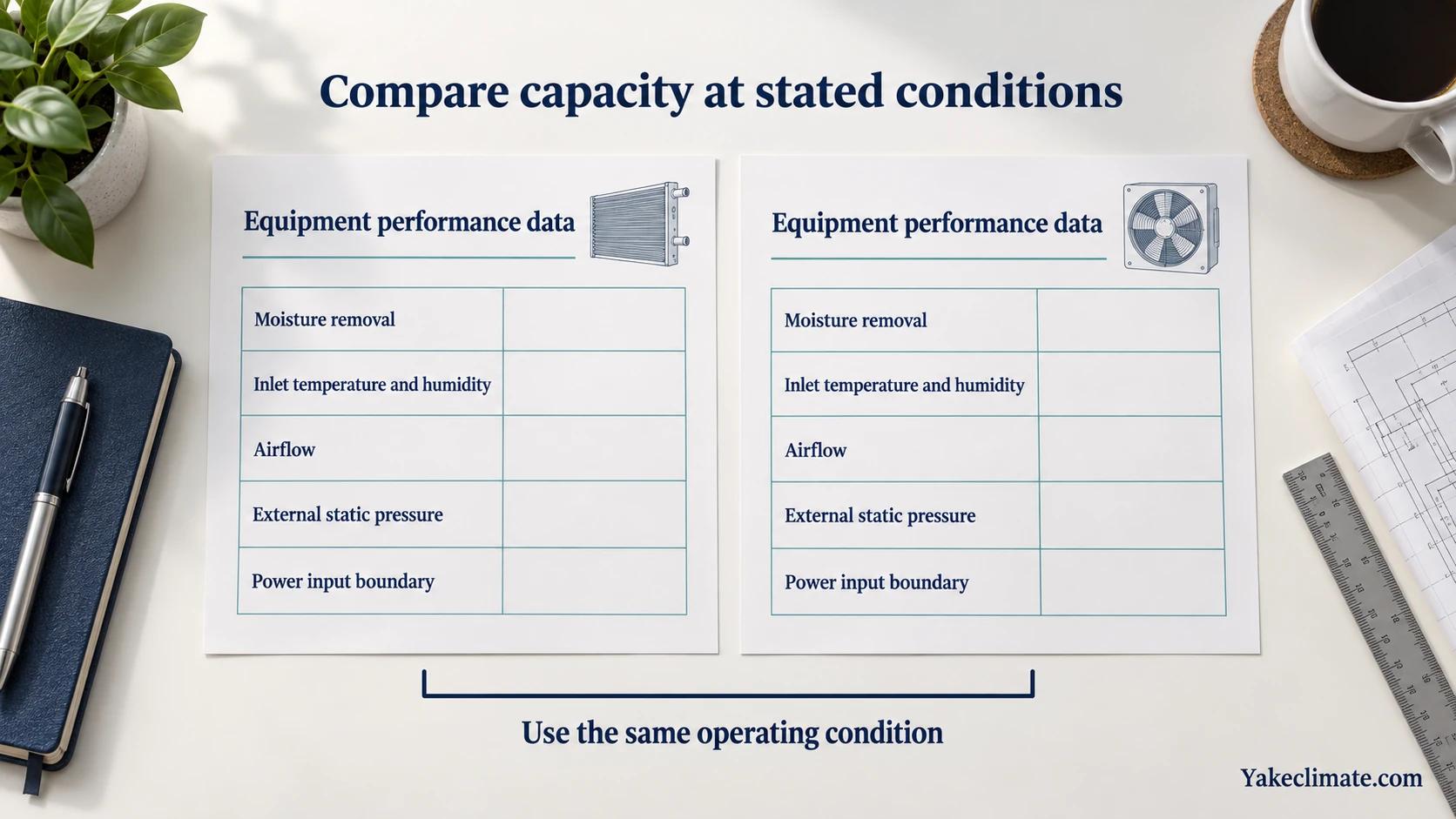
For consumer and whole-home dehumidifiers in the United States, the eCFR Appendix X1 test procedure defines test requirements for measuring energy performance and includes formulas for product capacity, humidity ratio and integrated energy factor. Industrial equipment is often specified outside that consumer framework, but the same lesson applies: capacity must be tied to a test condition and measurement method.
Ask for these values together:
| Item | Ask the supplier to state |
| Rated capacity | kg/h or L/day at the named inlet condition. |
| Inlet air condition | Dry-bulb temperature and RH, or dew point and humidity ratio. |
| Outlet air condition | Expected supply air temperature and humidity at the same point. |
| Airflow | Process airflow at the unit or duct connection. |
| External static pressure | Available pressure for ducted units. |
| Power input | Compressor, fans, reactivation heater or total input boundary. |
| Performance boundary | Refrigerant, desiccant, hybrid or other technology. |
This prevents a common purchase error: selecting the model with the largest catalog capacity while ignoring the room's real operating condition.
Define the Moisture Load
Capacity follows load. A specification should state where the moisture enters the controlled space and how that load changes over time.
| Moisture source | Example input |
| Infiltration | Door openings, leakage, pressure difference and outdoor condition. |
| Ventilation or makeup air | Airflow volume, hours of operation and outdoor design condition. |
| Product or material drying | Starting moisture, target moisture, batch weight and drying time. |
| Washdown or cleaning | Water volume, exposed area and recovery time. |
| People and process | Occupancy, wet process equipment, tanks or open water. |
| Agriculture | Crop water use, irrigation schedule, screens and night targets. |
For sizing guidance, use the commercial dehumidifier sizing calculator guide or the greenhouse-specific project data checklist when crop moisture is the source.
Specify the Installation Format
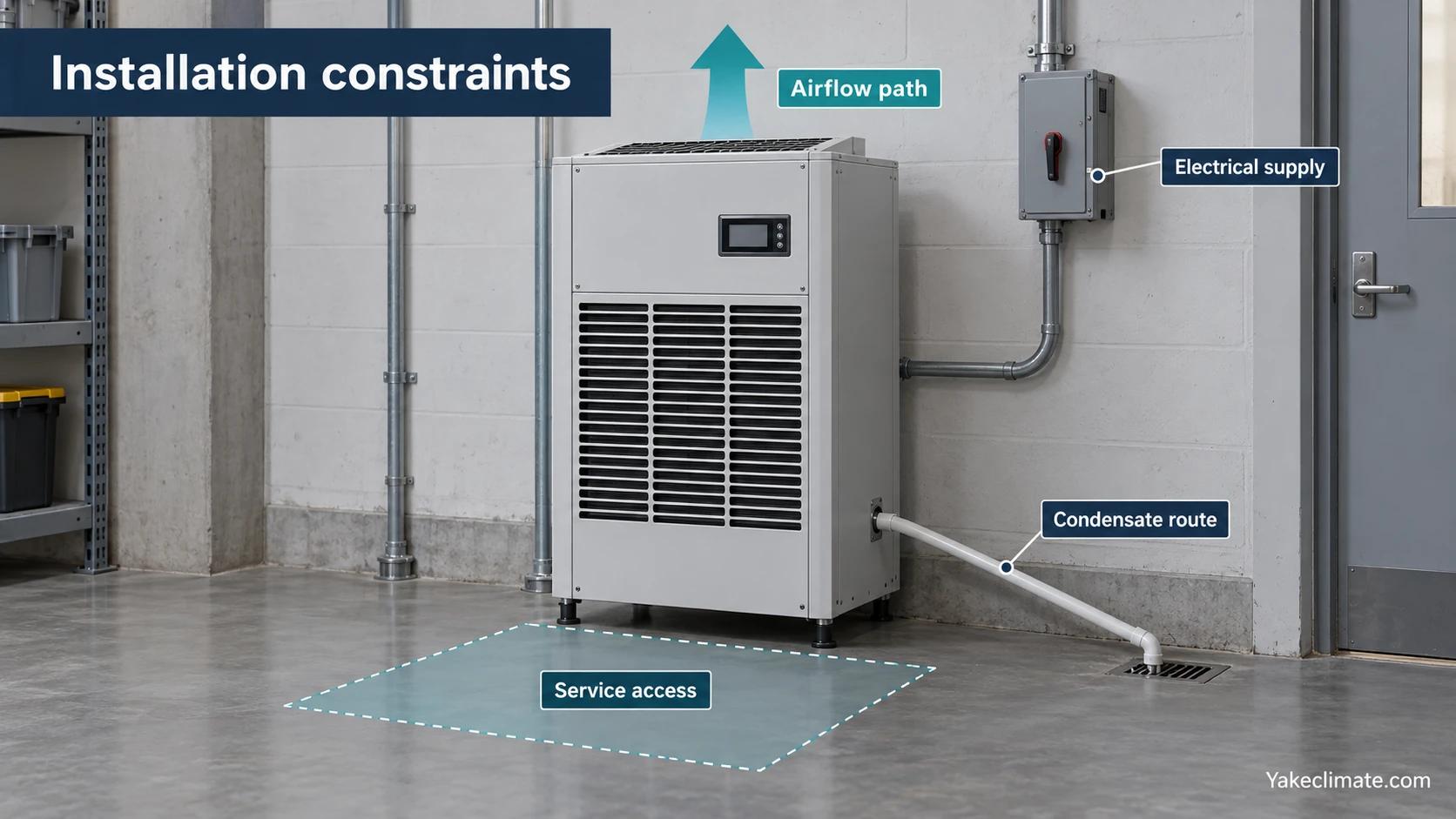
The same moisture load can require different equipment layouts. Floor-standing, ceiling-mounted, wall-mounted and ducted units create different constraints.
| Format | Specification focus |
| Floor-standing unit | Footprint, condensate drain, service clearance and forklift route. |
| Ceiling-mounted unit | Structural support, access panel, drain slope and safe service height. |
| Wall-mounted unit | Wall strength, supply-air throw, return path and condensate route. |
| Ducted unit | External static pressure, duct sizing, return location and balancing. |
| Outdoor or remote equipment | Weather protection, heat rejection, pipe or duct route and controls. |
Include Electrical, Safety and Material Details
An industrial dehumidifier is not only an airflow device. It must fit the site's electrical and safety environment.
| Field | What to include |
| Power supply | Voltage, phase, frequency, breaker limits and available spare capacity. |
| Refrigerant or heater boundary | Refrigerant type, reactivation heat source or heat-recovery option. |
| Material exposure | Corrosive vapor, dust, washdown, salt, chemicals or high temperature. |
| Filtration | Filter grade, dust load, access side and replacement interval. |
| Drainage | Gravity drain, lift pump, trap, freeze risk and overflow alarm. |
| Noise and vibration | Site limits and nearby work areas. |
| Safety standard | Applicable local electrical and refrigeration safety requirements. |
IEC 60335-2-40 covers safety requirements for electric heat pumps, air conditioners and dehumidifiers within its stated scope. For export projects, the buyer, installer and local authority still need to confirm which national or regional conformity path applies.
Define Controls and Data Signals
Control details should appear in the specification, not as an afterthought. At minimum, state whether the unit will run on its own controller or be staged by a building system, PLC or greenhouse computer.
| Control point | Practical question |
| Control variable | RH, dew point, humidity ratio or external enable signal? |
| Sensor location | Room return air, process air, duct, canopy zone or cabinet? |
| Staging | Single setpoint, multi-stage, variable speed or external command? |
| Alarm output | High humidity, low temperature, overflow, fan fault, compressor fault? |
| Communication | Dry contact, 0-10 V, 4-20 mA, Modbus, BACnet or custom interface? |
| Data logging | What values must be trended for acceptance and maintenance? |
If the project needs BMS or PLC integration, read the industrial dehumidifier controls guide.
A Practical RFQ Specification Checklist
Before requesting a quotation, send this package:
- room size, layout and photos,
- target temperature and humidity condition,
- moisture source and estimated peak load,
- outdoor or makeup air design condition,
- installation format and available space,
- duct route or airflow path if applicable,
- electrical supply and site limitations,
- drainage route and condensate handling requirement,
- controls, alarms and communication interface,
- project stage, quantity and acceptance method.
Yakeclimate designs and manufactures industrial dehumidification equipment for complex climate applications. This fits the public focus of Industrial Dehumidification for Complex Climate Applications. For a project review, send the specification package through the contact page or start from the industrial dehumidifier product family.
FAQ
Frequently Asked Questions
What is the most important industrial dehumidifier specification?
The most important specification is the moisture-removal requirement at the actual operating condition. Capacity, airflow, power input and controls should all be tied back to that target condition.
Why do two dehumidifiers with the same L/day rating perform differently?
The rating may use different inlet air temperatures, humidity levels, airflow boundaries or test methods. Always compare capacity and energy data at the same air condition.
Should I specify RH or dew point?
Use the variable that matches the process risk. RH is common for comfort and storage, while dew point or humidity ratio is often clearer for condensation control, low-temperature spaces and process drying.
Can a supplier size equipment without all project data?
A supplier can make a preliminary estimate, but the missing data should stay visible. Final selection should wait until the moisture source, target condition, airflow path and installation limits are confirmed.


