
1. The Selection Starts With the Water Source
Condensation is water that forms when a surface cools below the dew point of the air touching it. Moisture load is the rate of water vapour entering the space from leakage, ventilation, door openings, or internal sources. Dew point is the temperature at which air becomes saturated and water starts to condense.
An electrical cabinet dehumidifier should be selected from the condensation risk, operating temperature, moisture load, drainage route, and control interfaces. Cabinet volume matters, but it is not enough on its own. A small cabinet with frequent door openings or humid ventilation air can have a higher moisture load than a larger, well-sealed enclosure.
The first decision is also not a model number. It is whether the problem is liquid ingress, condensation, or both. A dehumidifier can lower the internal dew point. It cannot repair a damaged gasket, stop rain entering through a cable gland, or compensate for an open drain path.
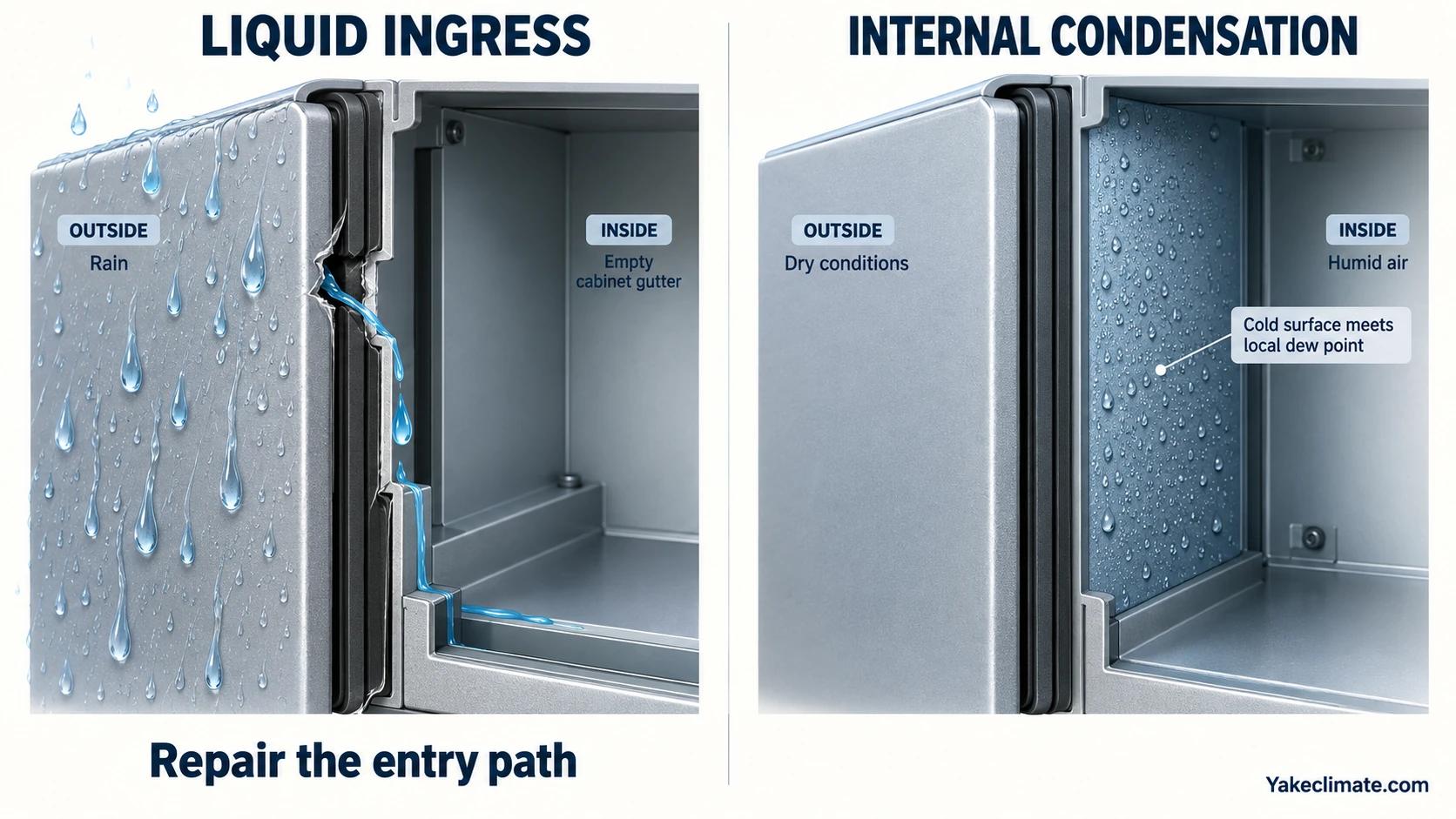
Identify the Water Source First
Start by recording where the water appears and when it appears.
External ingress normally leaves a path: staining below a door seal, water around a cable entry, droplets beneath an unsealed roof joint, or a wet area after washing or rain. Repair the boundary before adding environmental equipment.
Internal condensation follows temperature. It often appears on the roof panel, shaded wall, cold plate, cable gland, busbar support, or another surface that cools below the dew point of the internal air. It may be worst before sunrise, after a shutdown, when warm humid air enters a cold cabinet, or when cooling equipment creates a local cold surface.
Moisture carried by airflow appears when a fan or required ventilation system brings outdoor air into the enclosure. If the outdoor dew point is high, ventilation can increase the cabinet's moisture load even while it performs another necessary function.
The physical test is simple:
Condensation is possible whenever the coldest relevant surface is at or below the dew point of the air touching it.
The calculation and field measurement method are explained in Condensation Risk in Battery Enclosures.
2. Repair the Cabinet Boundary
Environmental control works best after basic enclosure defects are removed.
- Inspect door gaskets for compression loss, cracks, and contamination.
- Check cable glands, unused knockouts, and penetrations.
- Look for drain or vent openings that allow humid air to bypass the intended path.
- Check whether service work leaves the door open during humid weather.
- Confirm that rainwater cannot run along a cable into the enclosure.
- Remove standing water and dry wet insulation or absorbent material.
An IP or NEMA enclosure rating describes protection under specified tests. It does not establish whether moisture already inside the enclosure will condense when a surface cools below the local dew point. Evaluate internal humidity, surface temperatures, door openings and installation conditions alongside the enclosure rating.
3. Choose the Control Method
The appropriate method depends on whether the project needs to raise surface temperature, reduce moisture content, replace air, or combine these actions.
| Method | What it does | Best use | Limit |
|---|---|---|---|
| Boundary repair | Stops liquid and vapour ingress | Gasket, cable entry, or rain-path defects | Does not manage internal moisture |
| Heater | Raises surface and air temperature | A verified cold-surface risk when heat can reach the affected part within its safe temperature limits | Does not remove water |
| Ventilation | Replaces internal air | Dry outdoor climate | Adds moisture in humid weather |
| Dehumidifier | Removes water and lowers dew point | Moisture load requires a lower internal dew point across the protected air path | Does not repair the boundary |
These methods are not interchangeable. A heater can prevent water on one surface without lowering the cabinet's moisture content. A dehumidifier lowers the dew point throughout the air it treats. Ventilation may help in a dry climate and make conditions worse in a humid one.
For a direct comparison, see Heater, Ventilation or Dehumidifier for Electrical Enclosures?.
Refrigerant or Thermoelectric Dehumidification
The following two active equipment routes illustrate cabinet and container selection. They are not an exhaustive list: passive methods or other technologies may be suitable under different moisture loads and operating conditions.
Refrigerant-cycle equipment cools air below its dew point at an evaporator, collects the condensed water, and reheats the dried air as it passes the condenser. It provides higher water-removal capacity, but performance depends strongly on air temperature and humidity. The unit must remain within its stated operating envelope.
Thermoelectric equipment uses a semiconductor module to create a cold side and a warm side. Water can condense when the cold surface is below the incoming air dew point. Compare the selected configuration at the required temperature and humidity, including electrical input, heat rejection, drainage and operating limits. Do not infer capacity or efficiency from the technology name alone.
| Comparison | Refrigerant unit | Thermoelectric unit |
|---|---|---|
| Water removal per unit of energy | Compare measured water removal and total power at the project inlet condition | Compare measured water removal and total power at the same inlet condition |
| Installed size and clearances | Check the selected unit, service access, airflow and drain arrangement | Check the selected unit, service access, heat rejection and drain arrangement |
| Low-temperature operation | Limited by operating envelope | Can suit cold conditions when rated |
| Typical use | Containers, larger cabinets, higher loads | Small enclosures, lower loads |
The technology label does not select the unit. The project still has to compare moisture load, required dew point, temperature range, space, power, airflow, and drainage.
4. Capacity Must Be Checked at Project Conditions
A catalogue capacity is measured at a stated temperature and relative humidity. It is not a constant output across every site.
Selection should account for:
- Free air volume, after batteries, busbars, inverters, ducting, and other equipment occupy the enclosure.
- Outdoor design conditions, using coincident temperature and humidity or dew point rather than unrelated annual extremes.
- Internal temperature range, including shutdown, night-time, and winter conditions.
- Air exchange, including leakage, ventilation, service doors, and cable paths.
- Initial wetting, if the cabinet must recover after installation, washing, or a humid service event.
- Target condition, preferably expressed as a dew point below the coldest relevant surface with an agreed margin.
- Duty cycle and redundancy, including whether one unit can be unavailable for maintenance.
Do not assign a dehumidifier from cabinet dimensions alone. The same dimensions can represent very different moisture loads.
5. Design the Drainage Before Fixing the Unit
Every condensing dehumidifier produces liquid water. That water needs a controlled route out of the protected boundary.
Before choosing a condensing unit, confirm a safe discharge point, a continuous-fall gravity route or a maintainable pump arrangement, and a penetration that preserves the required enclosure protection. Check freezing, backflow, overflow and alarm handling at the project conditions. If these cannot be integrated, revisit the equipment route rather than leaving condensate inside the enclosure.
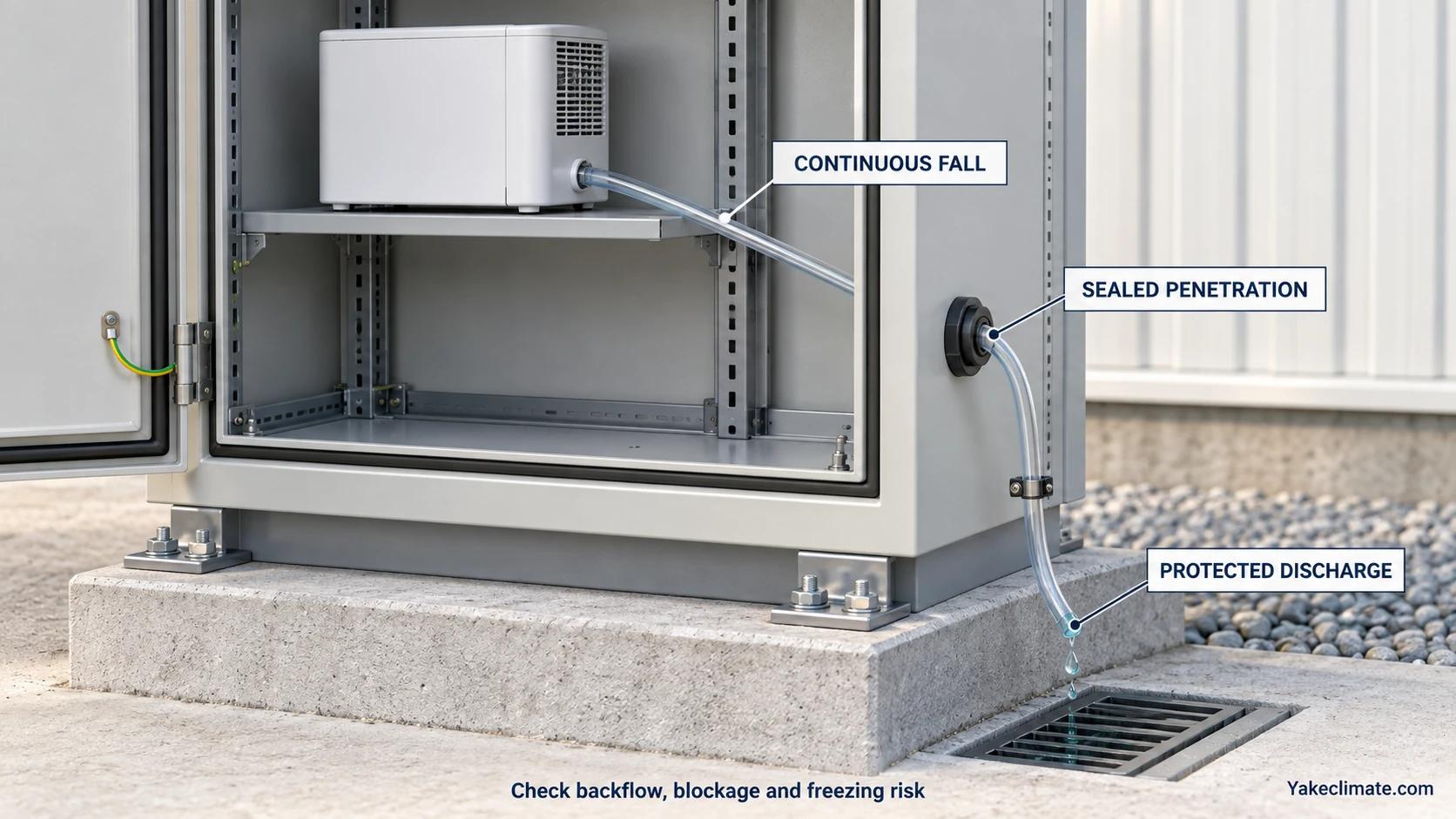
The drainage decision belongs in equipment selection; detailed hose routing, termination, blockage and commissioning checks belong in the dedicated drainage guide below.
The drainage design is developed further in Condensate Drainage in Sealed Battery Cabinets and Containers.
6. Airflow and Sensor Placement
Compact equipment still needs an unobstructed air path. A unit hidden behind a solid rack may dry only a small recirculation pocket while the roof and door remain wet. Keep the stated inlet and outlet clearances and avoid discharging directly into the return.
Place the humidity and temperature sensor where it represents the risk being controlled, not simply where wiring is convenient. A warm sensor beside a power converter can report safe relative humidity while a cold wall on the opposite side is already below dew point. Where the coldest surface is uncertain, temporary logging at several points is more useful than guessing.
7. Controls, Alarms, and Maintenance
At minimum, the project should decide:
- what starts and stops the unit;
- whether control is based on relative humidity, dew point, or another project requirement;
- which local or remote alarm indicates failure;
- what happens if the drain blocks;
- what operating data the BMS or EMS needs;
- how sensor plausibility and calibration are checked;
- how the unit can be serviced without exposing live equipment or leaving the enclosure open unnecessarily.
Do not assume a protocol or register list from a product-family name. Confirm the required interface against the selected configuration and the approved project documentation.
8. Information to Prepare for Selection
- Cabinet or container drawing and free air volume.
- Indoor or outdoor location and site climate data.
- Minimum and maximum internal temperature, including shutdown.
- Current humidity, target dew point or target RH, and the coldest known surface.
- Ventilation rate, door-opening pattern, and suspected leakage paths.
- Internal heat sources and active cooling arrangement.
- Available mounting envelope and required clearances.
- Power supply and permitted electrical load.
- Gravity drain or pump route, discharge location, and freezing risk.
- Required dry contact, communication, alarm, and operating data.
- Service interval and whether the design will be deployed across multiple sites.
9. Discussing an Electrical Cabinet Project
Industrial Dehumidification for Complex Climate Applications
Yakeclimate designs and manufactures industrial dehumidification equipment for complex climate applications, with a focus on agriculture and energy projects.
We co-develop application-specific dehumidification equipment around the operating conditions, interfaces, and integration requirements of the wider project or system.
Explore energy-storage dehumidifiers or contact Yakeclimate with the cabinet conditions, drainage route, and control requirements.
FAQ
Frequently Asked Questions
Do I always need an active dehumidifier for an electrical cabinet?
No. First identify whether the water comes from external ingress or internal condensation. Repairing a gasket, cable entry, or rain path may solve an ingress problem. Heating may be appropriate when the affected surfaces can be kept above the local dew point within safe temperature limits. Active dehumidification is appropriate when moisture removal is required to lower the internal dew point at the project conditions. Compare the moisture load, heat distribution, power and operating range before selecting either route.
Does cabinet volume determine the dehumidifier size?
No. Volume is one input. Air leakage, ventilation, door openings, outdoor dew point, internal temperature, the target condition, and any recovery load can dominate the required water removal.
Can ventilation control moisture in a cabinet?
Only when the incoming air has a lower dew point than the internal air and it reaches the affected surfaces. In humid weather, ventilation can raise the internal dew point. Ventilation specified for another function must be treated as a moisture load when selecting the dehumidifier.
What is the difference between a heater and a dehumidifier?
A heater raises surface or air temperature so that an affected surface stays above dew point; it does not remove water. A dehumidifier removes water from treated air and lowers its dew point. The correct choice depends on moisture load, the location and temperature of at-risk surfaces, heat distribution, power, airflow and operating range.
What drainage is preferred?
Prefer a continuously falling gravity drain to a safe external discharge when the installation permits it. Protect the penetration, prevent backflow and blockage, and consider freezing. If gravity drainage is not possible, define pump capacity, failure alarms, and overflow handling.
Should control be based on relative humidity or dew point?
If condensation is the failure mode, dew point referenced to the coldest relevant surface describes the risk more directly. A fixed RH setpoint permits different moisture contents as temperature changes.
References
- IEC 60529 defines degrees of protection provided by enclosures (IP Code). Its scope does not make an IP rating proof of protection against internally produced condensation; relevant product requirements and the installed moisture-control design must be assessed separately.
