
Diagnosing suspected condensation in a battery cabinet or BESS container starts by comparing nearby-air dew point and the temperature of the first wet or coldest relevant surface on the same time axis. A surface at or below that dew point indicates that condensation is physically possible, allowing for sensor uncertainty. Confirm the water pattern and rule out leaks, ingress and other sources before assigning cause.
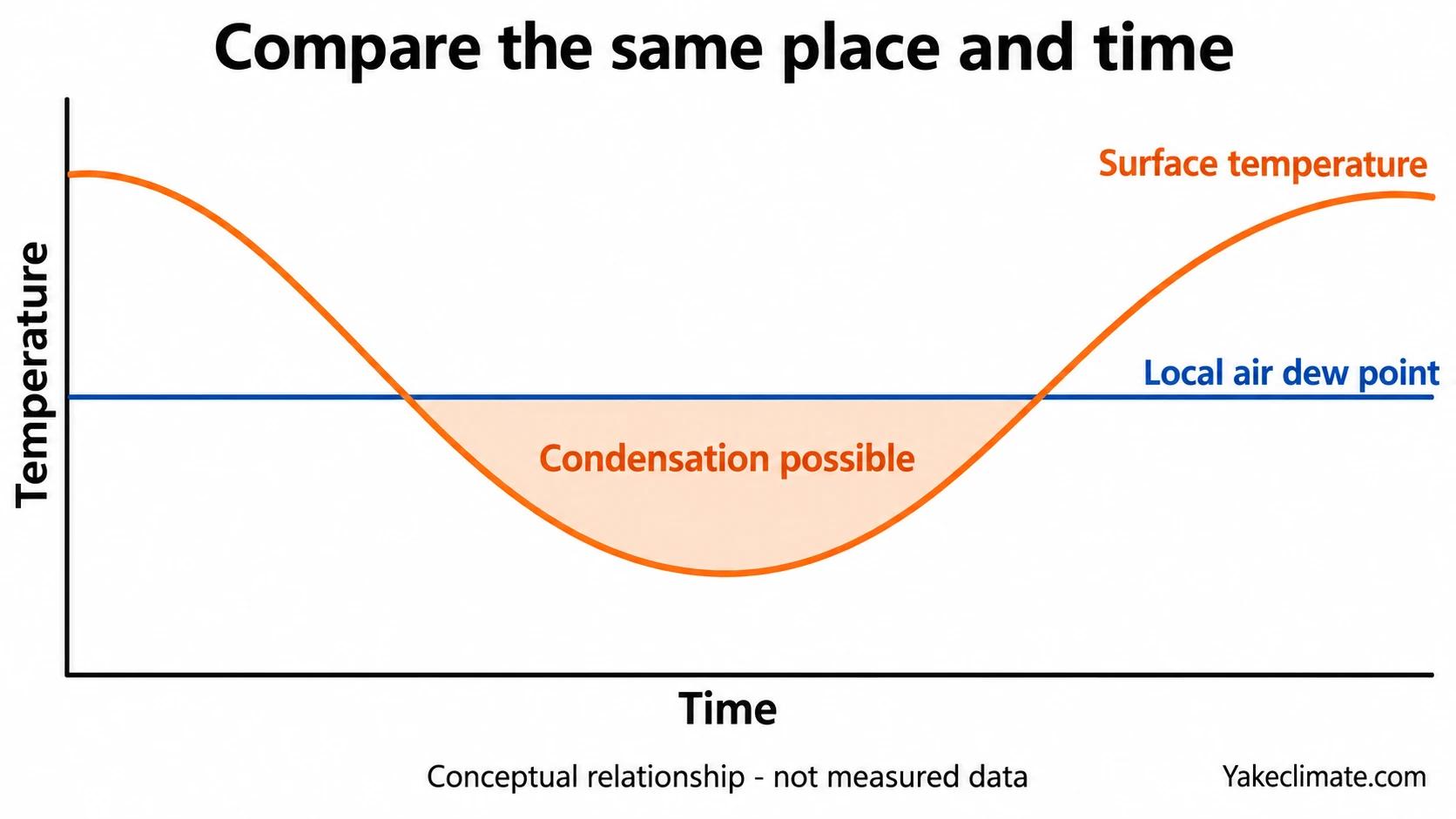
A single RH reading taken during a daytime visit is not a diagnosis. The event may have happened before sunrise, after a shutdown, when a service door opened, or while ventilation introduced humid outdoor air.
First Confirm That It Is Condensation
Water inside an enclosure can come from:
- rain, wash water or flooding;
- a leaking cooling or drainage circuit;
- moisture released by wet material brought inside;
- condensation from water vapour already in the air.
Ingress usually leaves a physical path. Condensation follows cold surfaces and operating transitions. Inspect the pattern before moving or drying anything.
| Observation | More consistent with |
|---|---|
| Stain below a cable entry after rain | External ingress |
| Droplets across a roof panel before sunrise | Surface condensation |
| Water below a cooling unit or drain connection | Drain or cooling-system leak |
| Wet metal after a humid door-opening event | Warm humid air contacting a cold surface |
| Repeated corrosion at one cold bridge | Local condensation |
More than one source can be present. A damaged gasket can admit rain and also increase humid-air exchange.
Map Where the Water Appears
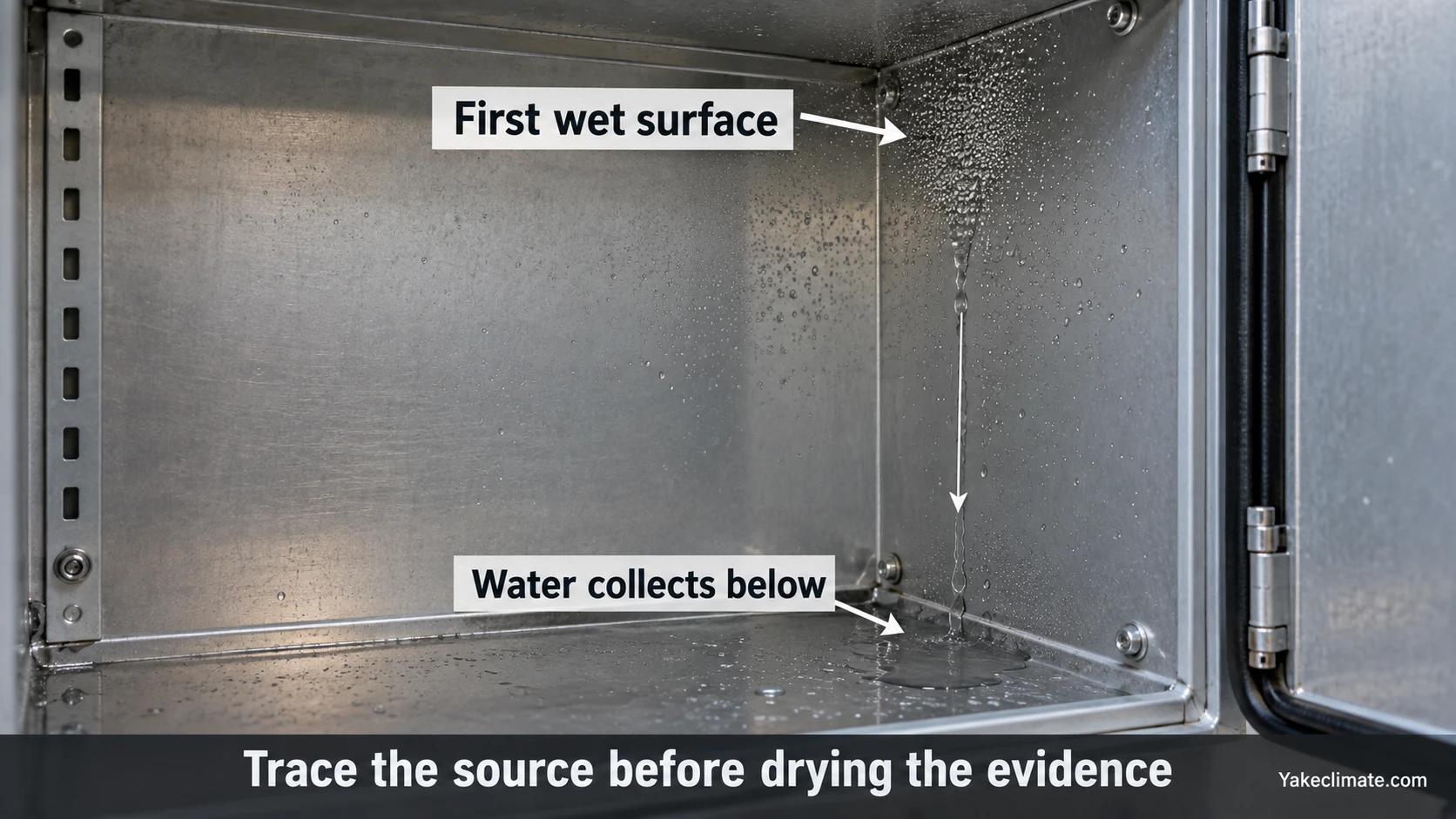
Photograph and mark the first wet locations:
- roof and upper corners;
- external walls, especially shaded or wind-exposed sides;
- floor and cable entries;
- cold plates, coolant lines and air-conditioning components;
- busbar supports, connectors and printed circuit boards;
- behind insulation or covers;
- around door seals and penetrations.
The first wet surface matters more than the area where water finally collects. Droplets can run down a panel and make the cabinet floor look like the source.
Build a Time Line
Ask when the event occurs relative to:
- sunset and sunrise;
- charge and discharge cycles;
- cooling-unit start and stop;
- cabinet shutdown or restart;
- service-door opening;
- rain, fog or a warm humid weather change;
- ventilation or purge operation;
- maintenance and washing.
Different timing points to different mechanisms. Condensation just before sunrise suggests a cold exterior panel and overnight cooling. Condensation immediately after opening a cold cabinet in humid air suggests a door event. Condensation during active cooling suggests a local surface below the air dew point.
Log Air and Surface Conditions
Use co-located air temperature and RH to calculate dew point. Add contact surface-temperature sensors to the roof, cold wall, cooling component or other suspected cold point.
Recommended logging:
- use the same clock for every channel;
- sample often enough to see transitions, not only daily averages;
- cover the difficult weather and operating period;
- record door, fan, cooling and dehumidifier status;
- note sensor location and accuracy;
- keep raw data rather than screenshots only.
Plot:
- internal dew point;
- suspected surface temperature;
- outdoor dew point where relevant;
- A dew-point/surface-temperature crossing, interpreted with sensor uncertainty and observed wet locations, supports a condensation hypothesis; it does not by itself prove the water source.
The crossing between dew point and surface temperature is direct evidence of condensation risk.
Check the Coldest Surface
The coldest surface is not necessarily near the humidity sensor.
Candidates include:
- a metal roof radiating heat to a clear night sky;
- a shaded wall exposed to wind;
- a cold plate or refrigerant line;
- a thermal bridge at a mounting frame;
- a floor above a cool foundation or cable trench;
- a high-conductivity cable gland;
- a heavy component warming more slowly than incoming air.
If the coldest location is unknown, rotate temporary surface sensors through several positions or use an infrared survey carefully. Shiny metal can give misleading infrared readings unless emissivity is addressed.
Check Air Entry and Moisture Sources
Inspect:
- damaged or compressed gaskets;
- unsealed and unused penetrations;
- pressure-equalisation vents;
- cable trenches and ducts;
- drainage penetrations;
- required ventilation airflow;
- door-opening duration;
- cleaning and commissioning moisture;
- wet insulation or absorbent contamination.
A nominally sealed cabinet still exchanges air as it heats and cools. The question is how much humid air enters, from where, and during which transition.
Check a Trench Connection, Then Follow the Specialist Diagnosis
A cable trench can connect the enclosure to cooler or wetter air or provide a liquid-water path. Record standing water, entry points and whether the first wet area is near the cable boundary. For the full trench-specific diagnostic path, see cable-trench moisture and switchgear diagnosis.
- an unsealed transition;
Do not solve a trench moisture problem by increasing cabinet airflow before understanding the direction and moisture content of that airflow.
Ventilation and cooling change the diagnosis.
Ventilation may be required for safety or thermal reasons. Its humidity effect depends on the outdoor dew point. If outdoor air is wetter than internal air, the ventilation system increases the load on the dehumidifier.
Sensible cooling alone lowers dry-bulb temperature and generally raises RH if humidity ratio stays constant. Cooling with actual condensate removal can lower humidity ratio and dew point. In either case, a cold coil, pipe or local panel may fall below the dew point of adjacent air during operation or cycling.
See Battery Room Ventilation and Humidity Control and Why a BESS Container Can Still Condense with Air Conditioning.
Separate Symptom Control from Root Cause
Possible responses include:
- repairing ingress paths;
- insulating a thermal bridge;
- changing airflow distribution;
- limiting unnecessary humid-air entry;
- warming a known cold surface;
- lowering internal dew point with active dehumidification;
- coordinating cooling, ventilation and dehumidification controls.
The right response follows the measured mechanism. Installing a larger dehumidifier without repairing a rain path is not a root-cause correction. Adding a heater to one panel does not remove accumulated water from the whole enclosure.
Minimum Diagnostic Record
Prepare:
- enclosure drawing and site location;
- photographs with water locations marked;
- date, time and operating state of each event;
- internal and outdoor temperature/RH logs;
- calculated dew point;
- at least one suspected surface-temperature log;
- door, cooling, ventilation and dehumidifier status;
- gasket, penetration, trench and drain inspection results;
- corrosion, alarm and failure history;
- any change made and the result after the change.
Discussing a Condensation Investigation
Yakeclimate designs and manufactures industrial dehumidification equipment for complex climate applications, with a focus on agriculture and energy projects.
We co-develop application-specific dehumidification equipment around the operating conditions, interfaces, and integration requirements of the wider project or system.
Review condensation physics, explore energy-storage dehumidifiers, or contact Yakeclimate with the site record.
FAQ
Frequently Asked Questions
What measurements support a condensation diagnosis?
Log nearby-air dew point and the first wet or coldest suspected surface temperature on the same clock. A crossing makes condensation physically possible after accounting for sensor uncertainty; confirm that timing and water location fit, and investigate leaks or ingress before concluding the source.
Why is a daytime RH reading not enough?
The event may occur at night, during shutdown, after a door opens or while cooling operates. RH also changes with temperature. A daytime reading can look acceptable after the water has already evaporated.
Where should temporary sensors be placed?
Place air temperature/RH sensors away from direct supply air and strong heat sources. Put surface sensors on the roof, shaded wall, cold plate, floor or other points most likely to be cold. Record exact positions so the result can be reproduced.
Can a cable trench cause cabinet condensation?
Yes. A trench can contain cool, humid air or standing water and connect to the cabinet through cable entries. Measure trench and cabinet conditions and inspect the transition before changing airflow.
How long should a diagnostic log run?
Long enough to capture the operating and weather transition that causes the event. That may be several day-night cycles, a cold snap, a humid weather change, a restart or a representative ventilation event. A fixed duration is less important than capturing the failure condition.
Should a dehumidifier be selected before the diagnosis is complete?
Usually no. Selection requires the moisture source, temperature range, air exchange, target dew point, drainage and controls. A premature model choice can hide the symptom without correcting the dominant source.
