
Condensation in an electrical enclosure happens when a surface temperature falls below the dew point of the air inside. An anti-condensation heater can help when only one or a few surfaces need to stay above dew point, but it raises temperature without removing water, so it may not protect the enclosure when moisture enters continuously or during extreme temperature swings. Ventilation provides net moisture removal when incoming air has a lower humidity ratio than the air it replaces; the permitted airflow and thermal conditions still need to be checked. A dehumidifier removes water directly and lowers the dew point, which is the more direct route when moisture load is the dominant problem. The right choice depends on the condensation condition, the moisture source, and the operating extremes, not on energy cost alone. This page gives a condition-based comparison to help you decide.
Start with the Condensation Condition
Before choosing a method, define the condensation condition you are solving:
- Is one surface colder than the dew point of the air inside (for example, an outer wall or door in winter)?
- Is moisture entering continuously, through door openings, leaks, or air exchange with a humid environment?
- Do temperature swings push the enclosure through dew point during normal operation (for example, outdoor cabinets in a day–night cycle)?
- Is the enclosure sealed, semi-sealed, or ventilated by design?
Use these answers to identify whether the project needs warmer surfaces, lower air moisture content, source correction or a combination.
When to Evaluate Heating
Heating may help where a cold surface approaches the local dew point. Check whether the proposed heat reaches that surface throughout the operating range, and whether the added heat is compatible with the enclosed equipment.
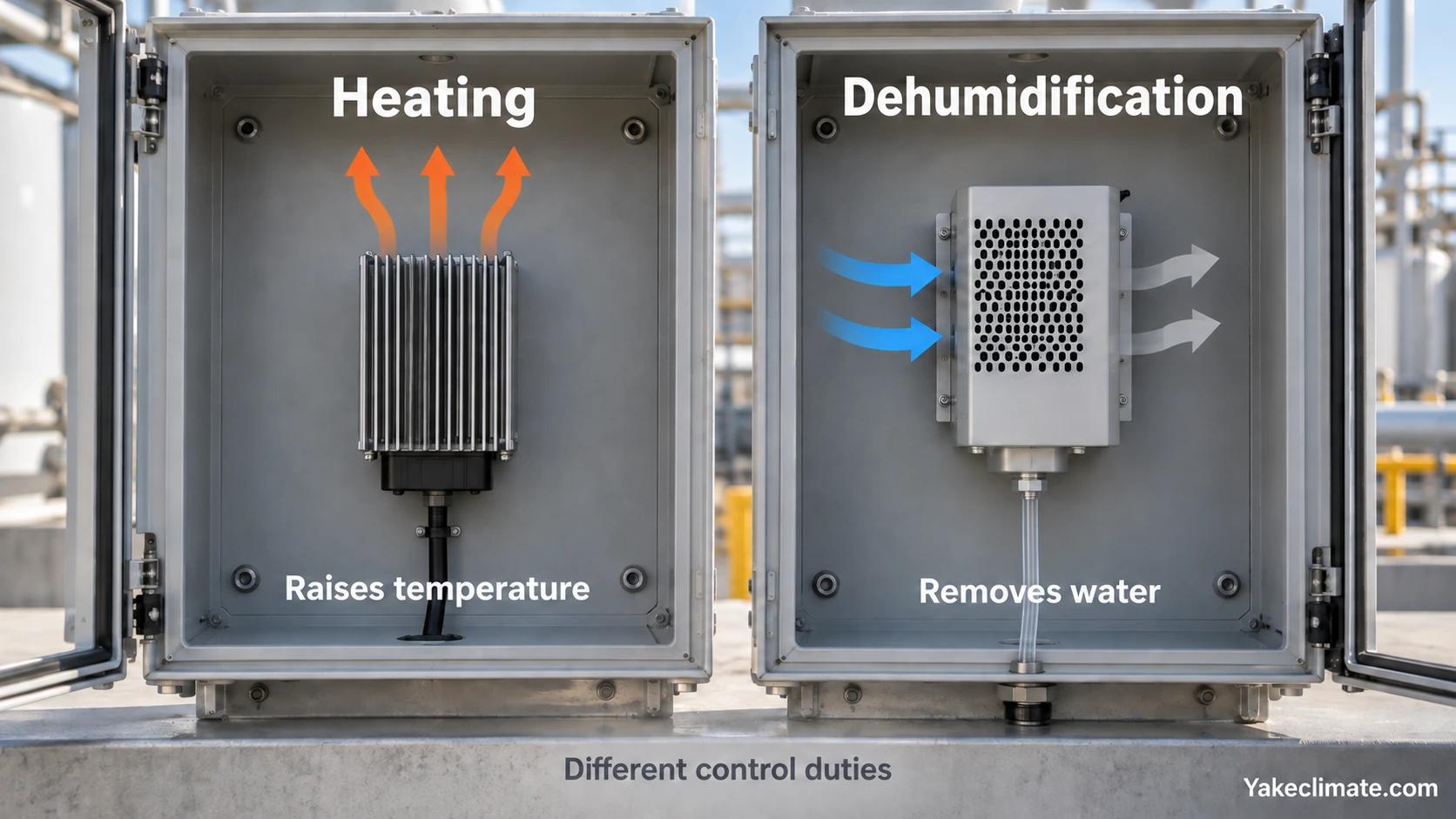
A heater raises temperature but does not remove water. If moisture keeps entering or conditions move outside the design case, condensation risk can remain. Evaluate the heater and the enclosure’s operating envelope together.
When Ventilation Can Help
Ventilation exchanges enclosure air with surrounding air. For net moisture removal, compare the incoming and outgoing humidity ratios at the relevant conditions, then check airflow and thermal constraints. Outdoor RH alone does not determine whether ventilation will dry the enclosure.
For protective membrane designs, see the membrane vent selection guide.
Ventilation can be useful for enclosures that already have a designed air path and for equipment rooms where air exchange is expected. It is not a substitute for dehumidification when the outdoor air is the moisture source.
When to Evaluate Passive Desiccant
Passive desiccant retains a finite quantity of water. Evaluate its usable capacity against the expected moisture load and the interval available for replacement or regeneration. Enclosure leakage and maintenance access remain part of that assessment.
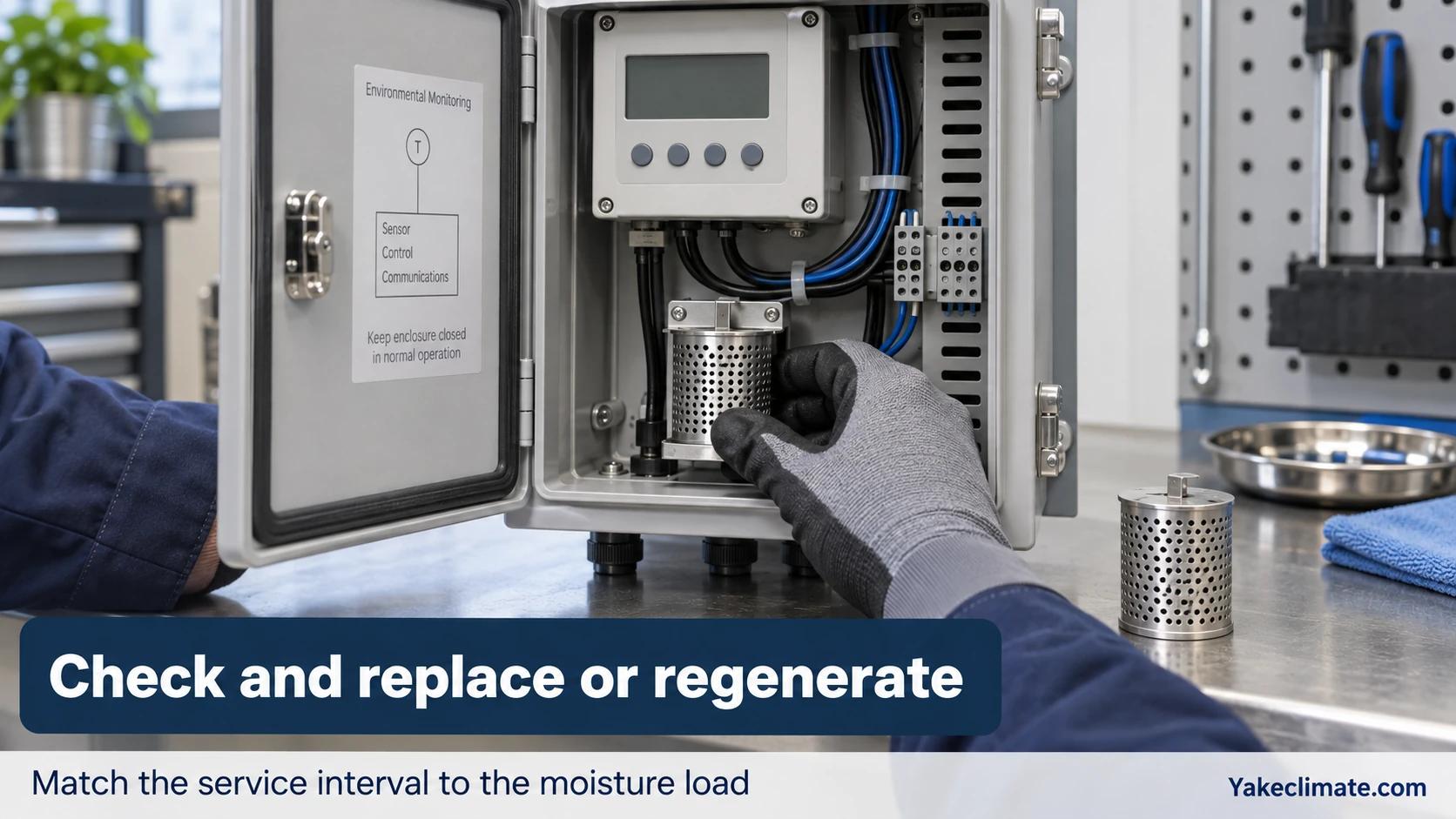
If the moisture load or service interval is unknown, keep the required desiccant capacity and replacement schedule unresolved until those inputs are established.
When to Evaluate Active Dehumidification
An active dehumidifier removes water from the air directly, which lowers the dew point inside the enclosure. This is the more direct route when moisture ingress is continuous or when temperature control alone cannot keep surfaces above dew point.
Heating changes temperature; dehumidification removes water from air. If moisture continues to enter, first review the source and then assess the remaining removal duty. Neither mechanism alone establishes the more reliable arrangement for a particular enclosure.
Compare the Methods
| Condition to investigate | Heating question | Ventilation question | Passive-desiccant question | Active-removal question |
|---|---|---|---|---|
| One or more cold surfaces | Can heat reach the relevant surface within equipment temperature limits? | Would air exchange change moisture or surface temperature beneficially? | What moisture load and service interval must it cover? | Is lowering local air dew point necessary and feasible? |
| Recurring moisture ingress | Can surfaces remain above local dew point across the event? | Is incoming air drier on the same moisture-content basis? | Can usable capacity cover the interval between services? | What removal duty remains after addressing the source? |
| Low estimated load and controlled access | Is a surface-temperature intervention needed? | Is exchange permitted by the enclosure design? | Is the load estimate supported and the replacement route practical? | Does the required duty justify active equipment? |
| Large temperature swings | What is the coldest relevant surface during transition? | What do incoming air and heat exchange do during that period? | How does the verified load change by period? | What is capacity at those entering conditions? |
| Both cold surfaces and moisture ingress | Define a separate heating duty if needed | Evaluate the permitted exchange route | Assess finite capacity and maintenance | Define removal duty and coordinate with other controls |
The table is a decision aid, not a substitute for measuring the actual surface temperature, dew point, and moisture source on site.
Assign a Job to Each Method
A project may need both surface-temperature control and moisture removal. Define the duty of each proposed method, how the controls interact and how the combined arrangement will be checked under the relevant conditions.
The combination should be designed around the measured conditions, not added as a default. Each method has a job; if a method has no job, leave it out.
Five Decision Questions
- What is the coldest surface temperature relative to the air dew point?
- Where does the moisture come from, and is it continuous?
- What is the operating envelope, including extremes?
- Is the enclosure sealed, semi-sealed, or ventilated?
- What maintenance and access interval can the site support?
Do Not Use Energy Cost Alone
Compare whether each proposal can meet the defined operating conditions, then compare energy, maintenance and the consequences of an excursion. Energy cost alone does not establish suitability.
Information to Prepare
For a project comparison, prepare:
- enclosure dimensions and mounting location;
- surface temperature and dew point readings at the risk period;
- moisture source and ingress estimate;
- temperature swing range and extremes;
- power availability and maintenance access.
FAQ
Frequently Asked Questions
Does an anti-condensation heater remove humidity?
A heater adds heat; it does not remove water from the air. Whether a protected surface stays above local dew point depends on the installation and operating conditions.
When is ventilation better than a dehumidifier?
Evaluate ventilation when incoming air has lower moisture content on the same comparison basis, sufficient exchange is available and the enclosure’s thermal, protection and safety requirements permit it. Compare the remaining duty before choosing a method.
Can I use a heater and a dehumidifier together?
Yes, when both cold surfaces and moisture ingress are present; each addresses a different part of the problem.
How do I know which method to choose?
Measure the local air and relevant surfaces, identify the moisture source and use the comparison questions above to define what each proposed method must demonstrate.
Discussing an Enclosure Control Route
Share the operating conditions, the condensation pattern, and the power and maintenance constraints with the Yakeclimate engineering team. The project review starts from the measured conditions and confirms the equipment interface and validation steps before any selection is finalized.
Contact Yakeclimate with the operating conditions and integration requirements.
