

A commercial portable dehumidifier uses energy to remove water under specific inlet and operating conditions. Begin with the required humidity or dew-point target and the water that must be removed. A rated daily capacity does not tell you the site's actual litres per kilowatt-hour. This guide covers operating an existing unit; for a new system, start with the moisture load and delivered capacity at project conditions.
What to measure before changing settings
Record the unit's electrical energy in kWh and water removed in litres over the same representative interval, together with inlet temperature, relative humidity, setpoint, run hours, occupancy or process state, and outdoor-air conditions. Divide kWh by litres for site energy per water removed, or invert it for L/kWh. Do not call kW/L an energy-efficiency figure: kW is power, while kWh is energy. A standardized integrated energy factor applies only to eligible equipment tested under its specified procedure; do not transfer it to an unverified industrial unit.
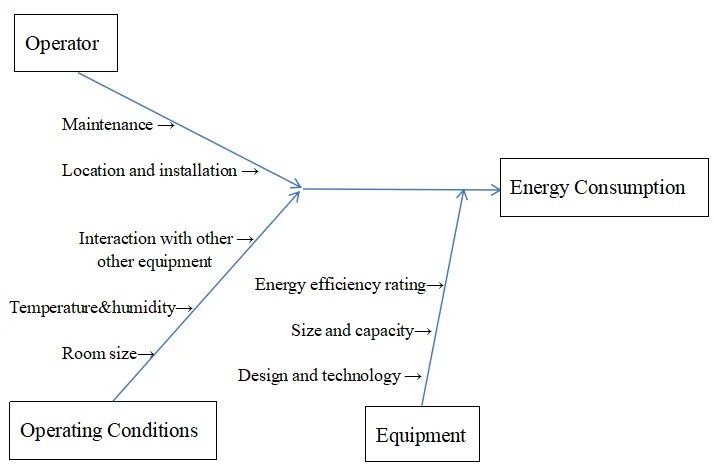
Compare like with like. A wetter inlet can increase condensate collection while also changing energy use; a cooler inlet can reduce a refrigerant unit's delivered capacity or trigger defrost. A before/after comparison is useful only when operating conditions, load and the measured interval are comparable. If they are not, document the difference and avoid claiming a percentage saving.
Ten operating checks
1. Define the duty. Set the required humidity, dew point or surface-protection limit from the product and process. Record normal, peak and recovery conditions. Floor area or a universal 40–50% RH target cannot substitute for a moisture balance.
2. Check delivered capacity at the actual inlet. Compare the moisture input with the manufacturer's water-removal data at the relevant temperature and humidity. If that data are missing, request it or measure a representative duty; do not assume the catalogue's warm, wet rating applies to a cooler space.
3. Establish a matched energy baseline. Meter kWh and condensate together. Note whether a tank fills and stops the machine, whether a drain or pump is operating, and whether other HVAC equipment removes moisture. The condensate collected by one unit is one removal term, not the room's entire moisture load.
4. Avoid an unnecessarily low setpoint. Lowering the target can lengthen run time without improving the product or surface outcome. Use a control deadband and sensor location that represent the protected zone; verify cold-surface risk using dew point rather than an arbitrary room RH alone.
5. Match schedules to moisture duty, not only occupancy. Material drying, wet processes, ventilation and infiltration can continue after people leave. An unoccupied setback or shutdown is appropriate only if the documented target remains safe through that interval and recovery completes before the next process duty.
6. Keep the unit's air path open. Follow its required inlet and outlet clearances and inspect filters and coils. Blocked airflow can reduce water removal and change operating conditions. Do not use a generic clearance distance in place of the selected unit's installation instructions.
7. Reduce avoidable incoming moisture. Check outside-air volume, open doors, envelope leaks and wet material deliveries. Ventilation may be required for people or process safety, so the goal is a verified air balance and control sequence, not indiscriminate closure.
8. Verify drainage and continuous duty. A full tank or blocked drain can halt water removal while electricity or fans continue to operate. Check trap, pump, overflow alarm and maintenance access for the selected configuration.
9. Coordinate with the wider HVAC system. If cooling or ventilation also affects moisture, compare the combined operating sequence and total system energy. Adding a portable unit does not automatically lower cooling energy; a full-reheat dehumidifier can add sensible heat to the space.
10. Re-measure after each change. Compare matched intervals for kWh, litres removed, target compliance and process conditions. If energy falls because the protected area becomes too wet, that is not an efficiency gain. Investigate runtime, airflow and maintenance before buying a different unit.
For a new project, use the commercial selection guide to establish load and distribution. For an existing installation, the maintenance checklist and running-cost method provide deeper checks. Keep these as separate tasks rather than treating one page as a substitute for engineering selection.

Share the target condition, operating schedule, entering-air measurements, moisture sources and current equipment data when requesting a project review. A suitable response should state which capacity, energy and drainage assumptions still need verification.


