
An IP-rated enclosure can still condense because ingress protection and condensation control are different design questions. IEC 60529 classifies how an enclosure protects against access to hazardous parts, solid foreign objects and water under specified conditions. It does not guarantee that every internal surface will remain above the dew point.
A cabinet can pass its specified ingress test and still exchange moist air as it heats, cools, breathes through a pressure device or is opened for service.
What an IP Rating Tells You
The IP Code provides a standard way to classify degrees of protection provided by an electrical enclosure. The selected rating is important for dust, water and access protection within the defined test and product scope.
It does not provide:
- an air-leakage rate for a moisture-load calculation;
- an internal RH or dew-point target;
- the temperature of the coldest internal surface;
- a door-opening recovery requirement;
- a drainage design for internally generated condensate;
- a guarantee against condensation during shutdown or thermal cycling.
Do not read additional performance into the code that the enclosure manufacturer has not declared.
How Moisture Can Be Present Inside
Water vapour can enter or remain inside through:
- humid air trapped during assembly;
- service doors opened in humid weather;
- cables, gaskets and penetrations;
- pressure-equalisation devices;
- air exchange caused by heating and cooling;
- required ventilation;
- wet packaging, cleaning or commissioning;
- materials that release absorbed moisture.
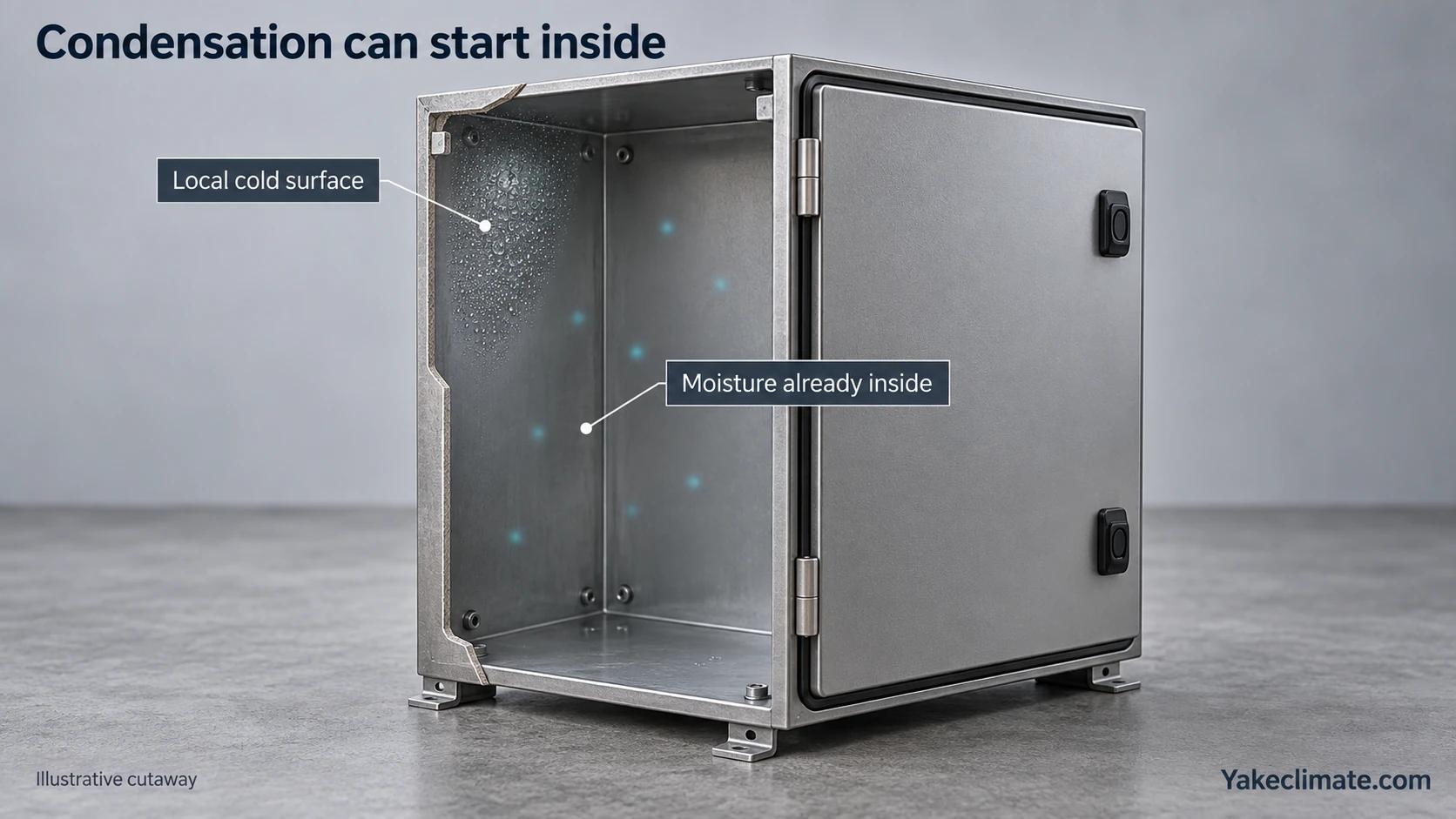
An enclosure does not need a visible rain leak to contain enough water vapour for condensation.
Thermal Cycling Makes an Enclosure “Breathe”
Air expands as it warms and contracts as it cools. Pressure differences can move air through small paths or a designed pressure-equalisation device. Repeated day-night and load cycles can therefore exchange internal and external air.
The amount depends on:
- enclosure volume;
- temperature swing;
- pressure-control design;
- seal condition;
- penetrations;
- door use;
- wind and fan pressure.
The IP rating alone is not an air-change value and should not be used as one in a dehumidifier calculation.
A Cold Surface Can Condense Internal Moisture
Even if the average enclosure air is warm, local surfaces may be colder:
- roof and shaded walls;
- mounting frames and thermal bridges;
- cable glands connected to outside metal;
- cooling coils, refrigerant pipes or cold plates;
- floor sections above a cool foundation or trench;
- heavy components that warm slowly after a door opens.
Condensation begins where local surface temperature reaches or falls below local air dew point.
| Design input | Why it matters |
|---|---|
| Internal dew point | Describes the moisture available to condense |
| Minimum surface temperature | Identifies the first likely wet point |
| Leakage and door events | Defines the incoming moisture load |
| Ventilation duty | May dominate moisture entering the enclosure |
| Drainage | Removes water collected by cooling or dehumidification |
| Control sequence | Determines protection during load changes and shutdown |
Sealing Can Help, but It Must Be Deliberate
Repairing damaged gaskets and sealing unused openings can reduce uncontrolled humid-air entry. However, the enclosure may still need:
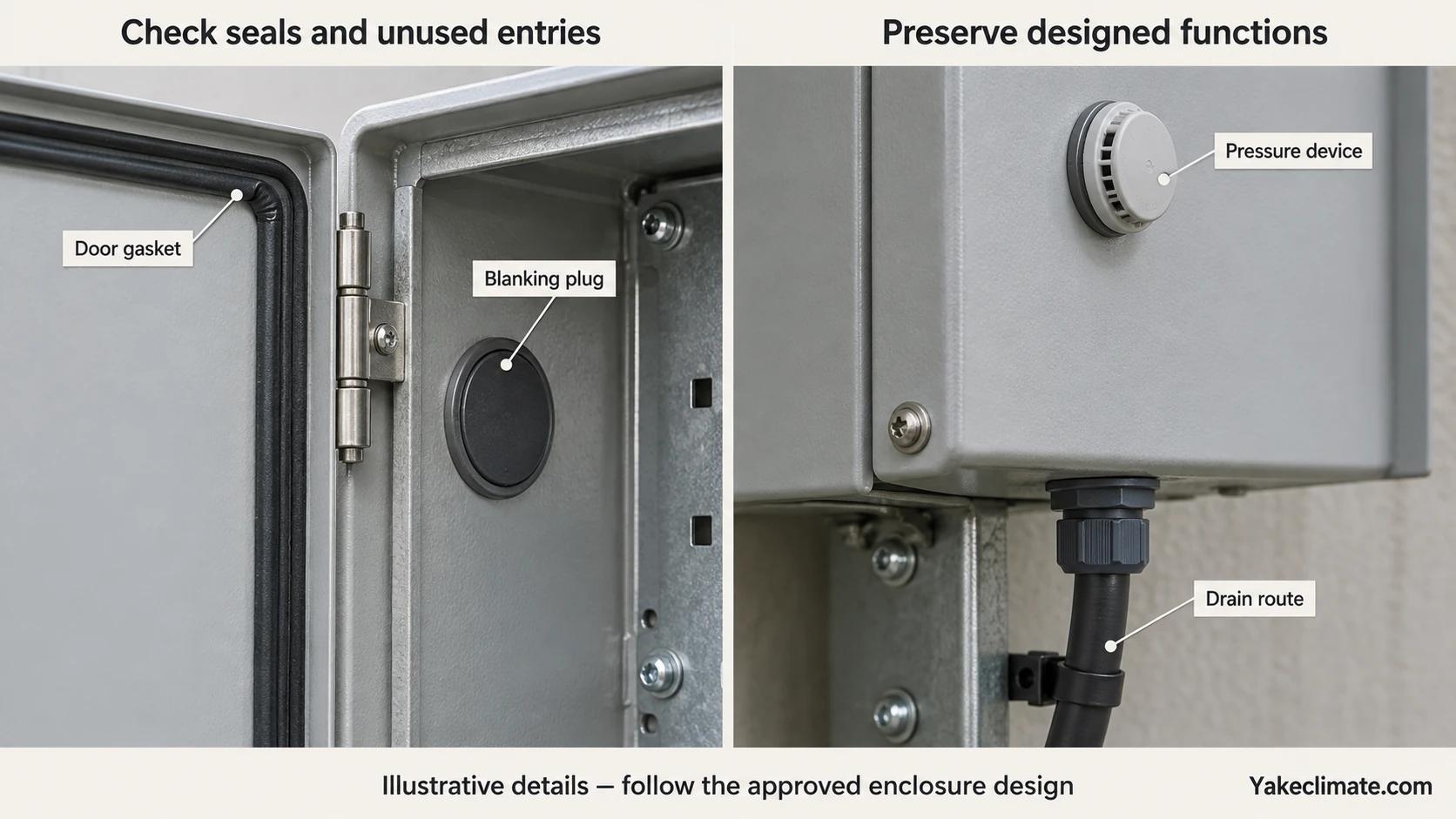
- pressure equalisation;
- thermal ventilation;
- safety ventilation;
- drainage;
- service access;
- cable movement and maintenance clearance.
Every change must preserve the declared enclosure performance and the electrical, fire and service requirements. Adding an unapproved hole, vent or seal can solve one symptom while creating another compliance or reliability problem.
Cooling Units Need Their Own Condensate Strategy
Enclosure cooling can lower internal air temperature and condense water on the evaporator. The condensate must be collected and discharged reliably. Poor sealing can also increase the amount of warm humid air entering a cooled enclosure.
Follow the selected enclosure and cooling-unit instructions for cable entries, unused openings and condensate routing. Review unintended openings as one possible moisture path while preserving required ventilation, pressure equalisation and drains. Neither an IP label nor a generic sealing rule establishes the actual moisture load.
What an IP Rating Leaves to Moisture Control
After identifying the moisture path and credible cold surface, compare the control methods against local dew point and enclosure constraints. Heating may keep a cold surface above dew point; ventilation can reduce moisture only when the incoming air has a lower dew point and ventilation is permitted; dehumidification lowers the internal dew point. Required vents, pressure devices and drains must remain functional.
Review Moisture Control Systems for Electrical Cabinets after confirming the moisture source.
Check the Operating Conditions, Not Only the Label
For a rated enclosure with condensation risk, record the site dew-point range, operating and standby temperatures, credible coldest surface, documented or estimated air exchange, door and service events, and required vents and drains. Define how these conditions will be checked during commissioning. An IP code does not supply these project inputs.
The result is an enclosure that is specified for its real environment rather than protected by a label that answers only part of the design question.
Discussing a Rated Enclosure
Yakeclimate designs and manufactures industrial dehumidification equipment for complex climate applications, with a focus on agriculture and energy projects.
We co-develop application-specific dehumidification equipment around the operating conditions, interfaces, and integration requirements of the wider project or system.
Explore energy-storage dehumidifiers or contact Yakeclimate with the enclosure rating, site climate, penetrations, operating cycle and cold-surface information.
FAQ
Frequently Asked Questions
Does a high IP rating prevent condensation?
No. It provides a declared degree of ingress protection under the applicable standard and product conditions. Condensation depends on internal dew point, local surface temperature and moisture exchange.
Is an IP-rated cabinet airtight?
Do not assume so. An IP rating is not an air-leakage test result for a moisture-load calculation. Use manufacturer data, leakage testing or a documented engineering assumption.
Can condensation happen without a damaged seal?
Yes. Moist air may be trapped during assembly, introduced when doors open or exchanged through designed pressure equalisation. A cold surface can then condense that internal moisture.
Should every opening be sealed?
Only in accordance with the enclosure, cable, fire, pressure and service design. Required vents, drains and pressure devices should not be blocked without engineering approval.
Will a heater preserve the IP rating?
The heater itself does not determine the rating. Its mounting, cable entries and any enclosure modifications must comply with the declared enclosure system and manufacturer instructions.
What should be specified in addition to IP rating?
Specify temperature, humidity or dew point, cold-surface margin, air exchange, door events, ventilation, drainage, controls, alarms and commissioning criteria.
