
1. The Question That Separates Suppliers
Rated dehumidification capacity is the water removal figure measured at a stated entering-air condition. Entering-air condition is the temperature and humidity of the air at the equipment inlet. Regeneration energy is the heat consumed by a desiccant wheel to dry its media.
There is one question that separates manufacturers faster than any other, and it takes a single email to ask:
What is your equipment's water removal rate at [your temperature] and [your humidity], and was that figure measured or calculated?
A manufacturer that has test evidence can provide a traceable table or curve with its test basis, conditions, instrumentation or report. A curve alone does not prove that every point was measured; ask which points are measured, which are interpolated or modelled, and whether the exact model and configuration are covered.
This article sets out the rest of the checklist.
2. Do They Ask About the Application First?
A supplier who quotes a model number before asking what the equipment has to do is selling from a price list. The information a serious supplier needs before proposing anything:
- What the space is, and what it is for.
- The moisture sources and their magnitude.
- The target condition, and whether it is relative humidity, dew point, or a material condition.
- The operating temperature range.
- The ventilation arrangement.
- Installation constraints and available services.
- The destination market and applicable requirements.
If none of this is asked, the proposal that follows is a guess. The reasoning behind each input is set out in commercial dehumidifier selection.
This is also a fair test to apply to yourself: a buyer who cannot supply these inputs will get a poor proposal from even a capable supplier.
3. Performance Data at Your Condition
This is the highest-value part of the evaluation, and it deserves detail.
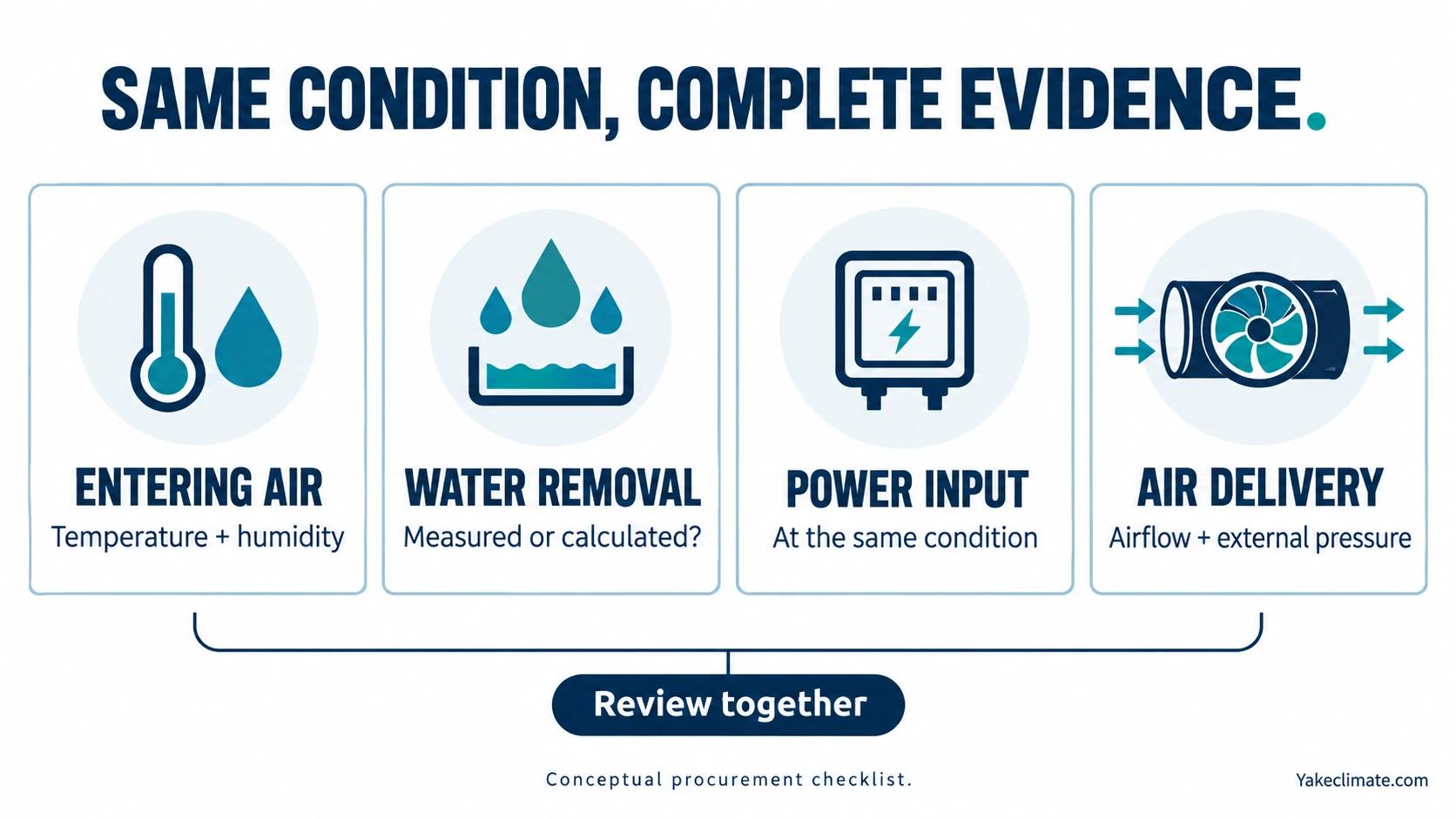
| Request | Why it matters |
|---|---|
| Capacity at the design condition | Rating conditions differ between markets; headline figures are not comparable |
| Capacity table or curve | Useful only when the supplier states which points are measured, interpolated or modelled and supplies the basis |
| Measured, interpolated or calculated | The basis and uncertainty determine what the figure can prove |
| Power input at the same condition | Efficiency varies with condition; capacity alone does not describe cost |
| Airflow and external static pressure | Determines whether the equipment can be ducted as intended |
| Performance at range extremes | A 5–38 °C unit behaves very differently at 8 °C than at 30 °C |
| Regeneration energy for desiccant | A substantial operating cost that does not appear in the removal figure |
Rating conditions differ between procedures and equipment categories. A portable or whole-home test point cannot be applied to industrial equipment as a universal US rating. Ask which procedure, edition, category and test condition produced the quoted figure; compare industrial offers only at stated entering-air temperature, humidity, airflow and external static pressure. The full rating-condition explanation is in what a daily water removal rating really means.
4. Technology Route
A supplier who recommends the same technology regardless of the application is selling what they make rather than what the application needs.
Refrigerant and desiccant routes can suit different duties, but the choice is conditional. Compare delivered water removal, outlet condition, entering air, temperature limits, defrost or regeneration heat, exhaust, airflow and whole-system energy at the project duty. A supplier should explain why its proposed configuration fits and where its range does not. The general selection framework is in commercial dehumidifier selection.
Refrigerant choice is a related question, particularly for export. What refrigerant is used, what alternatives are offered, and how the supplier is positioned for the HFC transition timetable in your market are legitimate procurement questions for equipment expected to remain serviceable for fifteen years. The framework is in R290 vs. R410A in industrial dehumidification.
5. Engineering and Integration Capability
For anything beyond a catalogue purchase, the question is what the supplier can actually adapt and how that process works.
- What is genuinely configurable. Airflow and pressure, coil configuration, control interface, materials and finish, enclosure format, connection positions. Some of these are straightforward; others require design work and validation. A supplier should distinguish between them clearly rather than agreeing to everything.
- How interfaces are defined. Electrical supply, control signals, communication protocol, mounting, air connections, and drainage. On a project where the equipment integrates with a wider system, these need to be specified and agreed rather than assumed.
- Who does the surrounding design. Identify whether structural provision, ductwork, drainage, controls and installation are performed in-house, by disclosed and approved subcontractors, or by the project team. Put the scope and responsibility interfaces in writing.
- What validation accompanies a modification. If a unit is modified, confirm whether the published performance evidence still applies to the modified configuration and what validation is needed.
6. Manufacturing and Test Evidence
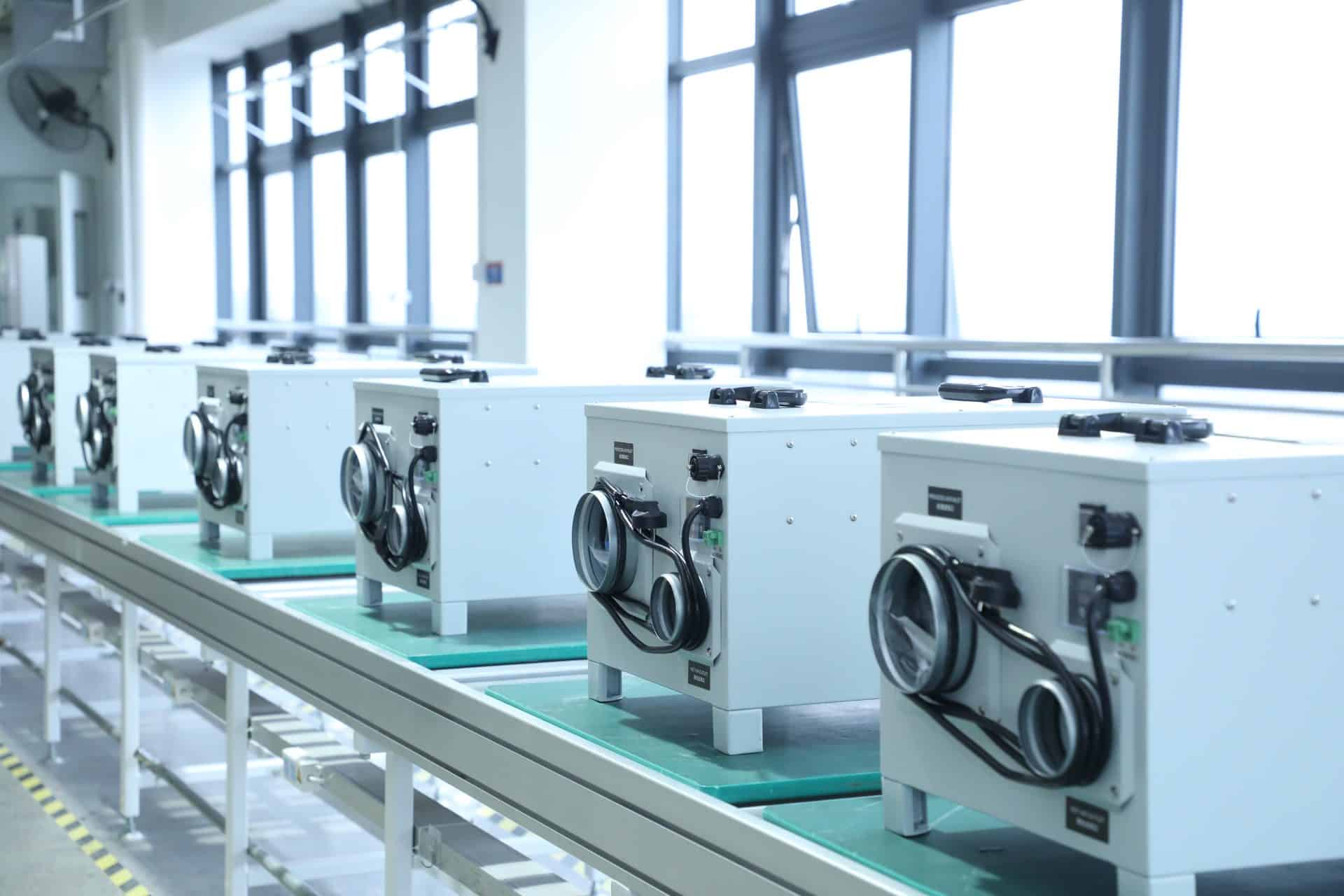
- What testing is done, on what basis, and on what proportion of production. Is every unit run-tested, or is testing on a sample basis? What is measured? Is a test record supplied with the unit?
- Test facility. Performance testing against entering-air conditions requires a controlled test environment. The achievable range of temperature and humidity determines what conditions the manufacturer can actually verify, which determines whether their capacity table is measured or extrapolated.
- Quality system. Certification scope and what is actually covered by it.
- Component sourcing. Which major components, compressor, fan, controls, are used, and whether they are available for service in your market.
- Traceability. Whether unit-level records exist, which matters for warranty claims and fleet deployments.
Requesting a factory visit, in person or remotely, remains one of the more informative steps available, and the response to the request is informative in itself.
7. Documentation and Market Requirements
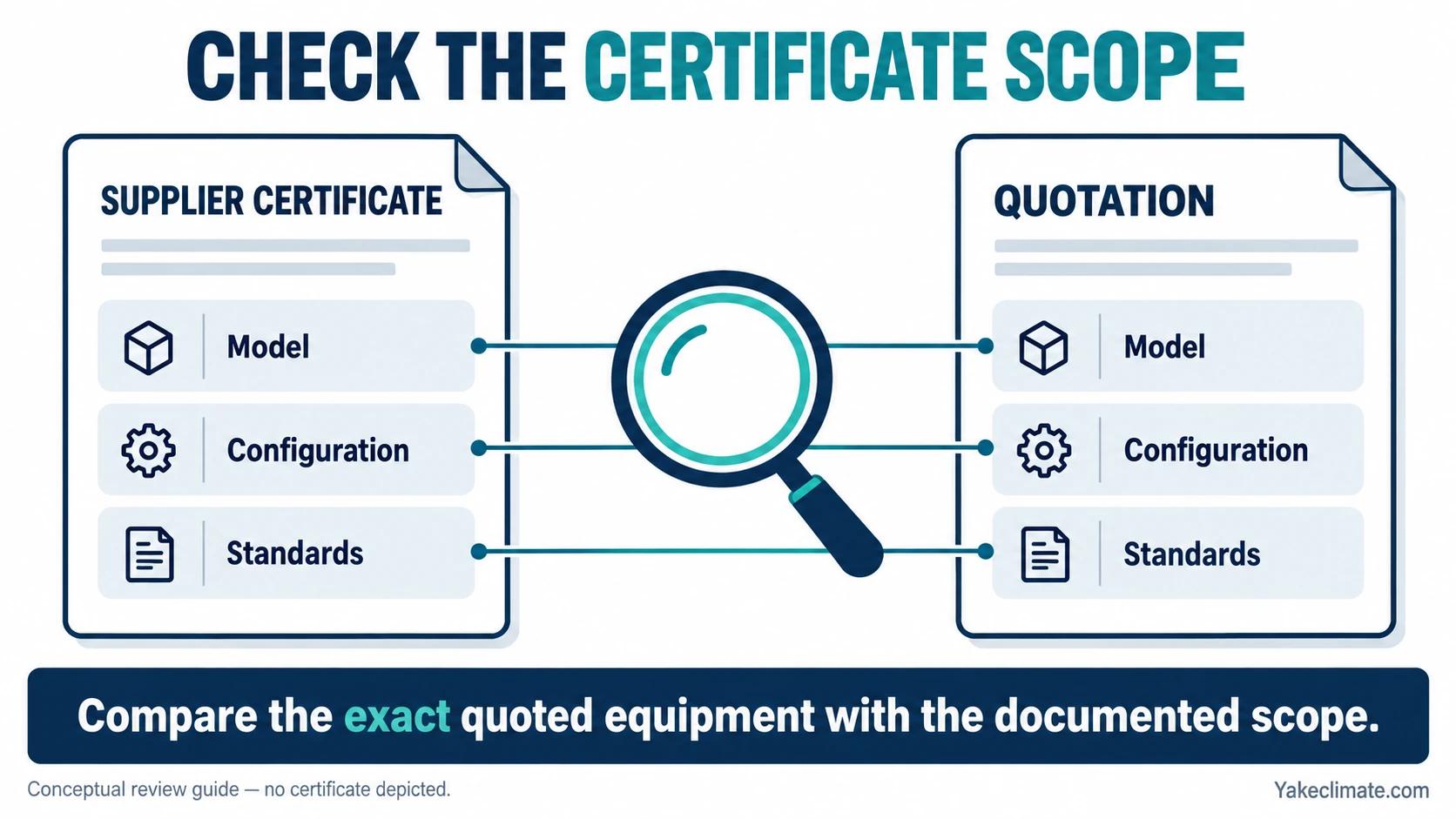
Certification scope is the detail that matters. A certificate applies to specific products, specific configurations, and specific standards. A certificate covering one model does not automatically cover another in the same range, and a certificate covering a standard version may not cover a modified one. Ask which models and configurations a given certificate covers, and check that it matches what you are buying.
- Which market's requirements. Product safety, electrical, EMC, and pressure equipment requirements differ by market. A supplier should state which requirements they have addressed for your destination and what documentation accompanies the equipment.
- Documentation supplied. Installation instructions, operating and maintenance manuals, wiring diagrams, spare parts lists, declarations, and test records. Whether they are available in a language your installation and service teams read.
- Where responsibility sits. Determining whether a specific installation complies with local requirements involves the installation context and the authority having jurisdiction, not only the equipment. A supplier who guarantees compliance of an installation they have not seen is overstating what they can know.
8. Service and Lifecycle
- Spare parts availability and lead time, particularly for wear items and the components most likely to fail.
- Service capability in your market: whether the manufacturer has a presence, works through partners, or expects the buyer to arrange service, and whether local technicians hold the qualifications the refrigerant requires.
- Technical support: access to engineering support for commissioning and diagnosis, and its response expectations.
- Product lifecycle: how long the model is expected to remain in production and supported, which matters where a design will be repeated across sites over years.
- Warranty terms: what is covered, what conditions apply, and what happens to warranty when the equipment is modified or integrated.
9. Warning Signs
A short list, all observable before any money changes hands:
- Capacity quoted without conditions. A figure without an entering-air condition is incomplete.
- No traceable basis for the project duty. Ask for a test report or other documented basis for the quoted design-point performance, including any interpolation or modelling. Repeated inability to support the quoted point is a warning; absence of a full curve alone does not prove the equipment was never tested.
- Every requirement gets a yes. Real equipment has an operating envelope and real manufacturers have limits.
- Claims to do everything. Suppliers positioning as complete-system, turnkey, or one-stop providers should be asked which parts they perform themselves and which they subcontract.
- Certificates whose scope does not match the product. Check the model and configuration listed against what is quoted.
- Unverifiable claims. Market position, project counts, customer names, and installed base presented without anything that can be checked.
- Performance guarantees without a test condition. A quoted capacity that does not state where and how it will be verified is difficult to assess or enforce.
- No interest in the application. The earliest signal available.
10. Questions to Ask Before Ordering
Compact enough to send as a single enquiry:
- What is the water removal rate at our design entering-air condition, and was it measured or calculated?
- Can you provide a capacity and power table across a range of entering-air temperatures and humidities?
- At what airflow and external static pressure was that capacity measured?
- What is the performance at the extremes of the stated operating range?
- For desiccant equipment: what regeneration energy is required, at what temperature, and from what source?
- Which refrigerant is used, what alternatives are available, and how does that position the equipment for the transition timetable in our market?
- What testing is performed on production units, and is a test record supplied?
- Which certificates apply to this exact model and configuration, and what standards do they cover?
- What documentation is supplied, and in which languages?
- What are spare parts lead times, and what service capability exists in our market?
- What is configurable on this platform, and what validation accompanies a configured unit?
- How will performance be verified at commissioning, and against what criteria?
Agree acceptance criteria before ordering: what is measured, where, for how long and under which load. This makes later performance questions easier to assess, as set out in commercial dehumidifier selection.
11. Working With Yakeclimate
Industrial Dehumidification for Complex Climate Applications
Yakeclimate designs and manufactures industrial dehumidification equipment for complex climate applications, with a focus on agriculture and energy projects.
We co-develop application-specific dehumidification equipment around the operating conditions, interfaces, and integration requirements of the wider project or system.
A manufacturer can define and validate its equipment and interfaces; it is not automatically the project system integrator. Structural provision, ductwork, drainage routing, control programming, installation and local compliance normally remain with the project engineers and authority having jurisdiction. For a custom design and acceptance workflow, use the custom engineering partner checklist rather than treating this manufacturer-evidence page as a design package.
The inputs that make a first discussion productive are the ones listed at the top of this article: what the space is, where the moisture comes from, the target condition, the operating temperature range, the ventilation arrangement, the installation constraints, and the destination market.
Explore the industrial dehumidifier range for equipment context, review the custom engineering and application route when project interfaces and acceptance need definition, see manufacturing capability, or contact Yakeclimate to review the operating conditions for your project.
FAQ
Frequently Asked Questions
What is the one question that separates suppliers?
"What is your water removal rate at our design entering-air temperature and humidity, and was that figure measured or calculated?" Ask for the report or traceable test basis, exact model/configuration and any interpolation or extrapolation behind a table or curve.
Why can capacity figures from different suppliers not be compared directly?
Capacity is a measurement or calculation at a stated condition, not a fixed property. Portable, whole-home and industrial procedures have different scope and editions. Do not use a portable or whole-home rating point as a universal industrial rating, or apply a universal percentage conversion. Compare like-for-like conditions and the stated procedure for the quoted configuration.
How do I check a certificate?
Read the scope. A certificate applies to specific models, configurations, and standards. Ask which models and configurations are listed, which standards are covered, and confirm that this matches exactly what is being quoted.
Should a supplier accept every requirement?
No. Real equipment has an operating envelope and suppliers have limits. An unqualified yes to every specification is a reason to request the configuration, assumptions and evidence behind the offer. A supplier who explains the fit and boundaries gives you more useful information, even when the answer is less convenient.
What should I ask about refrigerants?
Which refrigerant is used, which alternatives are available for the same model, and how the supplier is positioned for the HFC transition timetable in your destination market. For equipment expected to remain serviceable for fifteen years, refrigerant availability and service cost over that period are legitimate procurement questions. Where a flammable refrigerant is offered, also ask about the applicable transport provisions for pre-charged equipment.
How should acceptance be agreed?
Agree the criteria before ordering. State which parameter is measured, at which location, over what period, and under what load, airflow and ventilation condition. Also agree that a commissioning baseline will be recorded: capacity, power, entering and leaving air conditions, airflow and configuration. That baseline is what any later performance question will be assessed against.


