
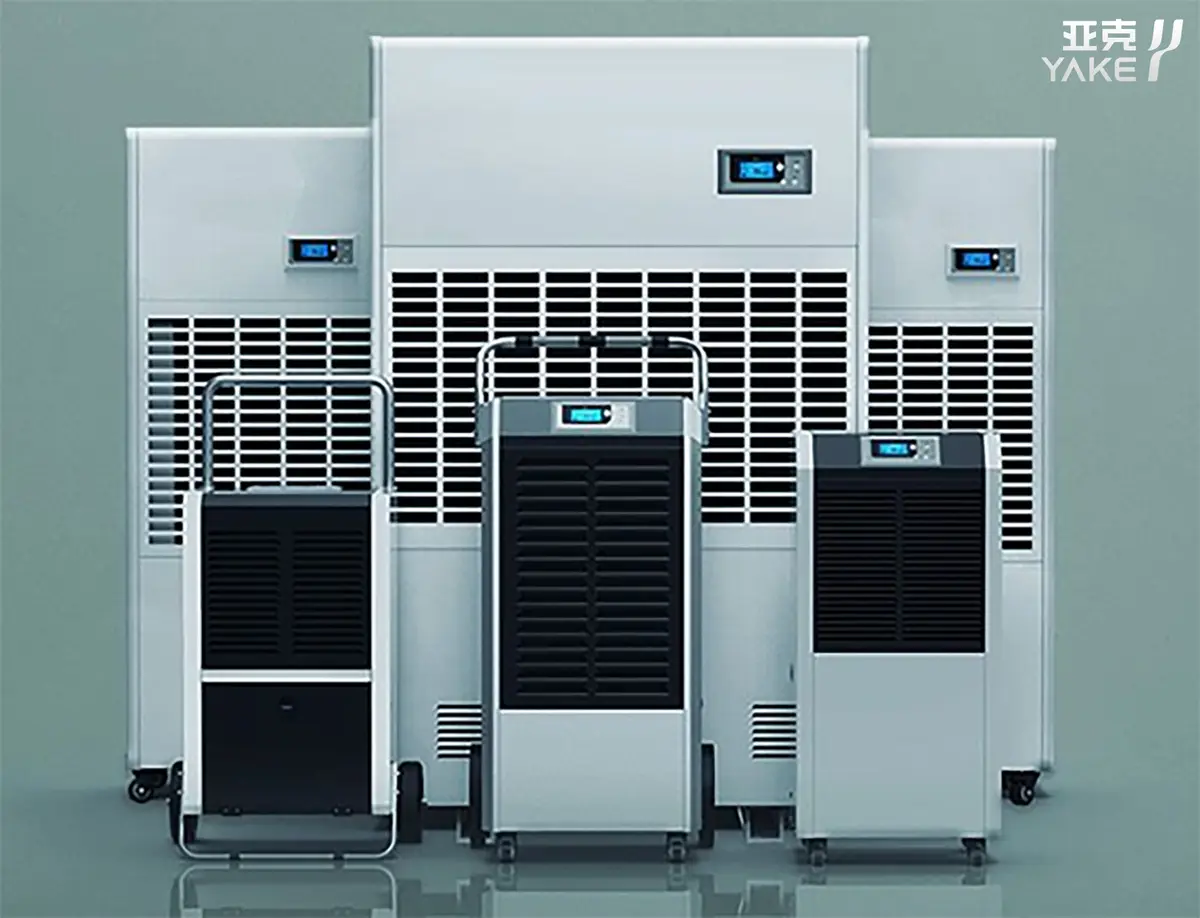
1. What a Refrigerant Dehumidifier Does
Dew point is the temperature at which air becomes saturated and water starts to condense. Energy factor is the water removed per unit of electricity.
A refrigerant dehumidifier cools air below its dew point on a cold evaporator coil, condenses water out, and reheats the air at the condenser before returning it to the space. The mechanism is simple, and it defines both the benefits and the limits of the technology.
2. Where It Is the Right Choice
| Operating condition | Refrigerant | Desiccant |
|---|---|---|
| Warm, humid air | Compare delivered removal, defrost and electrical input at the design point | Compare regeneration source, exhaust, fans and total system energy at the same duty |
| Moderate RH target | Often suitable if capacity and controls match the load | May be unnecessary unless the target or conditions require it |
| Cold entering air | Capacity may fall or frost; verify defrost and effective water removal | May suit the duty, but include regeneration heat, exhaust and system energy |
| Low target dew point | May be limited; verify achievable outlet dew point and energy | May suit low dew point duty; verify regeneration conditions and whole-system energy |
| Frost-sensitive duty | Use only with a verified operating envelope, defrost response and protected outcome | Use only after a matched comparison of outlet condition, regeneration and system boundary |
Refrigerant equipment can suit commercial buildings, warehouses, growing rooms, and similar spaces with warm humid loads, when the selected unit delivers the required water removal at the actual entering-air condition. The benefit is not a universal technology advantage: compare delivered capacity, defrost or other recovery behaviour, and total energy at the project conditions.
3. Measurable Benefits
| Benefit | What it actually means | Condition |
|---|---|---|
| Water removal capacity | Removes moisture at a stated entering-air condition | Warm, humid conditions |
| Energy per litre | Measured or calculated electricity per unit of water removed at a stated condition | For running cost, include electricity and any regeneration heat, fan, exhaust and downstream-cooling duties at local energy prices |
| Reheat effect | Air returns warmer, reducing overcooling in some spaces | Depends on the space |
| Continuous drainage | Condensate leaves through a defined route | Drainage designed |
| Simple service | Filters, coils, and drain are accessible | Installation provides access |
The words "improved air quality" and "comfort" are outcomes, not specifications. The engineering content is the capacity and energy at a defined condition. If the entering-air temperature and humidity are not stated, the benefit cannot be compared.
4. Where the Benefits Are Earned
The benefit case is strongest where the application matches the envelope:
- Warm process areas with high moisture loads, where the coil condenses efficiently.
- Ventilated buildings where outdoor air dominates the load and the outdoor condition is warm and humid.
- Growing rooms running at moderate temperatures with high transpiration.
- Restoration and drying work in temperate conditions, where continuous removal matters.
In each case the equipment is selected on the load, the design entering-air condition, and the energy factor at that condition, not on a catalogue headline.
5. Where the Benefits End
The limits are as important as the benefits:
- Cold conditions. Verify the selected unit’s rated operating envelope and effective capacity after defrost at the required inlet temperature and humidity.
- Low dew point targets. A refrigerant coil may be limited by its entering state and coil conditions; a desiccant system may be appropriate, but verify the required outlet dew point, regeneration heat, exhaust and total energy at the same duty.
- High ambient heat. Verify delivered capacity, input power, condensing conditions, protection and the complete unit's permitted operating envelope at the project's high-ambient duty. Refrigerant cycle limits are one design input, not a stand-alone selection rule. See refrigerant design considerations.
Compare refrigerant and desiccant systems at the same entering state, target outlet condition, water-removal duty and whole-system energy boundary. The detailed comparison is in commercial dehumidifier selection.
6. Energy Claims Must Be Condition-Based
Energy efficiency is a measured figure at a stated condition, not a property of the machine. A unit's energy factor at 30 °C / 80 % RH says nothing about its performance at 10 °C. Compare power input and water removal at your design condition, and include defrost, regeneration heat, exhaust, fan power and any downstream cooling in the same system boundary. Ask whether the figures are measured or calculated. The rating-conditions problem is explained in what a daily water removal rating really means.
7. Integration, Maintenance, and Operation
The equipment only delivers its benefit inside a working system:
- Controls. The unit must control on the project's variable, whether RH, dew point, or an external command. A humidistat alone cannot serve a dew point strategy.
- Drainage. Continuous gravity drainage or a condensate pump is a design input, not an afterthought.
- Maintenance. Filters, coils, and drains follow condition-based intervals, as set out in commercial dehumidifier maintenance.
- Refrigerant. The refrigerant type, its GWP, and the regulatory timetable in the destination market affect long-term serviceability.
8. Discussing a Project
Industrial Dehumidification for Complex Climate Applications
Yakeclimate designs and manufactures industrial dehumidification equipment for complex climate applications, with a focus on agriculture and energy projects.
We co-develop application-specific dehumidification equipment around the operating conditions, interfaces, and integration requirements of the wider project or system.
Explore industrial dehumidifiers, review desiccant rotor dehumidifiers, or contact Yakeclimate with the space, moisture sources, target condition, and operating range.
FAQ
Frequently Asked Questions
When is a refrigerant dehumidifier the right choice?
A refrigerant dehumidifier may be a good fit when the space operates in a suitable temperature range, the target humidity is moderate, and the load is driven by warm humid air. Commercial buildings, warehouses, and growing rooms are possible examples. For colder entering air, low dew points, or frost-sensitive duty, compare the actual refrigerant and desiccant configurations at the required inlet and outlet conditions, including defrost, regeneration heat and whole-system energy; do not select by temperature label alone.
Is a refrigerant dehumidifier always more energy-efficient?
Only at matched operating conditions and system boundaries. Its energy per litre may be favourable in warm, humid conditions and may deteriorate as the entering air cools or defrost begins. Compare power input, effective water removal, defrost, regeneration or exhaust duties, and any downstream cooling at the design condition rather than comparing catalogue figures from different conditions.
Does a refrigerant dehumidifier improve air quality?
It removes moisture and may reduce conditions that support mould growth, but air quality is an outcome, not a specification. The engineering benefit is delivered capacity and energy at a stated condition. Filtration, ventilation and source control do separate jobs.
Why does capacity fall in cold conditions?
At low entering-air temperatures, check the selected unit’s operating envelope, evaporator conditions, defrost cycle and effective water removal. There is no universal entering-air temperature at which every project should switch from refrigerant to desiccant equipment.
How should the energy benefit be verified?
Ask for capacity and power at your design condition, measured or calculated, and record a commissioning baseline of water removal, power, airflow, and entering and leaving conditions. Future performance is compared against that baseline.
References
- AHAM DH-1, Dehumidifiers, capacity rating standard (US)
- ASHRAE Handbook—HVAC Applications and Fundamentals (psychrometrics and environmental control references)
- Commercial dehumidifier selection


