
Comparable baseline measurements help distinguish equipment degradation from changes in operating conditions or moisture load.
- Compare the cost of restoration against replacement on measured energy and capacity, not on age alone.
1. The Short Answer Is Condition-Based, Not Age-Based
Capacity is the water a dehumidifier removes at a stated entering-air condition. Energy factor is the water removed per unit of electricity, the efficiency number that matters for operating cost.
Age alone does not establish deterioration. Compare water removal, power, airflow and operating conditions with a commissioning baseline before assigning a cause.
The useful question is not "how old is the machine?" It is "what condition is the machine in, and how do I prove it?"
2. What Actually Degrades
| Component | Failure mode | Effect |
|---|---|---|
| Filters | Clog with dust | Airflow drops; capacity and energy efficiency fall |
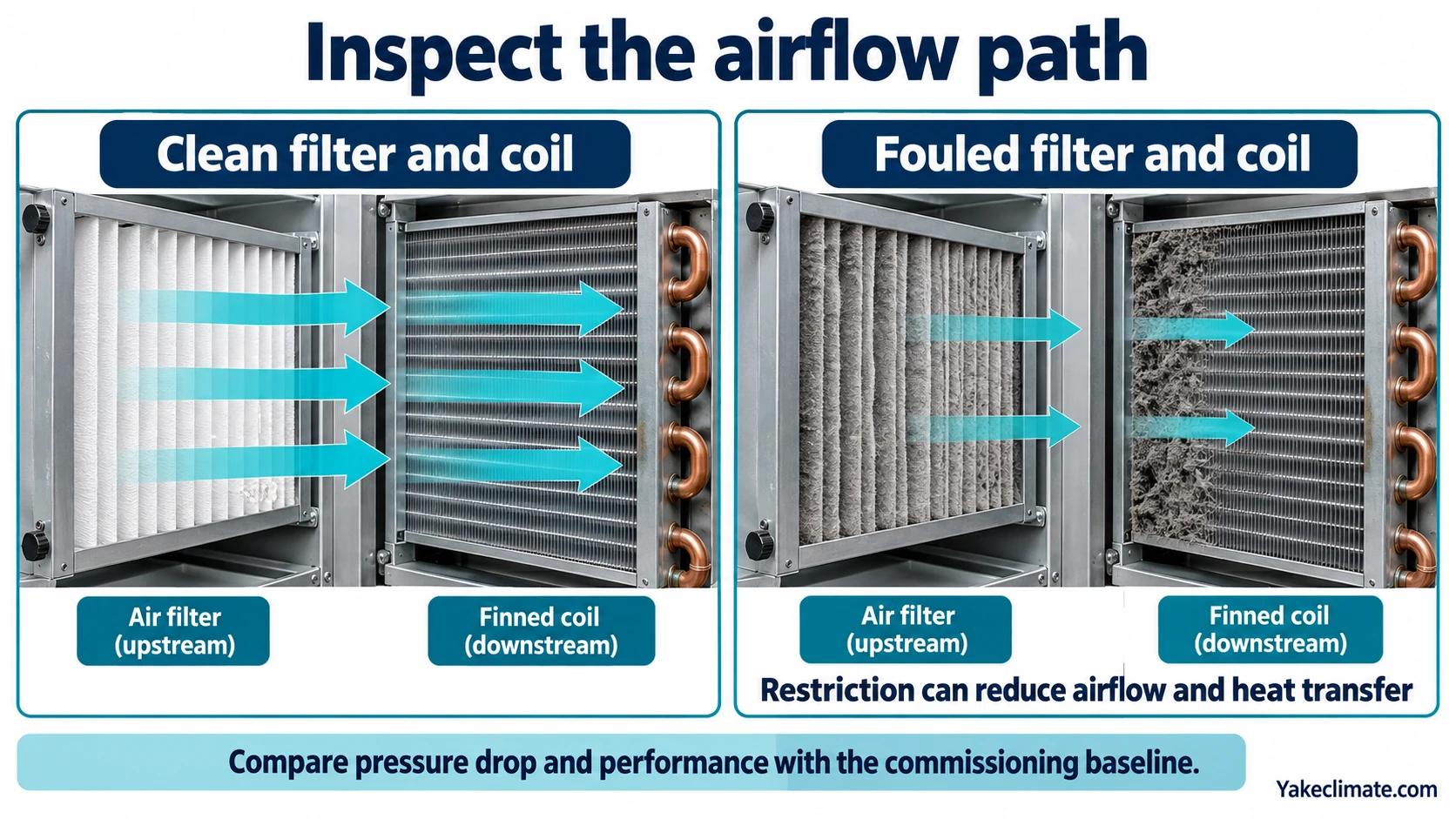
| Coils | Particulate fouling | Airflow and heat transfer fall; capacity drops |
| Refrigerant charge | Leak or incorrect charge | Evaporator temperature and capacity move off optimum |
| Fan and motor | Wear, imbalance, belt or bearing loss | Airflow drops; noise and energy rise |
| Desiccant media | Contamination and aging | Moisture transfer falls; regeneration energy rises |
| Sensors and controls | Drift, calibration loss | Machine controls on a wrong reading |
| Drain path | Blockage or partial obstruction | Recovery behaviour degrades; water backs up |
Filter and coil fouling should be investigated alongside airflow and refrigerant-circuit condition. Research on air-conditioning heat exchangers illustrates how combined faults can reduce performance, but those results are not a capacity-loss forecast for every dehumidifier. Use measurements on the actual installation to assess the effect.
Incorrect refrigerant charge may affect measured moisture removal and electricity use. A suspected leak, charge measurement or refrigerant-circuit repair must be handled by qualified service personnel under applicable local requirements; do not top up or open the circuit as a user task. Compare the actual unit with its service documentation rather than extrapolating a research percentage.
For desiccant equipment, assess media condition, contamination, seals and regeneration conditions against the selected equipment documentation. Service life is specific to the media and its operating history; a design-life statement for one product is not a general replacement interval.
3. How to Detect Reduced Efficiency
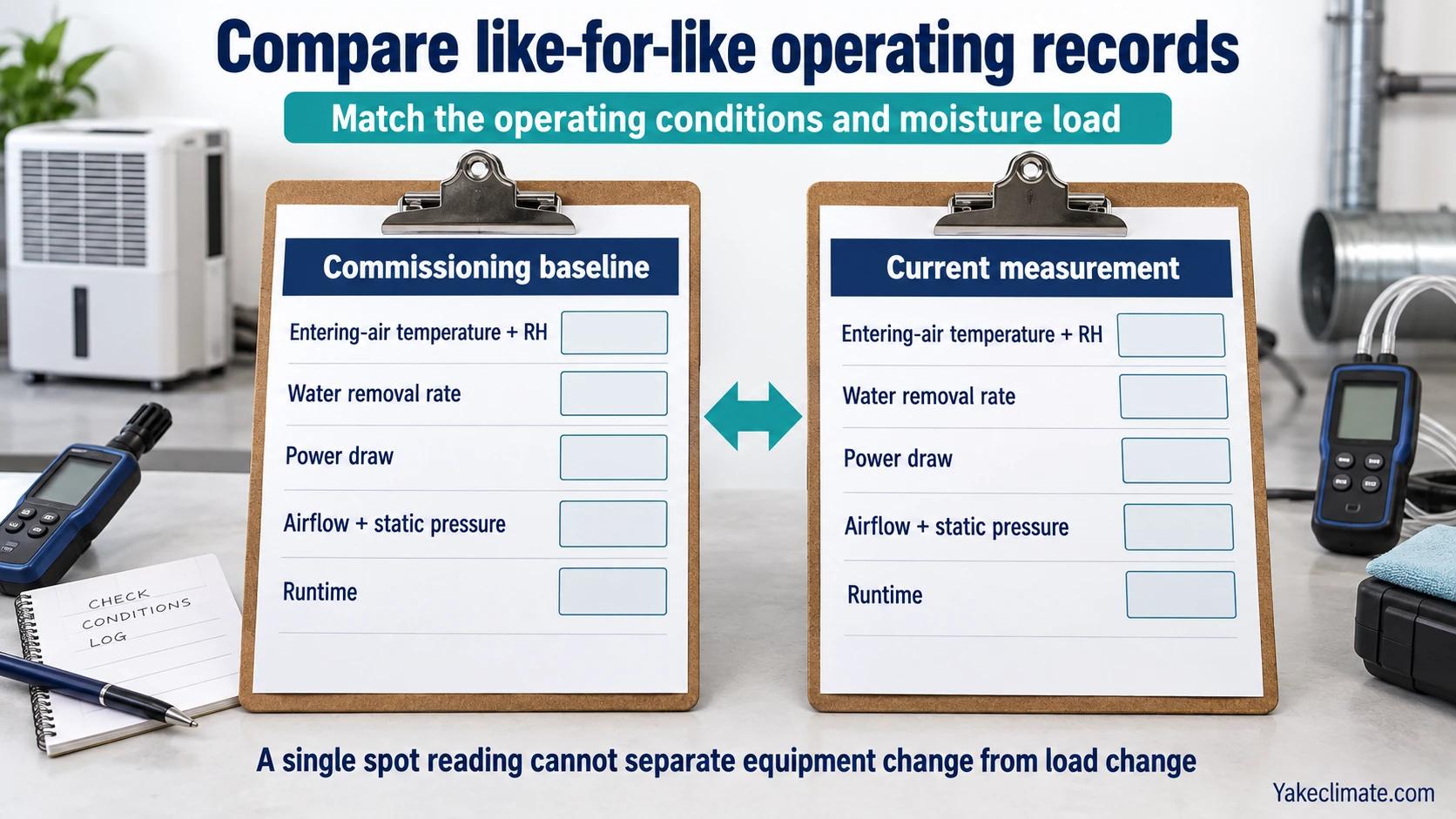
The reliable method is comparison against a baseline, not a feeling that the machine is working harder.
Record at commissioning:
- water removal rate at a stated condition;
- power draw;
- entering and leaving air conditions;
- airflow and static pressure;
- condensate rate;
- runtime per day.
Later, repeat the same measurements at the same conditions. Then the following become diagnosable:
- humidity creeps above setpoint at the same load;
- runtime per day increases at the same conditions;
- condensate volume falls for the same entering-air condition;
- power draw rises for the same water removal;
- airflow at the filter position is noticeably lower;
- the unit alarms more often or fails to reach setpoint.
A single spot reading cannot distinguish a degraded machine from a changed load. Baseline comparison can.
4. The Maintenance Plan
The plan follows the degradation table:
- Filters. Clean or replace on a schedule set by the environment, and measure pressure drop when practical. High-dust environments need shorter intervals.
- Coils. Inspect for fouling, especially on the entering-air face. Clean when pressure drop or performance indicates, using the manufacturer's method.
- Refrigerant circuit. Qualified service personnel should check superheat, subcooling or operating pressures against the service manual and applicable requirements. Investigate any charge deviation; do not simply top up or open the circuit yourself.
- Fan and motor. Check airflow, vibration, and current draw against commissioning values.
- Drain path. Verify continuous flow and clean the drain pan, trap, and outlet.
- Desiccant media. Check wheel condition, seals, and regeneration temperature against the manufacturer's criteria.
Sensors. Verify readings against an appropriate reference using a documented procedure. Set the verification interval from the sensor requirements, exposure and observed drift.
Maintenance guidance of this type is developed further in commercial dehumidifier maintenance.
5. Repair or Replace?
Decide on measured facts, not on age alone.
- If the condition is fouling, airflow loss or another restorable component fault, obtain an actual repair quote and compare it with the measured capacity and energy improvement the repair is expected to deliver.
- If the machine needs repeated repairs, compare the actual repair quote with the unit's expected remaining life, measured operating cost and capacity under the current load before choosing replacement.
- If capacity has genuinely fallen because the application changed, a new unit is a load question, not a maintenance question.
- If a major component, compressor or desiccant wheel has failed, compare the actual component-and-labour quote with the unit's expected remaining life, measured operating cost and capacity needs before deciding whether replacement is better.
For a fleet or repeated design, track energy and runtime per unit over time. That data turns the repair-or-replace decision from an argument into a calculation.
6. Conclusion
Dehumidifiers lose efficiency when their operating condition is allowed to degrade, not simply because they age. Fouling, incorrect refrigerant charge, airflow loss and media aging are measurable mechanisms. Use a commissioning baseline and maintenance plan; for repair or replacement, compare the actual quote, expected remaining life and measured operating cost and capacity.
7. Discussing a Project
Industrial Dehumidification for Complex Climate Applications
Yakeclimate designs and manufactures industrial dehumidification equipment for complex climate applications, with a focus on agriculture and energy projects.
We co-develop application-specific dehumidification equipment around the operating conditions, interfaces, and integration requirements of the wider project or system.
Explore industrial dehumidifiers or contact Yakeclimate to review the operating conditions and maintenance requirements for your project.
FAQ
Frequently Asked Questions
Do dehumidifiers lose efficiency with age?
A unit can lose capacity when its condition changes, but age alone cannot quantify the effect. Compare water removal, power, airflow and operating conditions with the commissioning baseline.
How much capacity can fouling cost?
The effect depends on the equipment, contamination, airflow and other faults. Compare measured water removal and power under comparable conditions; do not apply a percentage from an air-conditioning experiment directly to a dehumidifier.
Why does refrigerant charge matter for dehumidifiers?
Age alone does not establish deterioration. Compare water removal, power and airflow with the commissioning baseline under comparable conditions. If charge or a leak is suspected, have qualified service personnel diagnose and repair the circuit under applicable local requirements.
How do I know my machine is actually degrading?
Compare water removal, power, airflow and runtime with the commissioning baseline under comparable conditions. A difference warrants investigation of load, airflow, controls and equipment condition; it does not by itself identify a failed component.
How long does a desiccant wheel last?
There is no universal desiccant-wheel replacement interval. Review the selected media documentation, contamination history, seals, regeneration conditions and measured performance before deciding whether service or replacement is needed.
When should I replace instead of repair?
Choose replacement when the actual repair quote, expected remaining life and measured operating cost make restoration less defensible, or when the current load has genuinely outgrown the machine. Decide from measured energy and capacity, not age alone.


