
1. Not Two Settings of the Same Machine
Critical temperature is the temperature above which a refrigerant cannot condense into liquid regardless of pressure. GWP is its global warming potential relative to carbon dioxide, on a stated assessment basis. Refrigerant safety classification addresses both toxicity and flammability; it is not a complete approval of an equipment design or installation.
R290 and R410A are not two settings of the same machine. Changing between them changes the compressor, the operating pressures, the lubricant, the throttling device, the safety case, the certification route, and the markets the finished equipment can be sold into.
That is why "which refrigerant is better" has no answer. The useful questions are more specific: what does each one do to the design, where does each one run out of envelope, and what does the regulatory timetable require of a machine that has to remain serviceable for fifteen years?
| Property | R290 (propane) | R410A |
|---|---|---|
| Safety class | A3 (lower toxicity / higher flammability) | A1 (lower toxicity / no flame propagation under the classification test) |
| GWP (EPA reference table) | about 3 | about 2,088 |
| Critical temperature | about 96.7 °C | about 70–71 °C |
| Safety and charge assessment | Confirm applicable requirements for the actual A3 configuration | Confirm applicable requirements for the actual A1 configuration |
| High-ambient capacity | Verify the complete unit at the project condition | Verify the complete unit at the same project condition |
GWP values depend on which assessment report a regulation references. The figures above follow the US EPA reference table. The applicable regulation in the destination market should be checked, since the same refrigerant can carry different official values under different regulatory instruments.
2. Why It Is Not a Drop-In
Four things change together, which is why substitution is a redesign rather than a recharge.
- Operating pressure. R410A runs at substantially higher pressure than R290. Pressure vessels, valves, service ports, and pressure protection all have to match the fluid.
- Volumetric capacity. R410A carries more cooling capacity per unit of swept volume. A compressor selected for one refrigerant will deliver a different capacity on the other, so it must be re-selected, not just refilled.
- Lubricant compatibility. Confirm the compressor manufacturer’s approved refrigerant and lubricant combination, oil-return requirements and component compatibility. Do not assume an existing lubricant or circuit is suitable for a different refrigerant.
- Throttling and circuit design. Expansion device sizing, tube diameters, and circuit lengths follow from the fluid's properties and mass flow.
R290's flammability additionally changes the electrical design, enclosure construction, leak detection provisions, factory processes, and service procedures. There is no configuration in which one is dropped into a machine designed for the other.
3. Critical Temperature and High-Ambient Performance
This is where the two fluids diverge most usefully for equipment selection, and it is rarely discussed in refrigerant comparisons.
As condensing temperature rises toward a refrigerant's critical temperature, cycle efficiency and capacity fall, increasingly steeply as the gap closes. R410A's critical temperature of roughly 70–71 °C is low compared with most alternatives, so it approaches this regime at condensing temperatures that occur in real high-ambient operation.
Critical temperature is one input to refrigerant-cycle design, not a ranking of finished dehumidifiers. R290 has a higher critical temperature than R410A, but capacity, efficiency and operating limits depend on the compressor, heat exchangers, controls and test conditions. Research comparing R22 and R410A air conditioners does not directly measure R290 dehumidifiers. Compare complete dehumidifiers at matched inlet conditions, with declared power and water-removal measurements.
For a dehumidifier destined for a hot climate, a greenhouse in the Gulf, a warehouse in Southeast Asia, or an unconditioned industrial building in summer, this is a design consideration rather than an environmental one.
4. The Dehumidifier-Specific Point
Most refrigerant comparisons are written about air conditioning, and one structural difference makes them incomplete for dehumidifiers.
In an air conditioner, the condenser rejects heat to a separate outdoor air stream. In a typical recirculating dehumidifier, the evaporator and condenser sit in series in the same air path. Air is drawn in, cooled below its dew point at the evaporator so water condenses out, and then passes over the condenser, which reheats it. Air leaves warmer and drier than it entered.
Two consequences follow:
- Condenser conditions depend on the equipment layout, airflow and room heat balance. In a typical series-airflow recirculating unit, air first passes the evaporator and then the condenser; this arrangement does not establish a universally higher condensing temperature than an air conditioner.
- Compressor discharge temperature and lubricant compatibility must remain within the selected components’ limits. Verify these for the full operating envelope rather than inferring them from the refrigerant name.
This is why a refrigerant comparison written for split air conditioners should not be applied directly to dehumidification equipment, and why capacity and efficiency claims must be tied to dehumidifier test conditions rather than air-conditioning ones. The broader point about rating conditions is set out in what a daily water removal rating really means.
5. Confirm the Applicable Safety Requirements
For R290, the practical constraint on industrial capacity is frequently charge quantity and the standards route that follows from it.
The permitted refrigerant charge depends on the applicable product standard and edition, its scope, the refrigerant, equipment construction, installation conditions and required protective measures. A single charge figure is not a universal allowance for all dehumidifiers. Confirm the applicable requirements in the destination market and document the selected product’s assessment before fixing the design.
A design outside one allowance cannot simply assume a different standard grants permission. Determine the complete applicable product and installation requirements, and revise the configuration where needed. The product assessment must establish compliance for the actual construction and use.
This standards-route decision is often the real gate on an R290 industrial design. Which route applies to a specific machine depends on its scope classification, capacity, installation context, and the standards adopted in the destination market. That determination belongs to the manufacturer's compliance assessment for that product, not to a general article.
A second practical constraint is component availability: the range of compressors and components qualified for hydrocarbon service at larger capacities is narrower than for HFC service.
6. The Regulatory Timetable
The HFC transition is the reason R410A's position is changing, and the timetable is specific rather than general.
Refrigerant restrictions are specific to the market, equipment category, activity and compliance date. In the EU, review the applicable provisions of Regulation (EU) 2024/573, including relevant amendments and exceptions. In the US, review both the EPA Technology Transitions restrictions and applicable SNAP conditions. Do not transfer an air-conditioner deadline or allowance to a dehumidifier without confirming its classification. Rules for new manufacture or import are not interchangeable with rules for servicing existing equipment.
United States. The EPA operates its own timetable under the AIM Act's Technology Transitions programme and the SNAP programme, with rules applying to specific end uses and equipment categories on their own schedule.
Two things determine what applies to a given machine: which equipment category it falls into, and its rated capacity. Both are classification questions, and a dehumidifier's classification under a regulation written primarily around air conditioning and heat pump categories is not always self-evident. Confirming the classification with the manufacturer and against the requirements of the destination market, before the refrigerant route is fixed, is the practical step.
For equipment with a fifteen-year service life, the relevant question is not only what is permitted at the point of sale but what refrigerant availability and service cost look like over that life.
7. Transport Is a Real Constraint
This rarely appears in refrigerant comparisons and regularly surprises buyers.
R290 is flammable, so transport review must consider the refrigerant, charge quantity, equipment category, transport mode and route. A1-classified refrigerant equipment can also fall under dangerous-goods provisions; A1 is not a blanket exemption. Confirm the applicable classification, any conditional exemption, packaging, marking and documentation with a qualified logistics provider for the actual shipment.
For a manufacturer shipping internationally, and for a buyer importing equipment, this affects freight options, cost, lead time, and in some cases whether a particular routing is available at all. Charge quantity influences which provisions apply.
It does not make R290 equipment impractical to ship: a large volume of hydrocarbon-charged equipment moves internationally every year. But it is a logistics factor that should be established early rather than discovered at booking. The applicable provisions should be confirmed with the freight forwarder for the specific product, charge quantity, and routing.
8. The Comparison Is No Longer Binary
Framing the decision as R290 versus R410A is increasingly out of date. The realistic field includes:
- A2L refrigerants, including R32, R454B and R1234ze(E), are additional candidates for an equipment assessment. Their requirements differ from those for A3 refrigerants, but charge restrictions, safety provisions and installation requirements still apply. Check the actual refrigerant, product standard and edition, equipment construction and destination-market rules; A2L classification alone does not establish suitability.
- R513A. An A1-classified option where the safety classification must be retained.
- R744 (CO2) and others. More specialised positions with their own pressure and cycle characteristics.
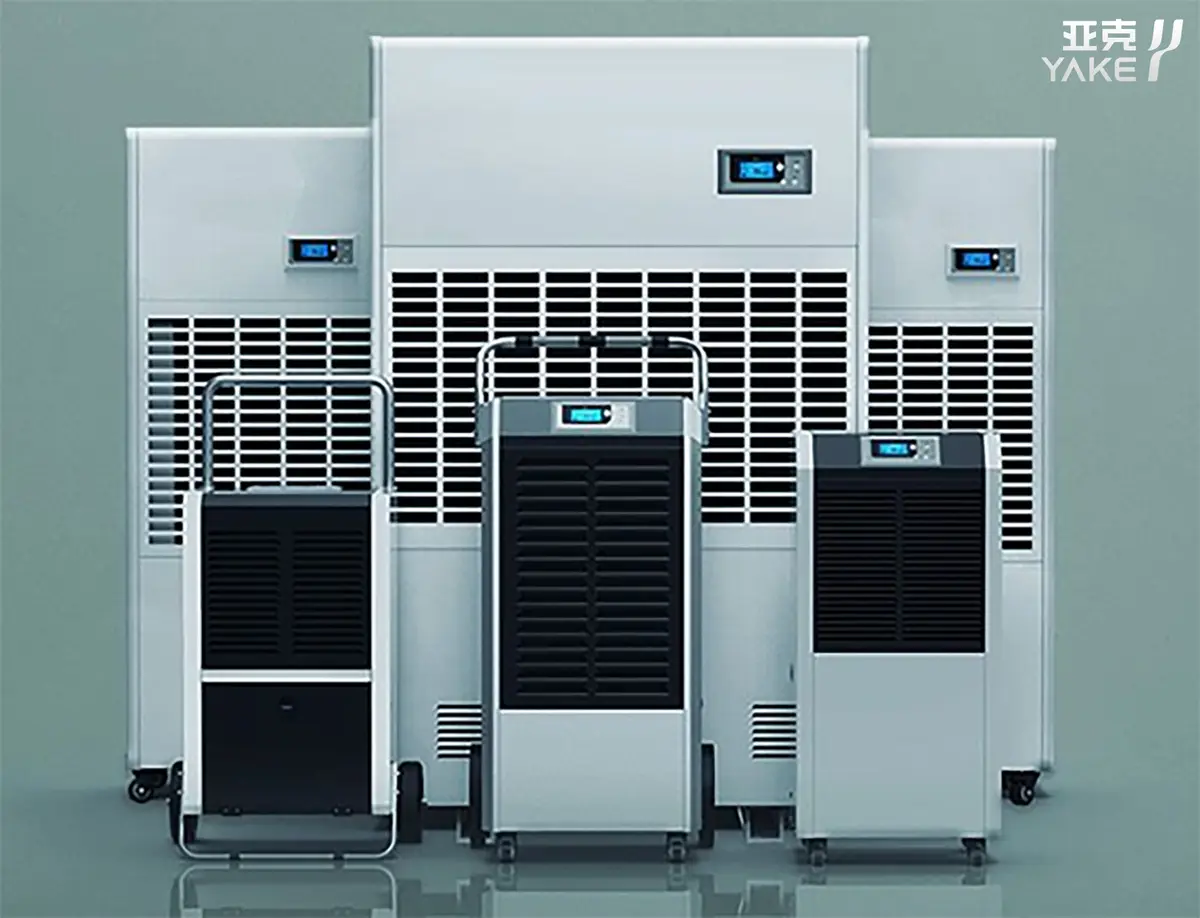
This catalogue already reflects a mixed position: the RYCM portable dehumidifier series is offered with an R410A or R290 option, and the ADS-100WB-06 energy-storage dehumidifier uses R513A. Different products in the same range use different refrigerants because their capacities, enclosure formats, target markets, and safety cases differ. The refrigerant follows the application rather than the other way around.
9. How to Evaluate the Route for a Project
The refrigerant is an output of the application review, not an input to it.
- Define the operating envelope: minimum and maximum ambient, entering-air condition, target condition, and load variation. High-ambient duty raises the weight of critical temperature.
- Establish required capacity and format. These determine the circuit size and therefore the charge quantity, which determines which standards route is available.
- Identify the destination market and equipment category. Classification determines which prohibitions and dates apply.
- Review the safety and installation context: enclosure format, installation space, ventilation, ignition sources, and the competence of the service organisation.
- Confirm the service model: refrigerant availability, service capability in the destination market, and expected life.
- Establish transport requirements for the charge quantity and routing.
- Compare complete units at matched conditions, not refrigerants in the abstract.
Steps 2 and 3 usually narrow the field faster than any thermodynamic comparison.
10. Information to Prepare
- Destination country or region, and any customer-specific standard.
- Required water removal capacity and the entering-air condition at which it must be delivered.
- Full ambient temperature range, including high-ambient extremes.
- Target humidity or dew point.
- Equipment format, installation location, available space, and ventilation conditions.
- Power supply and control interface.
- Certification requirements applicable in the destination market.
- Service arrangements and the qualification of the service organisation.
- Expected equipment life.
- Shipping route and any known freight constraints.
11. Discussing a Project
Industrial Dehumidification for Complex Climate Applications
Yakeclimate designs and manufactures industrial dehumidification equipment for complex climate applications, with a focus on agriculture and energy projects.
We co-develop application-specific dehumidification equipment around the operating conditions, interfaces, and integration requirements of the wider project or system.
Determining which regulatory provisions and standards apply to a specific machine in a specific market is part of the product's compliance assessment, undertaken with the applicable standard text and the requirements of the destination market. A general article describes the framework; it cannot make that determination.
Explore industrial dehumidifiers or contact Yakeclimate to review the operating conditions for your project.
FAQ
Frequently Asked Questions
Can an R410A dehumidifier be recharged with R290?
No. The two differ in operating pressure, volumetric capacity, lubricant requirements, and circuit design, so the compressor, throttling device, tubing, and pressure-rated components all have to be re-selected. R290's flammability additionally changes the electrical design, enclosure construction, leak detection provisions, and service procedures. Substitution is a redesign, not a recharge.
How should high-ambient performance be compared?
Critical temperature is one input to refrigerant-cycle design, not a ranking of finished dehumidifiers. R290 has a higher critical temperature than R410A, but capacity, efficiency and operating limits depend on the compressor, heat exchangers, controls and test conditions. Research comparing R22 and R410A air conditioners does not directly measure R290 dehumidifiers. Compare complete dehumidifiers at matched inlet conditions, with declared power and water-removal measurements.
What are the R290 charge limits?
The permitted refrigerant charge depends on the applicable product standard and edition, its scope, the refrigerant, equipment construction, installation conditions and required protective measures. A single charge figure is not a universal allowance for all dehumidifiers. Confirm the applicable requirements in the destination market and document the selected product’s assessment before fixing the design.
When does R410A become unavailable?
Refrigerant restrictions are specific to the market, equipment category, activity and compliance date. In the EU, review the applicable provisions of Regulation (EU) 2024/573, including relevant amendments and exceptions. In the US, review both the EPA Technology Transitions restrictions and applicable SNAP conditions. Do not transfer an air-conditioner deadline or allowance to a dehumidifier without confirming its classification. Rules for new manufacture or import are not interchangeable with rules for servicing existing equipment.
Does R290 affect shipping?
R290 is flammable, so transport review must consider the refrigerant, charge quantity, equipment category, transport mode and route. A1-classified refrigerant equipment can also fall under dangerous-goods provisions; A1 is not a blanket exemption. Confirm the applicable classification, any conditional exemption, packaging, marking and documentation with a qualified logistics provider for the actual shipment.
Is the choice really only between R290 and R410A?
No. Other refrigerants may be considered, including A2L options such as R32 or R454B. A2L does not remove charge restrictions or safety and installation requirements. Assess the actual refrigerant, equipment design, applicable standard and destination market. An alternative safety class is not permission to substitute refrigerants in an existing machine.
References
- US EPA, Technology Transitions GWP Reference Table — EPA
- Regulation (EU) 2024/573 on fluorinated greenhouse gases — EUR-Lex
- NIST, A Comparison of an R22 and an R410A Air Conditioner Operating at High Ambient Temperatures — NIST
- IEC 60335-2-40, seventh edition: higher hydrocarbon charge limits approved
- ASHRAE refrigeration resources: refrigerant classification and system safety standards
- EN 378, Refrigerating systems and heat pumps: Safety and environmental requirements
RYCM-90C — Portable Dehumidifier — 90 L/24h at 30 °C / 80 % RH · 5–38 °C The catalogue offers R410A or R290 configurations. Confirm the actual configuration, rated conditions, refrigerant charge and market-specific safety and transport requirements; portable format alone does not establish compliance.


