
A commercial dehumidifier for a grow room should be selected from the room's water balance, not from floor area alone. The right model depends on crop water use, lighting schedule, HVAC operation, ventilation or sealed-room strategy, air distribution and the humidity target at the canopy.
For the wider design context, review agriculture humidity control and greenhouse dehumidification before comparing equipment.
Define the Grow-Room Boundary First
Before choosing equipment, define what the dehumidifier is responsible for controlling. A sealed grow room, a ventilated greenhouse bay, a vertical farm room and a drying room can all be called "grow rooms," but the moisture boundary is different.
For stacked crop production, the vertical-farm water-balance example separates outside make-up water, internal moisture load and hourly equipment duty.
For mushroom production rooms, use the mushroom humidity-control guide to add species, production stage, CO₂ ventilation and washdown conditions to that brief.
| Boundary question | Why it matters |
|---|---|
| Is the room sealed, ventilated or hybrid? | Ventilation may remove moisture when outdoor air is dry, but it can add moisture when outdoor air is humid. |
| Is cooling equipment also removing latent load? | Cooling coils may remove water, but only when coil temperature and runtime support condensation. |
| Where is the crop canopy? | Humidity at the sensor wall can look acceptable while leaves stay wet in a dense canopy. |
| What is the crop stage? | Propagation, vegetative growth, flowering, fruiting and drying can create different moisture profiles. |
| Is the room one zone or several zones? | A single return-air sensor can hide local dead spots. |
For larger greenhouse projects, start with the greenhouse dehumidification design data checklist. For indoor crop spaces, the same principle applies: define the moisture source and control boundary before naming a model.
Estimate Moisture Load From Water Use
For a defined crop-and-growing-medium boundary over the same interval, evaporated and transpired water equals water supplied minus drainage minus the increase in stored water, when other liquid inputs and outputs are absent or separately accounted for. Stored water includes the medium and plant water. Internal recirculation is not a second supply across that boundary. State which flows are measured, the sign of storage change, and the interval before using the estimate as a room moisture source. This is a water-balance and evapotranspiration estimate, not a measured grow-room performance result; see the FAO water-balance method.
The initial calculation can use this structure:
| Input | Example format |
|---|---|
| Number of rooms | 4 rooms, each controlled separately |
| Crop and stage | leafy greens, herbs, tomato, strawberry or other crop |
| Canopy area | m2 or ft2 of active crop area |
| Daily irrigation | liters/day or gallons/day by room |
| Stored-water change and other liquid flows | Increase or decrease in medium and plant water over the same interval; separately recorded additional inputs or outputs |
| Drainage or runoff | measured volume or percentage |
| Lighting schedule | hours on, hours off and transition period |
| Target condition | temperature, RH, dew point or VPD range |
| Room air change | sealed, intentional fresh air or leakage estimate |
For preliminary sizing, use a stated net-water or evaporative-load estimate only as a starting point. Separate daily totals from peak periods and check plant retention, medium storage, drainage timing, and other moisture exchanges before treating the estimate as a dehumidifier duty.
Separate Lights-On, Lights-Off and Transition Periods
A grow room is not steady for 24 hours. During lights-on, transpiration and sensible heat gain may both be high. Cooling equipment may run long enough to remove some moisture, even if it was selected mainly for temperature. During lights-off, plant temperature, air temperature and HVAC runtime change, and the same RH value can be closer to dew point on leaves and structures.
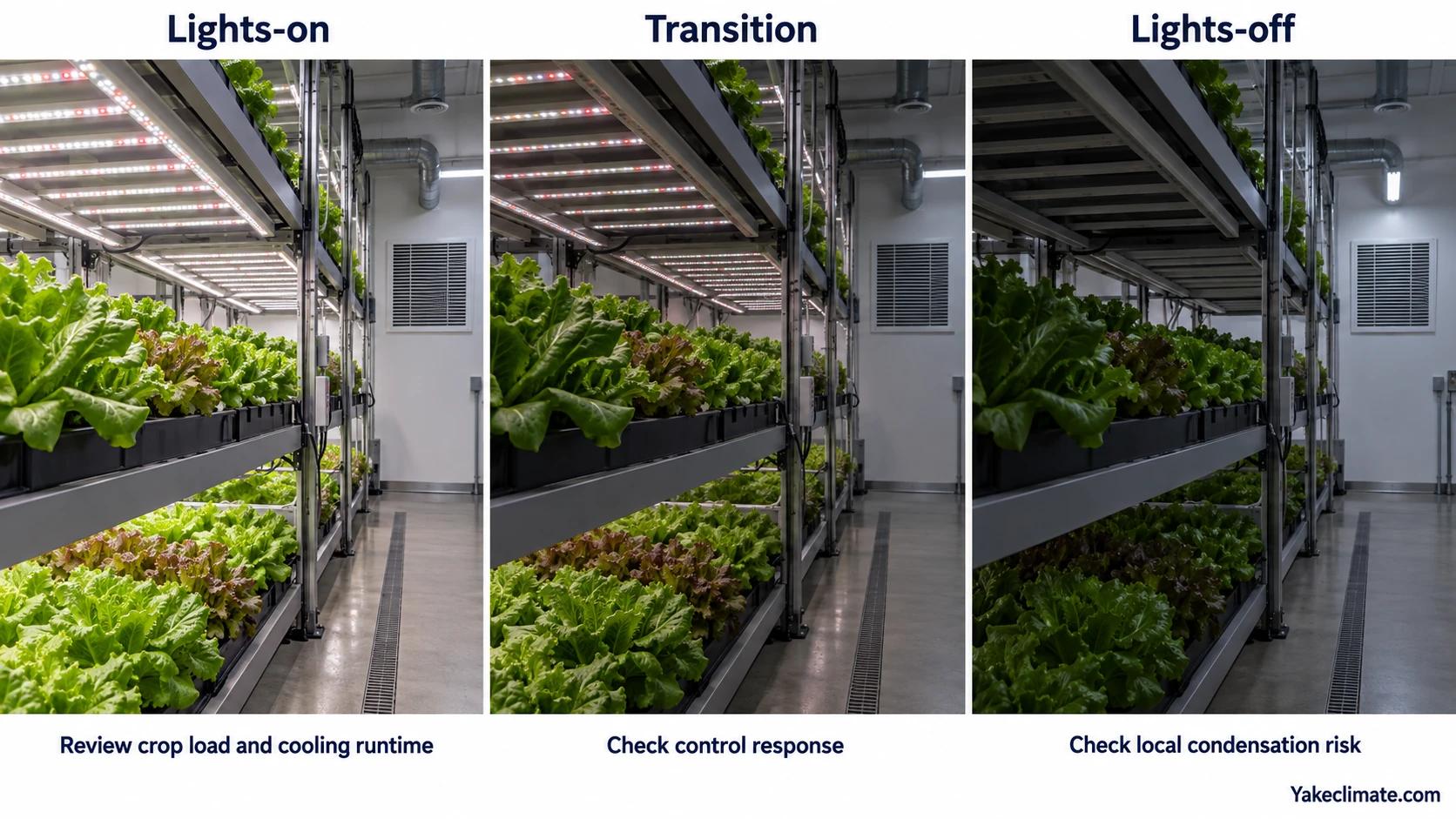
Check at least three periods:
| Period | What to check |
|---|---|
| Lights-on | Peak transpiration, cooling runtime, return-air humidity and airflow pattern. |
| Pre-lights-off transition | Whether humidity rises faster than equipment staging reacts. |
| Lights-off | Condensation risk, leaf wetness, minimum air movement and low-load HVAC behavior. |
NC State Extension notes that Botrytis risk is associated with high humidity and cool temperatures, and also points to avoiding prolonged leaf wetness and dead-air spots. The lesson for equipment selection is straightforward: a grow-room dehumidifier is not only a water-removal device; it is part of a control strategy that must protect the crop during the risky hours.
Match Technology to Room Temperature and Target Humidity
Commercial grow rooms usually compare refrigerant dehumidifiers, desiccant dehumidifiers and HVAC-integrated latent removal. None is automatically correct.
| Technology | Better fit | Watch point |
|---|---|---|
| Refrigerant dehumidifier | Warm rooms with moderate RH targets | Capacity falls when inlet air is cool or less humid. |
| Desiccant dehumidifier | Low dew point, cool conditions or tight humidity control | Reactivation energy and heat balance must be checked. |
| HVAC latent removal | Rooms where cooling runtime already aligns with moisture load | Temperature control may stop before humidity is controlled. |
| Hybrid arrangement | Projects with different day and night operating modes | Controls must decide which device leads under each condition. |
For the technology decision, compare dew point and operating condition in the refrigerant vs desiccant dehumidifier selection guide. For power planning, use the running cost calculation framework.
For greenhouse projects, compare greenhouse dehumidifier models at the required operating conditions.
Do Not Ignore Air Distribution
The dehumidifier can only remove the moisture that reaches it. Poor airflow can leave the canopy wet while the return sensor reports acceptable RH.
A practical layout check should include:
- supply-air throw and return-air path,
- air movement through and below the canopy,
- obstructions from benches, racks, curtains or ducting,
- distance between the sensor and the crop-risk zone,
- service access around filters, coils, fans and drains,
- noise or vibration limits near working areas.
Ceiling-mounted, wall-mounted, floor-standing and ducted units all solve different layout problems. For dense grow rooms, ducted or distributed airflow may be more important than a single larger unit.
Specify Controls and Alarms
A commercial grow room should not rely on a loose plug-in humidistat. The dehumidifier should receive a clear control signal, use the right sensor location and report faults before crop risk becomes visible.
Useful control points include:
| Control item | Specification |
|---|---|
| Control variable | RH, dew point, humidity ratio or VPD-related target. |
| Sensor location | Canopy zone, return air, duct or room average. |
| Staging | Lead-lag, multi-stage, variable speed or external enable. |
| Alarms | high humidity, low temperature, condensate overflow, fan fault and compressor fault. |
| Interface | dry contact, 0-10 V, 4-20 mA, Modbus, BACnet or project-specific signal. |
| Trend data | temperature, RH, dew point, run status, alarm history and condensate observations. |
When a building controller or greenhouse computer is involved, define responsibility clearly. The controller may provide the target and schedule, while the dehumidifier protects equipment operation and fault handling.
Grow-Room Dehumidifier Data Checklist
Send these inputs before requesting model selection:
- room dimensions and canopy area,
- crop, growth stage and target condition,
- irrigation, drainage, changes in growing-medium and plant water storage, other liquid flows, their shared measurement interval, and lighting schedule,
- HVAC system type and expected operating temperature,
- sealed-room, ventilation or leakage assumptions,
- airflow layout, rack or bench arrangement and photos,
- electrical supply and available breaker capacity,
- drainage route and condensate handling requirement,
- control interface, alarms and trend-data requirements,
- acceptance method for humidity performance.
Yakeclimate designs and manufactures industrial dehumidification equipment for complex climate applications. Submit water-use data, operating schedules and room layout so equipment can be assessed at the intended conditions.
Review grow-room dehumidification equipment considerations alongside the room load, heat rejection and installation constraints.
FAQ
Frequently Asked Questions
What size commercial dehumidifier do I need for a grow room?
Start with the room moisture balance. Use supply and drainage measurements over the same interval, account for changes in growing-medium and plant water storage and any other flows, and estimate evaporation plus transpiration. Then include ventilation and other room sources and sinks, and check peak operating periods. Irrigation minus drainage alone is not measured plant transpiration.
Is a bigger grow-room dehumidifier always better?
No. Oversized equipment can short-cycle, create uneven air distribution, waste energy and make controls harder to tune. The better target is enough capacity at the actual operating condition, with airflow that reaches the crop zone.
Should the grow-room dehumidifier control RH or dew point?
RH is common, but dew point is often clearer for condensation risk. Some projects monitor RH, temperature and dew point together, then use VPD or crop-stage logic in the main controller.
Can air conditioning replace a dehumidifier in a grow room?
Sometimes it removes part of the moisture load, but cooling control and humidity control are not the same job. If the cooling system stops after reaching temperature, humidity may continue rising.


