
1. Separate the Process System From the Equipment Environment
Process boundary covers the storage medium, tanks, piping, pumps, heat exchangers, and process controls. Ambient equipment boundary covers control cabinets, motor-control centres, junction boxes, instrument panels, pump rooms, and auxiliary buildings.
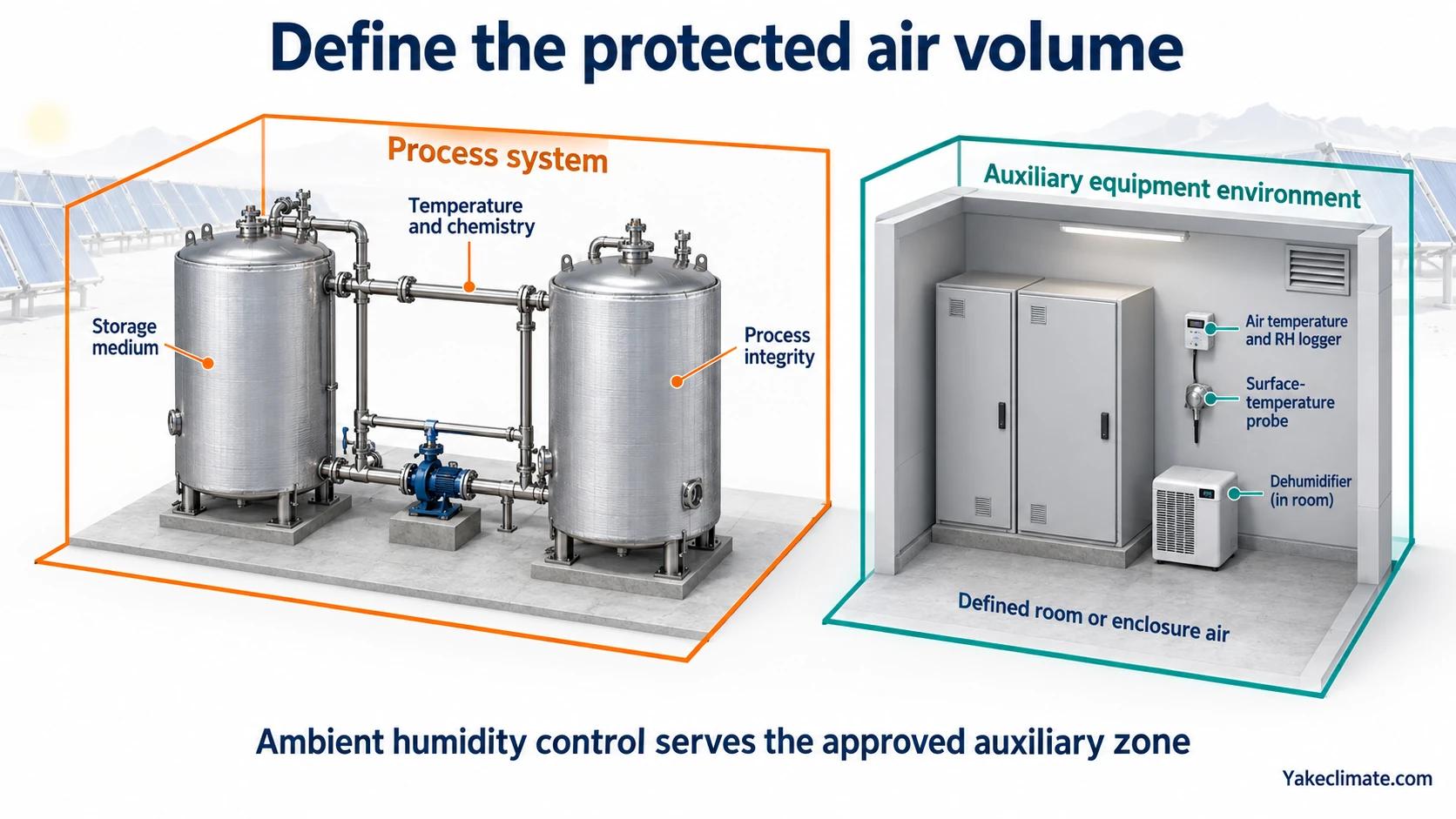
Solar thermal energy storage can use molten salts, heat-transfer fluids, water, steam, rocks, concrete, or other media. These process systems are designed around temperature, chemistry, containment, corrosion, freezing, and heat transfer.
Ambient dehumidification does not control the moisture content of a molten-salt tank or replace the process design. Its possible role is narrower: protecting electrical, control, and auxiliary equipment around the storage system when condensation, humid-air entry, or water ingress threatens reliability.
Process moisture, tank integrity, and fluid chemistry belong to the process designer. Ambient humidity control applies only to an air volume and equipment environment that has been defined and approved.
2. Where Ambient Moisture Can Matter
| Location | Typical risk | First action |
| Outdoor control cabinets | Solar heating, night cooling, rain, pressure changes | Seal, then assess dew point and cold surfaces |
| Pump and valve actuator enclosures | Heat, shutdown cooling, process leaks, washdown | Distinguish leakage from condensation |
| Electrical rooms and MCCs | Humid-air entry, cable entries | Seal penetrations, control the room |
| Junction boxes and instruments | Small thermal mass, rapid temperature change | Insulate and seal |
| Cable trenches | Water ingress, standing water | Drain and seal before air treatment |
| Insulated pipe and vessel exteriors | Water under insulation during shutdown | Inspect and repair cladding |
| Maintenance and spare-parts rooms | Stored equipment, doors | Room-level control if boundary is practical |
Each location has a different temperature, ventilation, and contamination condition. One site-wide RH value is not enough.
3. Control Cabinets and Junction Boxes
Outdoor cabinets can experience solar heating, night cooling, rain, wind, and repeated pressure changes. Moist air may enter through service doors, cable glands, damaged gaskets, or pressure devices.
Condensation becomes possible when a local surface reaches or falls below local air dew point. Common cold points:
- shaded walls and roof panels;
- cabinet base and foundation connections;
- large cable glands;
- metal connected to process piping;
- cooling components;
- instruments with low thermal mass.
Use the enclosure rating for its declared ingress-protection purpose, then assess internal dew point and cold surfaces separately.
4. Pump and Valve Areas
Pump stations can combine hot process equipment, cooling during shutdown, seals and potential process leaks, water washdown, ventilation, outdoor humid air, and electrical motors and controls.
First distinguish liquid leakage from condensation. Air dehumidification should not be used to hide a process-fluid leak, failed seal, roof leak, or drainage problem.
After liquid-water sources are corrected, local environmental control may be considered for an enclosed electrical or control zone.
5. Insulation and Cold-Surface Risk
Thermal-storage equipment is often associated with high temperature, but some surfaces can be cool during initial commissioning, prolonged shutdown, night operation, drainage or maintenance, cold-weather startup, or contact with cool foundations and structures.
Damaged insulation or weatherproof cladding can admit liquid water. Water beneath insulation is an integrity and corrosion-management issue that requires inspection and repair. Drying the surrounding air may support a controlled maintenance process, but it is not a substitute for restoring the insulation system.
6. Molten Salt Requires Process-Specific Control
Molten salts and their tanks operate under chemistry- and temperature-specific requirements. Research on thermal-storage tanks focuses on materials, corrosion, welds, thermal cycling, liners, instrumentation, and failure mechanisms.
Do not claim that a cabinet dehumidifier dries molten salt, prevents tank corrosion, controls salt chemistry, replaces tank heating, prevents salt freezing, or validates the storage process. Its role can be discussed only for the surrounding air and approved auxiliary equipment.
7. Water Ingress and Drainage Come First
Inspect:
- roofs and wall penetrations;
- cabinet doors and gaskets;
- cable trenches and foundations;
- drain paths;
- cooling-system condensate;
- washdown and maintenance water;
- pump seals and pipe connections;
- insulation cladding;
- standing water in equipment rooms.
Correct unintended liquid water before calculating an ambient moisture load.
8. Outdoor Dew Point and Daily Cycling
Solar facilities can have large day-night temperature swings. Equipment heated by the sun may cool rapidly after sunset while the outdoor dew point remains high. Cabinets and structural metal may then cross the dew point.
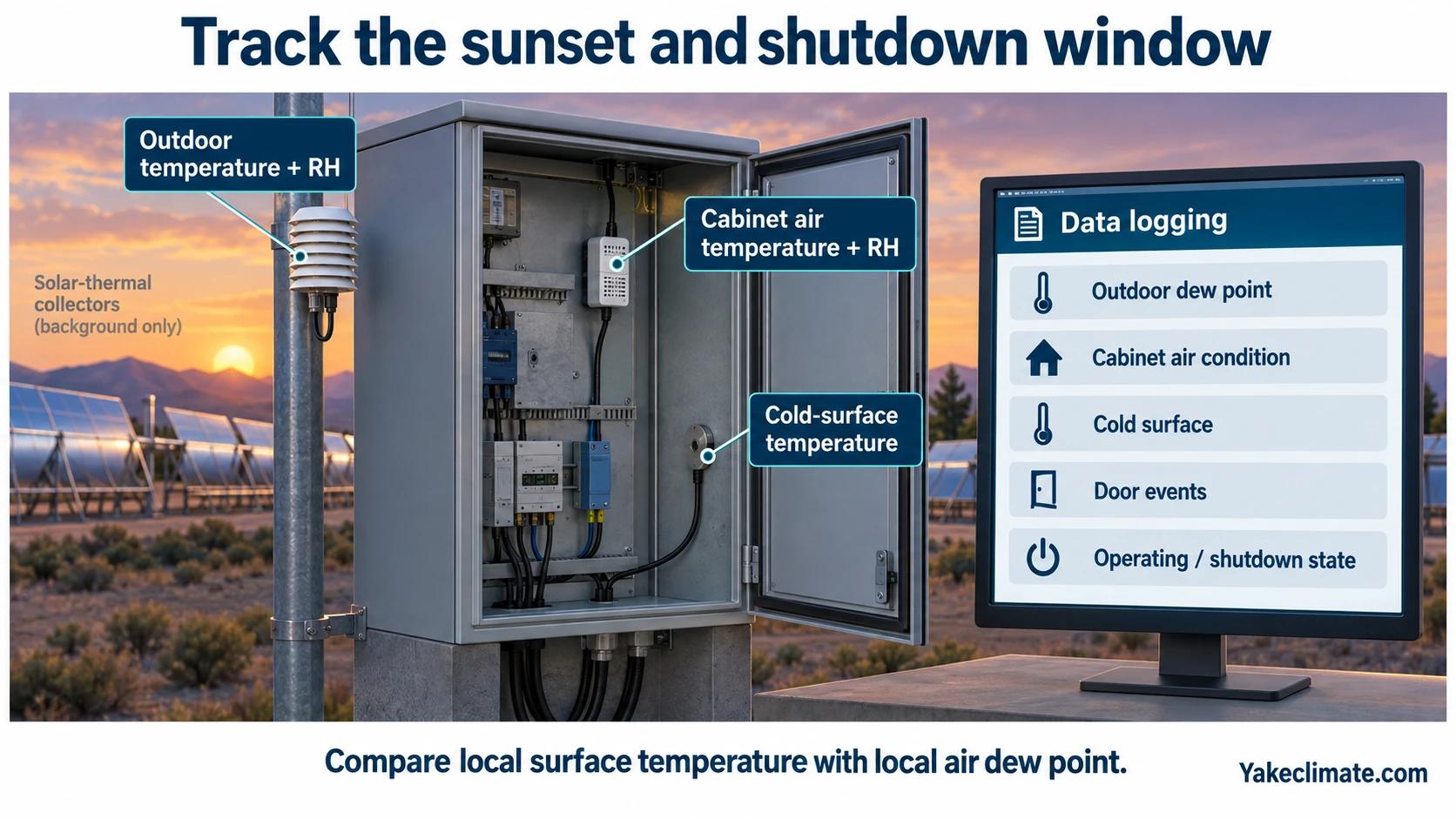
Trend:
- outdoor temperature and humidity;
- outdoor dew point;
- cabinet air condition;
- cold-surface temperatures;
- door and maintenance events;
- heater, ventilation, and dehumidifier status;
- process operating or shutdown state.
The most important event may occur during shutdown rather than full solar operation.
9. Dust, Salt, and Industrial Contaminants
Many solar thermal sites are dry and dusty; coastal or industrial sites may add salt or corrosive contaminants. Humidity control can reduce the time a surface remains wet, but it does not replace enclosure and coating selection, filtration, cleaning, material compatibility, corrosion monitoring, ingress and salt-spray evidence, or maintenance.
Select equipment and filters for the actual site. Do not infer a corrosion class from the presence of a dehumidifier.
10. Choose a Method for the Defined Zone
Possible measures:
- repairing water ingress and drainage;
- sealing unintended openings;
- controlled cabinet heating;
- managed ventilation;
- refrigerant dehumidification;
- desiccant drying for lower-temperature or lower-dew-point duties;
- monitoring dew point and cold surfaces.
For a small cabinet, a compact local device may be appropriate. For an equipment room, calculate ventilation, leakage, door events, and internal moisture sources. For an open pump area, air dehumidification may not create a controllable boundary.
11. Coordinate With Process and Safety Functions
Environmental-control equipment must not interfere with required process ventilation, hazardous-area classification, fire and gas systems, emergency shutdown, tank and pipe heating, pressure relief, maintenance access, or electrical protection. The process owner and responsible engineers define these interfaces.
12. Commissioning Checks
For an approved protected zone:
- confirm equipment and air boundary;
- inspect and correct liquid-water paths;
- verify sensor location and calibration;
- identify the minimum surface temperature;
- test airflow;
- test drainage or regeneration exhaust;
- confirm local and remote control;
- test alarms;
- record normal operation and shutdown;
- validate recovery after a representative humid-air event.
13. Discussing Auxiliary Equipment Protection
Industrial Dehumidification for Complex Climate Applications
Yakeclimate designs and manufactures industrial dehumidification equipment for complex climate applications, with a focus on agriculture and energy projects.
We co-develop application-specific dehumidification equipment around the operating conditions, interfaces, and integration requirements of the wider project or system.
Explore energy applications, review moisture control for electrical cabinets, or contact Yakeclimate with the protected equipment boundary and site condition.
FAQ
Frequently Asked Questions
Can a dehumidifier dry molten salt?
No, not in the sense discussed here. Molten-salt moisture and chemistry belong to the process system. Ambient dehumidification can only serve a defined surrounding air or auxiliary-equipment zone.
Where should moisture protection be reviewed?
Typical review points are control cabinets, electrical rooms, motor-control centres, junction boxes, instruments, and enclosed pump stations.
Can air drying replace insulation repair?
It cannot replace inspection, drainage, cladding repair, material selection, or the process corrosion programme. The insulation system must be maintained.
When is condensation risk highest?
After sunset or shutdown, metal can cool while outdoor air retains a high dew point. A local surface may then fall below dew point.
Can the whole pump area be dehumidified?
Only if a practical controlled air boundary can be created. Open-air exposure may make local enclosure protection more realistic than treating the entire area.
What must be defined before review?
The process boundary, liquid-water sources, safety and ventilation requirements, cold surfaces, outdoor dew point, and the exact auxiliary equipment to protect.
References
- US DOE: Solar thermal energy storage and heat-transfer media — DOE
- US DOE: Generation 3 concentrating solar power systems — DOE
- NREL: Failure analysis for molten-salt thermal energy storage tanks — NREL research hub
- NREL: Corrosion and durability research for concentrating solar power — NREL


