
A desiccant dehumidifier removes water vapor by adsorption. Humid process air passes through a moisture-attracting desiccant material, while a separate heated air stream dries that material so the cycle can continue.
Desiccant Dehumidification in One Sentence
Desiccant dehumidification is an adsorption process: water vapor moves from humid air onto a desiccant surface, then heat drives that moisture off the desiccant into an exhaust air stream. ASHRAE's technical committee scope for desiccant equipment distinguishes solid and liquid desiccants and notes that these systems dehumidify air rather than dry pressurized gases or liquids (ASHRAE TC 8.12).
In most industrial equipment, the desiccant is formed into a rotating honeycomb rotor. A portion of the rotor faces the process air stream and adsorbs moisture. Another portion faces hot reactivation air and releases that moisture outside the controlled space.
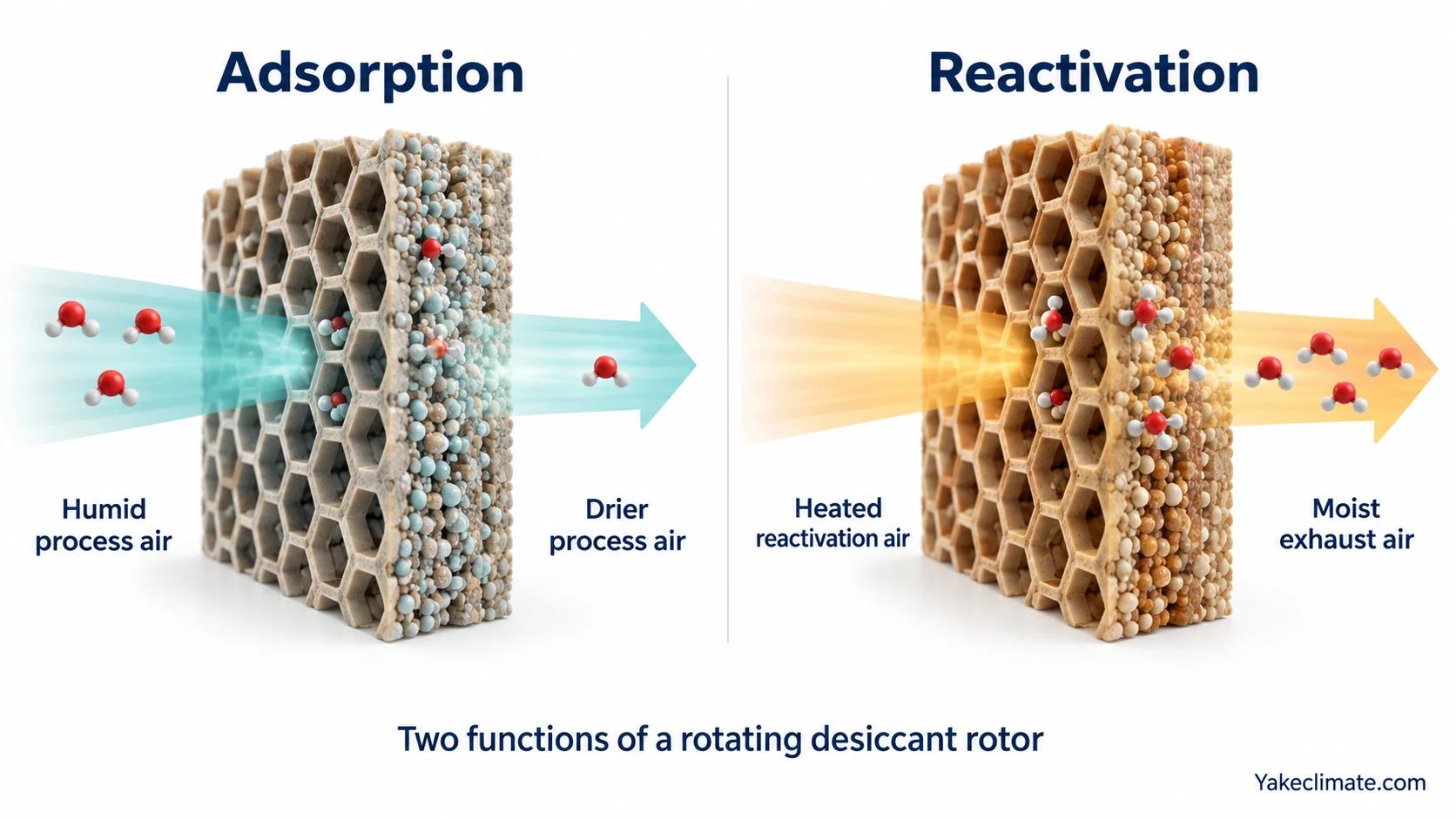
| Air stream | What it does | Design questions |
|---|---|---|
| Process air | Passes through the dry side of the rotor and leaves at a lower humidity ratio. | What inlet condition, supply condition and airflow are required? |
| Reactivation air | Is heated, passes through the wet side of the rotor and carries moisture away. | What heat source, exhaust path and energy limit are acceptable? |
| Purge or recovery air | Optional stream used in some designs to reduce carryover and improve efficiency. | Is the target dew point strict enough to justify the added complexity? |
Why Desiccant Units Reach Lower Dew Points
Refrigerant dehumidifiers remove water by cooling air below its dew point. That works well in many warm spaces, but a cold coil has a practical lower limit because condensate can freeze on the coil surface. In an ASHRAE Journal discussion on dehumidification, David Schurk explains that cold-coil systems are limited by freezing while desiccant systems remove moisture molecularly and can serve much lower dew point applications (ASHRAE Journal Podcast Episode 39).
That difference matters in battery dry rooms, low-temperature storage, powder handling, clean manufacturing and other processes where "keep RH under 60%" is too vague. The equipment target should be stated as inlet dry-bulb temperature, inlet humidity ratio, required leaving dew point, process airflow and allowable supply-air temperature rise.
The Main Components to Specify
The rotor is only one part of the system. A usable desiccant rotor dehumidifier also needs the air-handling, heating, sealing and control hardware around it.
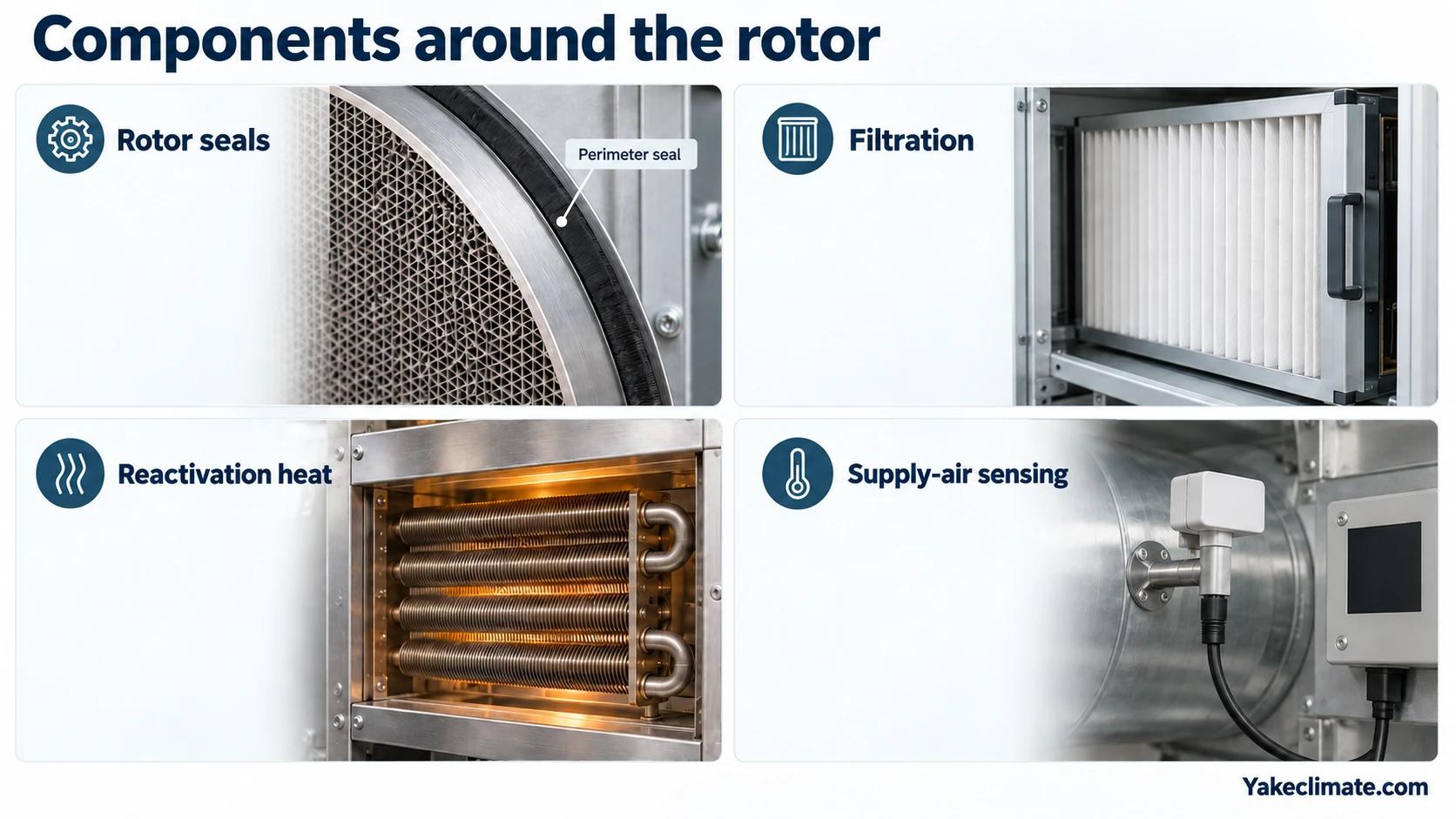
| Component | Why it matters | What to verify before purchase |
|---|---|---|
| Rotor media | Determines adsorption capacity, pressure drop and tolerance to contaminants. | Media type, face velocity range, regeneration temperature and replacement path. |
| Rotor seals | Limit leakage between wet and dry sectors. | Seal material, adjustment access and leakage impact on final dew point. |
| Reactivation heater | Supplies the heat that dries the rotor. | Electric, steam, hot water or gas availability and exhaust requirements. |
| Filtration | Protects the rotor from dust, oil mist and process contamination. | Filter class, pressure-drop allowance and maintenance access. |
| Controls | Holds leaving-air condition and protects the system. | Dew point sensor location, heater modulation, alarms and BMS protocol. |
A brief technology boundary: the inlet dry-bulb temperature, humidity ratio and required leaving dew point determine whether coil frost may limit refrigerant drying. Process airflow, reactivation heat and exhaust then shape a desiccant installation. A corporate-authored technical report hosted by DOE describes separate process and reactivation air paths and heat-driven regeneration; use the dedicated selection guide for equipment decisions.
For equipment comparison and sizing, use the refrigerant-versus-desiccant selection guide and carry the actual moisture-load inputs into the selected system.
Common Design Mistakes
The most common mistake is specifying "desiccant" because the application sounds demanding, without calculating the leaving-air condition. A desiccant unit can be oversized, under-reactivated or badly ducted just like any other HVAC system.
Watch for these failure points:
- Insufficient reactivation heat. The rotor cannot release moisture fast enough, so process-air dew point drifts upward.
- Wet-to-dry leakage. Poor seals or pressure balance allow reactivation air to contaminate the dry process stream.
- Dirty rotor face. Dust and oil reduce adsorption and increase pressure drop.
- Wrong sensor location. Room RH control may hide supply-air dew point instability.
- No exhaust plan. Reactivation air carries moisture out of the system and needs a controlled discharge path.
Warm industrial spaces may suit industrial dehumidifiers; lower dew point or coil-frost constraints may justify desiccant equipment. Use the selection guide for the comparison.
FAQ
Frequently Asked Questions
Does a desiccant dehumidifier cool the room?
Not by itself. Adsorption releases heat and reactivation also uses heat, so the supply air can be warmer unless the system includes cooling, heat recovery or post-treatment.
Is silica gel the same as liquid desiccant?
No. Silica gel rotors are solid desiccant systems. Liquid desiccant systems use a liquid solution and have different containment, corrosion and maintenance requirements.
When is refrigerant dehumidification still the better choice?
When the room is warm and the required humidity is moderate, refrigerant equipment often gives simpler installation and better electrical efficiency. Desiccant equipment becomes more compelling as the target dew point drops or coil frost becomes a constraint.


