
A wet cable trench can supply both liquid water and water vapour to switchgear. If cable entries are open or poorly sealed, humid trench air can move into the cable compartment as temperature and pressure change. Condensation then appears on the coldest internal surfaces, even when the switchgear room itself seems dry.
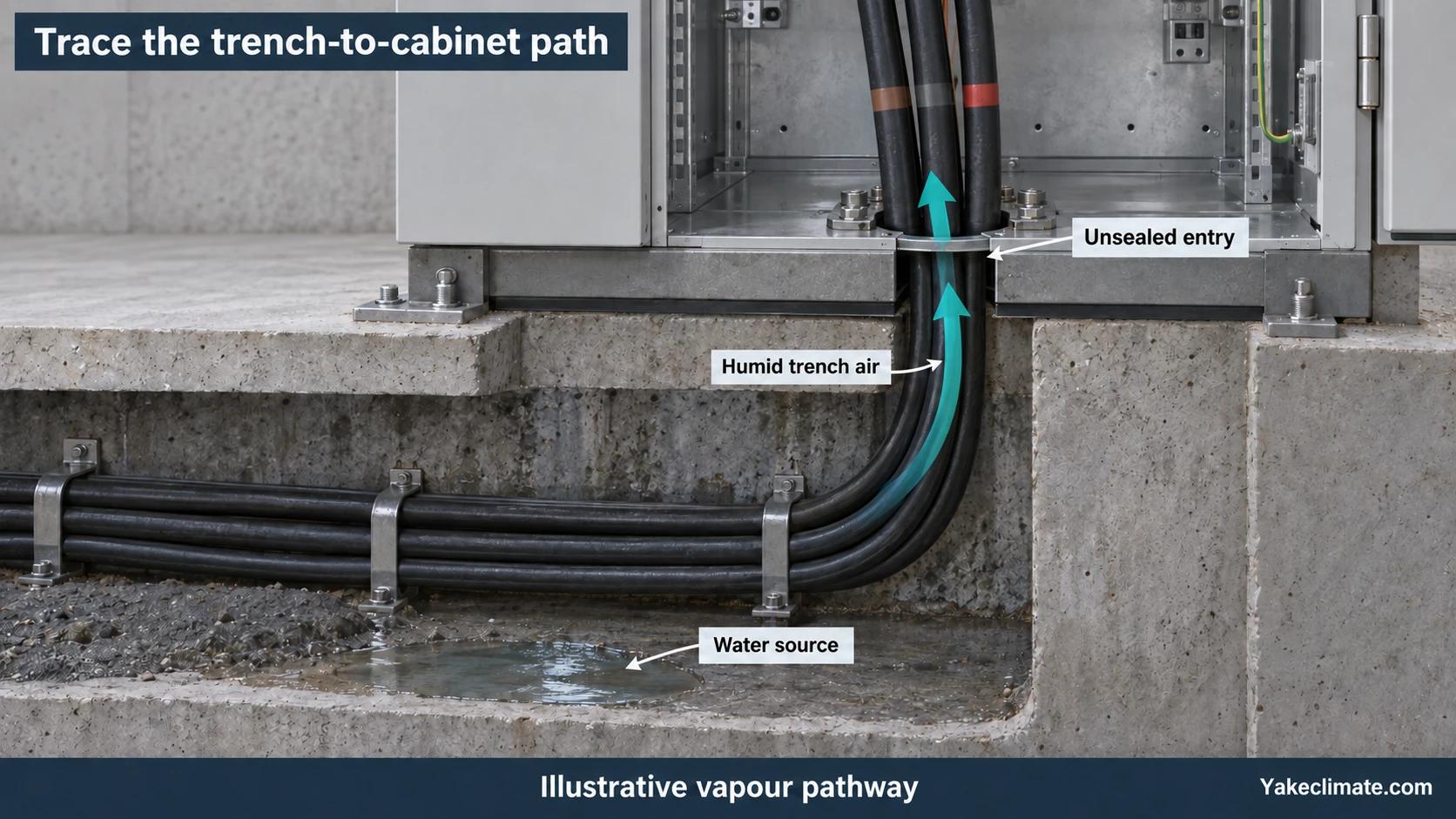
The first task is to stop and identify the moisture path. A cabinet heater or dehumidifier cannot compensate for uncontrolled flooding or rain ingress.
Start by Separating Liquid Water from Water Vapour
Inspect the trench and cabinet before drying them.
| Finding | Likely path | First response |
|---|---|---|
| Standing water in trench | Drainage, groundwater or rain problem | Remove water and identify its source |
| Water marks below a cable entry | Liquid migration or external ingress | Repair and reseal the path |
| Damp air but no visible leak | Vapour exchange from trench | Measure dew point and inspect openings |
| Droplets on several cold internal surfaces | Condensation | Compare surface temperature with local dew point |
| Repeated rust near cabinet base | Persistent local moisture exposure | Inspect trench connection, airflow and drainage |
Several paths can exist at the same time. Pumping out the trench may remove the immediate water while leaving an unsealed vapour path.
Why the Trench Can Be a Separate Air Zone
A cable trench is often cooler than the room above it and may have:
- standing water or damp concrete;
- limited ventilation;
- outside-air connections;
- long cable routes to other spaces;
- pressure changes from fans and weather;
- openings into several switchgear cubicles.
Its air can therefore have a different temperature and dew point from the switchgear room. A room sensor mounted at eye level will not show what enters at the cabinet floor.
Measure the trench and cabinet as separate zones.
How Moisture Moves into the Cabinet
Potential mechanisms include:
- liquid water travelling through an opening;
- humid air rising through cable entries;
- pressure changes caused by fans or thermal cycling;
- warm room air entering a cooler cable compartment;
- air circulation that bypasses the intended dry-air path.
The direction can reverse during the day. Smoke tests, differential-pressure measurements and time-aligned humidity logs can help identify air movement, provided the test method is safe for the electrical installation.
Inspect the Trench Before Changing Cabinet Airflow
Record:
- water depth and location;
- recent rain, groundwater or washdown events;
- trench drain condition;
- sump and pump operation;
- cracks, joints and cable-route penetrations;
- temperature and RH at several trench points;
- calculated trench dew point;
- visible corrosion, mould or deposits;
- cable-entry sealing at each affected cubicle.
Use this article's inspection sequence: first control standing water and identify its source; then inspect cable entries, drainage and the air boundary; then assess cabinet surfaces, dew point, airflow and any authorized drying option. Pumping, opening a cabinet, electrical isolation, drainage work and other interventions must follow site authorization, equipment documentation and qualified personnel requirements. This is the proposed diagnostic order, not a claim that every ring-main-unit or switchgear manual prescribes the same sequence. Treating the source before relying on local cabinet drying remains the priority; a dehumidifier working against an open water surface in the trench is being asked to dry the trench.
Inspect the Cabinet Bottom and Cable Chamber
Look for:
- unused gland openings;
- cracked or compressed seals;
- missing gland plates;
- unsealed gaps around grouped cables;
- cold metal connected to the trench or foundation;
- blocked internal air paths;
- heaters warming one zone but not another;
- dehumidification supply air that cannot reach the cable chamber.
Photograph the first wet or corroded point. Water that collects on the cabinet floor may have condensed higher up and run downward.
Measure Dew Point and Surface Temperature
Place an air temperature/RH sensor in the trench and another in the affected cabinet zone. Add surface-temperature sensors to:
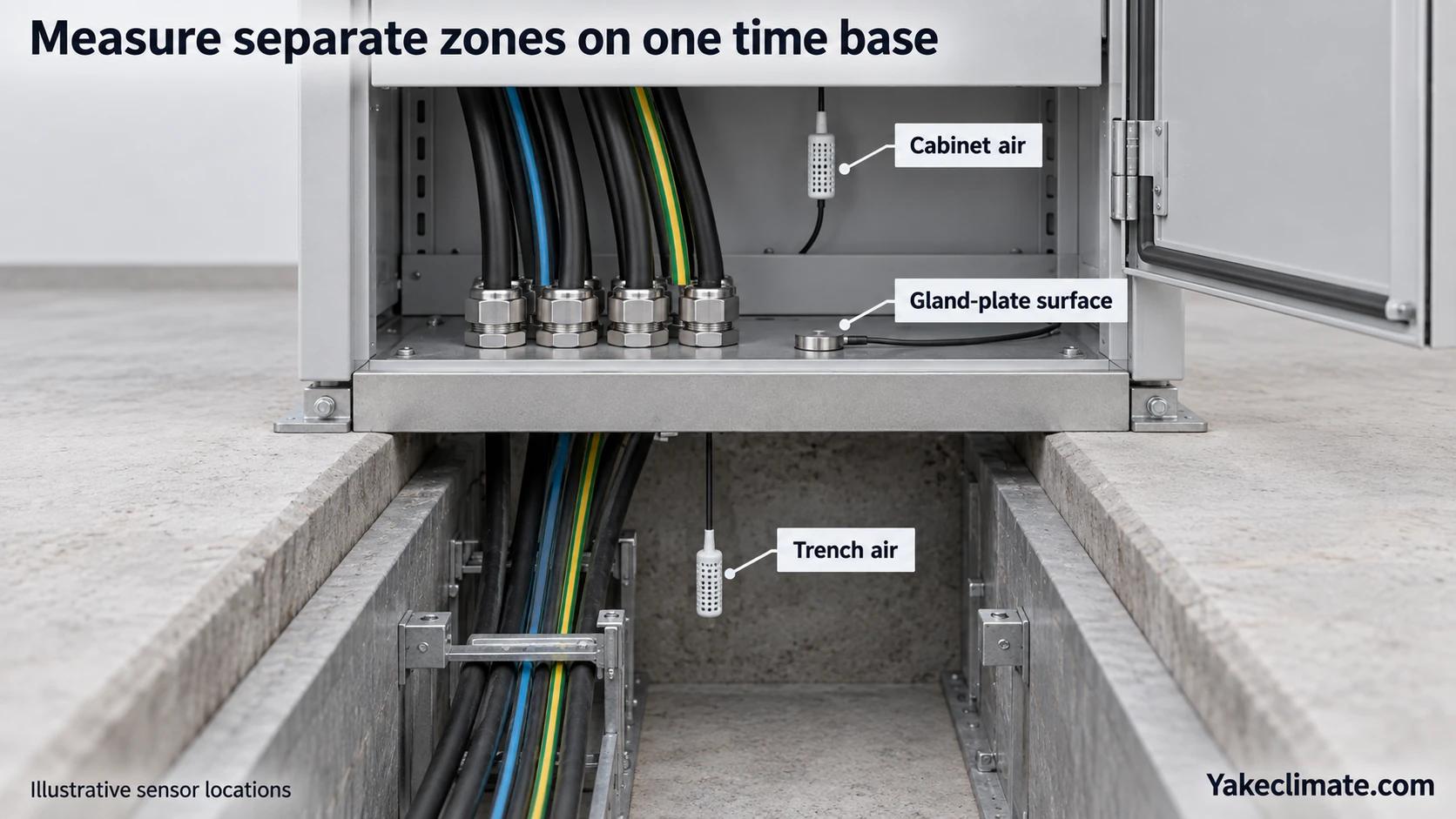
- the cabinet base;
- cable glands or gland plate;
- the coldest wall;
- representative insulation surfaces;
- any surface that first shows droplets.
Use one time base and log door, fan, heater and dehumidifier status. Condensation is possible when a surface reaches or falls below the dew point of the adjacent air.
Air Distribution Can Create Blind Areas
Dry air must reach the cable compartment and return to the treatment equipment. A fan that mainly circulates air in the busbar or control compartment can leave the bottom zone humid.
An open-access CFD study of high-voltage switchgear identified water-vapour infiltration, cable-trench water and poor sealing as important condensation drivers. It also showed that airflow distribution affects the dehumidification result.
For a real project, confirm:
- supply and return locations;
- separated compartments and barriers;
- blocked paths behind cables and equipment;
- required clearances;
- whether dry air leaks into the trench instead of treating the cabinet.
Choose Controls After the Source Is Understood
Possible measures include:
- repair external water ingress;
- improve trench drainage or sump control;
- seal cable entries with an approved system;
- insulate a persistent cold bridge;
- restore designed cabinet airflow;
- use a heater to keep a known surface above dew point;
- lower cabinet dew point with active dehumidification;
- coordinate alarms for high humidity, drain failure or equipment fault.
The electrical design, fire requirements and cable-entry certification determine which sealing and airflow changes are acceptable. Do not improvise a seal or airflow path that compromises the switchgear rating or maintenance access.
Verification After Remediation
Repeat the same measurements under the condition that caused the problem:
- confirm the trench stays free of unintended water;
- compare trench and cabinet dew point;
- confirm the coldest cabinet surface stays above the agreed margin;
- verify dry air reaches the affected zone;
- test heaters, dehumidifiers, drains and alarms;
- inspect again after a representative weather cycle.
Keep before-and-after trends and photographs as part of the maintenance record.
Discussing Switchgear Moisture Control
Yakeclimate designs and manufactures industrial dehumidification equipment for complex climate applications, with a focus on agriculture and energy projects.
We co-develop application-specific dehumidification equipment around the operating conditions, interfaces, and integration requirements of the wider project or system.
Review electrical-cabinet dehumidification, explore energy applications or contact Yakeclimate with trench conditions, cabinet drawings and environmental logs.
FAQ
Frequently Asked Questions
Can a cable trench cause condensation without flooding the cabinet?
Yes. Humid trench air can enter through cable openings and raise the cabinet dew point. Condensation then forms on an internal surface that is colder than that dew point.
Should cable entries be completely sealed?
They should meet the switchgear design, cable-entry system, fire, pressure and maintenance requirements. The project engineer should specify an approved sealing method rather than treating “fully sealed” as a generic instruction.
Will a cabinet heater solve trench moisture?
A heater may keep selected surfaces above dew point, but it does not remove standing water or repair an uncontrolled moisture path. Treat the trench source and verify the cabinet condition separately.
Where should humidity sensors be placed?
Use at least one sensor in the trench and one in the affected cabinet zone during diagnosis. Add surface-temperature sensors at the cabinet base, gland plate or first wet point.
Can a dehumidifier dry both the trench and the cabinet?
Only if the air boundary, volume, leakage and airflow path are intentionally designed for that duty. Drying an uncontrolled trench can create a much larger and unstable load than treating the cabinet.
What proves that the repair worked?
The trench remains free of unintended water, the cabinet dew point is controlled, the coldest surface stays above the agreed margin and the result is repeated during representative weather and operating conditions.
