
"How long should a dehumidifier run?" is the wrong question, because runtime is not something you set. It is something the equipment reports back to you about your building.

Runtime is a useful low-cost diagnostic signal when interpreted with the control state, measured condensate, inlet conditions and a commissioning baseline. It can flag changes worth investigating; it cannot by itself prove that the unit is sized correctly, the load is unchanged or capacity has degraded.
Runtime Is an Output
For a machine cycling on and off to hold a setpoint, the relationship is simple:
Runtime fraction ≈ moisture load rate ÷ capacity at the operating conditionA space generating 100 litres per day, served by equipment delivering 150 litres per day at that space's actual condition, will run about 67 % of the time. The same equipment in a space generating 140 litres per day runs about 93 %. Nothing about the machine changed.
Two points make this useful rather than merely arithmetic.
Capacity must be the capacity at the operating condition, not the catalogue figure. Rating conditions differ substantially between standards and are usually more favourable than real operating conditions — the subject of what a daily water removal rating really means. Using a catalogue number here will produce a runtime estimate that is far too optimistic.
Runtime is diagnostic evidence, not a direct measurement of all moisture generated by the space. A load-to-capacity estimate is useful only over a defined interval when unit capacity at the actual inlet condition is known, controls and cycling are understood, and moisture stored in materials or other removal routes are accounted for. Compare runtime with condensate, inlet conditions and commissioning records before assigning a cause.
What Normal Looks Like
A correctly sized installation follows a recognisable pattern.
Pull-down. On start-up, or after the space has been open, the equipment runs continuously until the setpoint is reached. Continuous operation here is correct and expected. How long it takes depends on how far the space is from target and on the load — and if a project has a defined pull-down requirement, that requirement may size the equipment rather than the steady-state load.
Steady state. Once at setpoint, runtime reflects the delivered capacity, ongoing moisture duty and control logic. It may be intermittent or nearly continuous; judge it against the target and design basis, not a universal duty-cycle percentage.
Seasonal variation. Runtime should track the load through the year — higher in humid seasons, higher when ventilation rates rise, higher during wet processes. A flat runtime across seasons in a space whose load clearly varies suggests the equipment is at a limit in one direction or the other.
Daily variation. Occupancy, process schedules, door openings and lighting schedules all move the load within a day. Runtime should show that structure.
The shape of the curve is as informative as the number. Runtime that varies sensibly with known load drivers indicates a system that is tracking its space. Runtime that is flat, or that does not respond to changes that should affect it, indicates something saturating.
Continuous Operation: Two Very Different Cases
Equipment running continuously is not automatically a problem. The distinction is whether it is holding setpoint.
Continuous and holding setpoint. The target was maintained during the observed period. This can be consistent with operation near the current duty, but it does not by itself prove correct sizing, full capacity or design margin. Compare inlet conditions, controls, equipment condition and the commissioning baseline before judging margin.
Continuous and not holding setpoint. Something is wrong, and there is a short list of causes.
| Cause | How to distinguish |
|---|---|
| Load higher than assumed | Compare measured condensate volume against the design load calculation |
| Capacity lower than assumed | Compare against the commissioning baseline at a similar operating condition |
| Operating condition colder than design | Check entering-air temperature; capacity falls sharply as it drops |
| Ventilation or infiltration increased | Check ventilation rate, door discipline, envelope changes |
| New moisture source | Process change, leak, wet materials introduced, drainage failure |
| Setpoint unachievable in current conditions | Check whether the target dew point is below what the equipment can produce |
| Air distribution failure | Check whether conditions are uniform; local humidity with satisfied sensor indicates distribution |
| Degraded capacity | Filter, coil, refrigerant charge, fan — see dehumidifier maintenance |
Work through the load, air path, controls, measurements and equipment condition before replacing a unit. Ventilation changes and fouled filters or coils are examples to check, not a ranked list of the most common causes.
Short Cycling Is the Worse Fault
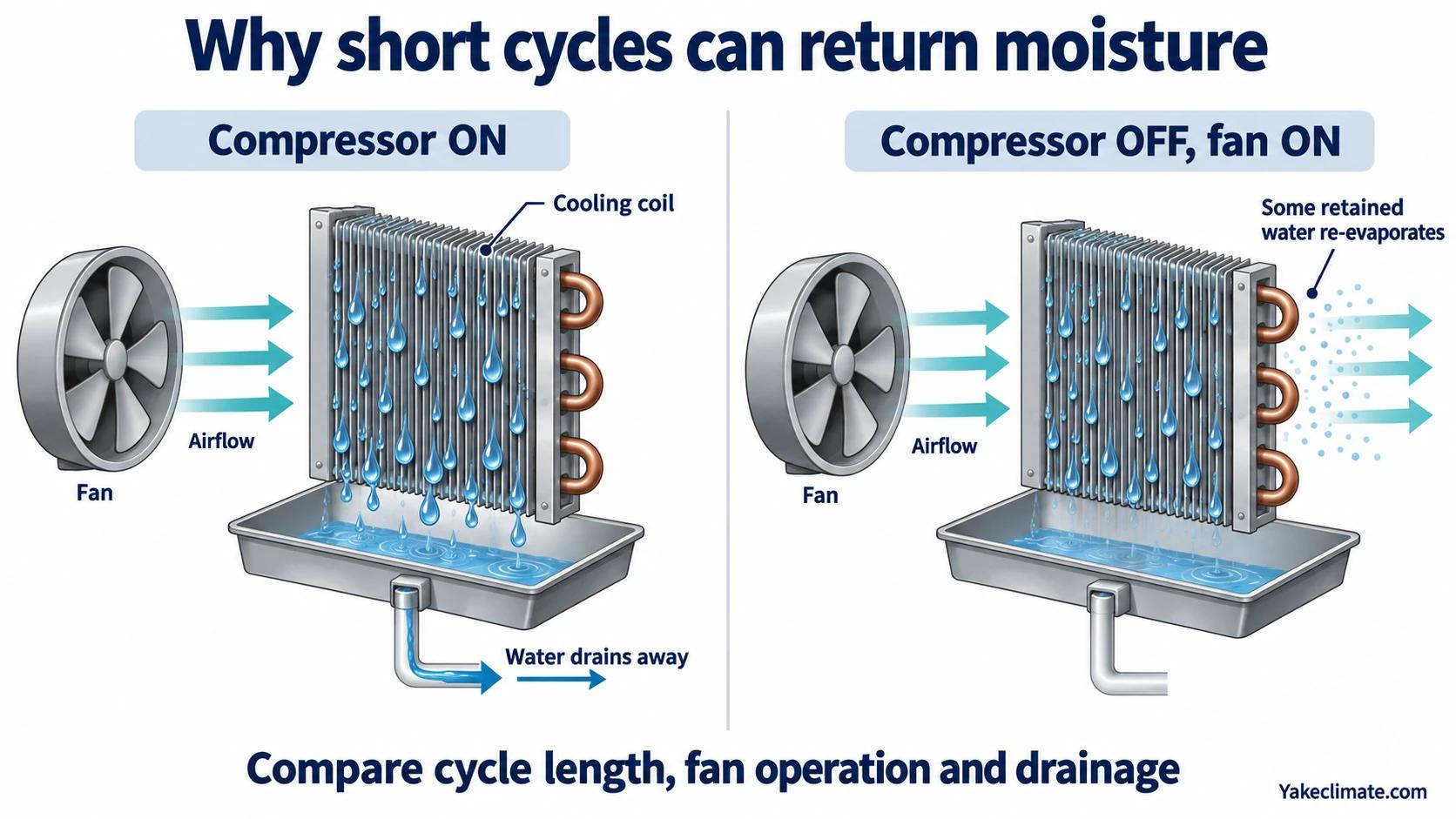
Repeated short cycles can reduce effective water removal or increase starts on some equipment. Compare cycle length, condensate, fan behaviour and the manufacturer's operating limits before deciding whether the pattern needs correction.
Why it happens. Oversized equipment for the load, a control deadband that is too narrow, or a sensor positioned where it responds to the machine's own discharge rather than to the space.
Why it matters. Three effects compound:
- Start-up losses. A refrigerant coil takes time to reach the temperature at which it condenses effectively. Short cycles spend a large fraction of each run cooling without dehumidifying.
- Re-evaporation. When the compressor stops while the fan continues, air passes over a wet coil and some condensate that has not yet drained evaporates back into the space — returning moisture that was already removed.
- Component wear. Frequent compressor starts are harder on the machine than continuous running.
The result is that a short-cycling installation can deliver considerably less moisture removal than its runtime fraction suggests, while appearing to satisfy its setpoint. This is the same mechanism that makes oversized air conditioning produce clammy spaces, described in temperature and humidity control in HVAC.
What to do. Widen the control deadband, move the sensor away from the discharge, or if the equipment is genuinely oversized, use staged capacity so that a smaller increment runs for longer periods rather than a large one running briefly.
Using Runtime as a Diagnostic
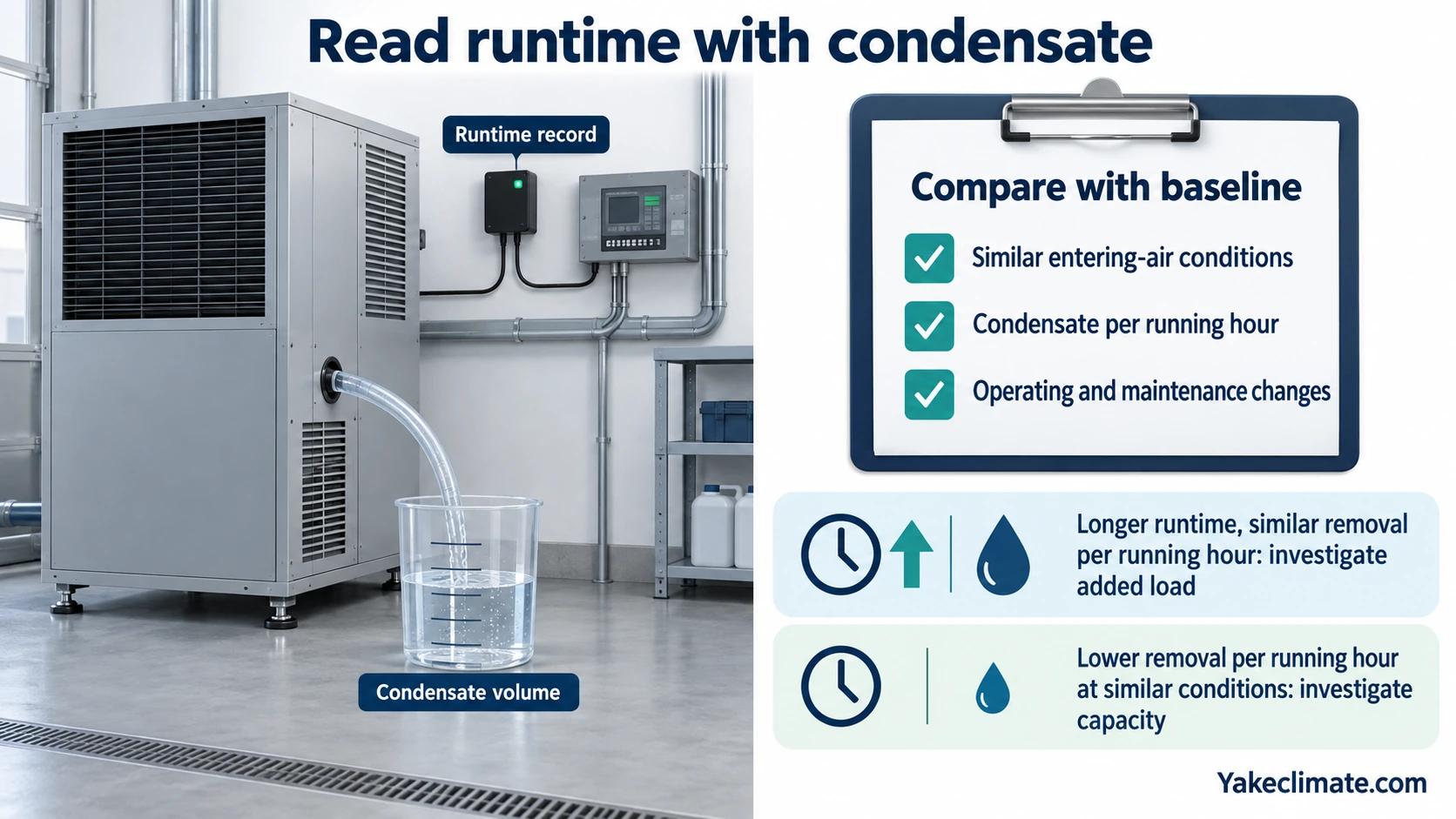
A matched baseline helps test whether higher runtime reflects changed moisture duty, changed delivered capacity, altered controls or a measurement problem. These explanations can coexist; the runtime trace alone does not separate them.
The method requires one thing recorded at commissioning: a baseline of capacity, power draw, and entering and leaving air conditions at a known operating condition.
With that baseline:
If runtime rises while condensate per running hour appears unchanged, increased load is one possibility. First match inlet temperature and humidity, airflow, setpoint, control state, drainage measurement and stored-moisture conditions with the commissioning baseline; only then investigate ventilation, infiltration or process changes.
If condensate per running hour falls at matched conditions, reduced equipment performance is a possibility. Check the inlet state, airflow, controls, coil condition, defrost, drainage and measurements before diagnosing the refrigerant circuit or other components.
If both have changed, treat them separately rather than assuming one explains the other.
Condensate per running hour is one useful derived figure when the collection or drain meter is reliable. Record operating state, inlet temperature and humidity, airflow and control settings at the same time; a temporary collection test must be safe and representative.
Without a baseline, none of this is available, which is why the commissioning record matters more than it appears to at the time.
Control Strategy Affects Runtime
Deadband. The gap between the setpoint at which the machine starts and the point at which it stops determines cycle length. A narrow deadband gives tighter control and shorter cycles; a wider one gives longer cycles and better effective moisture removal. Where the application tolerates some variation, widening the deadband usually improves performance.
Fan operation needs to match the selected unit and distribution duty. In some wet-coil configurations, continuous fan operation during compressor-off periods may re-evaporate retained condensate. Compare measured humidity, fan control options and manufacturer guidance rather than treating this effect as inevitable.
Setpoint choice. A setpoint tighter than the application requires increases runtime and energy for no benefit. Where the requirement is condensation prevention, a dew point setpoint referenced to the coldest surface — as set out in condensation risk and dew point — usually permits a less demanding target than an equivalent relative humidity setpoint chosen for safety.
Scheduling. Where the load has a known daily structure, running against that schedule is more effective than reacting to it. In lit growing environments, for example, the moisture load follows the photoperiod closely.
When Runtime Says to Review the Selection
Runtime indicates a selection problem rather than an operating problem when:
- Continuous operation fails to hold setpoint at conditions the equipment was specified for, and the diagnostic list above has been worked through.
- Runtime is at or near continuous during the mild part of the season, leaving nothing in reserve for the demanding part.
- Short cycling persists after the deadband has been widened and the sensor relocated, indicating genuine oversizing.
- If runtime has risen over successive years while condensate per running hour appears similar, a higher moisture load is one possibility. Match inlet temperature and humidity, airflow, setpoint, control state, drainage measurement and stored-moisture conditions with the commissioning baseline before assigning the cause.
- The space cannot be brought from an initial condition to target within the time the operation requires, even though steady-state performance is adequate — a pull-down requirement that the original sizing did not address.
The selection sequence to revisit is in commercial dehumidifier selection.
What to Record
- Runtime, logged as hours per day or as a percentage.
- Condensate volume, either collected or metered.
- Space temperature and relative humidity, logged together at sufficient resolution to see cycles.
- Entering-air condition at the equipment, which is what governs capacity.
- Outdoor conditions, to correlate load with weather.
- Ventilation rate and any changes to it.
- Setpoint and deadband settings, and any changes.
- Filter changes, cleaning and service events, with dates.
- The commissioning baseline, retained and accessible.
Log often enough to resolve starts, stops and moisture excursions, then retain representative records across the seasons and operating modes that matter to this project. A long seasonal series does not replace short-interval evidence when diagnosing cycling.
Discussing a Project
Yakeclimate designs and manufactures industrial dehumidification equipment for complex climate applications, with a focus on agriculture and energy projects.
We co-develop application-specific dehumidification equipment around the operating conditions, interfaces, and integration requirements of the wider project or system.
Explore industrial dehumidifiers, review industrial ceiling dehumidifiers, or contact Yakeclimate to review the operating conditions for your project.
FAQ
Frequently Asked Questions
How many hours a day should a dehumidifier run?
There is no universal number. At steady conditions, a rough runtime fraction can be estimated from moisture input divided by delivered water-removal rate at the actual inlet condition, if storage change and other removal paths are small and the control cycle is understood. The 100 versus 150 litres-per-day example gives about 67% only under those assumptions. Check whether the target is held and how the pattern changes with known loads.
Is it bad if the dehumidifier runs continuously?
It depends on whether the target is held and on the agreed design margin. Continuous operation during pull-down or a high-load period may be expected. If the unit runs continuously without holding target, investigate changed load, inlet conditions, distribution, controls, capacity and maintenance before changing the setpoint or unit size.
Why does my dehumidifier turn on and off constantly?
Frequent short cycles can result from oversized stages, narrow control deadband, sensor placement or control faults. Check cycle timing, inlet conditions and actual moisture removal before choosing a remedy. Depending on the selected equipment and fan control, wet-coil re-evaporation or repeated starts may also affect performance and service life.
How can I tell whether the load increased or the machine weakened?
Compare runtime, condensate per running hour, inlet state, airflow, control settings and drainage against commissioning records over a matched interval. Higher runtime with unchanged collection rate may indicate higher load, but it does not prove capacity is intact. Lower collection rate may indicate degraded performance, but first exclude changed air conditions, controls, airflow, storage and measurement error.
Should the fan run continuously?
Fan strategy depends on the selected unit and distribution need. Continuous circulation may improve mixing and sensor representativeness, but some wet-coil configurations can re-evaporate water during compressor-off periods. Compare the manufacturer's control options and measured room conditions rather than assuming one fan mode always gives better removal.
Does a lower setpoint remove more moisture?
A lower setpoint can increase runtime and energy if the equipment is able to reach it. Select the target from the actual material or surface requirement; for condensation risk, compare the air dew point with the coldest relevant surface and keep an agreed margin instead of lowering RH arbitrarily.
References
- AHAM DH-1, Dehumidifiers — capacity rating standard (US)
- ASHRAE Handbook — Fundamentals, psychrometrics and moisture load calculation


