
Compare dehumidifier capacity at the same entering-air temperature and relative humidity: 1 L/day equals about 2.1134 US pints/day, with the test conditions unchanged. A higher number measured in warmer, wetter air cannot establish which machine will remove more moisture at your operating point. Start by matching the conditions on both quotations. NIST conversion factors
Quick answer
- Keep the temperature, RH and test method beside every capacity number.
- Convert litres and US liquid pints freely; use model-specific performance data when changing operating conditions.
- Compare capacity and power at the same point before selecting equipment.
When comparing industrial dehumidifiers, request two separate entries: the published rating and the capacity at your project's entering-air condition. The first lets you check the catalogue; the second supports equipment selection.
Which test conditions belong in a comparison?
The complete test point and method identify a usable rating; the word “AHAM” alone leaves too much unspecified.
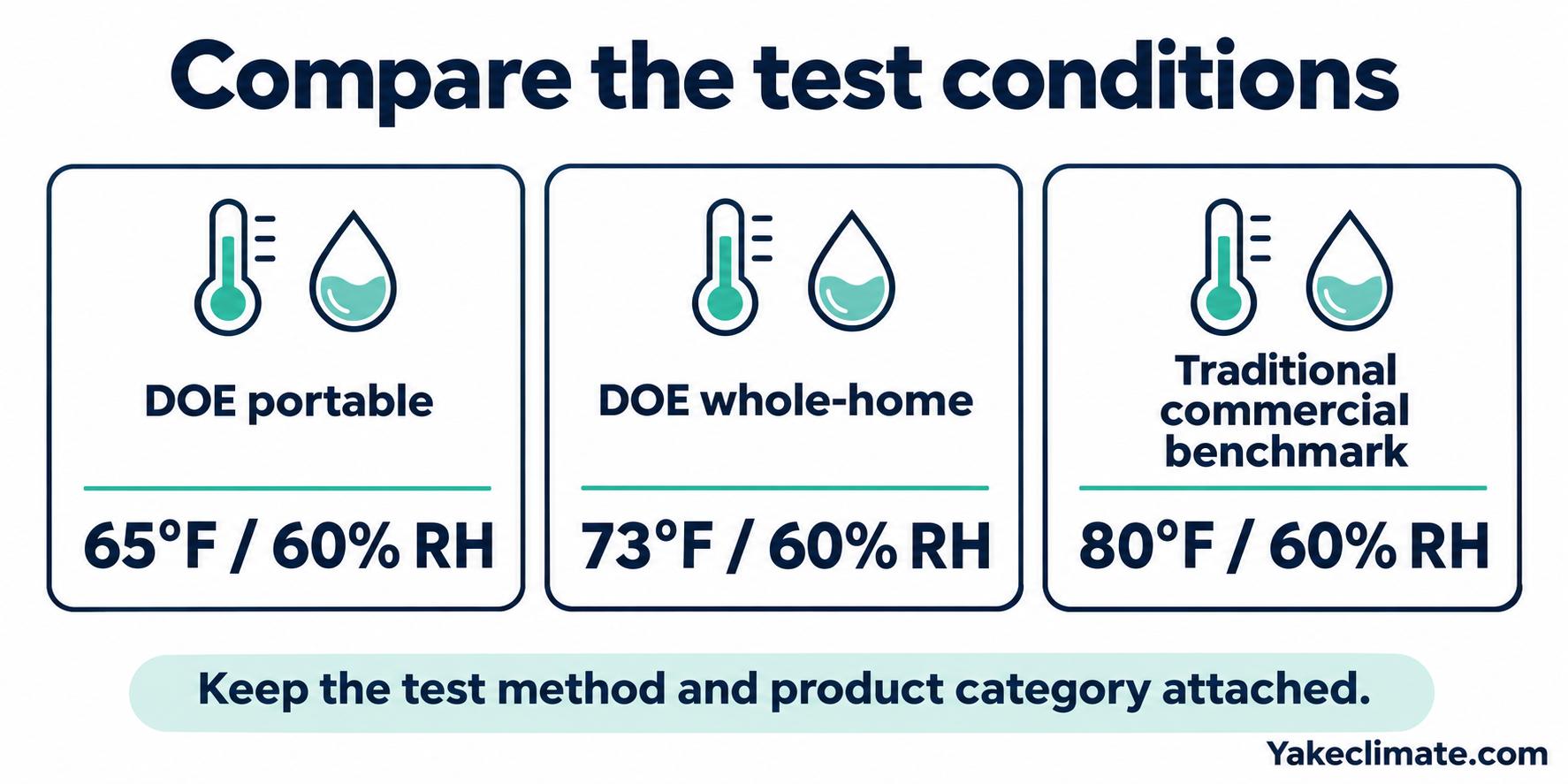
AHAM is the Association of Home Appliance Manufacturers, which publishes the DH-1 dehumidifier test standard. Commercial catalogues also use “AHAM capacity” as shorthand for a particular rating point. Record the standard edition and actual conditions instead of treating that shorthand as a universal temperature. AHAM DH-1-2022 listing
| Rating description | Temperature and RH | How to use it |
|---|---|---|
| Traditional 80°F commercial/AHAM benchmark | 80°F, approximately 26.7°C, at 60% RH | Compare with another explicitly stated 80°F/60% RH result using a compatible method. |
| DOE portable-dehumidifier test point | 65°F, approximately 18.3°C, at 60% RH | Use for the portable products covered by the procedure. |
| DOE whole-home-dehumidifier test point | 73°F, approximately 22.8°C, at 60% RH | Keep separate from portable-product ratings. |
| A catalogue rating at 30°C/80% RH | 86°F at 80% RH | Keep this condition attached after converting the capacity into pints. |
| “Saturation,” “maximum” or “up to” capacity | Obtain the stated temperature and RH | Leave the comparison incomplete until those conditions are supplied. |
The DOE points come from Appendix X1, section 4.1.1, Table 1, which also specifies the applicable test procedure. Its product categories should not be generalized to every machine sold as industrial equipment. The older 80°F context is documented in ENERGY STAR's explanation of the portable-test change. DOE test method, ENERGY STAR testing guidance
A rating expressed per day also needs a test method, not an assumption that the machine was physically tested for a full day. Appendix X1 specifies a 2-hour rating test period for the configurations in section 4.1.1, while reporting capacity in pints/day.
How do you convert L/day to US pints/day?
Multiply L/day by 2.1134 to obtain US liquid pints/day; multiply US pints/day by 0.4731765 to obtain L/day. These rounded factors follow the NIST volume conversion. Use the same temperature, RH and operating configuration on both sides. NIST, “pint (U.S. liquid)”
For example, Yakeclimate publishes 90 L/day at 30°C/80% RH for the RYCM-90C in its industrial equipment specifications. The conversion is:
90 L/day × 2.1134 = approximately 190.2 US pints/day at 30°C/80% RH.
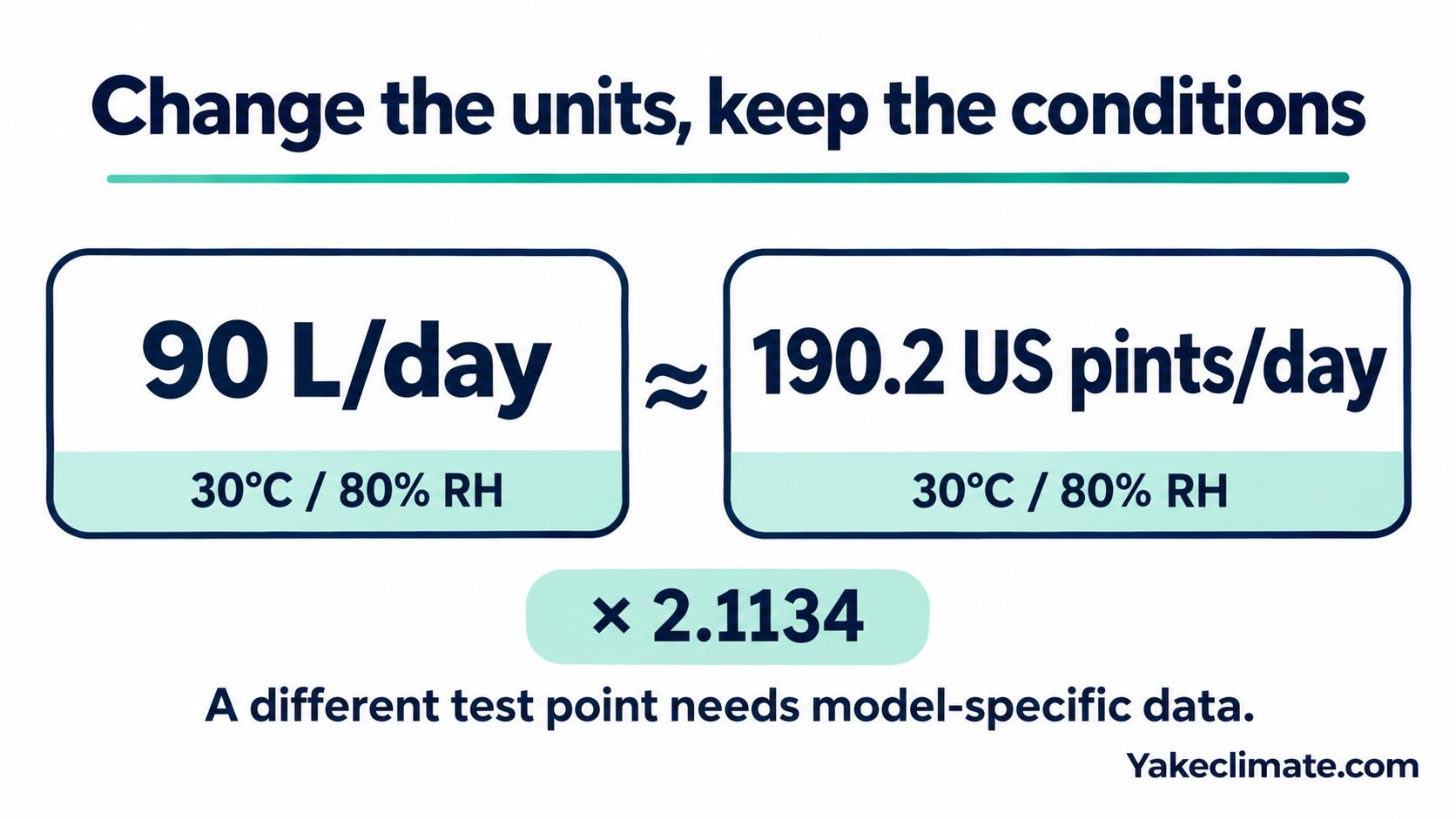
Write the converted specification as “approximately 190 US pints/day at 86°F/80% RH.” An 80°F/60% RH value requires a separate performance result at that condition.
| Capacity in L/day | Equivalent US pints/day |
|---|---|
| 20 | 42.3 |
| 50 | 105.7 |
| 90 | 190.2 |
| 100 | 211.3 |
Each row converts one volume rate; carry the original rating conditions into the converted entry. Also spell out US liquid pints in international quotations, because Imperial and dry pints are different units.
Can you convert a saturation rating into AHAM capacity?
No fixed multiplier can turn an unspecified high-humidity rating into reliable capacity at a different test point.
Refrigerant equipment removes water by cooling air below its dew point. Changing the entering-air condition changes the cooling and condensation process; coil behaviour and defrost can also affect removal. A proportion based only on room RH or the moisture contained in the entering air leaves out the machine's performance. ASHRAE Handbook, Mechanical Dehumidifiers
Use a published performance table or a test result for the same model and configuration. Where a supplier interpolates between measured points, ask it to identify those points and the interpolation method.
A rough old-to-new capacity correlation can help someone replacing a household unit understand a label change. ENERGY STAR explicitly notes that the change varies by model. For a commercial purchase, choose a documented matching-condition value over a generic percentage. ENERGY STAR capacity-change guidance
How should you compare three supplier offers?
Normalize the units first, then compare only the rows with matching operating conditions.
Suppose three illustrative offers arrive with the following ratings:
| Offer | Quoted capacity | Converted capacity | Test point |
|---|---|---|---|
| A | 90 L/day | 190.2 US pints/day | 30°C/80% RH |
| B | 100 US pints/day | 47.3 L/day | 80°F/60% RH |
| C | 50 US pints/day | 23.7 L/day | 65°F/60% RH |
The arithmetic is complete, but a performance ranking remains open. If your design inlet condition is 20°C/60% RH, ask all three suppliers for capacity at 20°C/60% RH. Keep that row separate from the catalogue rating and compare the returned data on a common basis.
Send the same worksheet to each supplier:
| Field | Required response | Comparison rule |
|---|---|---|
| Model and configuration | Model, revision, fan setting and operating mode | Keep configuration consistent across the supplied data. |
| Rating method | Standard and edition, or the manufacturer's documented method | Separate standardized ratings from other declared results. |
| Published test point | Entering-air temperature and RH | Preserve it beside the catalogue capacity. |
| Design-point capacity | L/day or US pints/day at the requested condition | Use this row for the capacity comparison. |
| Airflow and installation | Airflow, filter state and external static pressure where ducted | Request data for the intended installation. |
| Power at the same point | Measured input and included auxiliaries | Compare like-for-like energy boundaries. |
| Operating limits | Temperature range and defrost treatment | Check the demanding operating period. |
| Supporting record | Performance table or test report with its conditions | Return missing or inconsistent entries for clarification. |
We recommend selecting from the suppliers that provide complete, comparable design-point data. A larger headline number with missing conditions provides less decision value than a smaller, properly specified result. Once the data are comparable, match removal capacity to the moisture load using the commercial dehumidifier selection workflow.
Does a higher pints-per-day rating mean better efficiency?
No. Capacity measures water removal per unit of time; efficiency relates water removal to energy consumption.
IEF is expressed in L/kWh and includes energy associated with cycling off under its prescribed test method. Keep IEF values tied to their applicable procedure. A catalogue's maximum input power and its best-case water-removal number are insufficient to calculate an IEF. ENERGY STAR performance metrics
For an operating check, record collected water and metered energy over the same interval, together with inlet temperature, RH and operating mode. For an illustrative 12 L collected using 6 kWh, the measured interval result is 2 L/kWh. Label it as that interval's result; compare it with another measurement only after checking conditions and measurement boundaries.
What should you send with an equipment enquiry?
Send the lowest expected entering-air temperature, target RH, moisture-load estimate and installation arrangement alongside the comparison worksheet.
Include power supply, drainage and duct requirements so the proposed configuration matches the data supplied. For a unit already in service, use the separate guide to daily water collection and reduced output.
For an industrial equipment enquiry, share those conditions with Yakeclimate through the industrial dehumidifier page and request the available performance information for the proposed model.
FAQ
Frequently asked questions
Is 190 pints/day the same as 90 L/day?
Yes, approximately: 90 L/day is 190.2 US liquid pints/day at the same test point. Both entries describe the same volume rate. Keep the original temperature and RH beside the converted value; changing the unit leaves the underlying rating condition unchanged.
Does AHAM always mean 80°F and 60% RH?
No. Commercial catalogues frequently use that shorthand, but the quotation needs the actual method and test point. DOE Appendix X1 uses 65°F/60% RH for covered portable units and 73°F/60% RH for covered whole-home units. Ask for the edition and conditions attached to the result.
Can I divide saturation capacity by two to estimate AHAM capacity?
No. Use a result or performance curve for the specific model at the required temperature and RH. A ratio observed for one machine at two test points belongs to that comparison. Applying it to another model introduces an unsupported performance assumption.
Can I rank two dehumidifiers by capacity after converting their units?
Yes, if the test conditions, methods and configurations are comparable. Then compare their removal capacity against the same project moisture load, and assess power and installation requirements separately. If those conditions differ, collect matching-point data before using the converted numbers to rank the machines.
References
- NIST SP 811, Appendix B.8: conversion factors, P table.
- DOE, Appendix X1 to Subpart B of 10 CFR Part 430, section 4.1.1 and Table 1.
- ENERGY STAR, Dehumidifier Testing and Capacity, performance metrics and capacity changes.
- AHAM DH-1-2022 official listing, standard identification.
- ASHRAE Handbook, Mechanical Dehumidifiers and Related Components, mechanical-dehumidification principles.

