
Compare industrial dehumidifiers by the energy needed to meet the same moisture-control duty, not by nameplate power alone. First establish the required water removal and air conditions. Then compare water removed with every relevant energy input over the same interval, while confirming that the specified temperature and humidity are actually maintained.
Define an equivalent duty
Give each supplier the same entering-air temperature and humidity, required leaving-air or room condition, moisture load, airflow and external pressure. State the operating hours and acceptable variation. A result at an easier inlet condition or a higher allowed humidity is not an equivalent offer. Where the requirement is expressed as relative humidity, include its associated temperature.
For site comparisons, identify changes in production, door opening, ventilation and weather. Compare representative periods with similar duty, or document how the differences were accounted for. A lower meter reading during lighter production does not by itself demonstrate better equipment efficiency. Keep required ventilation and process conditions fixed rather than treating their reduction as an equipment saving.
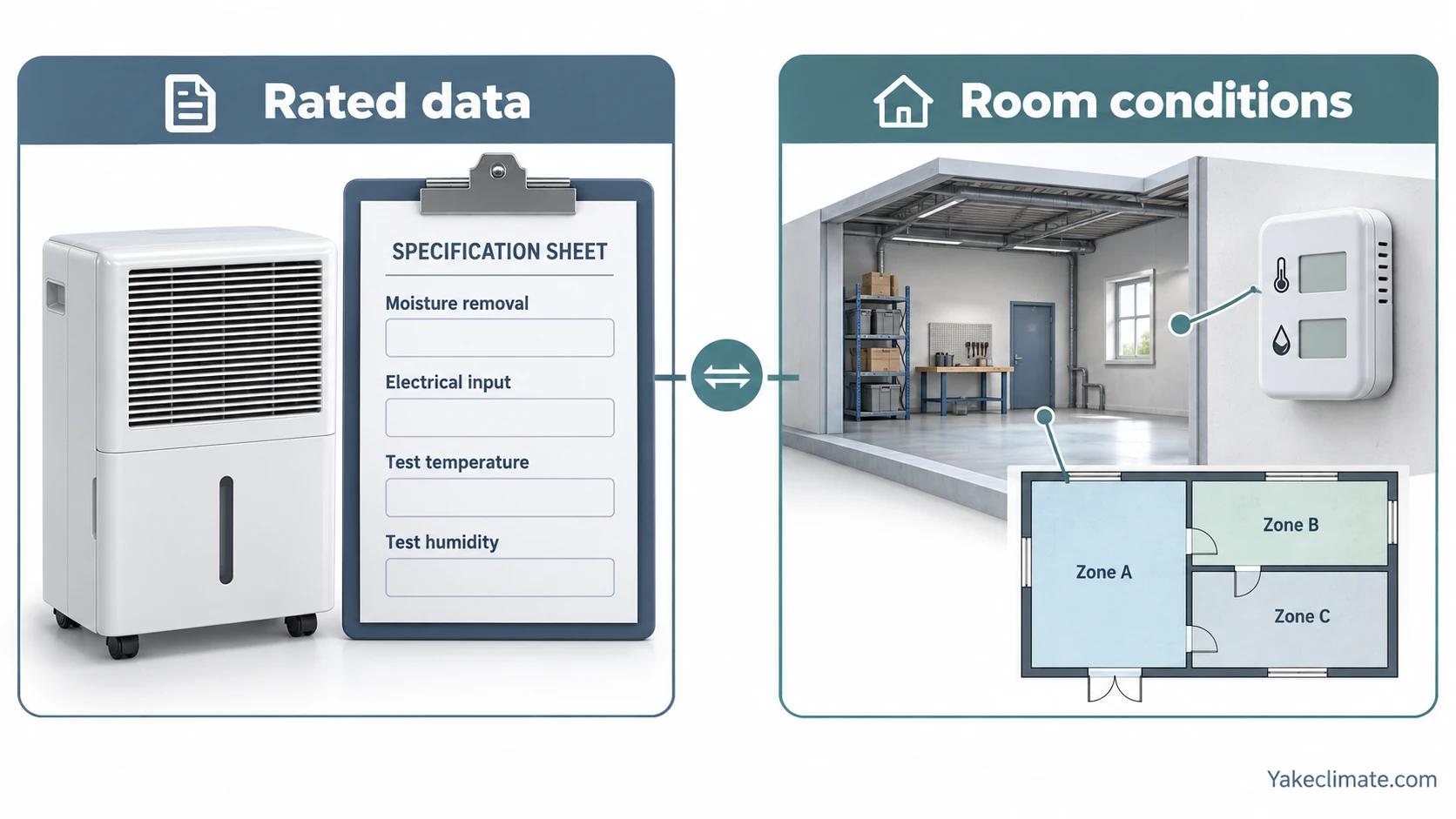
Use water and energy units consistently
Record water removed in kilograms or litres and the elapsed hours. Water removal rate is mass divided by time, such as kg/h. Specific energy is total input energy divided by water removed, such as kWh/kg: lower is better only for an equivalent duty and boundary. L/kWh reverses the ratio, so higher is better on that same basis. Do not silently interchange mass and volume; state any water-density conversion used.
Power in kW is an instantaneous rate; energy in kWh is accumulated use. Use energy metering over the comparison period where possible. Multiplying a stated power by hours assumes that power applies throughout those hours. Record cycling, standby and defrost within the agreed period rather than selecting only favourable active minutes.
Define how water removal is measured. Collected condensate can support a refrigerant-unit measurement when collection is complete. A desiccant system may discharge moisture in regeneration air instead of collecting liquid; agree an appropriate measured air-side moisture balance. Device water removal is not automatically the entire building moisture load.
Keep certification in its product category
The ENERGY STAR dehumidifier criteria distinguish portable and whole-home products. Their integrated energy factor is expressed in L/kWh and includes specified operating and standby/off-mode treatment. It is a defined test metric, not a universal industrial threshold or a substitute for a site energy comparison. Check the applicable product category and test version before comparing labels.
Draw the energy boundary before ranking equipment
List every meter or calculation included in the comparison: the unit, distribution fans, pumps, controls and any connected heating or cooling needed to deliver the specified air condition. State exclusions explicitly. Otherwise one offer can appear better simply because an auxiliary load sits outside its quoted boundary.
Report electricity, fuel input and supplied heat separately, with units and meter locations. If reporting an aggregate energy figure, define the conversion and whether it represents purchased energy or delivered heat. Do not add boiler fuel input and the heat it produces as two separate inputs to the same total. Price each purchased energy stream with its corresponding tariff; thermal and electrical kWh need not have the same cost.
Credit recovered heat only against an identified heating demand that it can actually replace during the comparison period. Show the gross inputs and the credit separately, including any additional pumps or fans. If heat is unwanted, include the connected cooling needed to hold the same temperature. An internal heat transfer is not a second energy supply or an automatic cost saving.
Compare technical routes at the required conditions
Refrigerant dehumidification cools air below its dew point to condense water. Reheat and heat-rejection arrangements affect the delivered air temperature and connected heating or cooling duty. Check the selected model’s performance at the proposed conditions, including its operating limits and defrost behaviour. Neither refrigerant name nor a single room-temperature threshold establishes the most efficient choice. ASHRAE: mechanical dehumidifiers.
For thermally regenerated desiccant systems, include regeneration heat as well as fan, pump and any required cooling inputs. Available regeneration temperature and the required moisture level influence suitability. A low electrical reading alone can conceal a substantial thermal input; waste heat still needs a defined availability and system boundary. Compare the complete arrangement, including combined cooling and desiccant stages where proposed. ASHRAE: sorbents and desiccants.
An efficiency feature is a proposal to verify
Ask for results across the expected duty range, including partial load, instead of ranking equipment by a feature name. For control changes, record the same required conditions before and after. For ducted installations, the air distribution and integration review is a related coordination task; this energy comparison still needs its own measured inputs and acceptance criteria.

A hypothetical comparison with a fixed boundary
Assume two all-electric arrangements each remove 80 kg of water over eight hours while meeting identical air-condition and airflow requirements. All agreed unit and auxiliary electricity is included. Arrangement A uses 48 kWh; B uses 40 kWh. These are invented inputs for arithmetic, not Yakeclimate test results or expected performance.
Both removal rates are 80 kg ÷ 8 h = 10 kg/h. A uses 48 kWh ÷ 80 kg = 0.60 kWh/kg; B uses 40 kWh ÷ 80 kg = 0.50 kWh/kg. At a hypothetical electricity price of $0.12/kWh, the period costs are $5.76 and $4.80. B costs $0.96 less for this assumed duty. The result does not establish annual savings or payback.
If B’s quoted 40 kWh excludes an additional 12 kWh of required cooling within the agreed boundary, its total becomes 52 kWh, or 0.65 kWh/kg and $6.24. It then costs more than A. This illustrates why the boundary must be fixed before comparing numbers; it is not a claim that any technology has that cooling penalty.
Turn the comparison into an acceptance record
Specify the duty, measurement period, instruments, water-removal method and meter boundary before testing. Log the achieved conditions alongside water and energy totals, note missing readings and abnormal operation, and document the condition of filters and air paths. A record that cannot demonstrate the required duty should not be labelled an efficiency pass merely because consumption was low.
For procurement, request the performance basis and interface requirements for the proposed industrial dehumidifier. Compare measured or documented alternatives against the same acceptance record. Keep capital cost and maintenance assumptions separate from the operating-energy calculation; a payback estimate additionally needs justified annual hours, tariffs and an agreed baseline.
FAQ
Frequently Asked Questions
Is the lowest-power unit the most efficient?
Not necessarily. Compare total energy per unit of water removed while both arrangements meet the same required duty. Lower power without sufficient removal or humidity control is not an equivalent result.
Can I compare kWh/kg directly with L/kWh?
They express opposite ratios and use different water units. Convert mass and volume on a stated basis, then use a consistent ratio and identical energy boundary.
Does a household efficiency label establish industrial performance?
No. Check its product category and test method. A category-specific label does not establish performance for a different industrial installation or its external auxiliaries.
What energy should a desiccant comparison include?
For a thermally regenerated arrangement, include regeneration heat, electrical auxiliaries and any required cooling within the agreed boundary. Show the energy streams separately before calculating cost.
Can heat recovery be counted as savings?
Only with an identified displaced heating input and a justified credit over the same period. Show gross energy and the credit separately; do not subtract the same benefit twice.
Does off-peak operation reduce energy consumption?
A lower tariff can reduce cost without reducing kWh. Check whether the shifted schedule still meets the moisture-control duty before comparing operating costs.
What proves annual savings?
A defensible comparison needs representative duty periods, complete energy boundaries and supported operating hours. One favourable test point or the hypothetical example above cannot establish annual savings or payback.


