
Calculate industrial dehumidifier running cost from energy used over a defined period and the applicable tariff. If estimating from power, match the averaging period to the hours used: an on-period average and a whole-interval average are different inputs. Then include relevant auxiliary and thermal energy, and check that the humidity duty is met.
Use this cost framework with the industrial dehumidifier product family, the industrial dehumidification resource page and the commercial dehumidifier selection guide so energy estimates stay tied to equipment selection.
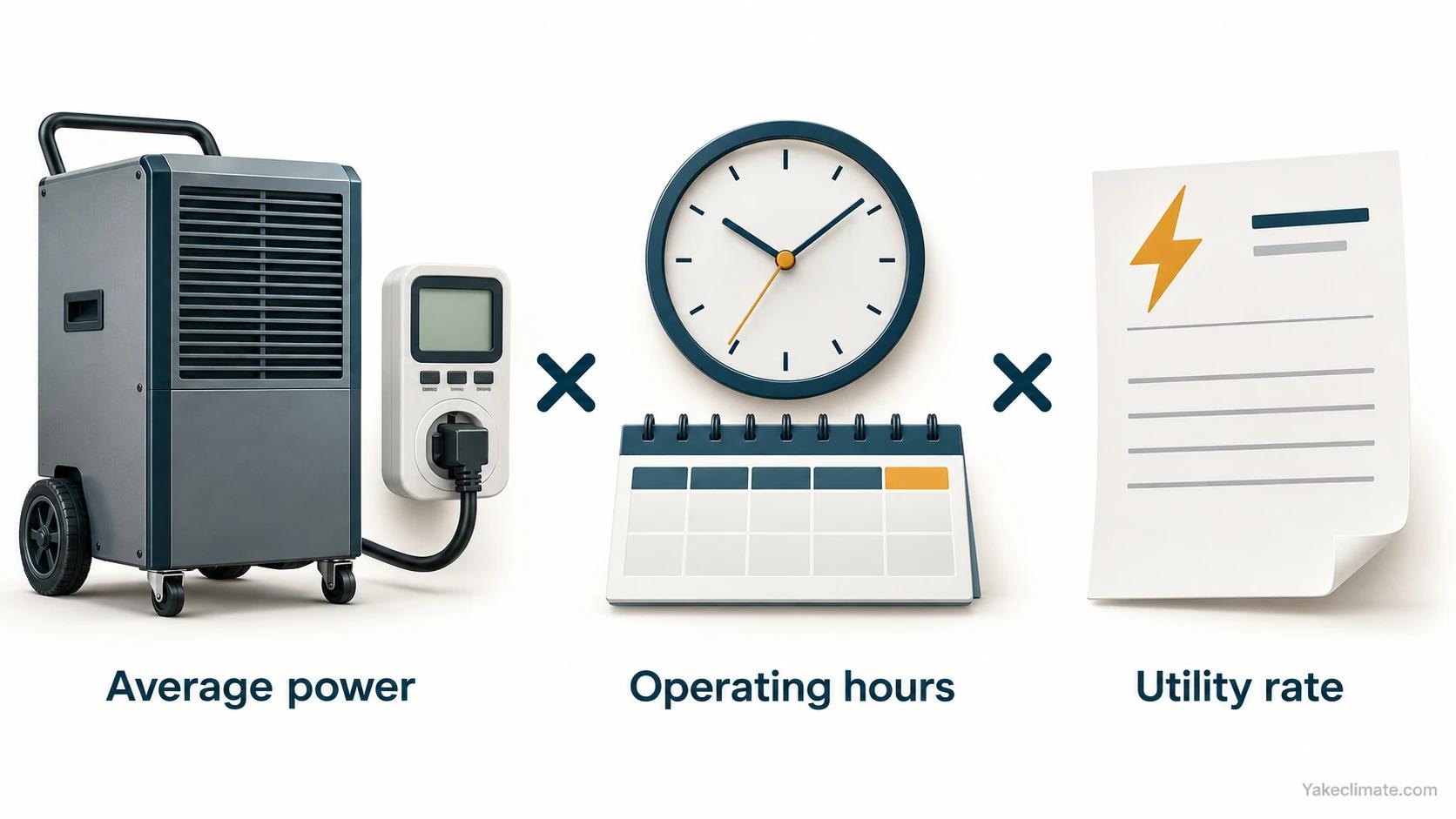
The Basic Formula
Choose one method for the same equipment boundary and period. A whole-interval mean includes off-time consumption measured within that interval; do not apply an on-time fraction again. With an on-period estimate, add off-period consumption only when it is not already included.
Measured method: energy (kWh) = end meter reading - start meter reading
On-period method: on energy (kWh) = mean-on power (kW) × actual on-hours (h)
Total energy = on energy + separately measured/estimated off-period energy, if excluded above
Whole-interval method: total energy (kWh) = whole-interval mean power (kW) × interval hours (h)
Energy charge = sum of each tariff-period kWh × its price per kWh
Monthly energy charge = sum of daily energy charges
Hypothetical on-period examples: each unit is assumed actually on for 18 hours per day at the stated mean-on input. These are arithmetic inputs, not Yakeclimate equipment measurements. Off-period energy and other bill charges are excluded.
| Mean-on input | Actual on-hours | Hypothetical tariff | On-period energy charge |
|---|---|---|---|
| 4 kW | 18 h/day | USD 0.12/kWh | USD 8.64/day |
| 8 kW | 18 h/day | USD 0.12/kWh | USD 17.28/day |
| 12 kW | 18 h/day | USD 0.18/kWh | USD 38.88/day |
For the 4 kW case, 4 × 18 = 72 kWh and 72 × USD 0.12 = USD 8.64. If off-period input is zero, the same energy over 24 hours has a whole-day mean of 3 kW: 3 × 24 = 72 kWh. Multiplying that 3 kW by 18 hours would undercount. Apply the site’s actual time-of-use prices and assess demand or fixed charges separately.
Average kW Is Not Nameplate kW
Nameplate input is not a measured shift average. Record whether supplied performance data describes full-load input, mean-on input or an interval average, and at which operating conditions.
| Situation | Why average kW changes |
|---|---|
| Unit cycles on and off | Whole-interval mean includes on and off periods; mean-on does not. |
| Variable-speed operation | Fans and compressors may modulate. |
| High door traffic | Moisture load and runtime may change; measure rather than assume a fan-power increase. |
| Dirty filters or coils | Resistance or heat transfer can change; airflow, runtime and input depend on the system. |
| Low-temperature operation | Refrigerant capacity may drop and defrost may appear. |
| Desiccant reactivation | Thermal input may sit outside the electric nameplate. |
For a live site, use a suitable real-power meter or kWh meter, or verified BMS data with known units and interval coverage. Current alone is not real power: voltage, phase configuration and power factor matter, and simple estimates may be inadequate for variable-speed equipment. Use supplier input data at the expected condition only as a labelled estimate.
Cost per kg Removed
Divide energy or cost by water removed over the same interval. Keep inlet conditions, humidity duty and included equipment comparable; a ratio alone does not demonstrate that a unit can meet the required load. The following values are hypothetical arithmetic examples, not measured product performance.
Energy per kg removed = daily kWh / kg of water removed per day
Cost per kg removed = daily cost / kg of water removed per day| Unit | Daily energy | Daily water removed | Energy per kg |
|---|---|---|---|
| Unit A | 120 kWh | 240 kg | 0.50 kWh/kg |
| Unit B | 95 kWh | 140 kg | 0.68 kWh/kg |
The calculated ratios are 120 ÷ 240 = 0.50 kWh/kg and 95 ÷ 140 ≈ 0.68 kWh/kg. B uses less daily energy but has the higher ratio in this example. These unequal water totals do not establish a fair equipment ranking without equivalent operating conditions and confirmation that each meets the required duty.
Document the water measurement as well as the energy meter boundary. Condensate collection and air-side moisture measurements are different methods; record which is used and any missing data. Do not label unit water removal as the entire building moisture load.
Why an 18-Hour Schedule Is Only a Schedule Assumption
An 18-hour enabled schedule does not establish 18 actual on-hours. Record cycling or modulation within the enabled period, and include any off-period energy in a daily total. The required moisture removal still needs a separate load assessment.
| Question | What it tells you |
|---|---|
| Will the unit be enabled for 18 hours? | Control schedule. |
| Will it run at full load for 18 hours? | Duty cycle and load intensity. |
| How many kg/h must be removed during those hours? | Sizing basis. |
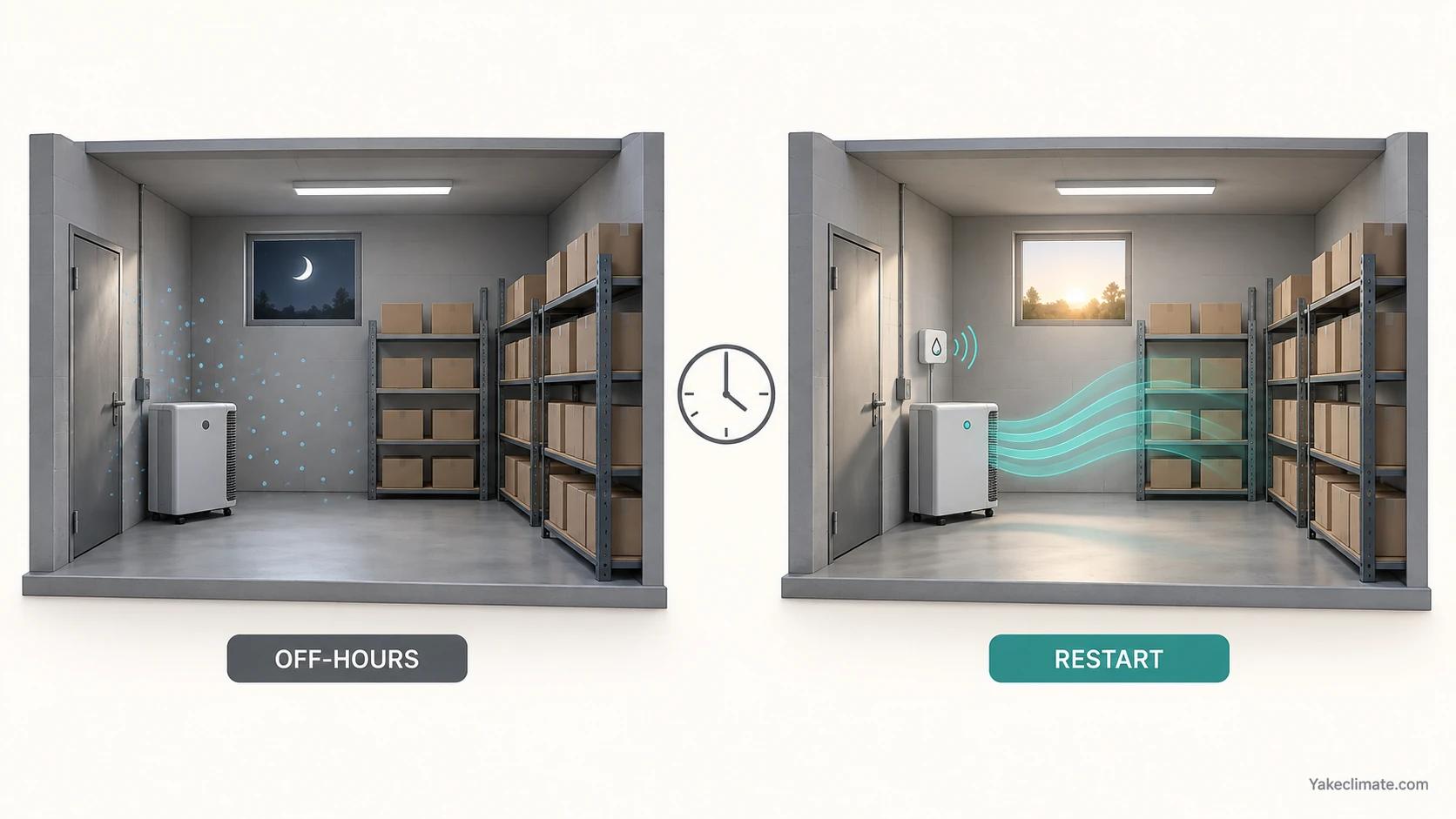
| What happens during the 6 off-hours? | Moisture rebound and restart load. |
| Is the process load tied to production hours? | Whether humidity follows a shift. |
If the room rebounds during off-hours, the unit may need a high recovery load at startup. In storage or agriculture, humidity risk can peak at night or during closed periods, not only during production hours.
Include Fan, Heat and Control Boundaries
Draw the measurement boundary and identify all included energy consumers. Count external auxiliaries separately only if the main meter excludes them. Keep electricity, purchased fuel and supplied heat distinct, applying the appropriate price to each. Do not count both fuel input and the heat generated from that fuel as separate purchases.
| Equipment type | Include in running-cost estimate |
|---|---|
| Refrigerant dehumidifier | Compressor, process fan, condenser fan, controls, pumps and defrost if relevant. |
| Ducted system | Fan electricity at installed airflow and pressure, including external booster fans if present. |
| Desiccant system | Process fan, regeneration fan, rotor drive and reactivation heat. |
| Hybrid unit | Cooling, desiccant, post-cooling, reheat and controls. |
| Multi-unit system | Lead-lag staging, standby fan behavior and alarm rotation. |
For desiccant-specific energy boundaries, see desiccant dehumidifier power consumption.
For equipment context, review the rotary desiccant model range before comparing operating costs at the same conditions.
Add Maintenance and Capacity Loss
Changes in filter, coil, drain, sensor or duct condition can affect moisture control and runtime. Check measured energy alongside water removal and the achieved condition. Filter resistance alone does not determine whether fan electricity rises or falls; the fan characteristic and control response matter.
| Maintenance issue | Possible effect to investigate |
|---|---|
| Dirty filter | Added resistance may reduce airflow; a controlled fan maintaining airflow may increase power. Check the fan/control curve. |
| Fouled coil | Moisture removal may fall and runtime may increase. |
| Low refrigerant charge | Reduced capacity and possible compressor stress. |
| Blocked condensate drain | Overflow or protective shutdown may interrupt humidity control. |
| Sensor drift | Incorrect control response may cause over-drying or inadequate control. |
| Duct leakage | Dry air lost before reaching the target zone. |
Use the commercial dehumidifier maintenance checklist to define inspection intervals and trend values.
A Practical Worksheet
Build the first estimate with these fields:
| Input | Value to collect |
|---|---|
| Target condition | Temperature, RH, dew point or humidity ratio. |
| Moisture load | kg/h, L/day or project calculation basis. |
| Operating schedule | Enabled schedule, actual on-hours and total measurement interval. |
| Expected duty cycle | Cycling/modulation record; do not reapply a factor to an interval mean. |
| Power or energy basis | Measured kWh, mean-on kW or whole-interval mean kW, with matching hours and meter coverage. |
| Utility rate | Energy charge, demand charge and fuel price if relevant. |
| Maintenance condition | Filter, coil, duct and sensor baseline. |
| Cost of failure | Product loss, downtime, mold, corrosion or quality risk. |
The final line is important. The cheapest operating mode is not always the right mode if it lets humidity exceed the process limit.
When to Ask for an Engineering Review
Ask for a deeper review when:
- the humidity target is below normal comfort range,
- the room has high ventilation or infiltration,
- the process load changes by shift,
- the project uses desiccant reactivation heat,
- failure causes corrosion, mold, product loss or safety risk,
- the site has demand charges or high energy tariffs,
- several units need staging.
Send the measurement period, power or energy records, utility prices, target condition and moisture-load basis through the contact page when reviewing running cost for an industrial dehumidification project.
FAQ
Frequently Asked Questions
How do I calculate the cost of running an industrial dehumidifier?
Use interval kWh, or mean-on kW × actual on-hours plus any excluded off-period energy. Alternatively, use whole-interval mean kW × interval hours without another duty factor. Apply the appropriate tariffs and include other energy inputs or bill charges within the stated cost boundary.
Is 18 hours per day enough for sizing?
No. It describes the schedule, not the moisture load. The unit may run at full load, partial load or cycle depending on humidity generation and control settings.
Why is cost per kg removed useful?
It relates cost to water removal, but compare only equivalent operating conditions, humidity targets and energy boundaries. Also confirm each option meets the required load; a favourable ratio does not prove sufficient capacity.
Should I choose the unit with the lowest nameplate power?
Not by itself. Check capacity at the real operating condition, airflow, controls, maintenance requirements and the cost of missing the humidity target.


