
A sealed electrical enclosure is not automatically a moisture-free enclosure. Water vapour may be trapped during assembly, introduced when service doors open or exchanged through gaskets, cable entries, vents and pressure-equalisation devices.
For humidity-control equipment, those air exchanges are part of the moisture load. If they are ignored, a dehumidifier may control the cabinet during stable operation but fail after maintenance, cooling transitions or humid weather.
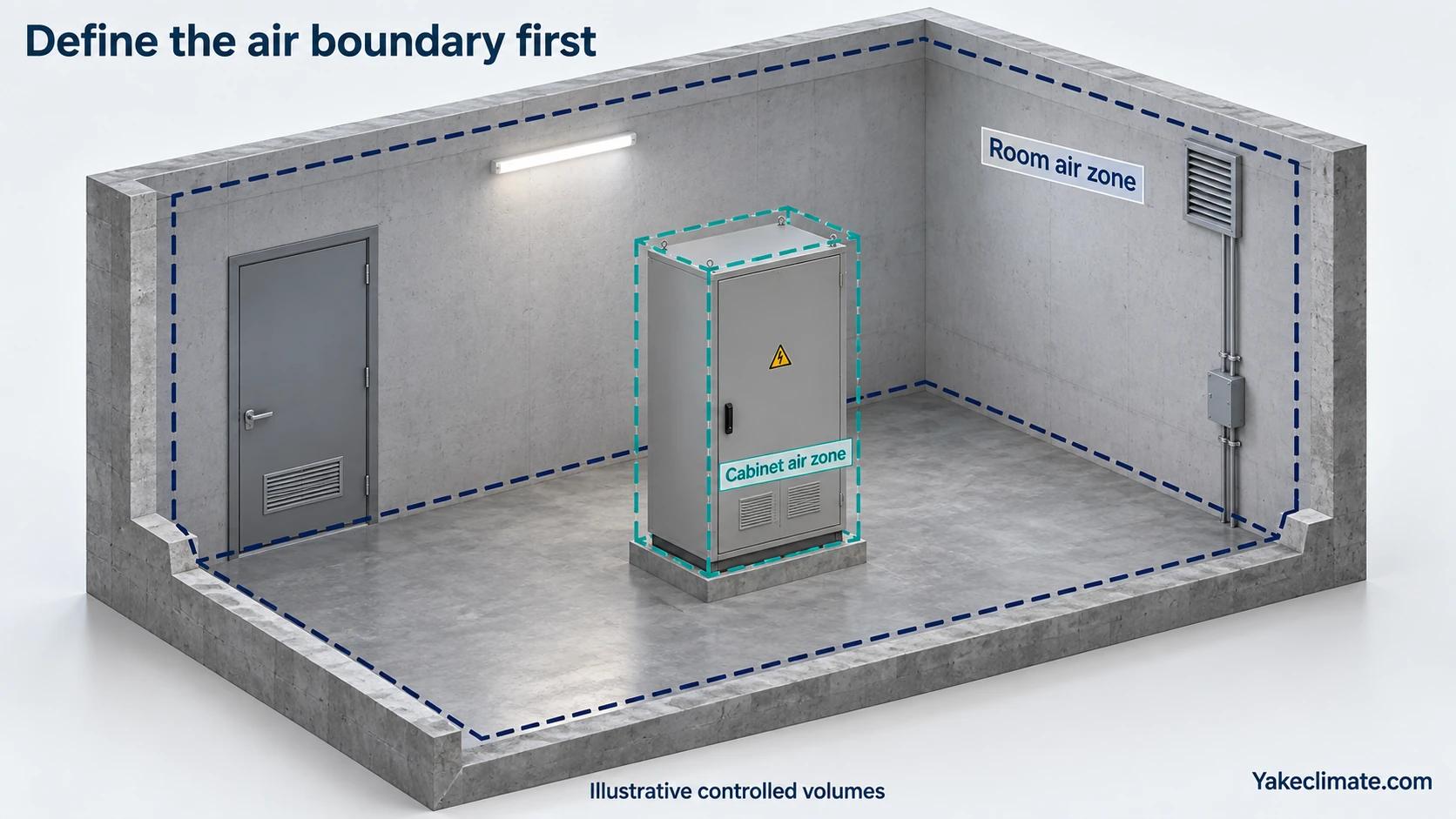
Define the Air Boundary First
Before estimating a load, draw the controlled boundary. It may be:
- one small electrical cabinet;
- a battery cabinet with several internal compartments;
- multiple cabinets connected by ducts;
- a BESS container;
- a room containing cabinets;
- a cable trench and switchgear space.
The boundary determines the air volume, leakage paths and door events that the equipment must handle. Treating a room and a cabinet as the same air zone can produce an unrealistic calculation.
“Sealed” Is a Design Description, Not a Leakage Number
An enclosure may have a declared ingress-protection rating and still exchange air. The rating does not provide the air-change rate required for a moisture-load calculation.
Potential paths include:
- door and panel gaskets;
- cable glands and grouped cable entries;
- drainage openings;
- ventilation grilles;
- pressure-equalisation devices;
- joints between modules;
- service ports;
- damaged seals and unfinished site penetrations.
Use manufacturer data, a leakage test or a documented engineering assumption. Do not convert an IP rating into an assumed air-change rate. Ingress protection and internal condensation control are related design considerations, but they answer different questions.
Temperature and Pressure Changes Move Air
Air expands when heated and contracts when cooled. Daily weather, equipment load and HVAC cycling can therefore create pressure differences between the enclosure and its surroundings.
Wind, exhaust fans, supply fans and connected ducts add further pressure effects. Air may enter through one path and leave through another even when no opening is visibly large.
The direction of flow can change during:
- startup and shutdown;
- high load and standby;
- day and night;
- fan operation;
- door closing;
- rapid weather changes.
A leakage test performed at one condition may not describe every operating state, but it gives a better basis than assuming zero exchange.
Service Doors Create a Step Change in Moisture
A service door can exchange enclosure air, but the exchanged fraction is not fixed by enclosure volume or opening time alone. It depends on pressure, wind, fan state, opening geometry and the connected air path. Record the event or use a stated engineering assumption instead of treating every opening as a complete air replacement.
- door area and opening duration;
- wind and pressure difference;
- indoor and outdoor dew point;
- enclosure and compartment volume;
- internal obstructions;
- whether fans remain on;
- temperature of internal surfaces;
- frequency of maintenance.
Warm humid air entering a cooler enclosure can raise internal dew point before metal and components warm. Condensation may then appear during or shortly after service.
Record realistic events instead of a generic statement such as “door occasionally opened.”
| Service input | Useful description |
|---|---|
| Frequency | events per day, week or maintenance cycle |
| Duration | typical and worst credible opening time |
| Door or panel | size and zone exposed |
| Site condition | outdoor or room temperature, RH and dew point |
| Equipment state | running, standby, isolated or cooling |
| Recovery target | time to return below the agreed dew point |
Ventilation Can Dominate the Moisture Load
Required ventilation is intentional air exchange, not leakage. It may be needed for heat, gas management, safety or pressure control. When outdoor dew point is higher than the internal target, ventilation continuously introduces moisture.
The environmental-control design should state:
- required airflow and operating schedule;
- outdoor design condition;
- whether air is recirculated, exhausted or mixed;
- how ventilation and dehumidification interact;
- what happens during alarms and shutdown;
- whether the target can be maintained while ventilating.
A cabinet dehumidifier should not be selected as if it were treating a closed volume when it is connected to a continuous humid-air stream.
Estimate Moisture from Air Exchange
At concept stage, the moisture introduced by air exchange can be described as:
For continuous incoming air, the moisture-rate contribution (kg water/h) is dry-air mass flow (kg dry air/h) × max[0, incoming humidity ratio − target humidity ratio] (kg water/kg dry air). This is a rate, not the water mass from one door event.
Use compatible units, a stated atmospheric pressure when converting temperature/RH to humidity ratio, and the actual incoming and target air conditions. The continuous-flow form can be applied to:
- continuous ventilation;
- estimated leakage;
- purge or pressure-control air.
For supplied-air proposals, see the purge-air review guide.
For a door event, moisture mass (kg water/event) ≈ exchanged dry-air mass (kg dry air/event) × the positive incoming-to-target humidity-ratio difference (kg water/kg dry air). If the exchange rate or air state changes while the door is open, integrate the dry-air flow and humidity-ratio difference over the event. State the exchange estimate and define recovery time. Continuous ventilation and leakage remain rates (kg water/h); convert event mass with a stated frequency or time basis before combining terms. This follows the moisture-flow balance described in ASHRAE's moisture-management framework; it is a method, not a measured leakage rate for this enclosure.
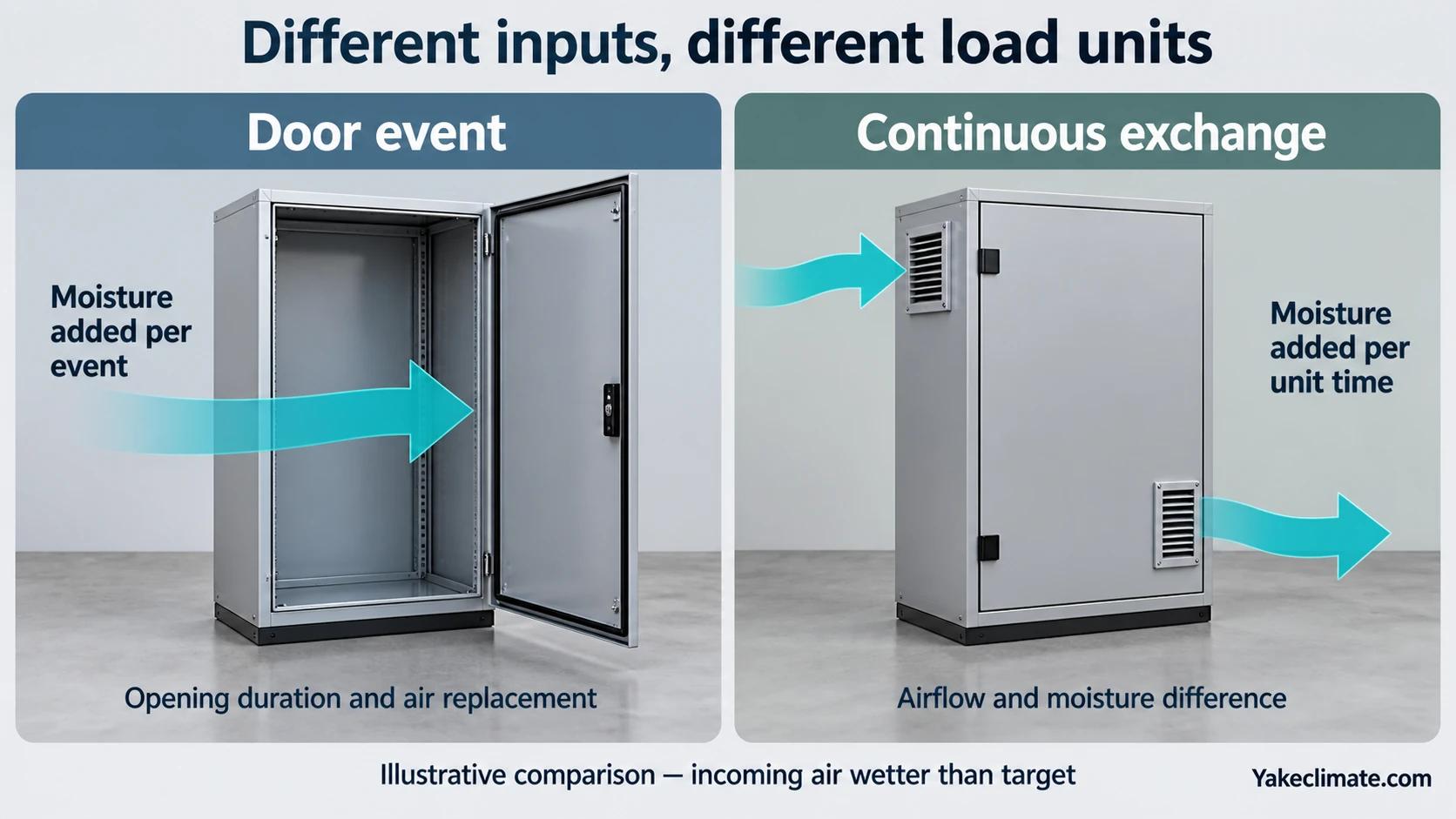
Do not size from enclosure volume alone. A small cabinet with frequent humid-air exchange can have a larger moisture load than a larger stable cabinet.
Internal Moisture Also Matters
External air is not the only source. Moisture can enter with:
- wet packaging;
- damp insulation or concrete;
- cleaning and washdown;
- condensate retained in a drain or tray;
- materials stored in humid conditions;
- water leaking from cooling equipment;
- assembly in uncontrolled ambient air.
Commissioning should include a dry-down period where relevant. A persistent internal source can otherwise be misdiagnosed as excessive air leakage.
Inspect and Classify Each Path
For every opening, decide whether it is:
- required and designed;
- required but damaged or incorrectly installed;
- temporary for service;
- unintended and repairable;
- unknown and requiring measurement.
Repairable leakage should normally be corrected before adding dehumidification capacity. Required ventilation, pressure devices and drainage must remain functional.
Do not block openings without checking electrical safety, thermal management, gas, fire, drainage and enclosure requirements.
Recovery Time Is an Acceptance Requirement
Steady-state humidity does not show how the system recovers from a service event. Define:
- starting outdoor and internal dew point;
- door opening or air-exchange event;
- environmental-control operating state;
- maximum acceptable internal dew point;
- required recovery time;
- coldest surface during recovery;
- alarms and records to retain.
Test a representative event during commissioning. Confirm that remote compartments recover, not only the air beside the dehumidifier.
Control Coordination
Humidity-control equipment may need to coordinate with:
- door contacts;
- ventilation commands;
- HVAC mode;
- standby and shutdown status;
- drain alarm;
- high-dew-point alarm;
- BMS or EMS communication.
For example, a door contact can identify why dew point rose, but the appropriate control response depends on the project. It should not automatically override safety ventilation or operate equipment outside its approved condition.
Inputs Specific to Leakage and Service Events
The full BESS sizing worksheet already covers climate, target condition, unit performance, installation and controls. For this air-exchange task, bring these specific inputs into that worksheet:
- leakage test or estimation basis;
- door size, frequency and duration;
- internal moisture sources;
- required recovery time;
If leakage is unknown, measure it or present a sensitivity range rather than hiding it in a precise equipment capacity. Carry these event-specific inputs into the BESS dehumidifier sizing worksheet for the complete capacity and integration decision.
Discussing Moisture Load
Yakeclimate designs and manufactures industrial dehumidification equipment for complex climate applications, with a focus on agriculture and energy projects.
We co-develop application-specific dehumidification equipment around the operating conditions, interfaces, and integration requirements of the wider project or system.
Explore energy-storage dehumidifiers, review electrical-cabinet moisture control or contact Yakeclimate with the enclosure boundary, air-exchange events and recovery requirement.
FAQ
Frequently Asked Questions
Is a sealed enclosure completely airtight?
Do not assume so. Most practical enclosures have joints, cable entries, pressure devices or service openings. Use declared leakage data, testing or a documented assumption.
Does a higher IP rating mean a lower moisture load?
It may be associated with a more controlled enclosure design, but the IP rating itself is not an air-leakage value and cannot be used directly in a moisture-load calculation.
How should a service-door event be included?
Describe the exposed air zone, outside condition, opening duration and frequency. Estimate exchanged dry-air mass and the positive humidity-ratio difference to obtain water mass per event, then define recovery time and cold-surface margin; do not apply a continuous flow rate directly to one event.
Can sealing replace a dehumidifier?
Reducing uncontrolled leakage lowers the incoming moisture load, but it does not remove moisture already inside or address required ventilation, service events and cold surfaces. The complete strategy may use both.
Can a larger dehumidifier compensate for a wet cable trench?
It should not be used as a substitute for stopping standing water, drainage failure or uncontrolled liquid ingress. Correct the water source and define any remaining vapour load.
What should be tested at commissioning?
Test representative normal operation, standby, a defined door or ventilation event, recovery time, remote-zone conditions, drainage and alarms.
