
Charge and discharge cycles do not create condensation by themselves. They change the heat released inside a battery energy storage system, the duty of its cooling equipment and the temperatures of walls, pipes, cold plates and electrical components. Condensation becomes possible when any of those surfaces falls to or below the dew point of the surrounding air.
The practical question is therefore not whether a BESS is charging or discharging. It is whether the operating transition makes a surface cool faster than the internal air can dry.
The Condensation Test Does Not Change
For any operating state:
condensation risk exists when surface temperature ≤ local air dew point
Relative humidity alone cannot show the complete risk. RH changes when air temperature changes, even if the amount of water vapour stays the same. Dew point represents the moisture content of the air; surface temperature shows whether that moisture can condense at a specific location.
Condensation Risk in Battery Enclosures explains the relationship between dew point, the coldest surface and the required control margin.
Why Operating State Changes the Temperature Map
Battery modules, power-conversion equipment, transformers and auxiliaries release different amounts of heat as system load changes. Heating, ventilation and air-conditioning equipment responds to those loads according to its own control sequence. The enclosure shell, structural frame and large components respond at different speeds because they have different thermal mass and exposure.
During a high-load period, internal heat may keep many surfaces above dew point. When load falls, the heat source can disappear before the enclosure has removed the moisture already inside. During standby or shutdown, an external wall, roof panel or cooling component may become the coldest point.
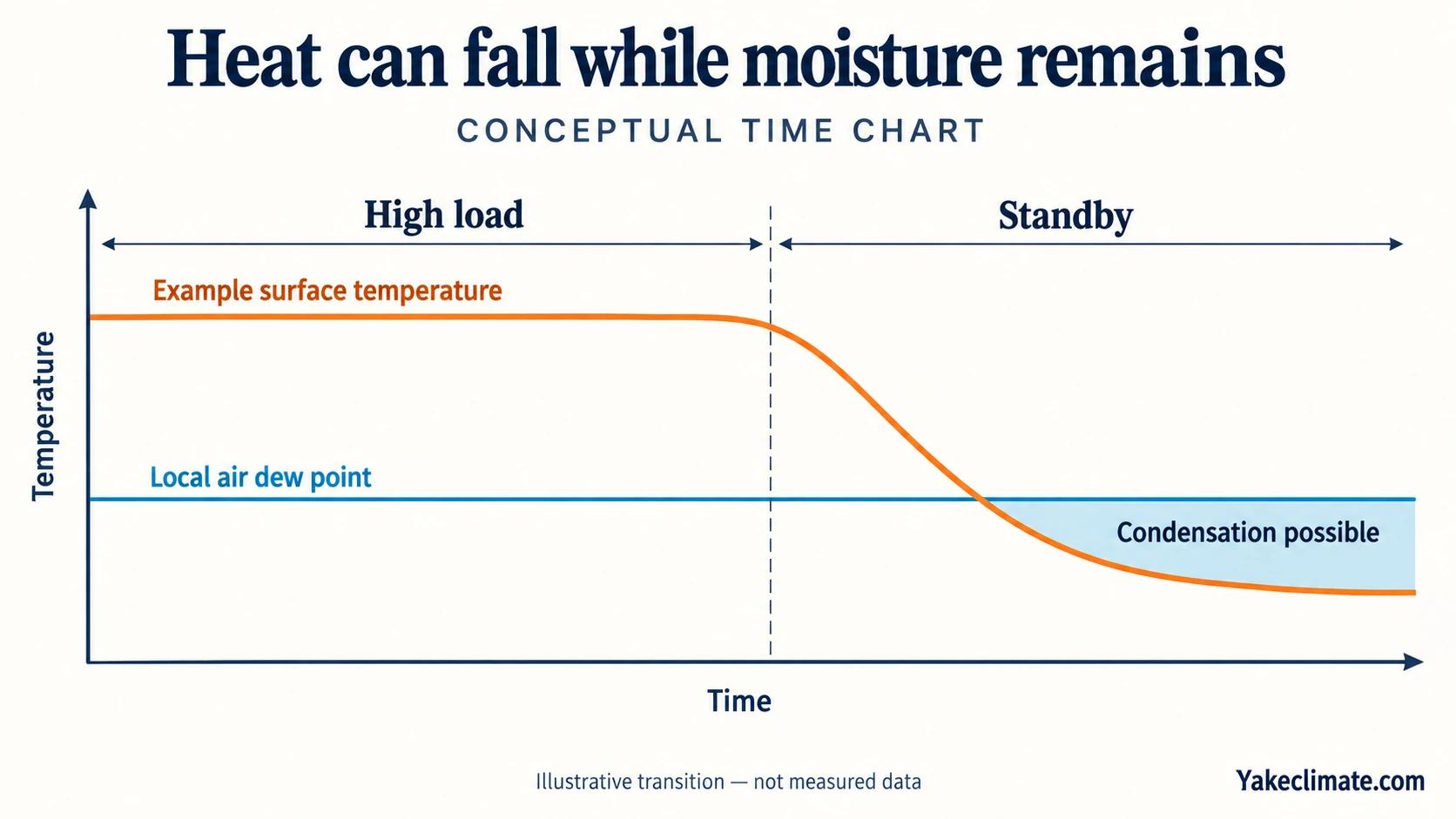
There is no universal rule that charging is wetter, discharging is colder or standby is always the highest-risk state. The answer depends on the system design, climate, controls and air exchange. That is why operating status must be recorded alongside environmental data.
Transitions That Deserve Attention
| Transition | What can change | What to check |
|---|---|---|
| High load to standby | Internal heat falls; cooling may continue or cycle | Cold plates, supply air, walls and control dead bands |
| Shutdown | Fans, heaters or dehumidifiers may stop | Minimum surface temperature and retained internal dew point |
| Restart | Cold equipment meets newly introduced or recirculated air | Dew-point and cold-surface trends from the pre-transition baseline through verified recovery; duration follows the actual event |
| Day to night | Roof and exterior panels cool with ambient conditions | Roof underside, shaded walls and thermal bridges |
| Night to morning | Outdoor dew point may remain high while metal is still cold | Door opening, ventilation start and surface recovery |
| Maintenance | Doors replace internal air with outdoor air | Outdoor dew point, opening duration and recovery time |
These are investigation prompts, not a prediction that every project will condense during each transition.
Cooling Can Create a Local Cold Surface
Cooling equipment may remove sensible heat while creating surfaces colder than the average room or container air. Evaporators, refrigerant lines, coolant pipes, cold plates and nearby metalwork can become local condensation points.
The air at the main humidity sensor may look acceptable while a cold component in another compartment is below dew point. Cooling-unit cycling can also produce short events that disappear before a routine inspection.
Check:
- minimum evaporator, pipe and cold-plate surface temperatures;
- condensate collection and drainage from cooling equipment;
- whether cold air impinges directly on electrical components;
- what happens when cooling continues after load falls;
- whether air-conditioning and dehumidification use coordinated setpoints.
Standby and Shutdown Are Part of the Design Condition
Normal-operation specifications often omit planned standby, emergency shutdown, supply loss, transport, commissioning and maintenance isolation. For each relevant state, identify which cooling, heating, ventilation and moisture-control auxiliaries remain powered, then record the local dew point and cold-surface response through the transition. Detailed period records and handover belong in the seasonal-shutdown enclosure guide.
If condensation control is required during those periods, the power source, restart behaviour, alarms and safe failure mode must be included in the design review.
Outdoor Dew Point Determines the Moisture Introduced
When doors, vents or leakage paths exchange air with the surroundings, the important moisture variable is outdoor dew point. Warm humid air entering a cooler enclosure can raise the internal dew point quickly, especially after a door event.
Compare:
- outdoor dew point;
- internal dew point before the event;
- volume and duration of exchanged air;
- temperature of the coldest internal surface;
- time allowed for recovery.
An outdoor RH value without coincident temperature is not enough to calculate the moisture load.
What to Log During a Cycle
Use a common time base for:
- charge, discharge and standby status;
- battery and PCS power;
- internal air temperature and RH or calculated dew point;
- outdoor temperature and RH or dew point;
- selected surface temperatures;
- HVAC, fan, heater and dehumidifier run status;
- door and ventilation events;
- condensate or high-water alarms.
Place surface sensors at credible cold points, not only beside the room sensor. A short commissioning log should include the transitions the project actually expects to experience.
Separate Cell Thermal Management from Enclosure Moisture Control
Battery thermal management protects cell and module temperature. Enclosure moisture control protects the air and surfaces around batteries, power electronics, busbars, controls and auxiliary equipment.
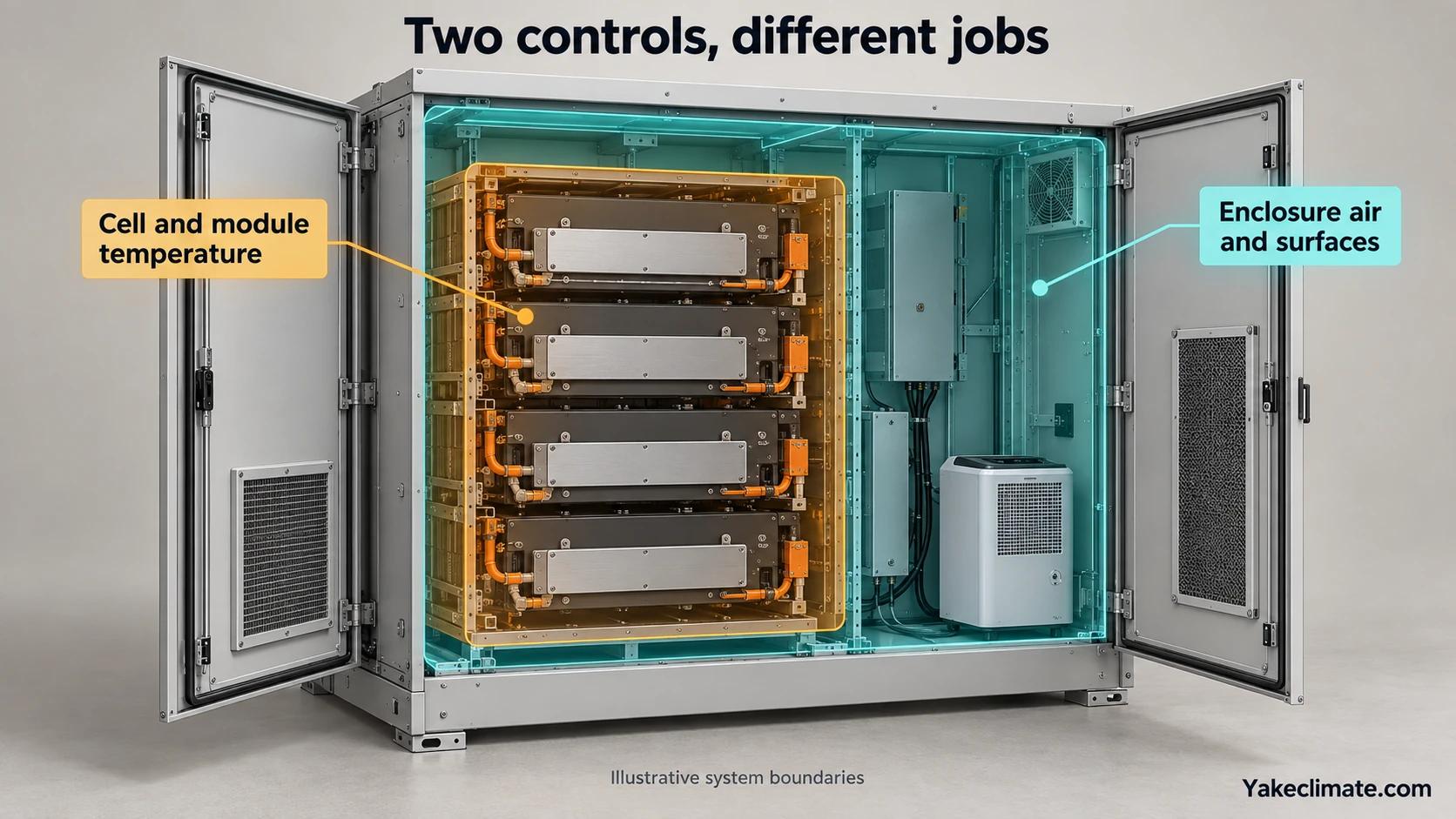
The two systems interact but do different jobs. A cooling system sized for battery heat does not automatically maintain a safe dew-point margin throughout the enclosure. A dehumidifier does not replace the battery thermal-management system.
Their controls should be reviewed together so that one system does not create a cold surface or airflow condition the other system cannot manage.
Design Questions for the Project Team
- What are the normal charge, discharge and standby profiles?
- Which operating state produces the highest internal heat?
- What is the minimum surface temperature in each state?
- Which environmental-control devices remain powered after shutdown?
- What outdoor dew point applies to door opening and ventilation?
- Are there separated air compartments?
- How quickly must the enclosure recover after service?
- Which trends and alarms are available to the BMS or EMS?
- What control margin is required between dew point and coldest surface?
Unknown values should be measured or retained as open engineering inputs. They should not be replaced by a generic RH setpoint.
Discussing the Operating Profile
Yakeclimate designs and manufactures industrial dehumidification equipment for complex climate applications, with a focus on agriculture and energy projects.
We co-develop application-specific dehumidification equipment around the operating conditions, interfaces, and integration requirements of the wider project or system.
Explore energy-storage dehumidifiers or contact Yakeclimate with the system states, site climate, cold-surface locations and environmental-control sequence.
FAQ
Frequently Asked Questions
Does charging always create the highest condensation risk?
No. Charging, discharging and standby produce different thermal conditions in different systems. Condensation risk is determined by the relationship between local dew point and local surface temperature, not by the name of the operating state.
Why can condensation appear after the load stops?
Internal heat can fall quickly while moisture remains in the air. A wall, roof, cold plate or cooling component may then cool below the internal dew point.
Should the dehumidifier continue running during standby?
That depends on the required environmental condition, available auxiliary power and failure strategy. If condensation control is required during standby, continued operation or another protective method must be defined and validated.
Is a single humidity sensor enough?
It may be enough for basic control in a well-mixed small volume, but it cannot reveal every local cold surface or separated compartment. Commissioning should compare air dew point with temperatures at credible cold points.
What data should be sent to the BMS or EMS?
Useful fields can include air temperature, humidity or dew point, run status, fault status, high-water or drain alarm, setpoint and operating hours. The exact protocol and register map must be confirmed for the selected equipment.
How long should cycle monitoring continue?
Long enough to capture the relevant charge, discharge, standby, weather and service transitions. The acceptance plan should define the events to capture rather than relying on an arbitrary number of hours.
