
Wind turbines and substation equipment can face cold metal surfaces, humid air, repeated temperature changes and long periods with limited service access. In these conditions, the environmental-control question is not simply “how many litres per day?”
The project must define the required dew point, minimum operating temperature, air boundary, leakage, ventilation, corrosion exposure and maintenance strategy. Desiccant and refrigerant dehumidification should then be compared against those conditions.
Why Low Temperature Changes the Selection
Refrigerant dehumidifiers remove moisture by cooling air below its dew point and collecting condensate. Their moisture-removal performance generally changes with entering air temperature and humidity, and frost protection may limit operation in colder conditions.
Desiccant rotor systems adsorb water vapour and use a separate heated regeneration airstream to release it. They can be useful where:
- air temperature is low;
- a lower dew point is required;
- condensation collection and freezing are difficult;
- the protected equipment has intermittent heat;
- stable drying across a wide condition range is important.
This does not make a desiccant system automatically better. It adds regeneration heat, process and regeneration airflow, ducting and discharge requirements that must fit the installation.
Begin with the Protected Air Volume
The controlled boundary may include:
- a wind-turbine tower;
- nacelle or hub;
- electrical cabinet;
- converter or transformer compartment;
- offshore platform room;
- substation control building;
- cable basement or connected service space.
These volumes may not be isolated. Open cable routes, tower doors, pressure differences and ventilation can connect them to outside air or adjacent zones. Define which volume is intentionally kept dry.
Low Temperature, Dew Point and Cold Surfaces
Condensation is possible when a surface temperature falls to or below local air dew point. In a wind turbine or substation, cold points may include:
- tower wall and base;
- roof and shaded enclosure panels;
- cable glands and structural steel;
- gearbox, generator or converter surfaces during shutdown;
- foundations and cable trenches;
- external-air ducts and louvres.
At low temperature, an RH target can be misleading because RH rises as air cools. A dew-point target or a surface-to-dew-point margin often provides a clearer design condition.
The project should specify the required margin and measurement uncertainty rather than copying one universal value.
Compare the Two Main Drying Methods
| Question | Refrigerant dehumidification | Desiccant rotor dehumidification |
|---|---|---|
| Moisture-removal mechanism | Air is cooled below dew point and condensate is collected | Moisture is adsorbed and removed in a regeneration airstream |
| Low-temperature behaviour | Must be checked against model operating envelope and frost control | Often considered for lower-temperature or lower-dew-point duties |
| Water handling | Requires condensate collection and drainage | Regeneration exhaust carries moisture away; no process condensate drain from adsorption |
| Energy input | Compressor and fans | Fans and regeneration heat |
| Installation | Air circulation plus drain | Process and regeneration air paths, heater and exhaust |
| Maintenance | Filters, coil, drain, refrigeration components | Filters, rotor, seals, drive, heater and ducts |
Capacity ratings must be compared at the actual entering condition. A headline value measured at warm, humid air cannot be assumed at a cold winter condition.
Select a desiccant system against the required moisture-removal duty at the actual entering-air condition and target leaving dew point, then verify process airflow, the delivered air path, regeneration exhaust, power and the selected unit’s performance data. Floor area and process airflow alone cannot establish the required capacity. The following catalogue figures are reference points, not winter performance:
These catalogue capacities are measured at 20 °C and 60% RH. The −10 °C lower limit is the stated applicable temperature, not a guarantee that either unit meets a target dew point at that temperature. Request performance data at the project’s entering-air and target conditions, and check the moisture load, airflow and regeneration duty together.
Wind-Turbine Airflow Needs a Route
Drying a tower or nacelle requires a defined supply and return path. Check:
- where dry air enters;
- whether air reaches the tower base and electrical zones;
- whether warm or humid air is trapped behind equipment;
- whether doors or vents create a shortcut;
- how regeneration exhaust is kept separate;
- whether fan pressure affects required ventilation.
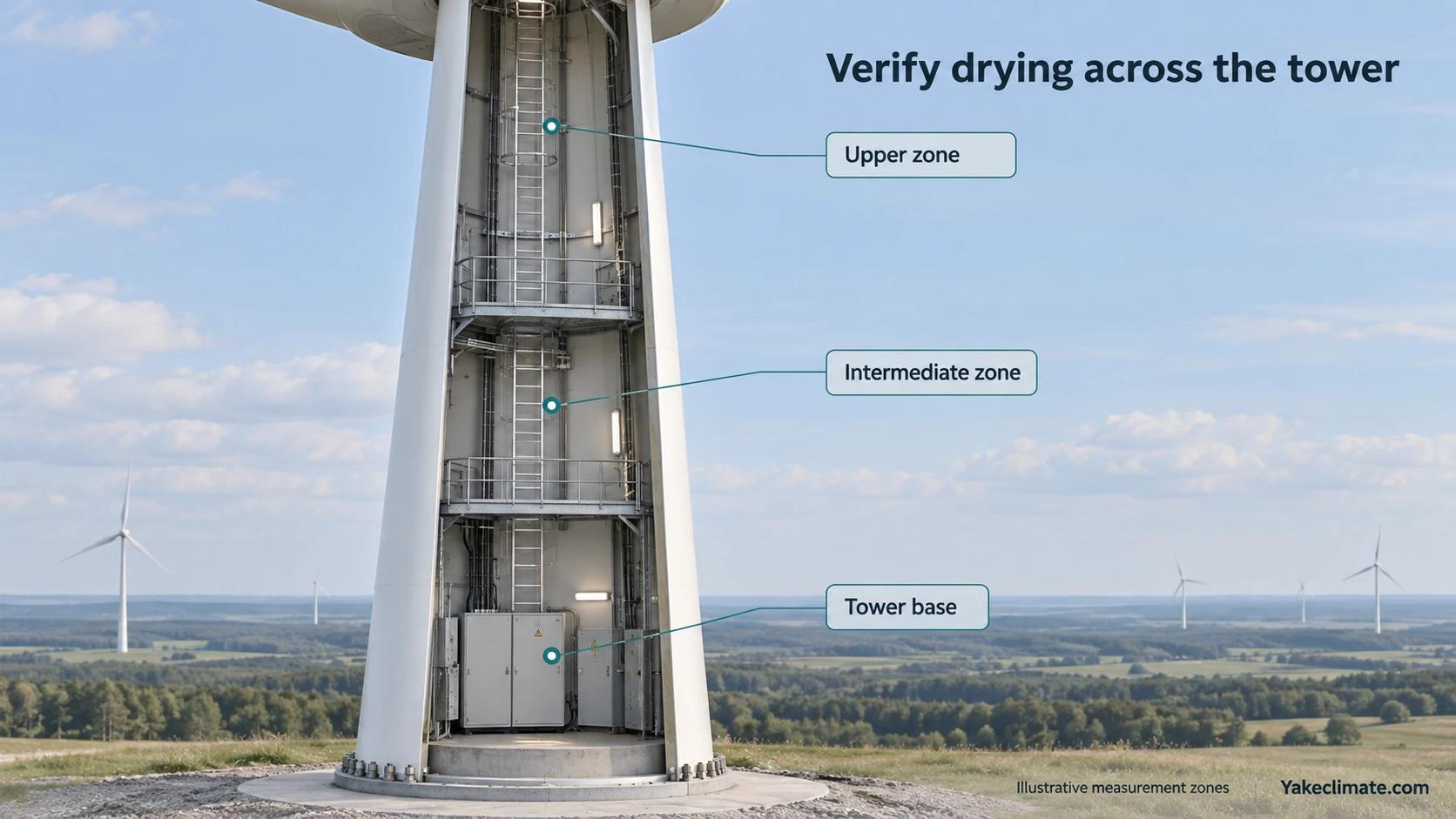
For a tall tower, air distribution and leakage can be as important as nominal dehumidifier capacity. Confirm the result with dew-point measurements at more than one height or zone.
Substation and Switchgear Boundaries
Substation equipment may connect to cable basements, trenches and outdoor switchyards. Moisture can enter from:
- damp cable trenches;
- unsealed penetrations;
- door opening;
- building infiltration;
- cooling and heating cycles;
- outside-air ventilation.
Correct standing water, drainage failures and damaged seals before relying on dehumidification. A dry-air system should not be presented as a substitute for civil-water control.
Salt and Corrosive Exposure Need Separate Evidence
Offshore wind and coastal substations may be exposed to salt and other contaminants. Lower humidity can reduce the time surfaces remain wet, but dehumidification does not by itself establish salt-spray resistance or corrosion protection.
Review:
- enclosure material and coating;
- fasteners and exposed metal;
- electrical component environmental ratings;
- heat-exchanger or coil protection;
- filter and air-intake design;
- salt-deposition cleaning;
- relevant corrosion and ingress tests;
- maintenance access.
Only claim a specific corrosion class, salt-spray duration or certification when it is documented for the supplied equipment and configuration.
Regeneration Air Must Be Engineered
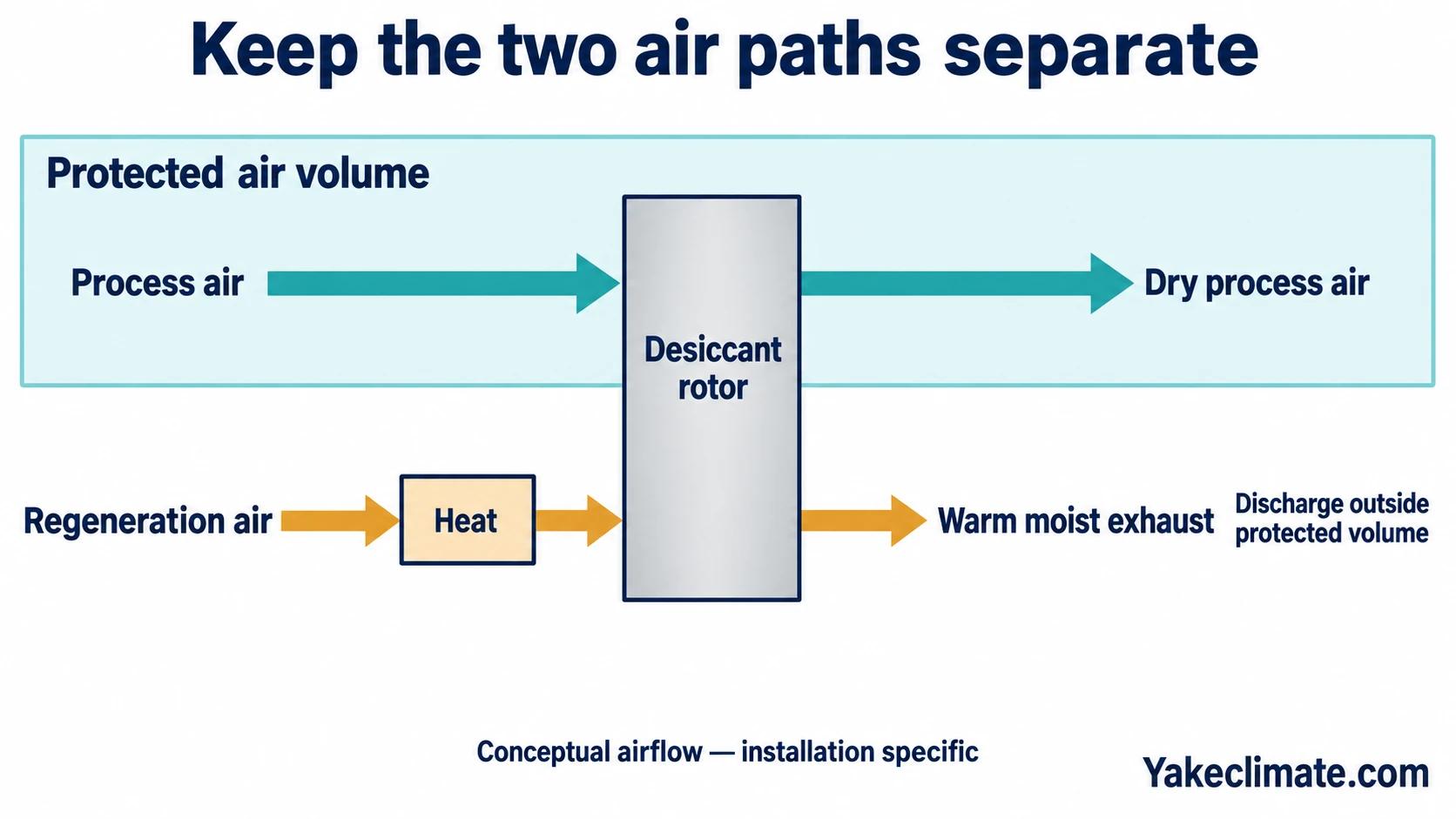
A desiccant rotor requires process air and regeneration air. Confirm:
- regeneration heat source and electrical supply;
- regeneration inlet condition;
- safe discharge location for warm moist air;
- prevention of exhaust recirculation;
- duct insulation and condensation control;
- pressure balance;
- heater and fan interlocks;
- high-temperature and airflow alarms.
If regeneration exhaust returns to the protected volume, the system can add back the moisture it removed.
Standby and Restart
Wind and substation equipment may remain unattended or lose auxiliary power. Define:
- whether drying remains active in standby;
- what happens after power loss;
- minimum restart temperature;
- alarm transmission when the main system is offline;
- acceptable recovery time;
- protection during transport and commissioning.
The dehumidifier's operating range and control sequence must match those states.
Monitoring and Acceptance
During commissioning, trend:
- outdoor temperature and dew point;
- process-air inlet and outlet condition;
- regeneration-air status;
- dew point in remote protected zones;
- cold-surface temperature;
- door and ventilation events;
- fan, heater and rotor status;
- alarms and power interruptions.
Test the lowest relevant operating condition where practical. If seasonal validation is not possible at handover, define how the first winter or high-humidity period will be reviewed.
Information Needed for Selection
Provide:
- protected equipment and air volume;
- site temperature and humidity range;
- target dew point or surface margin;
- minimum equipment operating temperature;
- leakage, ventilation and door events;
- process and regeneration duct routes;
- available power and heat;
- drainage constraints;
- salt, dust and corrosive exposure;
- communication and alarm requirements;
- maintenance interval and access;
- commissioning and seasonal acceptance plan.
Discussing Low-Temperature Drying
Yakeclimate designs and manufactures industrial dehumidification equipment for complex climate applications, with a focus on agriculture and energy projects.
We co-develop application-specific dehumidification equipment around the operating conditions, interfaces, and integration requirements of the wider project or system.
Explore desiccant rotor systems, review energy applications or contact Yakeclimate with the minimum temperature, target dew point, airflow boundary and corrosion exposure.
FAQ
Frequently Asked Questions
When should a desiccant rotor be considered?
Consider it when the project has low entering temperature, a lower dew-point target, difficult condensate drainage or a wide operating range. Compare the complete installation and energy requirement with refrigerant options.
Can a refrigerant dehumidifier operate in cold conditions?
Some models include low-temperature or defrost controls, but the actual operating range and capacity must be checked for the selected model and entering condition.
Does desiccant drying produce liquid condensate?
The rotor transfers moisture to a heated regeneration airstream that is discharged. The installation must safely route that warm moist exhaust and prevent recirculation.
Does a dehumidifier make equipment salt-spray resistant?
No. Humidity control may reduce surface wetness, but material, coating, filtration, cleaning and test evidence determine corrosion resistance.
How many sensors are needed in a tower?
Use enough temporary points to show conditions in the base, upper zone and protected equipment areas. The final permanent arrangement follows the validated airflow and risk map.
What if winter commissioning is not possible?
Complete the available functional tests and define a documented seasonal verification plan for the first representative cold or humid period.
