
A water-damage drying log is a dated record of where water was found, what was measured, which drying equipment was running, and how conditions changed. Here “log” means a record, not a timber log sent to a kiln. The record helps a restoration team compare like-for-like readings and explain its decisions; it does not itself dry a material, prove that hidden areas are safe, or guarantee an insurance outcome.
Start With the Affected Area and a Measurable Baseline
Identify the water source, the affected rooms and materials, and any access or electrical hazards before using drying equipment. Record the date and time of discovery and of each visit. Sketch or photograph the affected area and label the same measurement points on the sketch. For each point, identify the material and location precisely enough for another technician to return to it; “north wall, lower cavity side, point W2” is more useful than “wall wet.”
Take initial material readings at affected points and comparable unaffected reference points of the same material, when available. Record the instrument make or identifier, mode or scale, and whether the value is a percentage for that material or a relative meter indication. A pinless meter number on drywall is not automatically a mass-percent moisture content, and a reading from one material should not be compared as though it were the same scale on another. Where concealed moisture is suspected, document the limitation and the next inspection method instead of declaring the surface dry.
US EPA worker guidance: moisture meters can help identify wet materials and monitor drying progress.
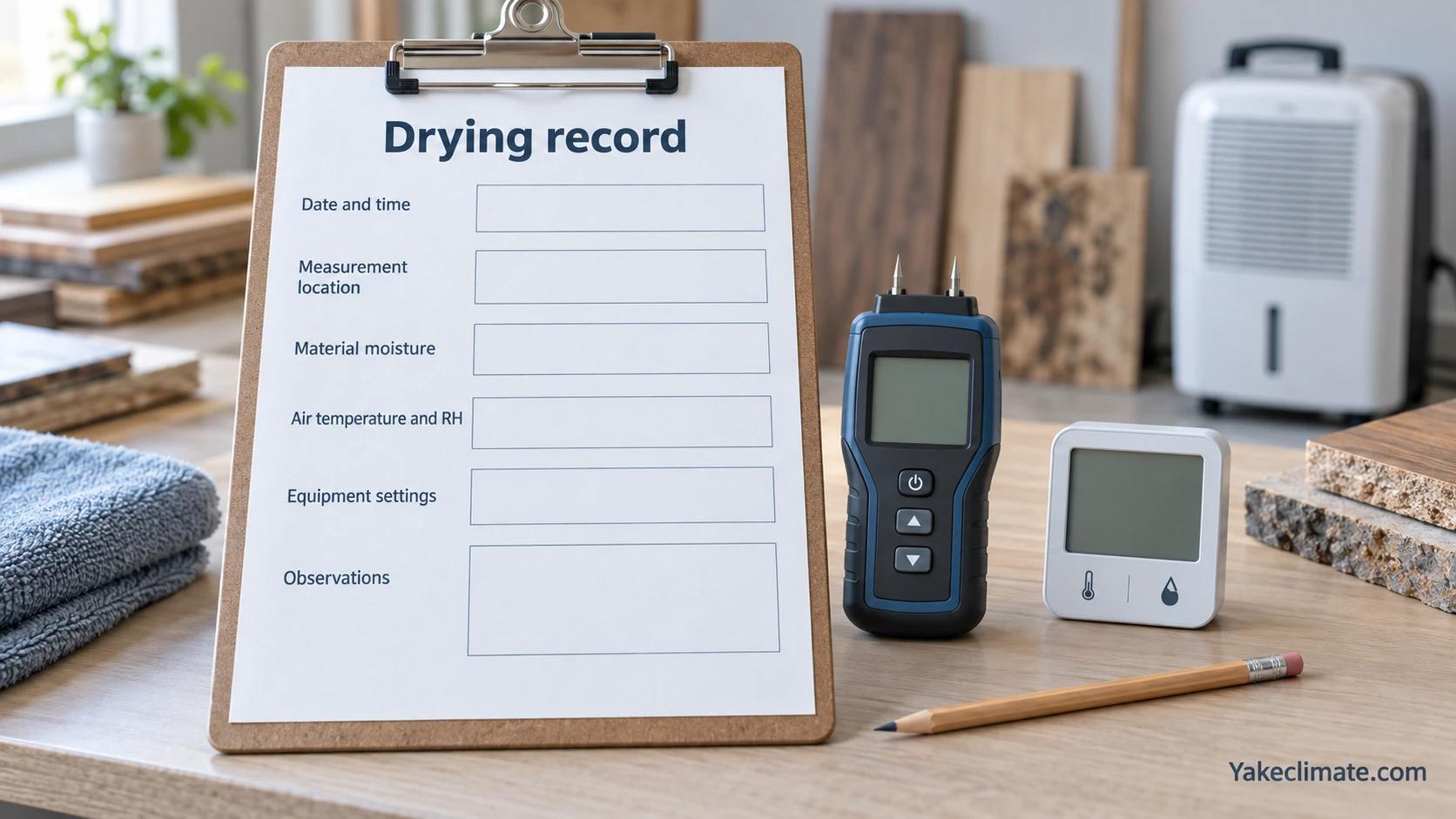
Use a Repeatable Daily Record
At each visit, measure the marked points again with a comparable instrument and setting. Log the room air temperature and relative humidity near the affected material, plus any relevant outdoor or adjoining-zone condition. Note whether equipment was running normally, its setting, condensate or drainage observations where useful, and any change in ventilation, isolation, access, or water source. A time stamp matters: one morning value and one evening value cannot be interpreted as simultaneous.
| Field in a blank record | What to enter | Why it matters |
|---|---|---|
| Site and point ID | Room, material, marked measurement location and reference point | Makes repeated readings comparable |
| Visit and instrument | Date/time, technician, meter ID, mode, scale and calibration/check note | Shows how each reading was produced |
| Material condition | Reading, unit or relative scale, visible condition and inaccessible areas | Separates observation from an assumed dry conclusion |
| Air and equipment | Temperature, RH, equipment type/status/setting and changes since last visit | Explains a change in drying conditions |
| Decision and next check | Adjustment, reason, responsible person and planned recheck | Connects the data to an accountable action |
The table is a blank field guide, not a completed project record or a substitute for the project’s required form. Keep original readings rather than rewriting an earlier entry when a later value looks inconsistent. Add a dated correction with the reason and re-measure the point if needed. Photographs and instrument records should carry a matching point ID and time.
Interpret a Trend Before Changing the Drying Setup
Compare a material with its own earlier readings and appropriate same-material reference points. A sustained decline at the same marked point can support progress, while one low reading cannot rule out wet material elsewhere. A flat or rising series may mean new water, a different measurement point or meter setting, inaccessible moisture, changed air conditions, or equipment trouble. Check these explanations before prescribing more heat or a larger dehumidifier.
Record what changed and why: for example, a leak was repaired, a cavity was opened by a qualified crew, an air mover was repositioned, or equipment stopped overnight. Describe observed results at the next visit. Dehumidifiers lower air moisture when correctly selected and operated; air movers can help exposed surfaces. Neither makes a universal material dry threshold or overrides a contamination and safety assessment.
US EPA material-specific drying guidance distinguishes drywall, concrete and wood responses.
Close the Record Against the Right Endpoint
Before closing the drying log, state the endpoint for each material and planned next use. The applicable restoration protocol, manufacturer instructions, material condition, local requirements and the next finish may call for different tests. Compare final readings at the mapped points with the agreed reference or specified acceptance method, and note any inaccessible locations or remaining repair work. There is no defensible universal “15% for wood and drywall” or “room RH below 60% proves every cavity is dry” rule.
Document the final inspection date, instrument and scale, points tested, remaining exceptions, reviewer and handoff. If mold, sewage, electrical danger or structural damage is suspected, use a qualified assessment and the relevant safety process; a drying log is not a remediation clearance. The public description of ANSI/IICRC S500 identifies professional water-damage restoration as its scope, but does not substantiate a universal numeric stop rule for this page.
IICRC: scope of the S500 professional water-damage restoration standard.
Connect the Log to the Wider Restoration Plan
A drying record is one part of a restoration job. The broader restoration guide covers assessment, extraction, material decisions and follow-up. If wood is among the affected materials, the separate meter guide explains instrument selection and the limits of readings. This page remains the guide to recording and reviewing the measurements, rather than a guide to kiln-drying timber or a product-performance claim.
Related guide: the overall water-damage restoration process.
Related guide: wood-moisture measurement instruments and interpretation.
Sources and Scope
US EPA, Mold: Worker and Employer Guide to Hazards and Recommended Controls.
US EPA, Mold Course Chapter 4: material-specific drying guidance.
IICRC, S500 standard overview; no numerical threshold inferred from the overview.
FAQ
Frequently Asked Questions
What is a water-damage drying log?
It is a dated record of the affected area, fixed measurement points, material and air readings, equipment operation, changes, and final review. It is not a method for drying timber logs.
How often should readings be entered?
Record a baseline before or at the start of drying and repeat at consistent intervals suited to the site and applicable protocol. Record the exact time of each reading and any event between visits; do not treat an arbitrary 24-hour interval as a universal rule.
Can the same moisture percentage be used for wood and drywall?
No. Instrument modes and scales differ by material and method. Log the meter and scale, compare repeat readings at marked points, and use the appropriate material and next-use acceptance criterion.
Does a low room RH prove a wall cavity is dry?
No. Air conditions help explain drying but do not measure hidden material. Check the relevant locations and record inaccessible areas or assessment limitations.
Does the log guarantee an insurance claim or safe occupancy?
No. It can document work and support review, but claim decisions and safety clearance depend on the applicable parties, evidence, hazards and procedures.

