
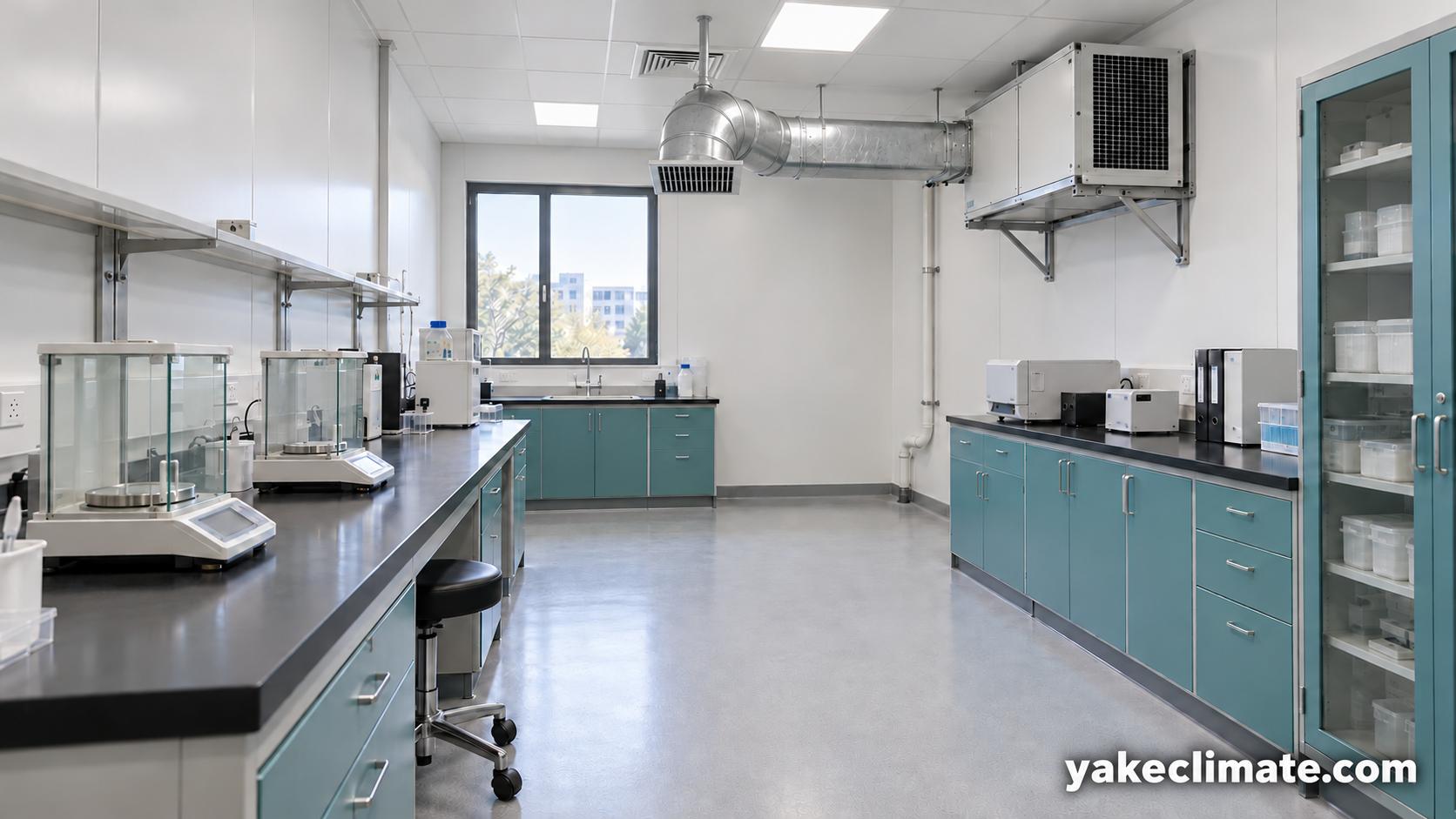
For a high-air-change laboratory receiving humid supply air, remove moisture in the air-handling system first. Choose a refrigerant dehumidifier for laboratory instrument or sample rooms with low outdoor airflow, sized at the actual room condition, such as 22 °C and 50% RH. Keep precision weighing rooms within 40–60% RH.
Quick answer
- Separate the ventilation load from the room load: 1,800 m³/h of outdoor air with a 10.6 g/kg moisture difference brings about 22.9 kg/h of water at an assumed dry-air density of 1.2 kg/m³.
- Use 40–60% RH for precision weighing; set other rooms from their instruments, stored materials and research requirements.
- Select capacity at the intended room temperature and RH, with continuous drainage and coordinated temperature control.
For a separate instrument room or sample store where floor space matters, compare industrial ceiling-mounted dehumidifiers after calculating the remaining moisture load.
What RH target should each laboratory room use?
Set humidity by the measurement or stored material: precision weighing needs 40–60% RH, while general laboratory and feed-storage conditions follow different design criteria.
| Room or activity | RH and temperature target | Moisture sources to calculate | Preferred treatment location |
|---|---|---|---|
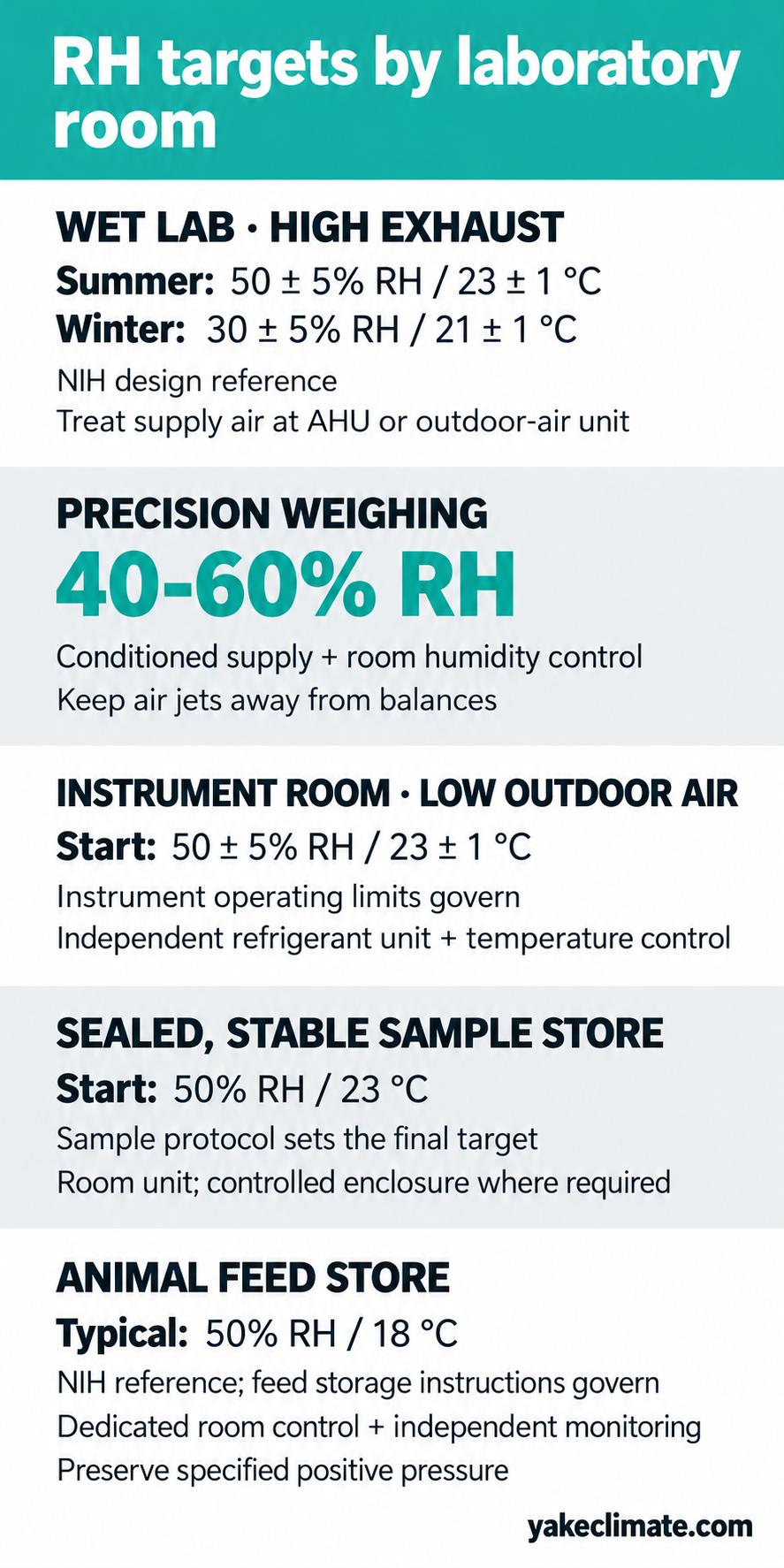
| General wet laboratory with substantial exhaust | NIH design reference: summer 50 ± 5% RH at 23 ± 1 °C; winter 30 ± 5% RH at 21 ± 1 °C | Outdoor replacement air, sinks, open water baths, wet processes and occupants | Air-handling unit or dedicated outdoor-air system, coordinated with exhaust |
| Precision balance or weighing room | 40–60% RH; select temperature stability for the weighing uncertainty | Supply/transfer air, door openings and occupants | Conditioned supply plus room humidity control; keep air jets away from balances |
| Separate instrument room with low outdoor airflow | Start at the NIH summer reference of 50 ± 5% RH at 23 ± 1 °C where the instrument's operating limits permit; instrument-specific limits govern | Supply/transfer air, leakage and occupants; instrument heat is a separate sensible load | Independent refrigerant unit plus temperature control |
| Ambient sample store for sealed, stable materials | Use 50% RH at 23 °C as an initial room-management target when the sample protocol permits those conditions; set tighter storage requirements from the material protocol | Door openings, leakage and moisture released by packaging or exposed samples | Independent unit for the room; a controlled enclosure for samples requiring a different environment |
| Animal feed store | NIH typical condition: 50% RH at 18 °C; the feed's storage instructions determine any refrigeration requirement | Deliveries, door openings, incoming air and exposed feed | Dedicated room control with independent monitoring; preserve the specified positive pressure |
The NIH values apply to NIH facility design, with separate provisions for special research conditions. The sample-store starting point uses its general laboratory summer condition; the sample's storage protocol sets the final target. NIH DRM, §6.1.9.1, Table 6.1.9.1 and feed-storage provisions.
For weighing, excessive drying can increase electrostatic errors. NIST recommends 40–60% RH and, for high-precision measurements, temperature variation within ±1 °C over 24 hours and less than 0.5 °C during a measurement series. Keep balances away from heating and cooling outlets. NIST GMP 10, §§1 and 6.
Animal holding rooms require species-specific conditions and ventilation. The feed-store row applies to stored feed; housing, cage washing and containment laboratories need their own environmental design.
Why can a dehumidifier struggle in a high-air-change lab?
A room dehumidifier struggles when incoming water exceeds its removal capacity; in a humid climate, high outdoor-air flow can make this the dominant load. Treat that load upstream in the ventilation or air-conditioning system. Laboratories commonly use all-outdoor-air supply, with airflow determined by exhaust, heat removal, ventilation and pressure requirements. ASHRAE Laboratories, introduction and §3.
Calculate the outdoor-air contribution using humidity ratio, w, in grams of water per kilogram of dry air:
Moisture load (kg/h) = Q (m³/h) × ρda (kg dry air/m³) × (w_in − w_room) (g/kg) ÷ 1,000.
Use the incoming air's actual condition at the point being evaluated. Airflow and density must share the same volume basis. This is the steady-state water balance used in psychrometrics. ASHRAE Psychrometrics, humidity parameters and space moisture gains.
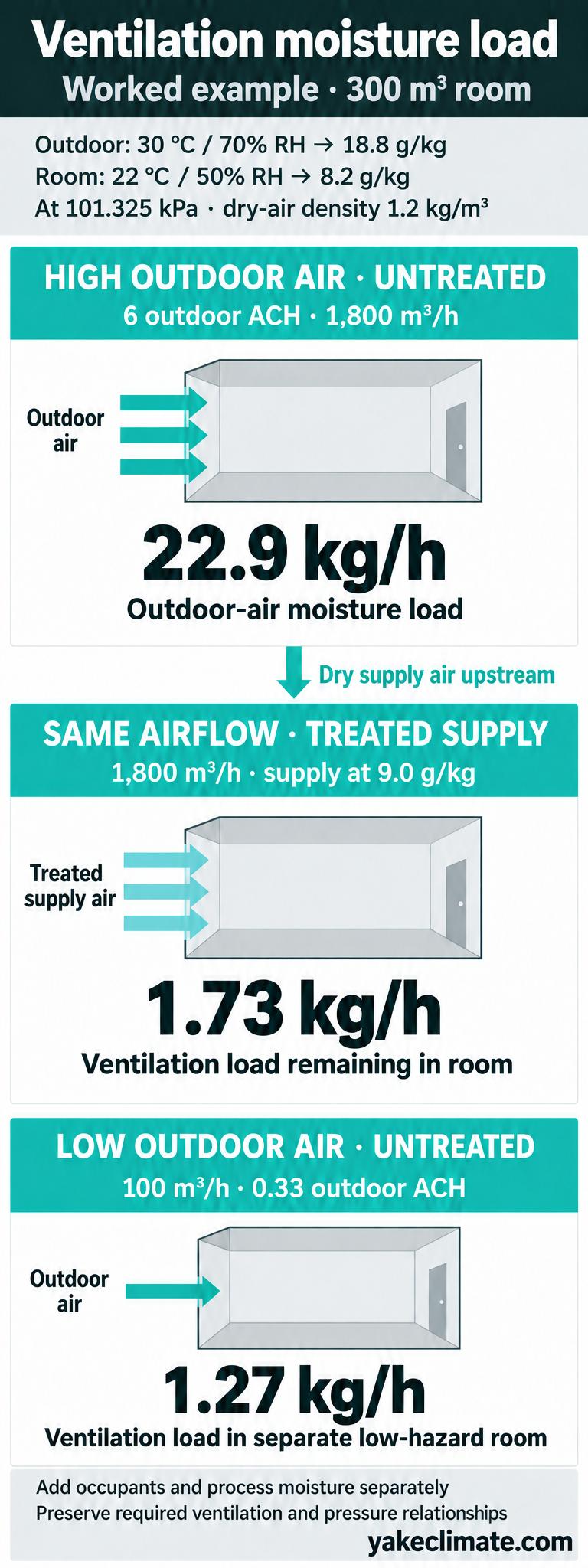
Assume a 300 m³ room, 6 outdoor air changes per hour, outdoor air at 30 °C/70% RH, and a room target of 22 °C/50% RH. At 101.325 kPa, the rounded humidity ratios are 18.8 g/kg outdoors and 8.2 g/kg indoors. Take 1.2 kg dry air/m³ as the estimating density. These inputs define the following worked example:
| Calculation | Result |
|---|---|
| Outdoor airflow: 300 m³ × 6 h⁻¹ | 1,800 m³/h |
| Moisture difference: 18.8 − 8.2 | 10.6 g/kg |
| Outdoor-air load: 1,800 × 1.2 × 10.6 ÷ 1,000 | 22.9 kg/h |
| Continuous daily equivalent: 22.9 × 24 | About 550 L/day |
The 6 ACH value is a chosen input for this example; the facility design establishes the required ventilation. The load above covers outdoor air alone; add moisture from occupants and processes separately. Use the moist-air property converter to replace the assumed weather and room conditions with project inputs.
An existing air handler changes the room calculation. If it delivers the same airflow at 9.0 g/kg, the ventilation contribution remaining in the room is 1,800 × 1.2 × (9.0 − 8.2) ÷ 1,000 = 1.73 kg/h, about 41 L/day. Most of the original outdoor moisture has already been removed. If supply air arrives below the room's target humidity ratio, it provides drying capacity for internal sources. Count each removal contribution once.
For comparison, a separate room receiving only 100 m³/h of the same untreated outdoor air has a ventilation load of 1.27 kg/h, about 31 L/day. For the same 300 m³ volume, this is 0.33 outdoor ACH, an assumed condition for a low-hazard instrument or storage room whose required ventilation has already been established.
This explains the complaint that laboratory dehumidifiers achieve little: a small unit faces a continuous supply of moisture in the high-flow case. The workable alternative is a dry supply-air stream, or an independent unit serving a genuinely low-load room. Preserve the laboratory's required ventilation, containment and pressure relationships; change airflow through the facility's hazard assessment and ventilation design. ASHRAE Laboratories, §§1.2 and 3.1.
Which dehumidifier for laboratory use should you choose?
Choose an independent refrigerant dehumidifier for a low-air-change room around 22 °C and 50% RH, with capacity demonstrated at that inlet condition. Ceiling or ducted installation frees workspace and permits deliberate supply-air placement.
| Condition | Recommended equipment arrangement | Selection check |
|---|---|---|
| High outdoor airflow with humid supply | AHU or dedicated outdoor-air dehumidification, with cooling and reheat as required | Supply humidity ratio, peak ventilation load, temperature and exhaust coordination |
| Low outdoor airflow, moderate room RH | Independent refrigerant unit, floor-mounted or ceiling-mounted | Removal at the design inlet, drainage, room heat gain and air distribution |
| Low dew-point process or a cold room | Compare desiccant drying with purpose-designed cooling equipment | Required outlet humidity ratio, regeneration heat/exhaust and temperature control |
| Hazardous, containment or particle-controlled room | Facility-designed environmental system | Approved circulation paths, contamination control, pressure and service access |
Refrigerant equipment condenses water on a coil below the air's dew point. At 22 °C/50% RH, that dew point is about 11.1 °C, making refrigeration a practical starting choice. As the required dew point falls, compare the coil conditions and defrost requirements with desiccant drying. ASHRAE Psychrometrics, cooling and dehumidification.
For the 100 m³/h example, assume 0.20 kg/h of internal moisture. The total becomes 1.27 + 0.20 = 1.47 kg/h. With a selected 20% design allowance, specify at least 1.8 kg/h at 22 °C/50% RH, approximately 43 L/day. Replace the assumed internal load and allowance with the operating schedule and recovery requirement. The general dehumidifier sizing guide covers other moisture sources.
Yakeclimate's RYDZ-90DM lists 90 L/day at 30 °C/80% RH, 1,000 m³/h airflow, 50–80 Pa external pressure and 1.2 kW maximum power. Its rated water removal converts to 3.75 kg/h. For the example room, request the model's capacity at 22 °C/50% RH and the airflow available against the proposed duct resistance before choosing it. Its recirculation airflow is separate from the room's outdoor-air requirement.
The listed electrical supply is 220 V, single-phase, 50 Hz. For a US project, establish the required voltage, frequency and electrical approvals with the equipment supplier before ordering. Include compressor/fan heat and the heat released by condensation in the room's cooling assessment; continuous dehumidification also needs continuous condensate disposal.
How should the room be commissioned and monitored?
Accept the installation against conditions at the balance, instrument or stored material, including periods of peak humidity and low cooling demand.
- Log the incoming air and room together. Record temperature, RH and humidity ratio in the supply, at the return and near the sensitive work. This separates an upstream moisture problem from a local one.
- Check distribution and temperature. Keep discharge jets and vibration away from balances. Coordinate the room's cooling and humidity controllers so that dehumidifier heat stays within the instrument's temperature limits.
- Prove drainage and access. Test continuous drainage, overflow protection and any condensate pump. Provide access for filters, coils and drain cleaning without disturbing stored samples.
- Test real operating states. Include door openings, occupied and unoccupied operation, and the expected exhaust settings. For weighing rooms, check repeatability and temperature stability alongside the RH record.
Supply diffusers should preserve hood and safety-cabinet airflow patterns, and maintenance access should protect laboratory work from leaks and disruption. ASHRAE Laboratories, §3.1 Air Distribution and §4.8 Operation and Maintenance.
FAQ
Frequently Asked Questions
Can a portable dehumidifier fix a humid laboratory?
Yes, when the room permits local air recirculation and its remaining moisture load fits the unit's capacity at the target temperature and RH. In a high-exhaust laboratory receiving humid supply air, correcting the supply-air moisture condition is the first action. Measure that condition before adding portable equipment.
Should a balance room be dried below 40% RH?
No, routine precision weighing should generally stay within 40–60% RH. Excessive drying increases the risk of electrostatic measurement errors. Use the balance's operating requirements and the weighing method to set tighter limits, and keep temperature and airflow stable while measurements are taken.
How much water must a laboratory dehumidifier remove?
About 1.8 kg/h at 22 °C/50% RH is the requirement in the low-airflow example: 100 m³/h of outdoor air at 18.8 g/kg, a room target of 8.2 g/kg, 1.2 kg/m³ dry-air density, 0.20 kg/h internal moisture and a 20% allowance. Change those inputs for the actual room.
Will lowering the thermostat solve high laboratory humidity?
No, temperature control alone leaves humidity dependent on coil operation and incoming moisture. A laboratory with substantial ventilation needs a specified supply-air humidity ratio and coordinated humidity control. In a separate low-load room, an independent dehumidifier can remove the remaining moisture while cooling maintains the required temperature.
For a separate instrument room or sample store, send the room and supply-air conditions, moisture load, duct layout, drainage and power requirements for ceiling-mounted dehumidifier selection.


