
Consider replacing or supplementing refrigerant dehumidification when verified performance at the job’s conditions cannot sustain the drying plan. A cold building or flat moisture trend is a reason to investigate, not an automatic instruction to use desiccant equipment.
This guide addresses the equipment decision. For source control, initial safety assessment and the wider recovery sequence, see dehumidification during building water-leak recovery.
Start With the Water Event
Have the restoration professional assess the water source, contamination, affected materials and safe access before deciding what can be dried in place. Equipment selection follows that assessment.
Do not start fans before determining that the water is clean or sanitary. Suspected contamination calls for appropriate containment and experienced assessment; drying equipment does not make contaminated materials safe.
Where a contract requires IICRC S500 classification, the qualified restorer should use the applicable edition. This article does not reproduce category or class definitions.
Water within a material must move toward an evaporating surface. Internal transport can limit drying even when the surrounding air is dry. Material temperature and the surface-to-air vapour-pressure difference also matter; neither drier air nor extra heat guarantees rapid drying. See evaporation, drying rate and dehumidification load.
A desiccant system is one way to change the air-side condition. Its value must be demonstrated for the required duty rather than inferred from the material name alone.
Compare Delivered Performance at the Job Conditions
Refrigerant equipment removes vapour by cooling air below its dew point. Evaluate the selected unit’s delivered capacity, airflow and operating envelope at the expected entering conditions.
A warm, humid capacity rating does not establish output in a cooler, drier room. Request performance information at the intended conditions and target, not just the largest litres-per-day figure.
Where frosting and defrost occur, include their effect on delivered capacity. There is no universal entering-air temperature at which all refrigerant units become unsuitable.
Review this performance as the job changes. A unit that handled an initial wet load may have a different useful output later; continuing suitability depends on the actual target and material progress.
Desiccant equipment uses a sorbent rather than a condensing coil for process-air moisture removal. Selection still depends on entering conditions, desired outlet condition, airflow and regeneration capability. Do not apply one catalogue model’s temperature range to an entire technology.
Use the following checks to decide whether to retain, replace or combine equipment:
| Observed situation | Decision before changing equipment |
|---|---|
| Refrigerant units meet target and materials are progressing | Continue the verified plan; a scheduled technology change is not required. |
| Cold or increasingly dry entering air | Check model capacity and defrost. Compare a desiccant proposal at those same conditions. |
| Material readings flatten | Investigate ingress, hidden layers, instruments and delivered output before diagnosing the limiting mechanism. |
| Material tolerates a different temperature or air condition | Have the restorer assess a revised plan within material limits; do not assume more heat is safe. |
| Considering combined equipment | Assign each unit a duty and verify the combined air, heat, drainage and exhaust arrangements. |
| Required endpoint is not being reached | Use the material-specific test and target to judge the revised plan, not room RH alone. |
Refrigerant and desiccant equipment may be combined where their assigned duties complement each other. A change should have a stated purpose and a measurable material response, not follow an assumed fixed sequence of drying phases.
Compare the whole system: regeneration heat, process and reactivation fans, and any added heating or cooling. Exhaust and replacement-air arrangements affect the duty. Confirm the available heat source and power supply; a low outlet dew point alone is not evidence of lower operating cost.
RY-1000M — Desiccant Rotor Dehumidifier — 180 L/24h at 20 °C / 60 % RH · −10 to +55 °C Published capacity: 180 L/24h at 20 °C / 60 % RH; published operating range: −10 to +55 °C. Check delivered output at the actual conditions, plus regeneration and exhaust requirements for the proposed duty.
RYCM-138C — Portable Dehumidifier — 138 L/24h at 30 °C / 80 % RH · 5–38 °C 138 L/24h at 30 °C / 80 % RH · 5–38 °C. Refrigerant portable option for a drying plan within its operating envelope; verify capacity at the actual conditions.
Plan Containment, Ventilation and Exhaust Together
Define the treatment zone with the responsible restoration and facilities teams. Its air exchange becomes part of the equipment duty.
Uncontrolled exchange with adjacent areas can undermine the intended air condition. Correcting avoidable leakage does not remove the need for adequate capacity or required ventilation.
- Close only approved openings. Maintain required access, emergency egress and fire protection when placing barriers.
- Coordinate HVAC with the responsible team. Use an approved restoration ventilation and containment plan; do not shut off the building system solely to improve drying. Preserve occupied-space safety and required ventilation.
- For an open-cycle rotor system, route moisture-laden reactivation exhaust to the approved discharge point, away from the drying zone and air intakes. Confirm the complete intake/exhaust arrangement and manufacturer’s requirements.
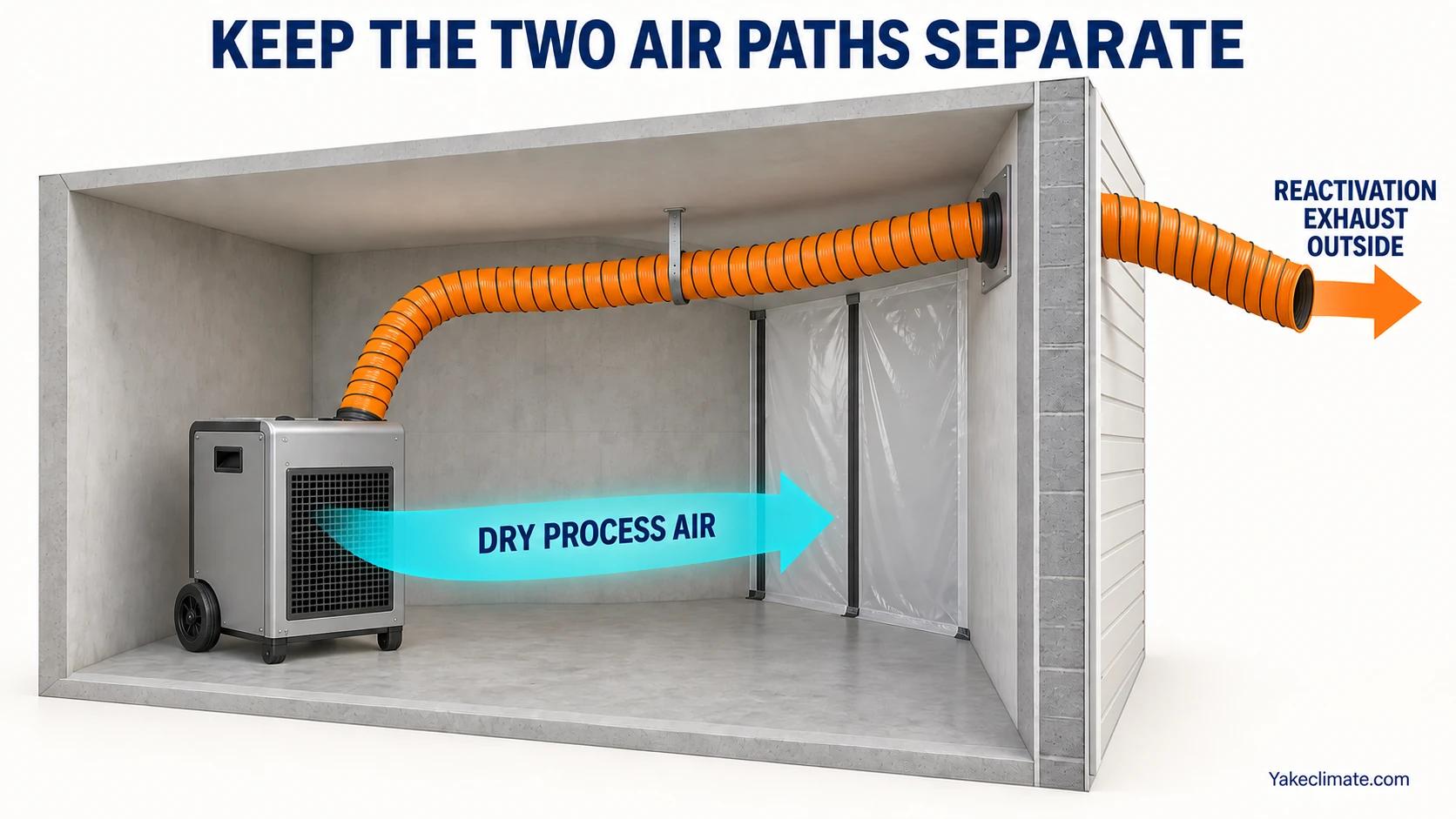
- Have the responsible team define pressure control for contamination and occupancy risks. Drying performance alone does not determine the required pressure arrangement.
The same reasoning, applied to portable equipment generally, is in commercial portable dehumidifiers.
Match Air Movement, Heat and Dehumidification
These measures affect different parts of drying. Choose them together, within the material and site constraints.
Air movement can assist surface evaporation and transport vapour away. If internal moisture transport limits the rate, more surface airflow may give little improvement; a plateau alone does not establish that diagnosis.
Heating a wet surface can increase the evaporation driving force, but material temperature, air vapour pressure and transport resistance must be considered together. Do not infer material temperature from room temperature.
Set temperature limits for the materials and finishes. Account for warm process air when assessing the system, rather than treating it as automatically beneficial.
Dehumidification can maintain a lower air vapour pressure. It works alongside heat transfer and internal moisture movement; it is not the only measure that can affect late-stage drying.
Before adding equipment, compare measured delivery and material response with the agreed plan. Change the suspected limiting condition and verify the response.
Measure the Material, Not the Air
Air conditions can meet their target while moisture remains within materials or hidden layers. Completion therefore requires the agreed material checks.
Use appropriate instruments for the material. Pin and pinless moisture meters, and in-situ probes for slabs, answer different questions and have different limitations.
Establish material-specific targets and test methods with the restoration professional. An unaffected comparable area can inform the reference, but is not automatically a valid dry standard for every assembly.
Measure the same locations each time. Mark them. Readings from varying positions produce a trend that reflects position rather than progress.
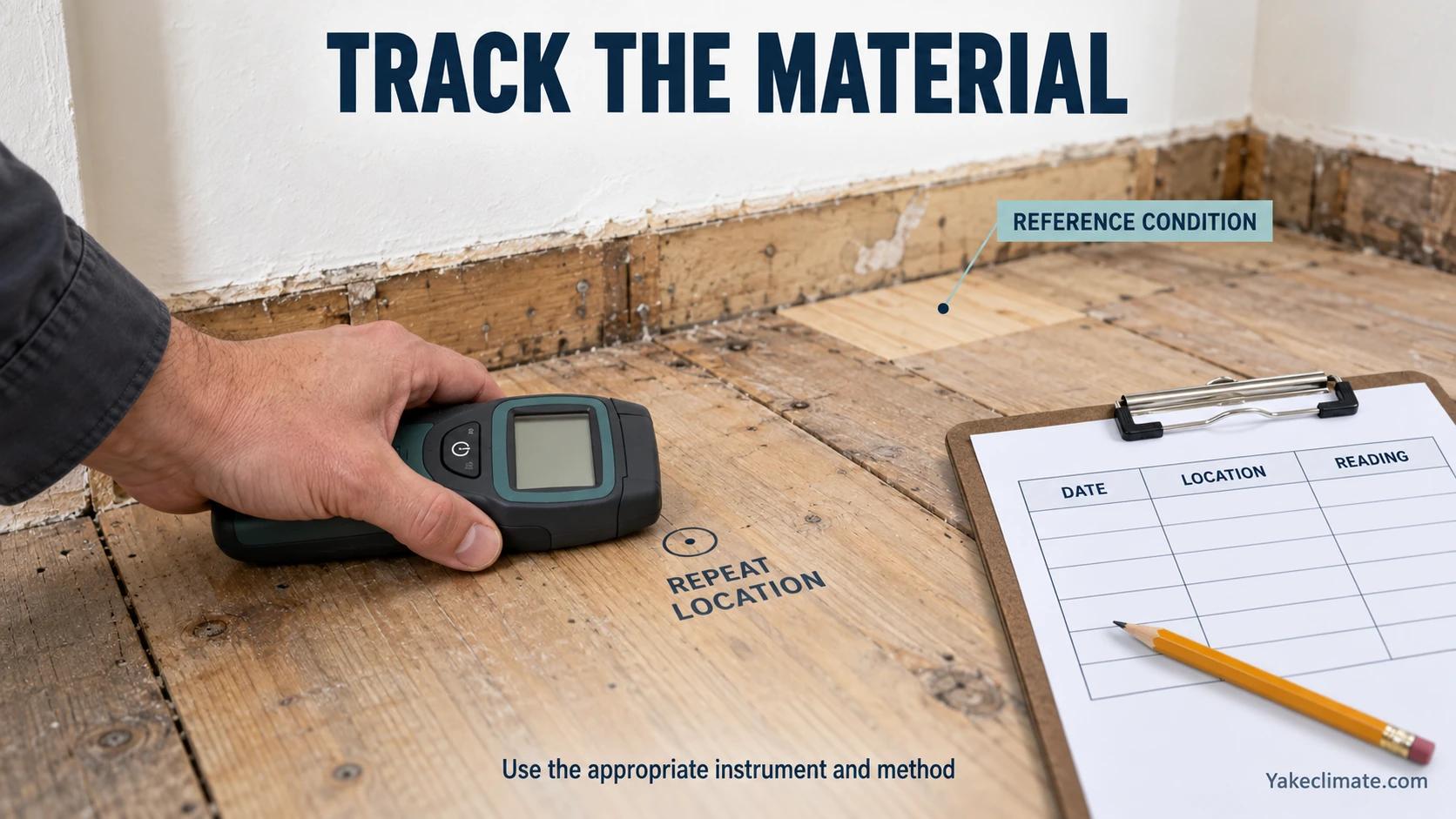
Record trends at comparable locations. A flattening trend warrants investigation; its shape alone cannot identify equilibrium or a drying phase.
For concrete, select the test method appropriate to the assembly and intended use; different methods answer different questions. See choosing a moisture barrier for concrete floors.
Log air temperature and humidity alongside material readings to give the trend context.
Documentation
Keep a record that explains the equipment decision and the evidence for completion. Agree any contract or insurer documentation requirements separately.
What a defensible record contains:
- Initial assessment: water source, contamination findings, affected materials and extent, with photographs.
- The dry standard established for each material type.
- Daily readings: material moisture at marked locations, air temperature and relative humidity inside and outside containment, and outdoor conditions.
- Equipment deployed, where, and for how long.
- Condensate volume where measurable — a direct record of water actually removed.
- The completion criterion and the readings demonstrating it was met.
- Any change in scope, with the reason.
Record why the plan changed, what response followed and how the agreed endpoint was verified.
Knowing When to Stop
Two failure modes, in opposite directions.
Do not stop solely because surfaces feel dry or room RH is acceptable. Check the agreed material endpoints and any concealed areas identified in the assessment.
Do not call a plateau equilibrium without investigation. Check ongoing ingress, hidden wet layers, instrument suitability, delivered capacity and restricted moisture paths. Then decide whether to adjust conditions, access the assembly or revise the treatment plan.
Use the curve with those checks; neither a flat trend nor a single low reading independently establishes completion.
Information to Prepare
- The water event: source, contamination assessment, date and extent.
- Affected materials, assembly layers, thickness, access and temperature limits.
- Building condition: heated or unheated, sealed or open, and the outdoor conditions.
- Whether the affected area can be contained, and the containment achievable.
- Current material moisture readings and the dry standard established.
- Current air conditions inside and outside the affected area.
- Equipment already deployed and what has been achieved so far.
- Available power supply and circuit capacity.
- Available exhaust route for desiccant reactivation air.
- The completion criterion, the test method, and any deadline.
- Occupancy and access constraints.
Discussing a Project
Yakeclimate designs and manufactures industrial dehumidification equipment for complex climate applications, with a focus on agriculture and energy projects.
We co-develop application-specific dehumidification equipment around the operating conditions, interfaces, and integration requirements of the wider project or system.
Restoration methodology, contamination assessment and completion criteria are determined by the restoration professional in accordance with the applicable standard of care and the requirements of the insurer and any authority involved.
Review desiccant rotor dehumidifiers, explore industrial dehumidifiers, or contact Yakeclimate to review the operating conditions for your project.
FAQ
Frequently Asked Questions
When should a desiccant dehumidifier be used instead of a refrigerant one?
Consider it when verified refrigerant performance cannot meet the required duty and a desiccant design can. Check actual entering conditions, target, regeneration, exhaust and energy use. Cold air alone is not a selection rule.
Why has my drying job stalled despite plenty of air movers?
A plateau is not a diagnosis. Check ongoing water entry, hidden layers, measurement consistency and delivered output before deciding that internal transport limits progress or that equipment should change.
Where should desiccant reactivation air be exhausted?
For an open-cycle rotor system, use the approved exhaust route, separate from the drying zone and intakes. Check discharge conditions, ducting and site containment with the responsible team.
Does containment really matter more than machine size?
Both matter. Reduce avoidable air exchange within the approved plan, while maintaining required ventilation, containment and enough delivered capacity. HVAC changes need the responsible team’s approval.
How do I know when the drying is finished?
Use the agreed material-specific tests and endpoints, including relevant concealed areas. Room RH and surface appearance alone do not prove completion. The restoration professional determines the required evidence.
Should heat be added to a drying job?
Only within the material and site limits. Material temperature can influence drying, but warming the room alone may not address the limiting moisture path. Verify the material response and include the added energy in the plan.
References
- IICRC S500, Standard for Professional Water Damage Restoration
- ASTM F2170, Standard Test Method for Determining Relative Humidity in Concrete Floor Slabs Using in situ Probes
- ASTM F1869, Standard Test Method for Measuring Moisture Vapor Emission Rate of Concrete Subfloor Using Anhydrous Calcium Chloride

