
Dry a concrete floor after a leak: first contain the incident
A concrete slab may look dry while coverings, joints or the slab below the surface still hold moisture. The task is to stop the water, make the area safe, remove liquid water, dry the affected assembly and verify the condition required for its next use. A calendar deadline or a single surface reading cannot replace that sequence.
Before anyone enters a wet area, identify electrical equipment, outlets and circuits that may be affected. Have a qualified person isolate unsafe power and evaluate the area. Do not operate a wet vacuum, heater, fan or dehumidifier in a location with unresolved electrical hazards. Stop the leak at its source if this can be done safely; otherwise bring in the responsible maintenance or emergency team.
Classify the water and the affected assembly
Find where the water came from and whether it could contain sewage, chemicals or other biological contaminants. The US Environmental Protection Agency's clean-water drying guidance does not apply unchanged to contaminated water: it calls for appropriate containment, protective equipment and experienced remediation, and says not to use fans until the water is determined to be clean or sanitary. If the source is unknown, treat it as unresolved and escalate before circulating air across the area.
Record the leak location, start and stop time if known, standing-water extent, visible staining and affected coverings. Check adjacent rooms, wall bases, joints, penetrations and below-floor spaces where moisture may have traveled. A slab on grade, a suspended slab and a finished floor with an underlayment have different hidden paths; document the actual assembly before deciding what can be dried in place.
- Isolate the source and document the initial area with dated photographs and a floor map.
- Determine whether the event involves clean water, suspect contamination, visible mold or damaged electrical/structural elements.
- Get specialist assessment where contamination, substantial hidden water, electrical exposure or movement/cracking is observed.
Remove free water and expose the wet surfaces
For a confirmed clean-water event and a safe work area, extract standing water from hard surfaces using equipment suitable for wet conditions. The EPA notes that water on concrete or cinder block can be removed with a water-extraction vacuum. A wet vacuum removes liquid water; it does not by itself establish that the slab or underlayment is ready for a new finish.
Lift or remove wet rugs, packaging and other loose absorbent materials according to the site's contamination and salvage plan. If an impermeable finish or underlayment traps water, have the responsible flooring or restoration specialist decide whether sections must be opened. Removing a bonded finish without understanding the assembly can add damage and does not fix a continuing source of moisture.
Control evaporation and remove the released vapor
Once water classification and electrical safety allow it, an air mover can carry moisture away from an exposed surface while a dehumidifier removes water vapor from the room air. Track both temperature and relative humidity at representative indoor points; compare outdoor conditions before relying on open doors or windows. Outdoor air with a higher dew point may add moisture despite feeling cooler, so ventilation is an operating decision, not an automatic instruction.
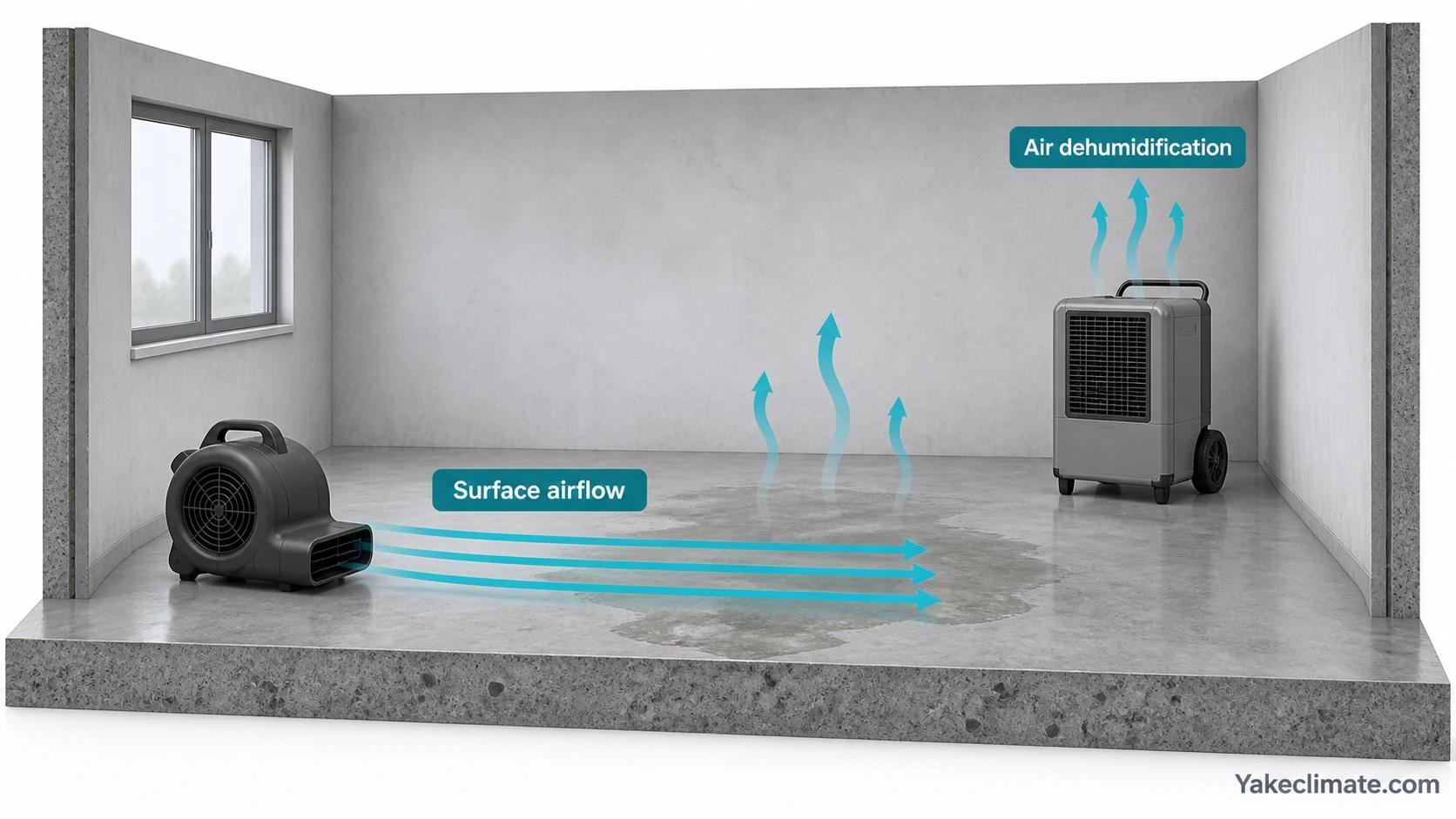
Place air movers so they support drying without spreading suspect material or obstructing egress. Avoid directing heat at a coating or slab without checking the flooring system, equipment instructions and site safety rules. There is no universal 50% RH trigger, fixed 10–30 °C band or promised drying-time reduction for every slab. Equipment size and operating conditions depend on the water load, exposed area, enclosure, outdoor air and moisture path.
- Log indoor temperature/RH and, when ventilation is proposed, outdoor temperature/RH or dew point.
- Record dehumidifier operation and collected water or drainage status, along with air-mover positions.
- Change the plan if measurements stop improving, hidden materials remain wet or new contamination is found.
Map progress; do not confuse a dry surface with a dry slab
Use the same marked locations to compare readings over time. A concrete-compatible electrical meter can help map relative wet and dry areas, but its reading is affected by mix, salts, reinforcement, coatings and instrument calibration; it is not a universal mass-water percentage or a final flooring acceptance test. Pair it with observations of the air, slab surface and adjacent materials, and record the instrument and method used.
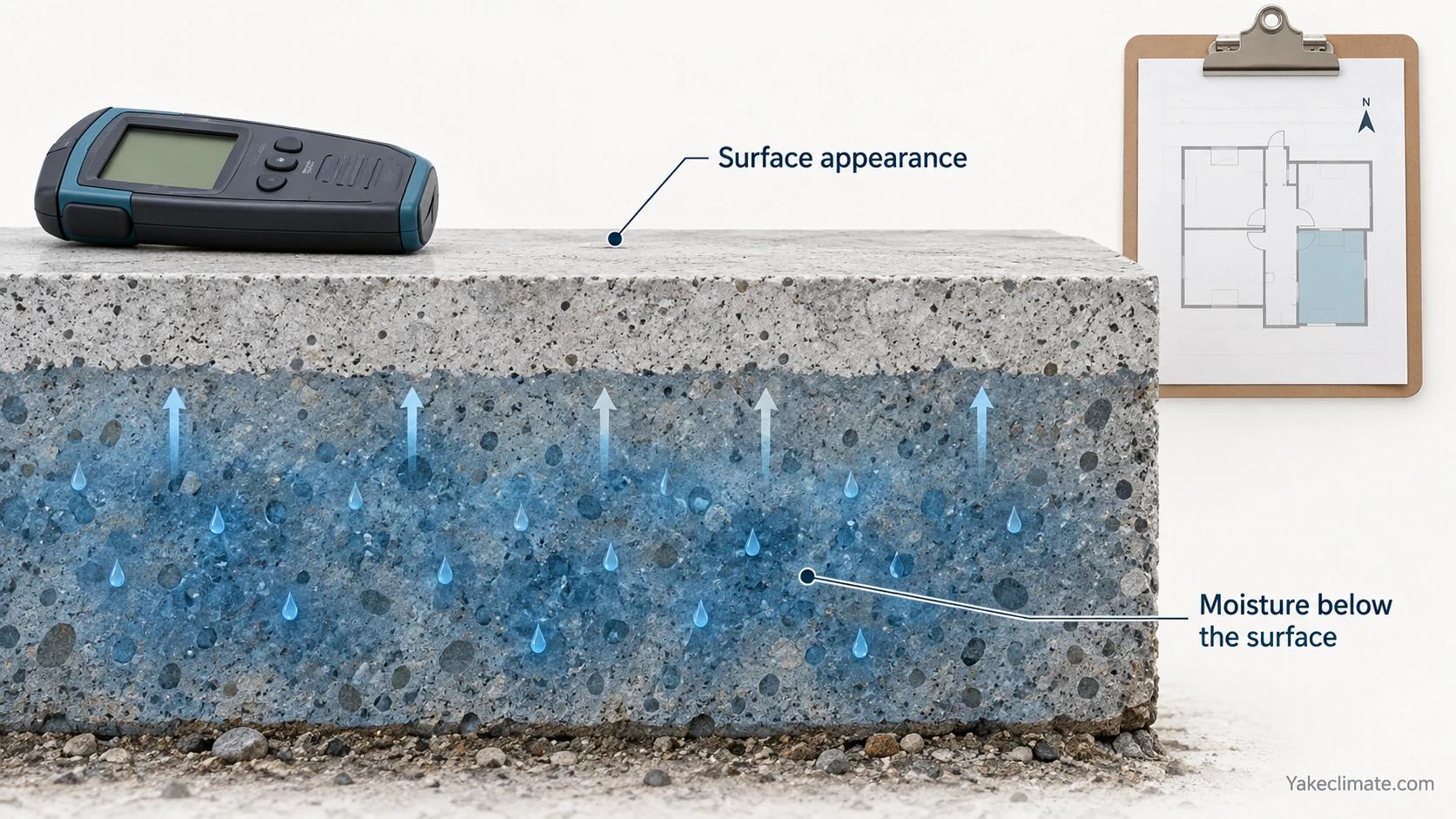
A taped plastic sheet can reveal surface darkening or condensation under a temporary cover. The absence of visible condensation does not quantify internal slab moisture and does not prove readiness for an adhesive, coating or impermeable flooring. Continue investigation if readings remain elevated or moisture returns after the surface appears dry.
Set the acceptance test from the next use
The endpoint for reopening a bare floor may differ from the endpoint for installing a moisture-sensitive finish. Before restoration or flooring, obtain the chosen flooring, adhesive or coating manufacturer's moisture limits and the test method required for that system. ASTM F2170 names an in-situ relative-humidity test for concrete floor slabs; ASTM F1869 names a calcium-chloride moisture-vapor-emission test for concrete subfloors. Use the applicable current standard and the product's instructions with a qualified tester rather than substituting a generic percentage from an article.
Agree in advance on test locations, preparation, environmental conditioning, number of tests, documentation and who signs off. Record the measured result and the selected system's acceptance limit together. A single percentage or promised drying time has no universal meaning without the material, method, location and product criterion.
When to hand the job to a specialist
- The water may be contaminated, or a persistent leak or flooding source has not been controlled.
- Electrical equipment is wet, the slab or adjacent structure has moved or cracked, or a concealed cavity cannot be assessed safely.
- Visible mold, significant odor or wet porous material calls for a remediation plan rather than indiscriminate air movement.
- A coating or flooring system requires documented moisture testing and warranty conditions that the site team cannot perform.
If a dark stain, efflorescence or recurring wet area is present, investigate water movement and the assembly before sealing over it. Surface cleaning or a new coating is not a substitute for source control and verified substrate suitability.
Document the closeout
Keep one record with leak cause and repair, water classification, affected-area map, equipment and environmental trend, material removal, moisture-test method/results, applicable floor-system criteria and sign-off. Recheck after normal building operation resumes if the source or assembly makes recurrence possible. The record shows what was observed and accepted; it does not imply a Yakeclimate laboratory test or guarantee an outcome.
Sources
US Environmental Protection Agency: clean-water drying and contaminated-water fan precautions
US Environmental Protection Agency: flood cleanup and indoor-air safety
ASTM International: F2170 in-situ RH test method title and scope
ASTM International: F1869 calcium-chloride emission test method title and scope
These public references define general safety and test-method context. They are not project-specific moisture limits, field results or a Yakeclimate performance claim.
FAQ
Frequently Asked Questions
How long does a concrete floor take to dry after a leak?
There is no reliable universal time. Record the water source, assembly, exposed area and environmental trend, then verify the endpoint needed for the floor's next use.
Can I use fans immediately?
Only after electrical safety and water classification are addressed. EPA advises against fans until water is determined clean or sanitary when contamination is possible.
Will a dehumidifier dry the slab by itself?
It removes water vapor from air and may support evaporation from an exposed slab. Hidden water, impermeable coverings and a continuing leak need separate action.
Does a plastic-sheet test prove the floor is dry?
No. It can reveal surface moisture under a temporary cover but cannot quantify moisture deeper in the slab or replace the chosen floor-system test.
What moisture percentage is safe before installing flooring?
No universal percentage applies. Use the flooring, adhesive or coating manufacturer's stated limit and the specified test method for the actual assembly.
When should a specialist assess the floor?
Escalate for possible contamination, electrical or structural hazards, hidden wet assemblies, visible mold, persistent moisture or required documented flooring acceptance.
Can I seal a damp concrete floor to finish the job faster?
Do not use a coating as a substitute for stopping the water source and meeting the chosen system's substrate and moisture requirements.

