
For a paper-only archive, start the design at 40% RH and 18 °C, with no more than 5 percentage points of RH change in 24 hours. Specify a dehumidifier for library storage at the actual room condition, separate sensitive collections, and add controlled humidification when winter air becomes too dry.
Quick answer
- Paper preservation storage can start near 40% RH; photographs, film and corroding metals need separate environmental requirements.
- A 1,200 m³ archive with 0.2 air changes per hour of leakage takes in about 95 L/day of water at the summer conditions below.
- Winter air at 0 °C/80% RH falls to about 24% RH when heated to 18 °C, creating a humidification duty.
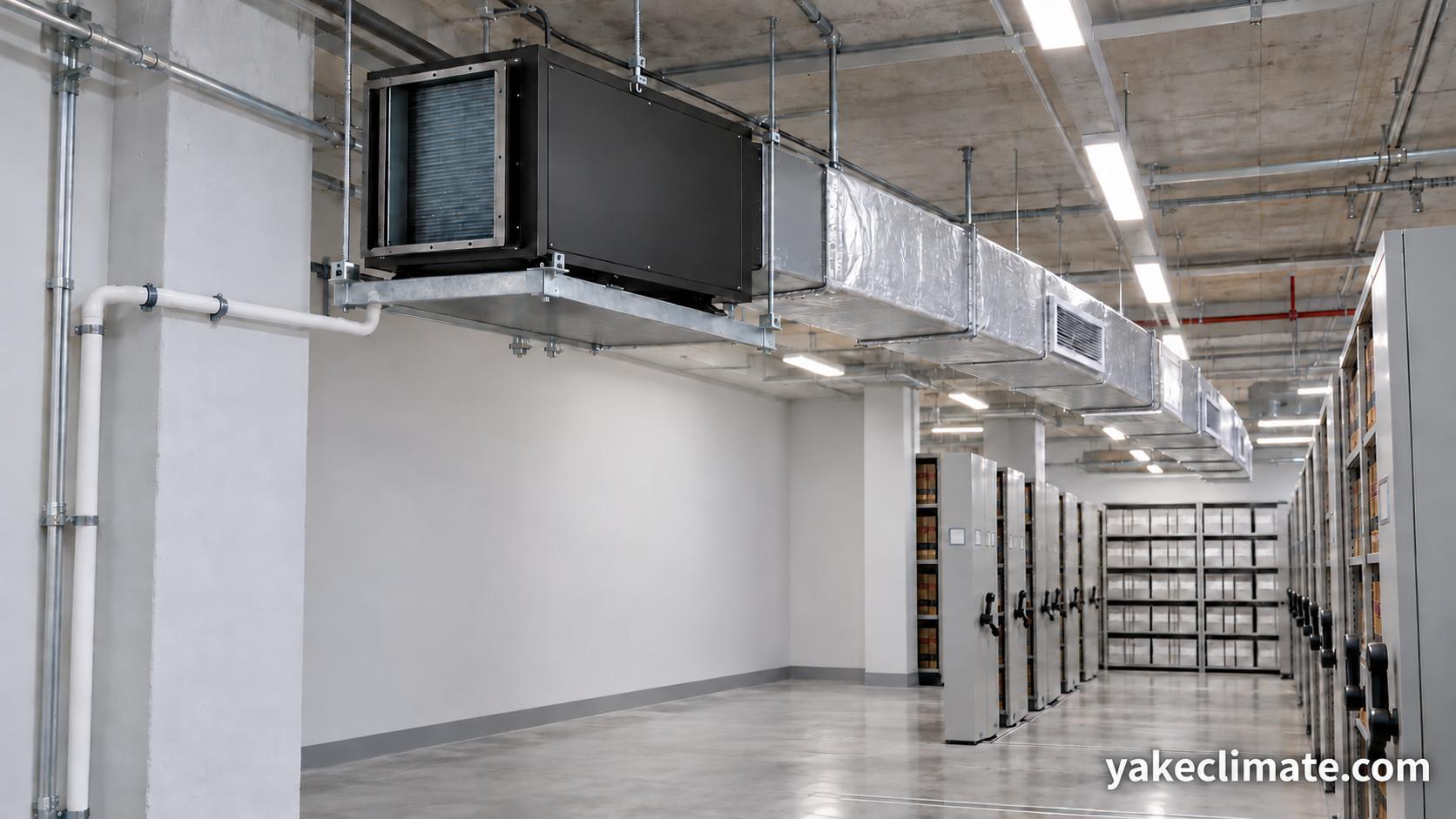
For a fixed installation that preserves floor space, compare industrial ceiling and ducted dehumidifiers using the collection’s temperature, moisture load, drainage and airflow requirements.
What RH and fluctuation limits fit each collection?
Set separate requirements for paper, photographic media, mixed collections and metals; use both a moisture target and a clearly defined fluctuation limit.
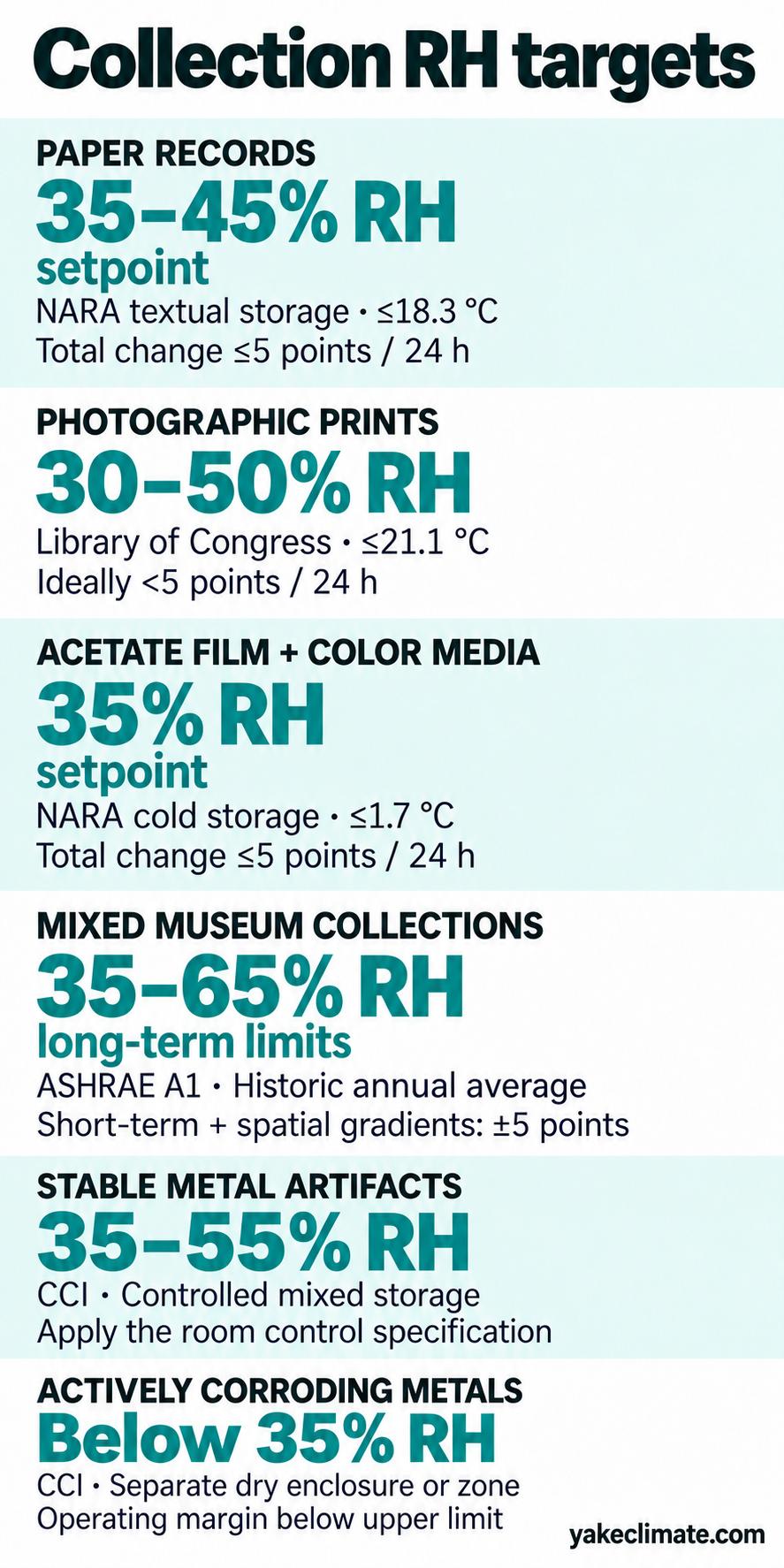
Paper absorbs and releases moisture as room RH changes, causing expansion and contraction; very dry conditions reduce flexibility, while damp conditions support mold. Temperature also affects deterioration, especially in photographic materials. NEDCC, environmental guidelines.
| Storage type | Temperature and RH reference | Fluctuation requirement and design decision |
|---|---|---|
| Paper records and bound volumes in a dedicated preservation store | NARA presidential-library textual storage: maximum 65 °F (18.3 °C), with a 35–45% RH setpoint | Maximum total change of 5 percentage points in any 24 hours; seasonal movement at most 5 points/month, with NARA approval for facilities under that standard. A 40% RH initial setpoint sits inside this range. NARA, §3.49 and Figure 3-3 |
| Photographic prints | Library of Congress: 30–50% RH, 70 °F (21.1 °C) or cooler | Ideally less than 5 percentage points of change in 24 hours. Color photographs need colder storage: 40 °F (4.4 °C) or below is recommended. Library of Congress, Storage of Photographs |
| Acetate film and color photographic media in NARA cold storage | Maximum 35 °F (1.7 °C), with a 35% RH setpoint | Maximum total change of 5 percentage points in 24 hours under this specification. Plan a separate cold store, protective packaging and a transition procedure. Identify the film base before choosing conditions. NARA, Figure 3-3 and note 2 |
| Mixed museum collections in purpose-built rooms | ASHRAE A1 uses the collection’s historic annual average, within long-term limits of 35–65% RH and 10–25 °C | Short-term fluctuations plus spatial gradients: ±5 RH percentage points; seasonal adjustment up to ±10 points from the annual average, moving at most 5 points per 30 days. ASHRAE, Table 13A and notes |
| Stable metal artifacts | CCI: 35–55% RH in controlled mixed-collection storage | CCI gives an upper humidity criterion, without a universal daily ± tolerance. Apply the room’s collection-control specification while keeping the metal environment below its limit. CCI, Storage of Metals |
| Actively corroding metal artifacts | CCI: isolate and keep below 35% RH | Use a separate dry enclosure or zone, with an operating margin below the upper limit; identify the corrosion cause and obtain a material-specific treatment plan. CCI, Relative Humidity and Conclusion |
Use the NARA values as a preservation-storage reference for the opening recommendation. Their requirements apply to the specified NARA facilities; a public reading room and a long-term repository have different uses. For federal records facilities, 36 CFR §1234.14 distinguishes paper, nontextual, temporary and permanent records, with different environmental provisions. 36 CFR §1234.14.
For other film-storage strategies, preserve the temperature/RH pairing in the selected guidance: NEDCC’s acetate-film storage row pairs 45 °F (7.2 °C) with 30% RH, or 41 °F (5 °C) with 40% RH. Choose the material’s storage strategy before specifying equipment. NEDCC, Chart 1.
How should daily swings and seasonal drift be measured?
Record daily maximum minus minimum separately from deviation around the target: 40% to 45% RH is a 5-point swing, while 40% ±5 points spans 35–45%, a 10-point swing.
For the paper-store example, track a rolling 24-hour maximum–minimum of at most 5 points. For an ASHRAE A1 room, assess short-term variation and differences across collection locations against its ±5-point criterion. ASHRAE defines short-term RH variation over periods shorter than 30 days; it includes more than a daily cycle. NARA, Figure 3-3 note 2; ASHRAE, Table 13A note c.
Move an approved seasonal target gradually. Under A1, a change from 40% to 45% RH takes at least 30 days. Keep the chosen annual average and seasonal adjustment inside the class limits, then apply any tighter requirements for individual objects or loans. A broad preservation range describes acceptable conditions for a chosen strategy; routine movement between its endpoints creates a different exposure.
How much dehumidification does a 1,200 m³ archive need?
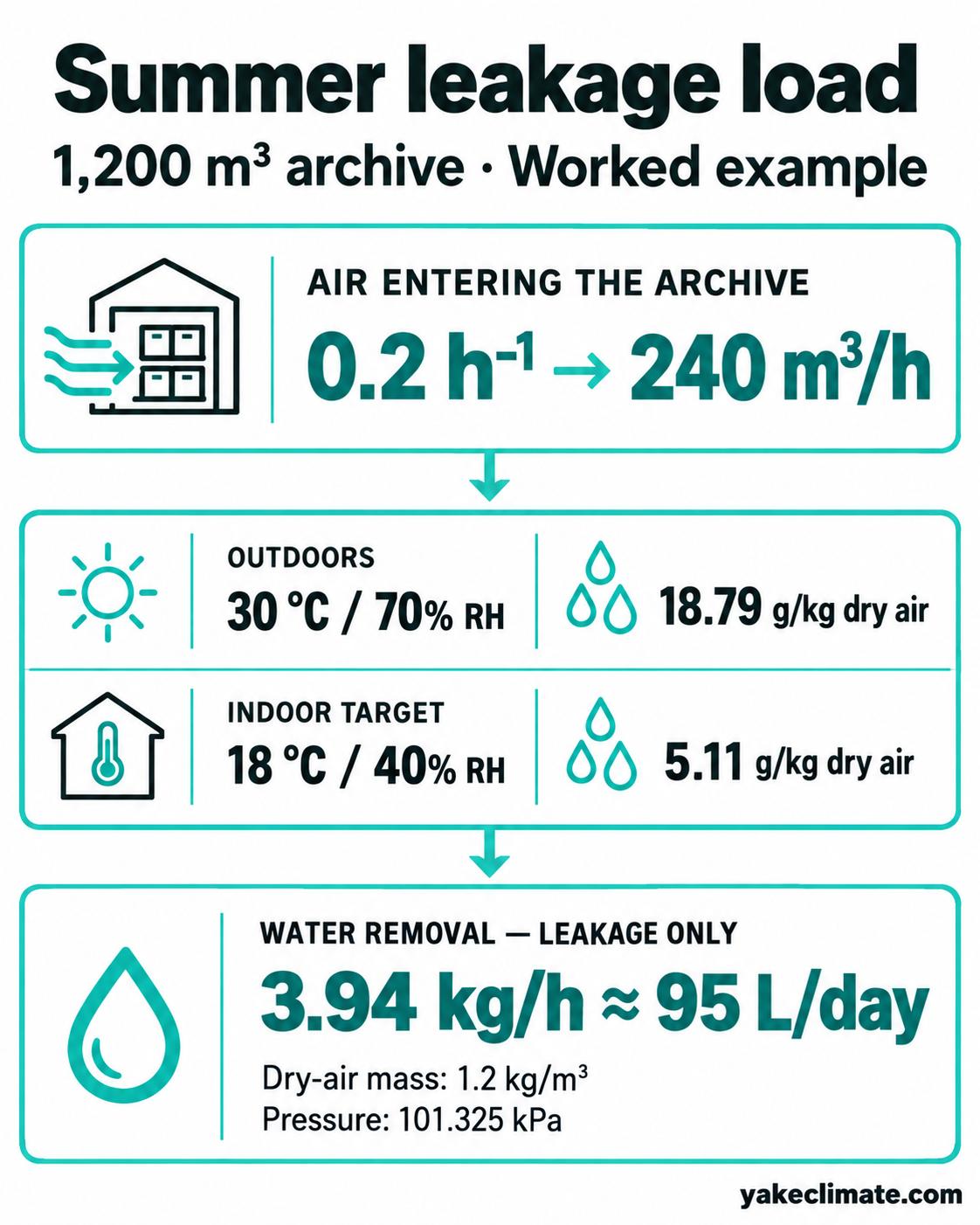
A 1,200 m³ paper archive at 18 °C/40% RH receives approximately 3.94 kg/h of water through leakage when outdoor air is 30 °C/70% RH and leakage equals 0.2 air changes per hour.
Use these illustrative design inputs:
| Input | Assumed value |
|---|---|
| Room size | 300 m² floor area × 4 m height = 1,200 m³ |
| Outdoor summer condition | 30 °C/70% RH |
| Indoor condition | 18 °C/40% RH |
| Leakage rate | 0.2 h⁻¹, equivalent to 240 m³/h |
| Atmospheric pressure | 101.325 kPa |
| Approximate dry-air mass per volume of leakage air | 1.2 kg/m³ |
The moisture balance is:
Leakage moisture load (kg/h)
  = room volume (m³) × leakage rate (h⁻¹)
    × dry-air mass per volume (kg/m³)
    × [outdoor − indoor humidity ratio] (kg/kg dry air)
At the stated pressure, outdoor humidity ratio is approximately 18.79 g/kg and indoor humidity ratio is 5.11 g/kg. Thus:
1,200 × 0.2 × 1.2 × (18.79 − 5.11) / 1,000
  ≈ 3.94 kg/h
3.94 × 24 ≈ 94.5 kg/day ≈ 95 L/day of liquid water
Calculate humidity ratio from vapor pressure using w = 0.621945 × pv / (P − pv), with both pressures in kPa. Here pv = RH/100 × pws, and the saturation-pressure approximation is pws = 0.611 × 10^[7.5T/(237.3 + T)], with T in °C. ASHRAE psychrometrics; NWS vapor-pressure equation.
How much does sealing the room change the result?
Reducing leakage by 50% reduces this part of the moisture load by 50%, with room size and indoor/outdoor conditions held constant.
| Assumed leakage rate | Incoming air | Moisture entering | Water equivalent over 24 hours |
|---|---|---|---|
| 0.1 h⁻¹ | 120 m³/h | 1.97 kg/h | 47 L/day |
| 0.2 h⁻¹ | 240 m³/h | 3.94 kg/h | 95 L/day |
| 0.5 h⁻¹ | 600 m³/h | 9.85 kg/h | 236 L/day |
Estimate leakage from the building and door use; these rates are illustrative scenarios. Add required mechanical outdoor air separately using its condition after any upstream treatment. Count only air entering from outside the controlled space in this incoming-air moisture calculation; assess recirculating supply airflow separately for distribution.
For an initial equipment duty, assume another 0.60 kg/h from remaining ventilation, occupants and materials combined, a 20% design allowance, and 20 effective operating hours per day against a continuous daily load:
Required operating capacity
  = (3.94 + 0.60) × 1.20 × 24/20
  ≈ 6.54 kg/h at 18 °C/40% RH
Replace the assumed additional load with a project calculation before ordering. Assess recovery from wet incoming materials separately and provide suitable capacity staging for the smaller routine storage load.
Which dehumidifier for library storage should you choose?
For the 18 °C paper-store example, first evaluate a fixed ducted refrigerant unit against the required 6.54 kg/h at 40% RH; choose a dedicated desiccant system when the required cool, dry condition exceeds the refrigerant unit’s performance.
| Room and operating need | Starting equipment choice | Procurement requirement |
|---|---|---|
| Paper storage near the example’s 18 °C/40% RH | Fixed ducted refrigerant dehumidification with coordinated temperature control | Capacity at that inlet condition, stable control at low load, continuous drainage and alarms |
| Cold photographic or film storage | Desiccant drying coordinated with refrigeration | Design supply dew point, regeneration arrangement and controlled retrieval of cold packages |
| Mixed collections with different targets | Separate zones or buffered enclosures | Material-specific targets, representative sensors and seasonal control settings |
| Small dry enclosure for corroding metal | Local controlled dry environment | Humidity kept below the material’s critical limit, plus pollutant and corrosion management |
Refrigeration removes moisture by cooling below dew point; desiccant drying is useful for the lower dew points of cold collection storage. Coordinate either method with room cooling because dehumidification affects temperature. ASHRAE, Dehumidification.
Yakeclimate’s RYDZ-7S catalogue lists 168 L/24h at 30 °C/80% RH, 1,800 m³/h airflow, 100 Pa external pressure and 2.8 kW maximum power. Its listed supply is 380 V, three-phase, 50 Hz. Compare a proposed model’s removal at the example’s 18 °C/40% RH against 6.54 kg/h, then check duct resistance and electrical compatibility for the installation. The listed 5–38 °C operating range describes temperature applicability; selection still needs the removal curve at the specified RH.
For US projects, specify the available voltage, phase, frequency and required approvals in the equipment request. The catalogue electrical rating is the starting configuration for that discussion.
Why does the same archive need humidification in winter?
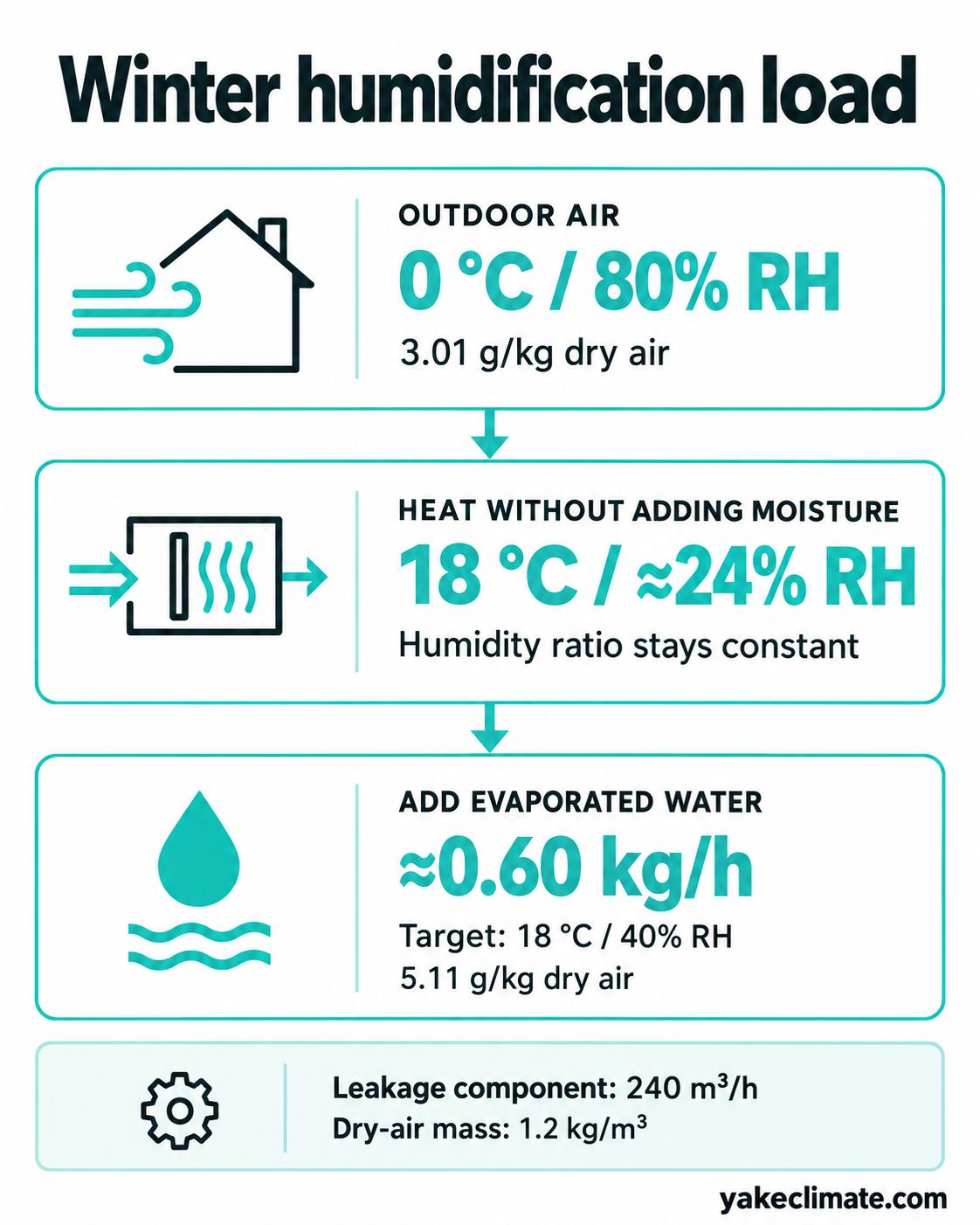
At 0 °C/80% RH outdoors, air heated to 18 °C without adding moisture reaches only about 24% RH; maintaining the example’s 40% RH target therefore requires water addition.
Outdoor humidity ratio is approximately 3.01 g/kg, compared with 5.11 g/kg at the indoor target. For the same assumed 240 m³/h leakage and 1.2 kg dry air/m³:
Winter humidification load
  = 240 × 1.2 × (5.11 − 3.01) / 1,000
  ≈ 0.60 kg/h of evaporated water
This is the leakage component; add mechanical ventilation and account for internal moisture sources in the full winter balance. Heating changes RH while the air’s humidity ratio stays constant. ASHRAE psychrometrics.
Choose clean-steam humidification for a winter system where close control and available heating favor it. An industrial ultrasonic humidifier is another candidate where treated water, hygienic maintenance, sufficient evaporation distance and the associated air-cooling load can be accommodated. Specify RO or deionized water and distribute fully absorbed moisture through the air system; keep mist and water leakage away from collections. ASHRAE, Humidification.
The Yakeclimate RYJS-03D catalogue lists 3 kg/h output, 0.235 kW rated power and a 220 V, single-phase, 50 Hz supply. The example’s 0.60 kg/h leakage duty is about one fifth of that output, so require suitable low-load control and check actual evaporation in the proposed installation. Its adjustable RH range describes selectable settings, rather than a guaranteed room-control tolerance.
Use a coordinated controller with a neutral band between humidification and dehumidification, an independent high-humidity cutout, and airflow interlocks. Check cold walls and windows before raising winter RH; where the building envelope limits humidity, use an approved seasonal strategy or a separately conditioned collection enclosure.
How should the equipment be installed and checked?
Place machinery and water services outside the collection footprint where practical, and assess humidity at the stored objects as well as at the controller.
- Protect against leaks. Provide continuous condensate drainage, service access, a drain pan and a water alarm where equipment or ducts could expose collections to water.
- Distribute air through storage aisles. Separate supply and return paths, and include the installed duct pressure loss in fan selection.
- Monitor the collection zone independently. Put loggers at representative shelf locations, including exterior-wall and doorway areas; keep sensors clear of direct supply jets.
- Record changes fast enough to see cycling. Start commissioning with 5–15 minute logging as a practical setup, then assess rolling 24-hour RH ranges, spatial differences and seasonal trends against the chosen specification.
- Test real operating events. Check door openings, low occupancy, overnight operation, drain faults and winter changeover; review summer and winter records before accepting year-round performance.
Independent room monitoring and collection-safe equipment placement are part of the environmental design. NARA, §3.49.6; ASHRAE, system design and humidification.
FAQ
Frequently asked questions
Can a domestic portable dehumidifier protect an archive overnight?
No, choose fixed equipment with drainage and fault protection for routine unattended preservation storage. Portable tank units add overflow and electrical risks. ASHRAE limits their role in collection settings to emergency use during occupied hours, with emptying and disconnection before staff leave. ASHRAE, Dehumidification.
Can silica gel replace a room dehumidifier?
Yes, for a suitably sealed small enclosure with a calculated moisture load and a conditioning or replacement schedule; it serves a different scale from a ventilated room. For metal artifacts, enclosure materials and gaseous pollutants also matter. Check the enclosure’s RH with its own sensor. CCI, Storage of Metals.
What is a practical starting RH for paper archives?
40% RH is a starting design choice for the dedicated paper-preservation example. Public reading rooms, historic buildings, mixed materials and loaned objects can require different conditions. Choose the collection target with its preservation history and building constraints, then specify how tightly it must be maintained. NEDCC, Set Points.
Should cold film be opened immediately after retrieval?
No, keep cold materials in appropriate protective packaging while they acclimatize to the receiving environment. The warmer room’s dew point determines condensation risk on cold surfaces. Plan the transition procedure alongside storage temperature, packaging and access frequency, so retrieval preserves the benefit of cold storage. ASHRAE, Table 13B.
Send the collection list, room dimensions, seasonal temperature/RH records, door and ventilation details, target limits, drainage layout and available power with your library and archive dehumidifier enquiry.


