

1. Same Problem, Different Boundary
Dew point is the temperature at which air becomes saturated and water starts to condense. Moisture load is the rate of water vapour entering a space from ventilation, leakage, doors, or internal sources.
Data centers and battery energy storage systems both depend on electrical and electronic equipment that must operate within defined environmental conditions. This makes data-center practice a useful reference for humidity monitoring, airflow management, alarms, and maintenance.
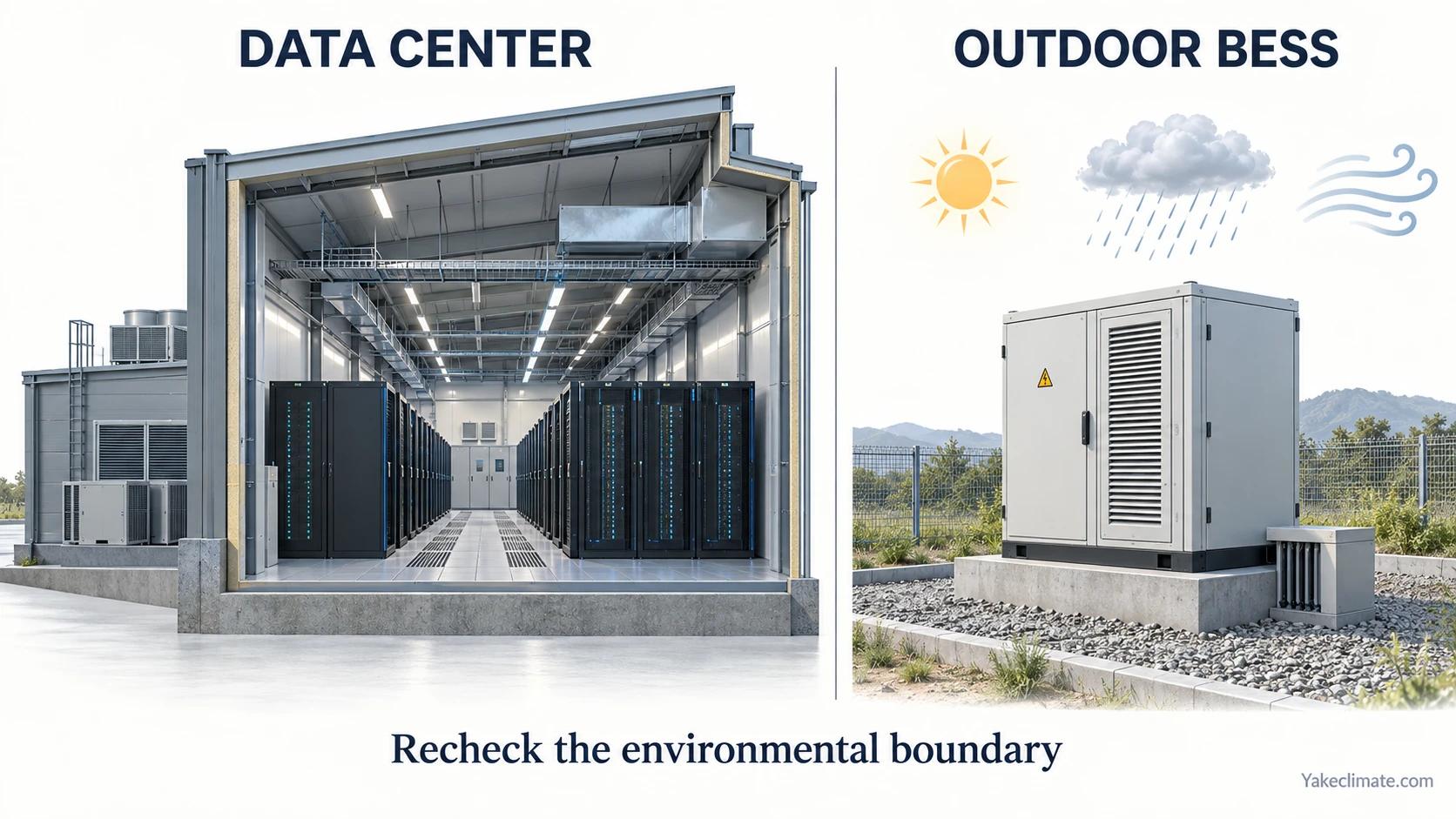
It is not a complete BESS design template. Many BESS installations are outdoor, compact, thermally dynamic, and divided into cabinets or containers with battery-specific safety and ventilation requirements.
The useful approach is to transfer the engineering method while rechecking the environmental boundary.
2. What Transfers: Measure Moisture as an Operating Variable
Dew point helps assess condensation by relating the air’s moisture content to cold-surface temperature. Data-center guidance uses a combined environmental envelope that can include air temperature, relative humidity and dew-point limits for the applicable equipment class. For a BESS, use the battery and enclosure suppliers’ approved environmental limits and evaluate relevant surface temperatures; data-center guidance does not replace those product requirements.
- air temperature and humidity should be recorded together;
- dew point helps describe the water vapour present;
- surface temperature determines whether condensation can occur;
- trends are more useful than a single spot reading.
Condensation risk exists when a local surface reaches or falls below the local air dew point. That relationship is valid in a server room, battery cabinet, switchgear compartment, or BESS container.
3. What Transfers: Define Environmental Zones
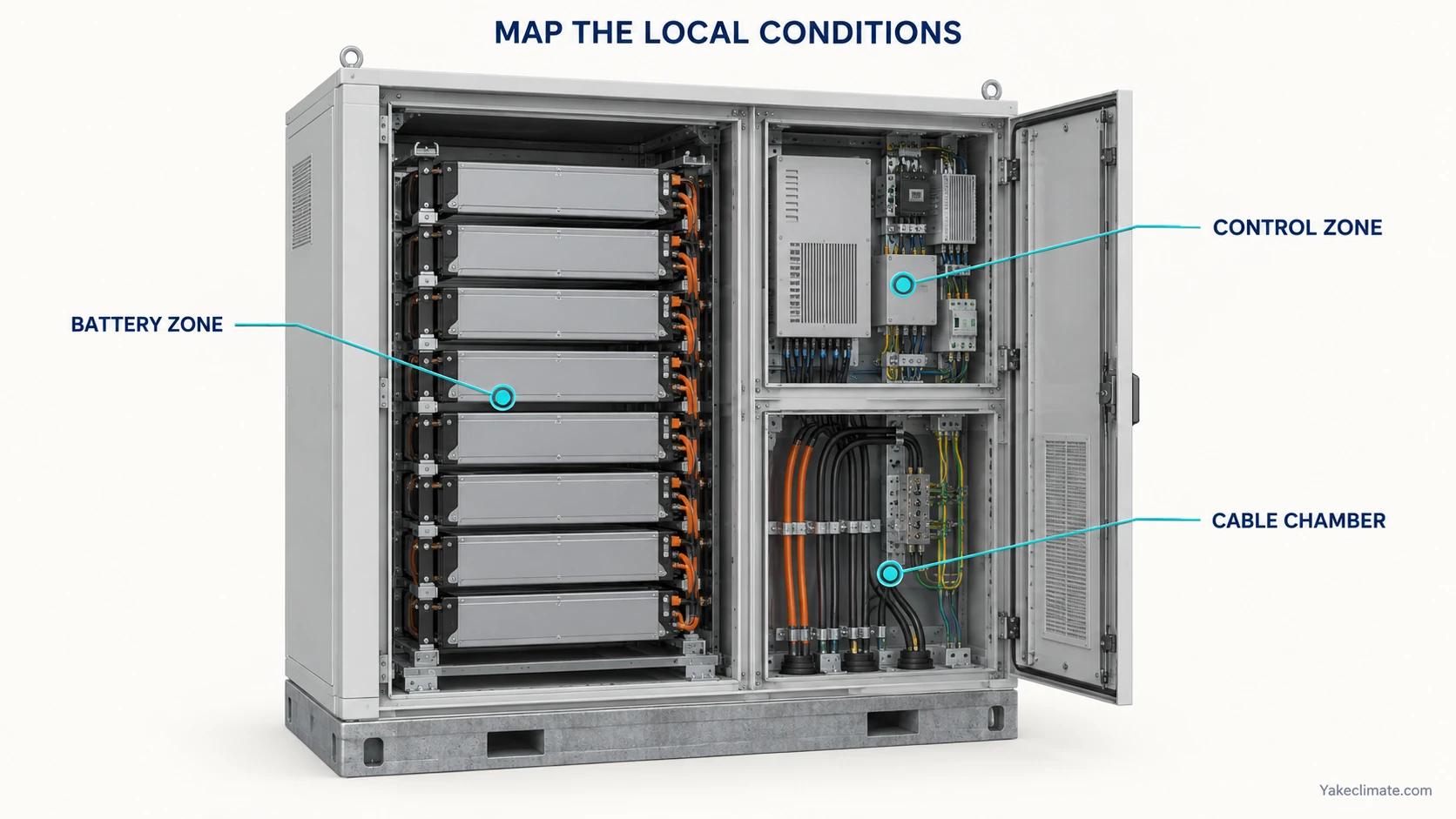
A data hall is not always one uniform environment. Cold aisles, hot aisles, underfloor spaces, and equipment exhaust can have different conditions. BESS equipment also contains zones:
- battery compartments;
- power-conversion and control sections;
- cable chambers;
- cooling supply and return paths;
- roof and wall zones;
- cabinets connected to a common enclosure.
Both applications benefit from a sensor and airflow plan based on these zones. One wall-mounted room sensor should not be assumed to represent every component.
4. What Transfers: Manage Airflow Deliberately
Controlled airflow helps prevent recirculation, stagnant pockets, and local temperature differences. In both data centers and BESS projects, review:
- where conditioned or dry air is supplied;
- how it returns;
- whether equipment blocks the path;
- whether separated zones receive treatment;
- where outside air can enter;
- how fan failure affects the environment.
Airflow quantity alone is not enough. The air must reach the area that needs protection without creating a new cold surface or bypassing the control sensor.
5. What Transfers: Alarm, Trend, and Maintain
Environmental control is more reliable when the operator can see:
- temperature, humidity, or dew point;
- equipment run and fault state;
- high-moisture alarm;
- drain or condensate alarm;
- fan or filter condition where available;
- door and ventilation events;
- operating hours and maintenance status.
The exact fields and protocol depend on the selected equipment. The transferable lesson is to define useful points, alarm actions, and data retention before commissioning.
Maintenance also transfers. Sensors need verification, filters and drains need inspection, and alarms need testing. A design that cannot be safely accessed is difficult to keep reliable.
6. What Does Not Transfer
| Data-center assumption | BESS reality |
|---|---|
| Managed building envelope | Cabinet or container exposed to sun, rain, high outdoor dew point, salt, dust, and day-night swings |
| Large air volume, distributed equipment | Small volume, dense components; one leak replaces a larger share of the air |
| Continuous IT load and cooling | Charge, discharge, standby, shutdown, and loss of auxiliary power |
| Outside air for economisation | Ventilation may serve heat, pressure, gas, or emergency functions |
| General environmental setpoint | Battery-specific safety, gas detection, and fire protection govern |
Apply the envelope comparison at each site: map weather exposure, cable entries, door openings and the surfaces that cool first. Those paths set the BESS moisture load; do not reuse a data-hall infiltration assumption.
Use actual compartment volume and surfaces to place sensors and distribute dry air. A cabinet-wide average may miss a cold plate, metal wall or cable chamber near a leak.
Test the control sequence through charging, discharging, standby, shutdown and loss of auxiliary power. The comparison table flags these states; acceptance needs measured conditions in each relevant state.
Keep humidity equipment inside the battery and enclosure safety design. Confirm power, drainage, controls and alarms with the thermal-management, gas-detection, fire-protection and emergency-response requirements.
Ventilation may be mandatory for heat, pressure, gas or emergency control. If incoming air is wetter than the compartment target, size the added moisture load and coordinate drying without disabling required ventilation.
7. Do Not Use One Universal RH Target
A suitable environmental condition depends on:
- equipment manufacturer limits;
- minimum surface temperature;
- contamination and corrosion risk;
- measurement uncertainty;
- cooling and ventilation sequence;
- outdoor design condition;
- required reliability and recovery time.
ASHRAE data-center guidance is valuable within its stated application, but a BESS target must be derived from the actual equipment and site. The project may control dew point, RH, a surface-to-dew-point margin, or a combination.
8. Commissioning Questions
For a BESS project informed by data-center practice, verify:
- Which air and equipment zones need monitoring?
- What is the coldest credible surface?
- What outdoor dew point and weather cycle apply?
- How much air enters through ventilation, leakage, and doors?
- What happens during charge, discharge, standby, and shutdown?
- Which environmental controls remain powered?
- Do all compartments receive conditioned or dry air?
- What alarms and trends reach the operator?
- How are sensors, filters, gaskets, and drains maintained?
- What test proves recovery after a defined moisture event?
9. Discussing BESS Environmental Control
Industrial Dehumidification for Complex Climate Applications
Yakeclimate designs and manufactures industrial dehumidification equipment for complex climate applications, with a focus on agriculture and energy projects.
We co-develop application-specific dehumidification equipment around the operating conditions, interfaces, and integration requirements of the wider project or system.
Explore energy applications, review energy-storage dehumidifiers, or contact Yakeclimate with the enclosure, climate, airflow, and control information.
FAQ
Frequently Asked Questions
Can data-center humidity setpoints be copied to a BESS?
Not without review. They can inform the method, but the battery supplier, enclosure, outdoor exposure, cold surfaces, safety requirements, and operating states determine the BESS condition.
Is dew point the right control variable?
Yes. Dew point describes the moisture content of the air. For condensation control, compare it with the temperature of the coldest relevant surface.
Why is a single cabinet sensor insufficient?
A compact cabinet can contain separated zones, restricted airflow, and cold surfaces close to external walls or cooling components. The main control sensor may not see those local conditions.
Does BESS redundancy follow data-center practice?
The principle can transfer: environmental protection should match the required reliability. The actual redundancy, power source, failure mode, and safe response must be defined for the BESS.
Can dehumidification replace required ventilation?
No. Required ventilation remains part of the safety and thermal design. Humidity control must be coordinated with it.
What is the first step in defining a BESS environmental specification?
Map the air boundary, operating states, outdoor design condition, cold surfaces, and required ventilation. Then define monitoring and equipment around those facts.
References
- ASHRAE Handbook: Data Centers and Telecommunication Facilities — ASHRAE Handbook chapter
- ASHRAE TC 9.9, Thermal Guidelines for Data Processing Environments: equipment-class environmental envelopes consider temperature, relative humidity and dew point together. These data-center limits should not be transferred directly to a BESS.
- ASHRAE: Gaseous and Particulate Contamination Guidelines for Data Centers — ASHRAE PDF
- US Department of Energy: Energy Storage — DOE
