
Data-center “free cooling” uses favorable outdoor conditions to reduce, or sometimes avoid, mechanical compressor cooling. It is not energy-free: fans, pumps, water treatment, filtration and controls still have loads. The practical choice is between air-side, indirect air-side and water-side paths, each with a different exposure of the IT environment to outdoor air, moisture and water use.
Compare the heat path before choosing a system
| Approach | How heat leaves the IT space | Main condition to check |
|---|---|---|
| Direct air-side economizer | Filtered outdoor air is supplied to the space and warmer return air is exhausted or mixed as needed | Outdoor temperature, humidity, contamination and required airflow at IT inlets |
| Indirect air-side exchange | Indoor and outdoor air circuits stay separate across an air-to-air heat exchanger | Heat-exchanger approach, fan energy, leakage and moisture-control requirements |
| Water-side economizer | Cool condenser or outdoor-loop water transfers heat through an exchanger to the chilled-water loop | Available wet-bulb or dry-bulb conditions, loop temperatures, water use and water treatment |
ENERGY STAR describes direct air-side economizers as bringing cool outdoor air to servers and exhausting warm air, with mixing, filtration and controls when needed. It describes a water-side economizer as using a separate heat exchanger to cool a chilled-water loop so the chiller can be bypassed under suitable conditions. These are distinct designs; “free cooling” is a mode, not a single machine or a promise to stop all mechanical equipment.
ENERGY STAR: air-side economizer operation and limits.
ENERGY STAR: water-side economizer operation and limits.
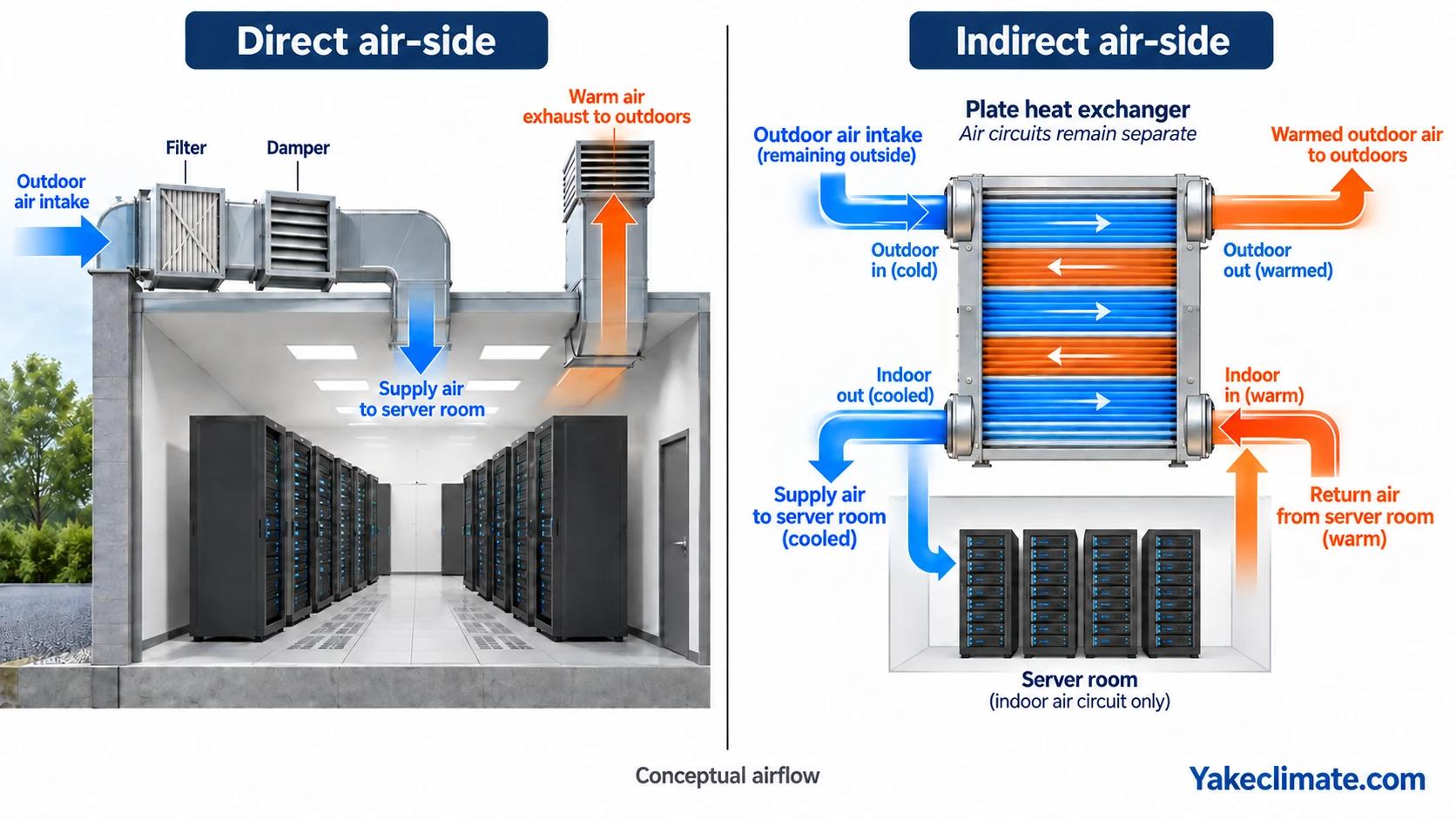
Direct air-side: outdoor air enters the data center
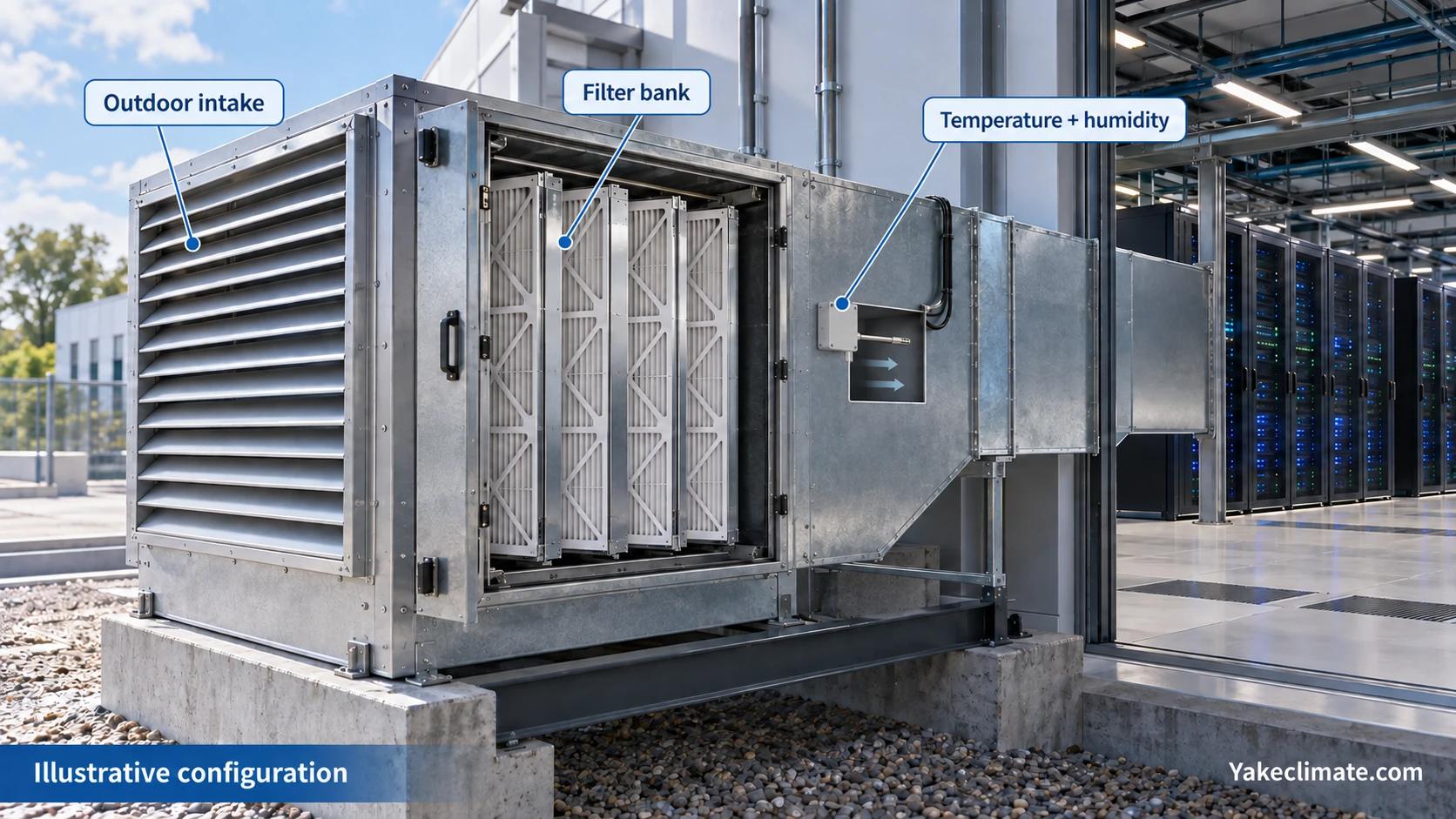
Direct economization can replace some cooling-coil work when the outdoor air meets the site’s allowable supply condition. Filters and outdoor-air intake design matter because the air contacts the IT environment. The sequence must check temperature, humidity and the applicable equipment limits, then move between full, partial and mechanical cooling as conditions change. A cool dry-bulb reading alone is not sufficient to approve outdoor air.
ENERGY STAR notes that humidity control may reduce the expected energy benefit and that retrofit duct space can be a constraint. Use the site’s hourly weather, IT inlet limits, contamination assessment and existing air-handling layout to estimate viable hours; examples from another data center are not a savings forecast for this one.
Indirect air-side: transfer heat without routine outdoor-air supply
An indirect air-to-air exchanger keeps the main indoor and outdoor air paths separate while transferring heat between them. That separation can reduce the outdoor-air particulate and moisture exposure of a direct system, subject to actual exchanger leakage and the complete air-side design. It also adds exchanger resistance and fan energy. Check the required approach temperature, pressure drop, controls, cleaning access and backup cooling; separation does not make humidity control unnecessary.
Water-side: account for the cooling loop and water
A water-side economizer transfers heat between a chilled-water loop and a cooler outdoor/condenser-side loop. It can deliver full or partial cooling depending on ambient conditions and required chilled-water temperature. A cooling tower may still consume water and treatment chemicals even when the chiller compressor is off. Other dry-cooler arrangements have different water and electrical trade-offs; do not label all water-side free cooling “water-saving”.
US Department of Energy guidance describes water-side economization, the distinction between series and parallel exchanger arrangements, and the need to evaluate water efficiency along with energy. Select the heat-rejection path and mode sequence from the actual loop temperatures and climate rather than a universal outside-air cutoff.
US Department of Energy: cooling-water efficiency opportunities for data centers.
What the site comparison must include
- IT load and inlet temperature/humidity envelope, including transients and equipment-specific limits.
- Hourly outdoor dry-bulb, wet-bulb or dew-point data appropriate to the proposed heat path.
- Full, partial and mechanical-cooling mode boundaries, controls, alarms and fallback behavior.
- Fan and pump energy, exchanger pressure drop, water consumption and treatment, maintenance and installation cost.
- Outdoor-air filtration or air-circuit leakage as applicable; condensate and humidity-control implications.
Model net annual energy and water use for the whole cooling arrangement, not compressor runtime alone. Compare a defined baseline under the same IT load and weather. “Up to” savings from an unrelated project cannot establish this site’s payback, carbon reduction, uptime or regulatory status. A free-cooling path also does not inherently provide N+1 redundancy; that requires an explicit capacity and failure-mode design.
Separate cooling and moisture-control responsibilities
Data-center thermal design, IT environmental limits and economizer selection belong to the project’s cooling engineers. If a linked electrical enclosure or other controlled space has a separate moisture or condensation requirement, specify that boundary and its control target independently. Yakeclimate can review dehumidification equipment within a documented integration brief; this page does not assert that Yakeclimate supplies the data-center free-cooling plant.
Yakeclimate engineering and application review.
Sources
ENERGY STAR, Use an Air-Side Economizer.
ENERGY STAR, Consider Water-Side Economizers.
US Department of Energy, Cooling Water Efficiency Opportunities for Federal Data Centers.
US Department of Energy, Best Practices Guide for Energy-Efficient Data Center Design.
FAQ
Frequently Asked Questions
Is free cooling actually free?
No. It can reduce compressor work under suitable outdoor conditions, but fans, pumps, filtration, controls and sometimes water treatment still use resources.
How does direct air-side cooling differ from indirect air-side cooling?
Direct air-side systems bring controlled outdoor air into the IT environment. Indirect air-side systems transfer heat between largely separate indoor and outdoor air circuits through a heat exchanger.
Does water-side free cooling always save water?
No. A water-side economizer using a cooling tower may still consume water and treatment chemicals. Evaluate the chosen heat-rejection arrangement and whole-system water balance.
Can any cool outdoor day support free cooling?
Not necessarily. Check the heat-exchanger approach, IT inlet limits, outdoor humidity or wet-bulb condition, contamination and equipment/control capability for the proposed mode.
What is partial free cooling?
An economizer supplies only part of the required cooling and mechanical equipment provides the remainder. The actual mode boundary depends on system temperatures, heat-exchanger performance and controls.
Will a free-cooling retrofit guarantee uptime or a short payback?
No. Reliability and payback depend on the existing plant, site climate, IT load, fallback capacity, controls, installation and operating cost. They need a site-specific comparison.
