
1. One Humidity Target Is Not Enough
Vapor pressure deficit (VPD) is the difference between the saturation vapor pressure at a given temperature and the actual vapor pressure of the air. It is a direct driver of transpiration and is a more useful control variable than relative humidity alone in plant environments. Moisture load is the rate of water vapour entering the space from transpiration, irrigation, infiltration, people, and ventilation.
High-value controlled crops place a premium on consistency. Humidity affects transpiration, leaf temperature, disease pressure, condensation, drying rate, and the stability of the finished crop. The control plan therefore has to follow the crop through each operating stage instead of relying on one room setpoint.
A reliable design begins with the crop brief and the facility schedule: propagation method, canopy area, lighting period, irrigation volume, room temperature, outdoor-air strategy, crop density, drying process, and the acceptable variation at each stage. These inputs define the moisture load that the HVAC and dehumidification equipment must handle.
2. Why the Stage Defines the Requirement
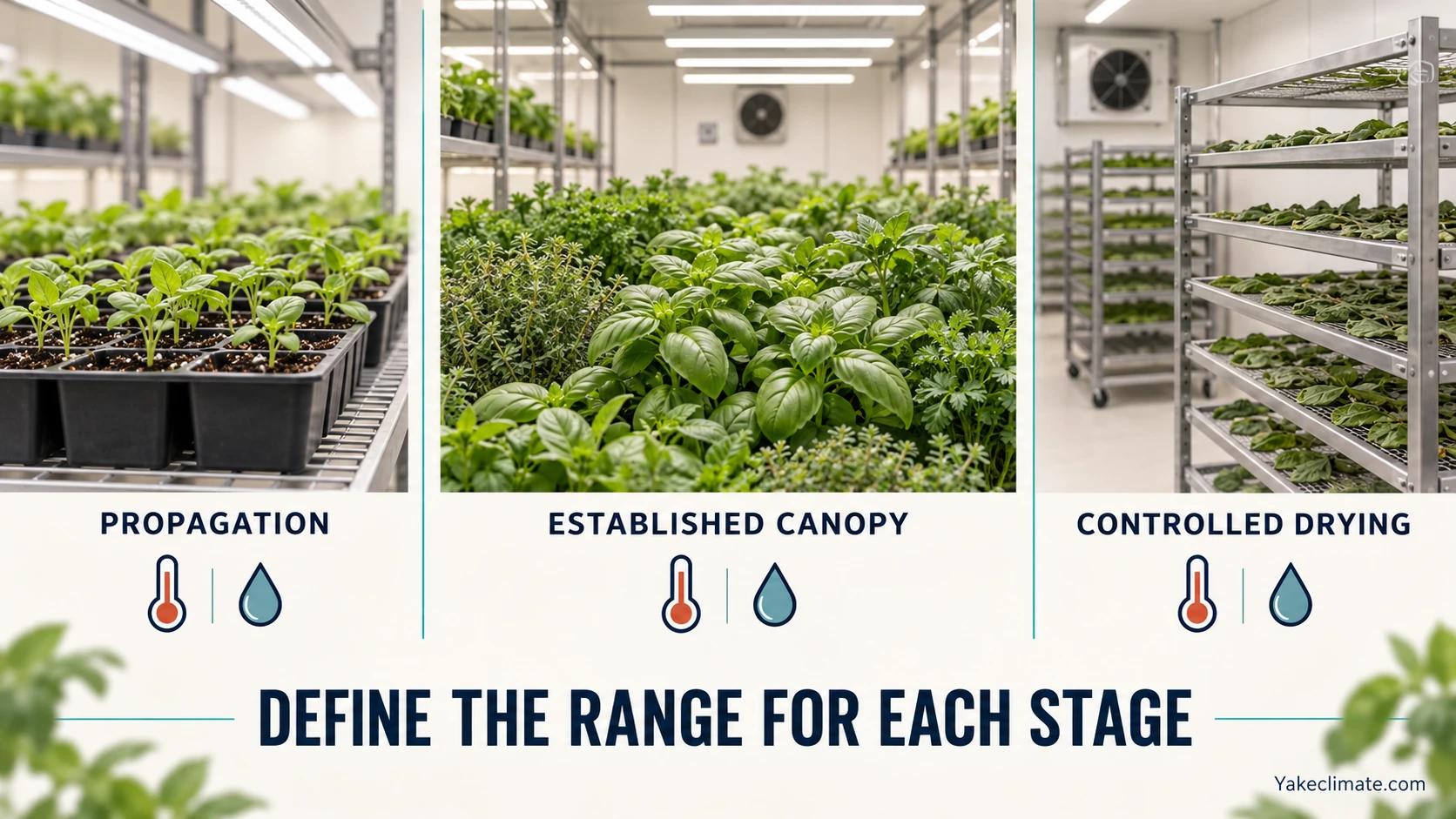
Propagation, vegetative growth, dense-canopy production, harvest, and controlled drying impose different demands. Young plants may need a gentler vapor-pressure difference while established canopies release much more water. Later production stages can become more sensitive to stagnant air and surface wetness. Drying changes the problem again because water leaves harvested material continuously while the process may require a narrow, repeatable rate of moisture removal.
| Stage | Main humidity concern | Design focus |
|---|---|---|
| Propagation | Gentle VPD; avoid seedling desiccation or surface wetness | Fine control, low airflow |
| Vegetative growth | Rising transpiration; disease pressure on leaf surfaces | Air distribution, latent capacity |
| Dense-canopy production | Stagnant humid zones inside the canopy | Inter-canopy airflow |
| Harvest and short-term hold | Condensation on harvested material and surfaces | Dew point below product surface temperature |
| Controlled drying | Continuous, repeatable moisture removal | Turndown and batch kinetics |
The crop owner or agronomist should define the acceptable environmental range. Equipment suppliers can then translate that range into airflow, sensible load, latent load, controls, and installation requirements. This separation keeps biological decisions with the cultivation team and engineering decisions with the environmental-control team.
3. Build a Moisture-Load Profile
Start with water entering the room. Irrigation that is not retained by the crop leaves through drainage, evaporation, or transpiration. Add moisture from wet floors, cleaning, humidification, people, door openings, and outdoor air. For drying rooms, include the initial and final product mass, target process time, batch schedule, and expected water removal.
A 24-hour average can hide the design peak. Moisture often rises after irrigation, during high-light operation, immediately after lights-off, or when cool outdoor conditions lower surface temperatures. Log these operating events and compare them with room humidity, return-air conditions, and condensate removal.
4. Use Airflow to Protect the Microclimate
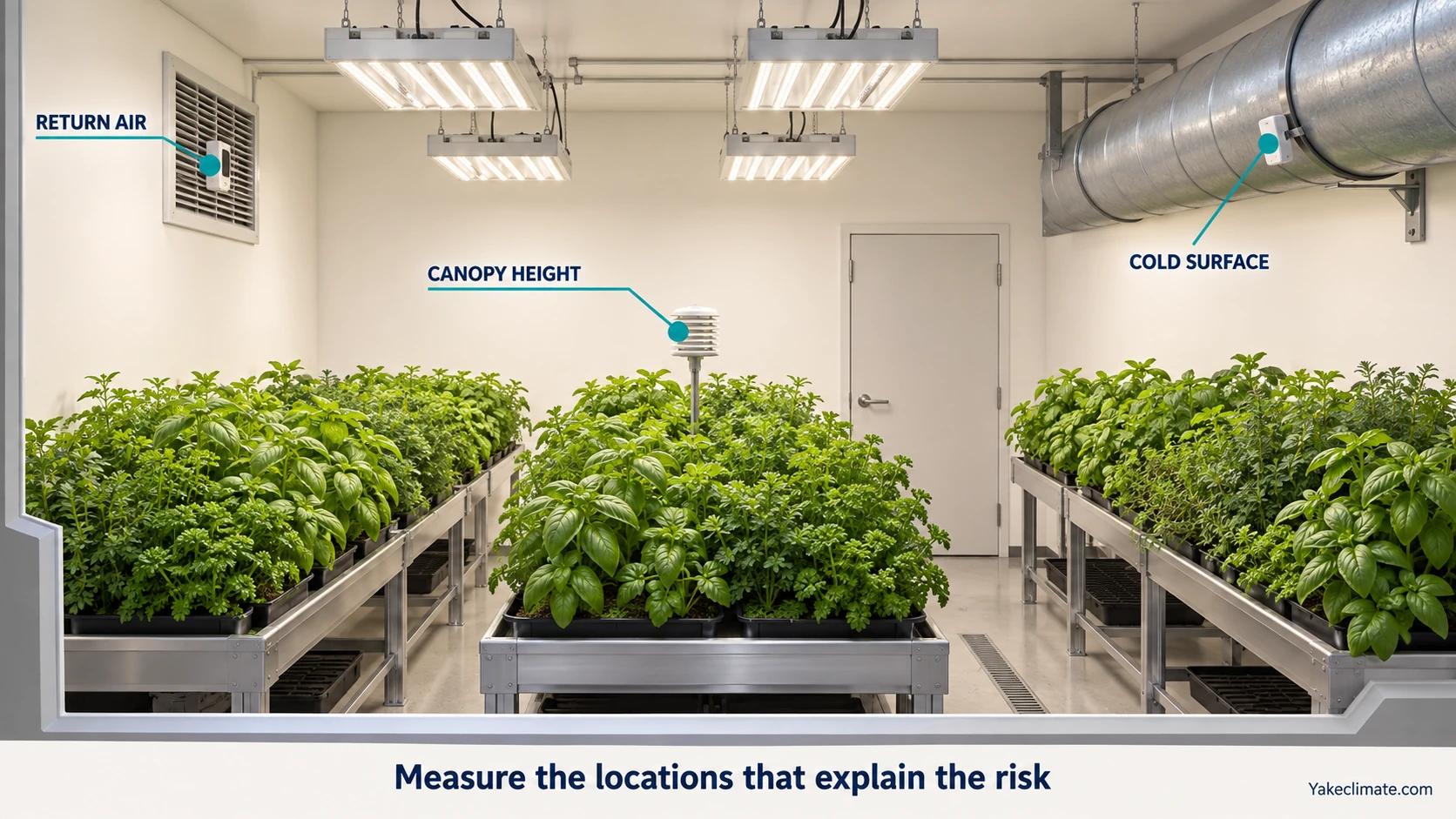
A central sensor can report an acceptable value while humidity remains high inside a dense canopy, behind racks, near walls, or around cold ducts. Air circulation should reduce these stagnant zones without creating damaging local air speed. Supply and return paths also need to prevent short-circuiting, where treated air returns to the unit before reaching the crop.
Dehumidification removes water from the air; circulation distributes the treated air; ventilation exchanges indoor and outdoor air; cooling manages sensible heat. These functions interact, but they are not interchangeable. The control sequence should state which system leads in each operating mode and how equipment responds when temperature or humidity moves outside the target band.
5. Measure the Conditions That Matter
Use calibrated temperature and humidity sensors at representative crop height, at the air return, and near known risk zones. Leaf or product temperature can be as important as room temperature because condensation begins when a surface reaches the dew point. Sensor placement, radiation shielding, response time, and calibration records all affect the reliability of the data.
Trend data should include lighting state, irrigation events, HVAC mode, dehumidifier runtime, door openings, alarms, and drainage. The aim is to explain why conditions changed, not merely to collect more readings.
6. Plan Controlled Drying as a Separate Process
Drying rooms need their own moisture-load calculation. The early part of a batch can release water quickly, while the final stage may require slower and more stable removal. Excessive drying capacity without suitable modulation can create uneven results; insufficient capacity can extend the wet period and increase risk.
Removing water vapour can maintain a driving force for evaporation during drying. The resulting drying rate and product quality depend on the material, air temperature, humidity, airflow and loading pattern. Establish the acceptable conditions and endpoint for the actual crop; a food-plant evaporation trial is not a crop-specific performance guarantee.
A drying load example
Example (illustrative): a 1,000 kg batch at 75 % moisture (wet basis) dried to 12 % moisture over 10 days.
| Input | Value |
|---|---|
| Dry matter | 250 kg |
| Water to remove | 715.9 kg (illustrative wet-basis assumption) |
| Process duration | 240 hours |
| Average removal rate | 715.9/240 ≈ 3.0 kg/h |
| Early-period rate | Not specified; obtain a drying curve or measured time series |
The average removal rate does not establish the peak or when it occurs. Obtain a drying curve for the material, loading, temperature and airflow under consideration, then check equipment capacity and turndown across that curve. Early, middle and final stages must not be assigned universal multipliers or peak times without that evidence.
Define batch mass, initial moisture, final moisture, process duration, room volume, rack arrangement, airflow path, temperature limits, and sanitation requirements before selection.
7. Select Equipment Around the Facility
Refrigerant dehumidifiers are often suitable when the room temperature and humidity support efficient condensation. Desiccant systems can be considered for lower-temperature or lower-dew-point conditions. The final choice also depends on heat rejection, power, drainage, ducting, maintenance access, controls, noise, redundancy, and how the unit fits the wider HVAC design.
For projects with repeated rooms or containers, agree the interface before production: mounting, air inlet and outlet, condensate route, power supply, communication protocol, alarm points, service clearance, labels, drawings, and validation steps.
8. Project Information to Prepare
Application and crop stages, room dimensions, canopy or rack area, temperature range, humidity targets, irrigation schedule, lighting schedule, outdoor design conditions, ventilation rate, power, drainage, controls, and required documentation provide a useful starting point for equipment review.
9. Discussing a Project
Industrial Dehumidification for Complex Climate Applications
Yakeclimate designs and manufactures industrial dehumidification equipment for complex climate applications, with a focus on agriculture and energy projects.
We co-develop application-specific dehumidification equipment around the operating conditions, interfaces, and integration requirements of the wider project or system.
Explore agriculture humidity control, review industrial ceiling dehumidifiers, or contact Yakeclimate to review the operating conditions for your facility.
FAQ
Frequently Asked Questions
Why is one room setpoint not enough for high-value crops?
Because the crop moves through stages with different demands. Propagation needs a gentle vapor-pressure difference, established canopies release far more water, dense-canopy production is sensitive to stagnant air, and drying needs a controlled, repeatable removal rate. Each stage needs its own target and equipment response.
What is VPD and why use it instead of relative humidity?
Vapor pressure deficit is the difference between the saturation vapor pressure at the air temperature and the actual vapor pressure. It drives transpiration directly, so it describes what the plant experiences better than relative humidity alone. A given RH setpoint permits different VPD values as temperature changes.
How do I find the real design peak in a growing room?
Log moisture-related events: irrigation, high-light operation, lights-off, door openings, and cleaning. Compare them with room humidity, return-air conditions, and condensate removal. A 24-hour average hides peaks that usually follow these events.
Does dehumidification actually speed up drying?
Dehumidification can support drying by removing water released into the air. The effect on batch time and quality must be established for the actual crop, rack loading, airflow and temperature limits; a result from another material or process is not a transferable drying-rate promise.
What is the right sizing number for a drying room?
The average follows from the stated illustrative mass and duration: 715.9 kg ÷ 240 h ≈ 3.0 kg/h. Do not multiply it by an assumed early-stage factor. If an early peak matters, use a drying curve, moisture measurements or a validated process model with stated boundary and uncertainty.
References
- Vapor pressure deficit as a driver of transpiration and plant traits in controlled environments — VPD review (Dimensions/DTIC)
- Published research on air dehumidification and water evaporation in a food plant provides process-specific context. It does not establish a numerical drying-rate improvement for the crop batches discussed here.
- Circulatory dehumidifying drying system water and heat balance — Journal of the Society of Agricultural Structures, Japan
- ASHRAE Handbook—HVAC Applications and Fundamentals (psychrometrics and environmental control references)


