
1. Temperature and Humidity Must Be Managed Together
Vapor pressure deficit (VPD) is the difference between the saturation vapor pressure at a given temperature and the actual vapor pressure of the air. Latent load is the moisture the climate system must remove. Dew point is the temperature at which air becomes saturated and water starts to condense.
Grow-room temperature and humidity have to be managed together. Temperature changes the amount of water vapour the air can hold, while crop transpiration, irrigation, outdoor air, and drying material determine the moisture load. A stable reading is useful only when it is measured in the right place and remains suitable for the crop stage.
The cultivation team should define acceptable day, night, transition, and drying conditions for the crop. The engineering team can then translate those targets into cooling, heating, airflow, dehumidification, humidification, sensing, and control requirements.
2. Vegetative Growth Changes the Moisture Load
As leaf area increases, transpiration and irrigation usually increase. A room that was easy to control after transplant can become moisture-limited later in the cycle. Record canopy area, irrigation volume, drain volume, lighting power, photoperiod, and room recovery after irrigation to understand the real latent load.
Humidity is often uneven. Dense foliage, rack layers, walls, corners, and equipment shadows can create local microclimates. Place sensors at representative crop height and compare them with return-air conditions. Air circulation should mix the room without creating excessive local air speed or bypassing the crop.
3. Use VPD With the Right Inputs
VPD combines temperature and humidity into an indication of the drying demand around a surface. For crop decisions, leaf temperature is more relevant than air temperature alone. Lighting, radiation, airflow, and transpiration can make leaf temperature differ from the room sensor.
A leaf-VPD example
Example (illustrative): room air at 24 °C and 70 % RH has a vapor pressure of about 2.09 kPa and an air-based VPD of about 0.90 kPa. A lit canopy at 27 °C has a saturation vapor pressure of about 3.57 kPa, so the leaf-to-air VPD is about 1.48 kPa, more than 60 % higher than the air-based figure. Controlling on room air alone understates the drying demand at the leaf.
Treat VPD as a diagnostic tool, not a universal recipe. The acceptable range depends on crop, cultivar, stage, root-zone condition, lighting, and production objective. Confirm the target with the cultivation team and verify sensor accuracy before changing equipment settings.
4. Plan for Lights-Off and Other Transitions
When lights switch off, sensible heat can fall faster than transpiration, and wet surfaces release moisture. Relative humidity can rise quickly even without a new water source. Cooling coils may also stop removing moisture as the sensible load falls.
A lights-off example
Example (illustrative): at 25 °C and 65% RH, using an assumed total pressure of approximately 101.325 kPa, the humidity ratio is about 12.9 g/kg dry air. At 20 °C with the same moisture content and pressure, the implied RH is near 88%. This is a sea-level reference calculation, not a high-elevation universal value.
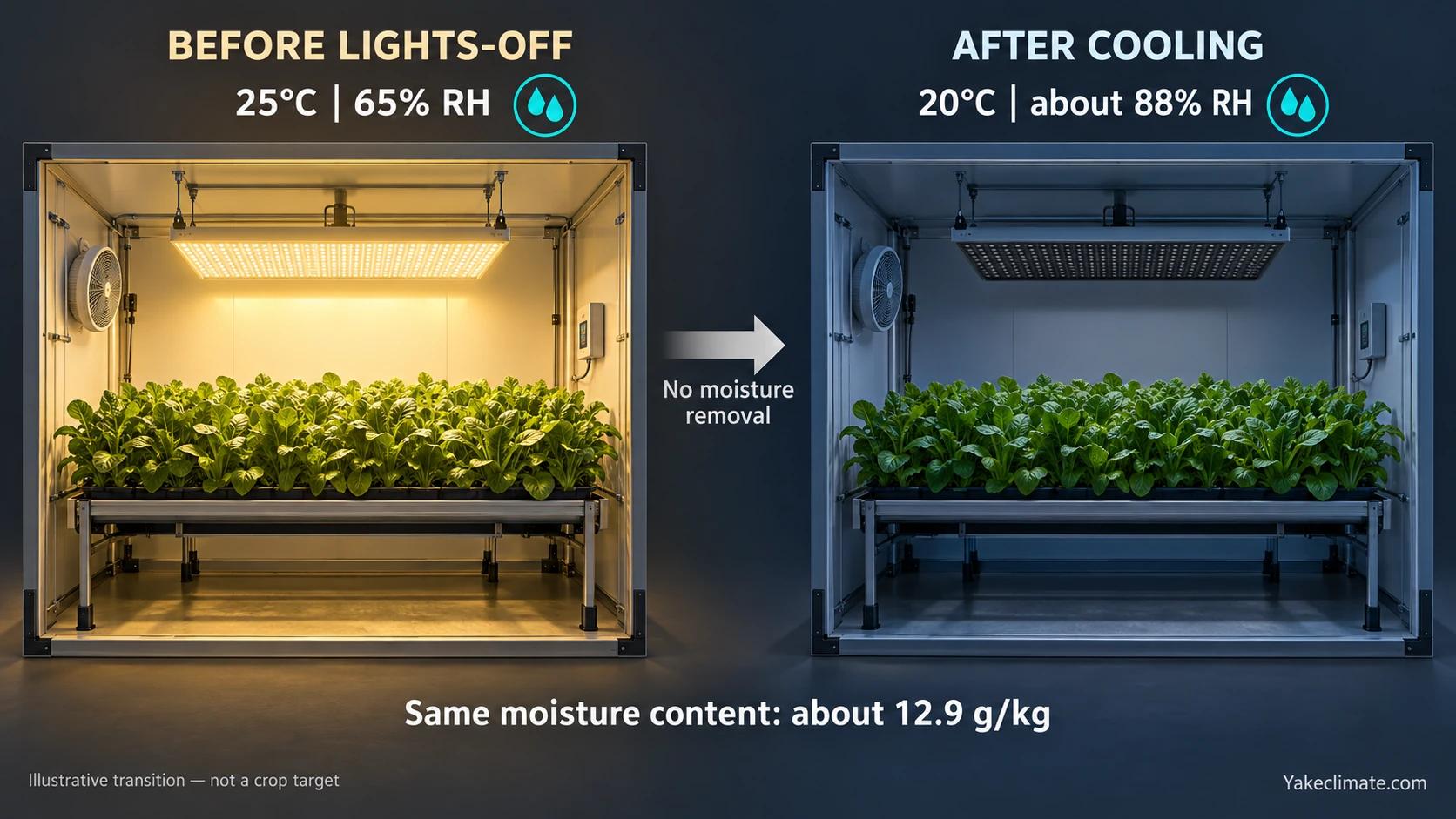
The control sequence may need staged dehumidification, reheating, fan-speed changes, or a gradual temperature transition. Trend the last part of the light period, the first hours after lights-off, and the period after irrigation. These windows usually reveal more than a daily average.
5. Prevent Condensation, Not Only High RH
Condensation begins when a surface reaches the dew point. Glazing, metal frames, ducts, pipes, panels, coils, and perimeter zones can become wet before the central room sensor reaches an alarm threshold. Measure or estimate surface temperature at known risk points and maintain insulation, vapour barriers, and drainage.
6. Controlled Drying Is a Different Operating Mode
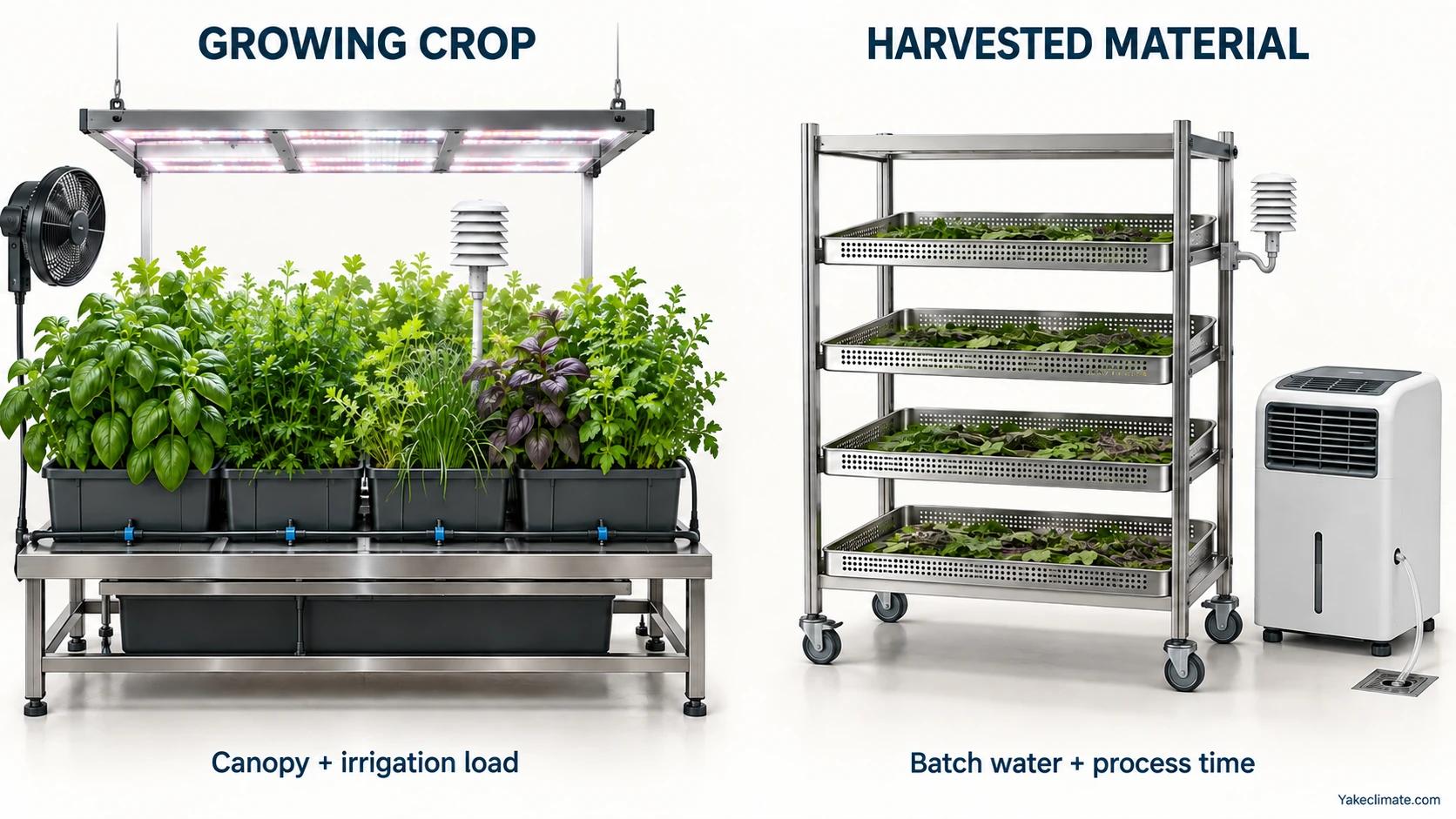
Harvested material releases water throughout drying. The release rate is usually highest early in the batch and declines with time. A useful design specifies batch mass, initial and final moisture, process duration, room volume, rack arrangement, airflow direction, temperature limits, and acceptable variation.
| Operating mode | Main control functions | Design focus |
|---|---|---|
| Vegetative growth | Cooling, dehumidification, air circulation | Latent capacity follows canopy growth |
| Lights-off transition | Staged dehumidification, reheat, fan control | RH spike and condensation windows |
| Controlled drying | Dehumidification with turndown, airflow | Batch kinetics, even surface drying |
Oversized equipment with poor modulation can shorten the process or create uneven surface drying. Undersized equipment can extend the wet period. Select capacity and control range together, and verify the process with weight, moisture, temperature, humidity, and airflow records.
7. Coordinate the Equipment
Cooling manages sensible heat and may remove moisture when the coil operates below dew point. Dehumidifiers manage latent load and may add heat to the room. Ventilation can remove moisture only when the outdoor air provides useful drying potential. Humidifiers add moisture when the air becomes too dry. The sequence should define priorities, interlocks, and alarm limits.
Equipment selection also depends on room temperature, available power, drainage, ducting, heat rejection, service access, controls, redundancy, and cleaning requirements. Refrigerant and desiccant technologies have different operating ranges and integration needs.
8. Measurement and Commissioning
Calibrate sensors, compare positions, confirm airflow, and test the room through representative operating transitions. Record how quickly temperature and humidity recover after doors open, irrigation starts, lights switch, or a drying batch is loaded. Commissioning should confirm the complete control sequence rather than a single steady-state reading.
9. Discussing a Project
Industrial Dehumidification for Complex Climate Applications
Yakeclimate designs and manufactures industrial dehumidification equipment for complex climate applications, with a focus on agriculture and energy projects.
We co-develop application-specific dehumidification equipment around the operating conditions, interfaces, and integration requirements of the wider project or system.
Explore agriculture humidity control, review industrial ceiling dehumidifiers, or contact Yakeclimate to review the operating conditions for your facility.
FAQ
Frequently Asked Questions
Why can temperature and humidity not be controlled separately?
Because temperature changes how much water vapour air can hold. A fixed RH target permits different moisture contents as temperature changes, and a temperature drop at constant moisture content raises RH sharply. The two variables have to be set and sequenced together.
Should control be based on air temperature or leaf temperature?
Leaf or product temperature is more relevant for crop decisions. Lighting and transpiration can make leaf temperature differ from the room sensor by several degrees, which changes the real VPD at the leaf. Measure both where the decision matters.
Why does humidity spike after lights-off?
When lights switch off, sensible heat falls faster than transpiration and wet surfaces continue releasing moisture. Air cools at roughly constant moisture content, so RH rises. A 5 K drop from 25 °C / 65 % RH to 20 °C at the same moisture content raises RH to about 88 %.
How do I size a drying room?
For batch kinetics, state the initial and final moisture basis explicitly: wet basis or dry basis, with the same basis at both endpoints. Batch mass, moisture change and process duration give an average removal rate; early release should be measured or represented by a documented drying curve rather than assumed.
What is the most common control failure?
Cooling and dehumidification working against each other: a cooling coil overcools, a dehumidifier adds heat, and the two systems oscillate. The control sequence must define which system leads in each operating mode.
References
- Vapor pressure deficit as a driver of transpiration and plant traits in controlled environments — VPD review (Dimensions/DTIC)
- ASHRAE Handbook—Fundamentals (psychrometrics used in the lights-off and leaf-VPD examples)


