
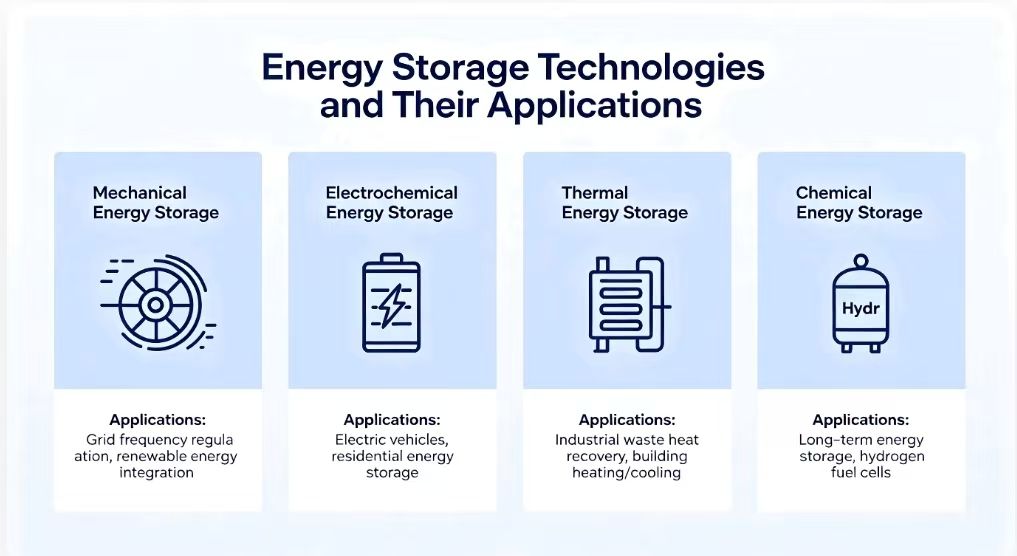
1. One Storage Market, Many Protected Environments
Balance-of-system equipment is everything around the storage medium: power conversion, controls, enclosures, cooling, and electrical distribution. Condensation is water that forms when a surface cools below the dew point of the air touching it. Dew point is the temperature at which air becomes saturated and water starts to condense.
Energy storage is a group of technologies, not one environmental application. Lithium-ion batteries, flow batteries, pumped storage, compressed air, thermal storage, flywheels, and hydrogen systems store energy in different forms and use different equipment. The US Department of Energy groups these under electricity storage technologies with distinct architectures and applications.
Humidity control is therefore applied to a defined equipment environment: an electrical cabinet, battery enclosure, control room, power-conversion unit, pump station, instrument panel, or other protected volume. It is not a universal treatment for the storage medium.
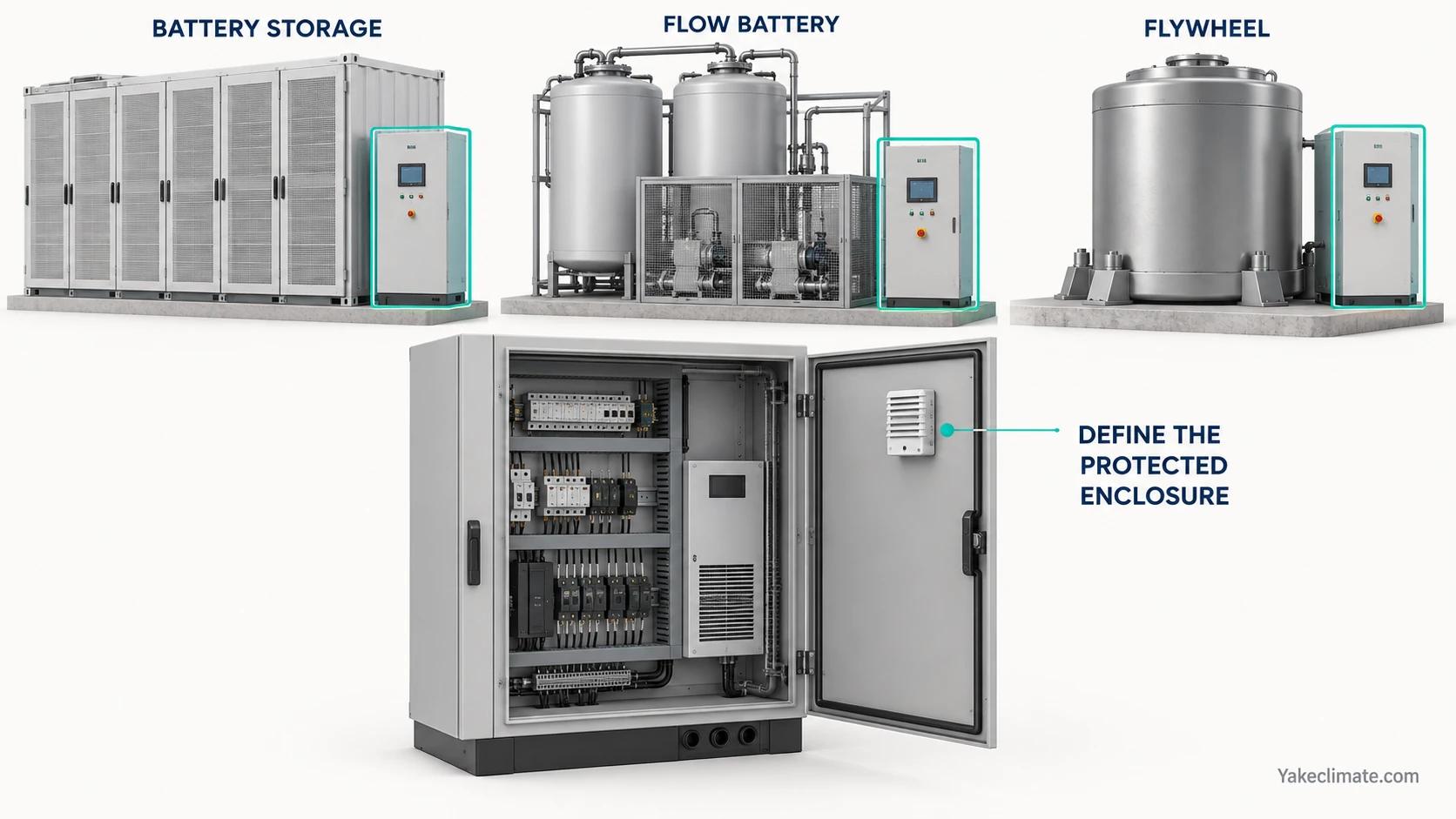
2. Compare Technology, Site, and Protected Equipment
Three questions keep the environmental review practical:
- What stores the energy?
- What balance-of-system equipment must remain reliable?
- Which enclosed spaces face condensation, corrosion, water ingress, or a low-dew-point requirement?
The answer changes by technology and project architecture.
3. Technology-by-Technology Review
| Technology | Typical protected equipment | Main humidity concern | Scope boundary |
| Lithium-ion BESS | Modules, racks, power conversion, controls, sensors | Condensation on cold metal; humid-air entry; connector corrosion; blocked drains | Does not replace thermal management, gas detection, ventilation, or fire safety |
| Lead-acid battery rooms | Racks, electrical equipment, ventilation systems | Ventilation air moisture; corrosion; temperature uniformity | Must be coordinated with required ventilation |
| Flow batteries | Electrical/control enclosures, pumps, piping, instruments | Enclosure condensation; pipe surface temperatures; leak containment | Ordinary dehumidification does not control electrolyte water content |
| Sodium, metal-air, emerging | Supplier-defined enclosures | Chemistry-specific atmosphere or sealing requirements | Do not transfer cell-manufacturing dry-room conditions to field enclosures |
| Flywheel | Cabinets, cooling, connectors, auxiliary rooms | Enclosure condensation; external corrosion | Not control of the internal vacuum or bearing environment |
| Pumped hydroelectric | Generator/control rooms, switchgear, cable galleries, underground spaces | Room and cabinet humidity; groundwater and seepage | Water is integral to the process; address liquid-water control first |
| Compressed-air | Compressors, piping, instrument air, control cabinets | Process-air moisture; cabinet humidity | Compressed-air drying is a process task; separate from enclosure units |
| Thermal storage | Control cabinets, actuators, instruments, junction boxes | Ambient humidity around auxiliary equipment | Does not control moisture content of the storage medium |
| Hydrogen / power-to-gas | Electrolysers, compression, fuel cells, controls | Hazardous-area constraints; ventilation interference | Device must be approved for the location and not interfere with gas safety |
The table is a review starting point, not a specification. Each project's equipment boundary, supplier requirements, and safety zoning decide what applies.
4. Condensation Assessment Across Technologies
For any protected enclosure:
condensation risk exists when local surface temperature <= local air dew pointReview:
- outdoor and internal dew point;
- minimum surface temperature;
- ventilation and leakage;
- door and maintenance events;
- heat and cooling cycles;
- drainage;
- contaminants;
- power availability;
- alarm and communication requirements.
This common method is more useful than assigning a universal RH limit to every storage technology.
5. Selecting Environmental-Control Equipment
The appropriate method may include:
- repairing liquid-water ingress and drainage;
- sealing unintended openings;
- heater control to maintain a surface margin;
- managed ventilation;
- refrigerant dehumidification;
- desiccant drying for lower-temperature or lower-dew-point conditions;
- coordinated monitoring and alarms.
| Condition | Preferred direction |
| One known cold surface | Heater or insulation, check drainage |
| Humid air enters repeatedly | Refrigerant dehumidification in the operating range |
| Low temperature or low dew point required | Desiccant drying, compare at actual conditions |
| Ventilation-driven load | Fix ventilation rate first, then size dehumidification |
| Hazardous area | Approve device for the zone; do not interfere with gas safety |
Selection follows the actual air boundary, not the technology name alone.
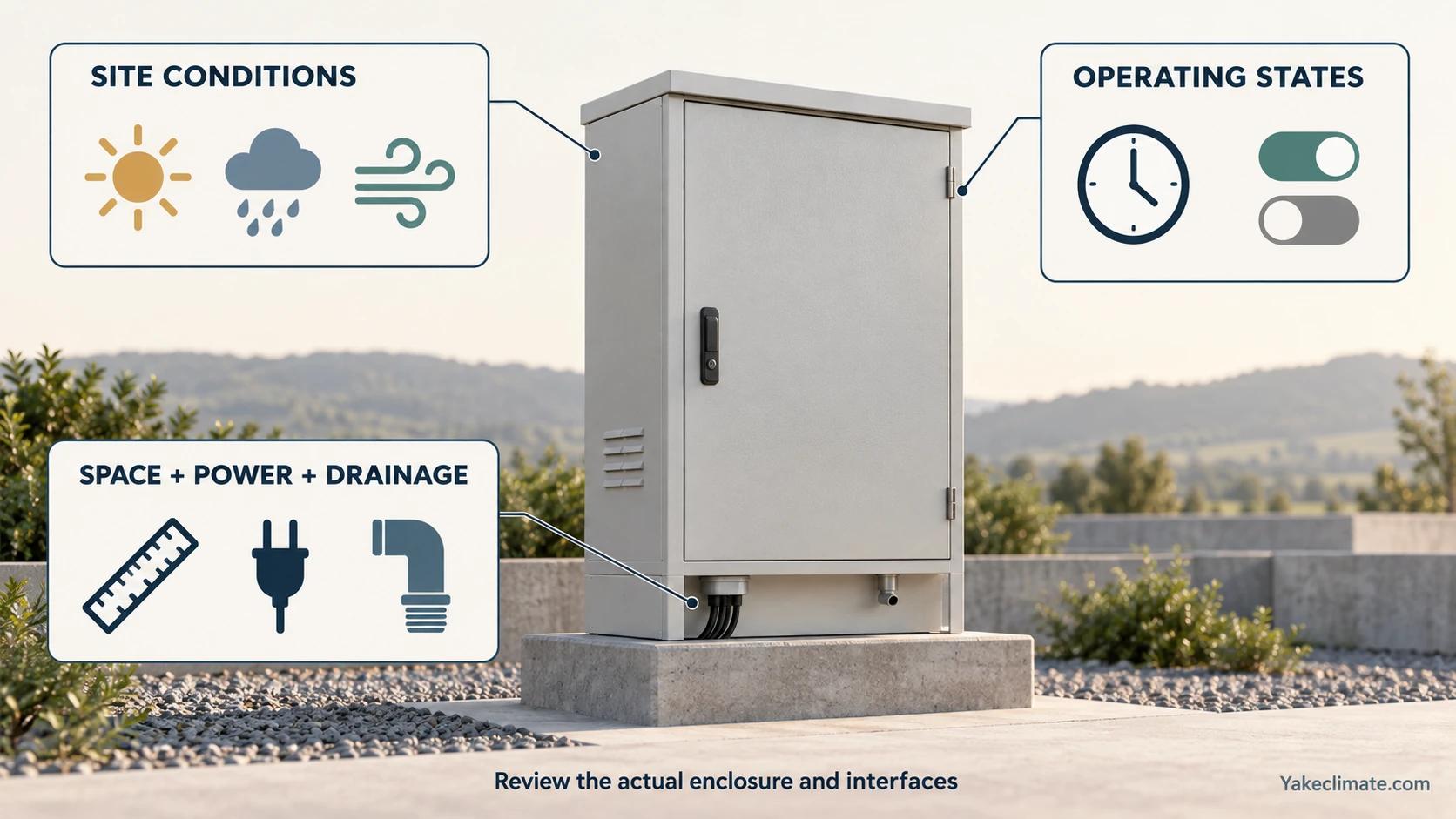
6. Information to Prepare
Provide:
- storage technology and system architecture;
- specific equipment or enclosure to protect;
- site climate and contamination;
- operating, standby, and maintenance states;
- temperature and humidity requirement;
- cold surfaces and cooling interfaces;
- ventilation, leakage, and door events;
- available space, power, airflow, and drainage;
- safety zoning and material requirements;
- commissioning and maintenance plan.
7. Discussing Energy-Storage Environments
Industrial Dehumidification for Complex Climate Applications
Yakeclimate designs and manufactures industrial dehumidification equipment for complex climate applications, with a focus on agriculture and energy projects.
We co-develop application-specific dehumidification equipment around the operating conditions, interfaces, and integration requirements of the wider project or system.
Explore energy applications, review energy-storage dehumidifiers, or contact Yakeclimate with the technology, protected enclosure, and environmental boundary.
FAQ
Frequently Asked Questions
Does every energy storage technology need dehumidification?
No. The need depends on the protected equipment, climate, cold surfaces, air exchange, drainage, and manufacturer requirements.
Can a battery manufacturing dry room standard be applied to a field BESS cabinet?
No. Manufacturing dry rooms may support sensitive cell-production processes and very low dew points. Operating BESS cabinets have different boundaries, loads, and safety requirements.
How should the humidity target be set?
Use equipment limits, dew point, minimum surface temperature, contaminants, and the project operating condition, not a technology label or a universal RH value.
Does dehumidification control the storage medium?
Usually it protects surrounding electrical, control, or auxiliary equipment. Any claim about the storage medium must come from its process or supplier specification.
When is desiccant drying needed?
Only for systems with a documented low-temperature or low-dew-point requirement. Compare desiccant and refrigerant methods at the actual operating condition.
What must be defined before selection?
The exact air volume and equipment to protect. Without that boundary, capacity and airflow cannot be selected reliably.
References
- US Department of Energy, Office of Electricity: Energy Storage — DOE
- US Department of Energy, Electricity Storage Technologies report — DOE PDF
- NFPA 855, Standard for the Installation of Stationary Energy Storage Systems — NFPA product page
- IEC 62933 series, Electrical energy storage (EES) systems — IEC Webstore
