
1. The Project Begins With the Product, Not the Machine
Wet-basis moisture is the mass of water divided by total wet mass. Dry-basis moisture is the mass of water divided by dry solids mass. Equilibrium moisture content (EMC) is the moisture a hygroscopic material tends toward at a given air temperature and relative humidity.
A post-harvest grain or seed drying project begins with the commodity's approved initial and final moisture contents, the mass per batch, the required drying time, and the quality limits, not with a dehumidifier capacity. A water mass balance gives the theoretical quantity to remove. The actual drying rate then depends on product properties, air temperature, humidity and velocity, bed depth, airflow resistance, equipment layout, and the material's approach to EMC.
This guide explains how to prepare those inputs. It does not recommend a moisture endpoint for any crop: the acceptable target must come from the commodity, storage period, market, seed-viability, and process requirements.
Scope: grain and seed, not every post-harvest process
"Post-harvest drying" can mean grain in a bin, seed in a low-temperature drying room, herbs on trays, fruit in a dryer, timber in a kiln, or a packaged product in conditioned storage. Those materials have different moisture relationships, heat limits, quality risks, and test methods.
This article covers the engineering brief for grain and seed drying in a controlled air process. The same mass-balance logic can help other projects, but the process targets and equipment must be revalidated for the material.
Before calculation, record:
- commodity, variety, and whether it is food grain or planting seed;
- approved moisture test method and reporting basis;
- initial moisture range and distribution;
- required final moisture and allowable variation;
- batch mass or continuous throughput;
- maximum product temperature and quality constraints;
- available drying time and downstream storage or packaging condition.
2. Wet Basis and Dry Basis Are Not Interchangeable
FAO post-harvest guidance distinguishes wet-basis moisture content from dry-basis moisture content.
Moisture fraction (wet basis) = mass of water / total wet mass
Moisture fraction (dry basis) = mass of water / mass of dry solids
The same material has different numerical values on the two bases. A project must state the basis next to every moisture percentage. Mixing them produces a wrong water-removal calculation even when the arithmetic is otherwise correct.
Commercial grain moisture is commonly discussed on a wet basis, but the accepted method for the specific commodity and contract controls.
3. Calculate Theoretical Water Removal
For wet-basis values, dry-solids mass stays constant during an ideal water-only calculation:
Dry solids = initial wet mass x (1 - initial moisture fraction)
Final wet mass = dry solids / (1 - final moisture fraction)
Theoretical water removed = initial wet mass - final wet mass
Educational example
Assume a 1,000 kg batch is measured at 20 % wet-basis moisture and the calculation endpoint is 12 % wet basis.
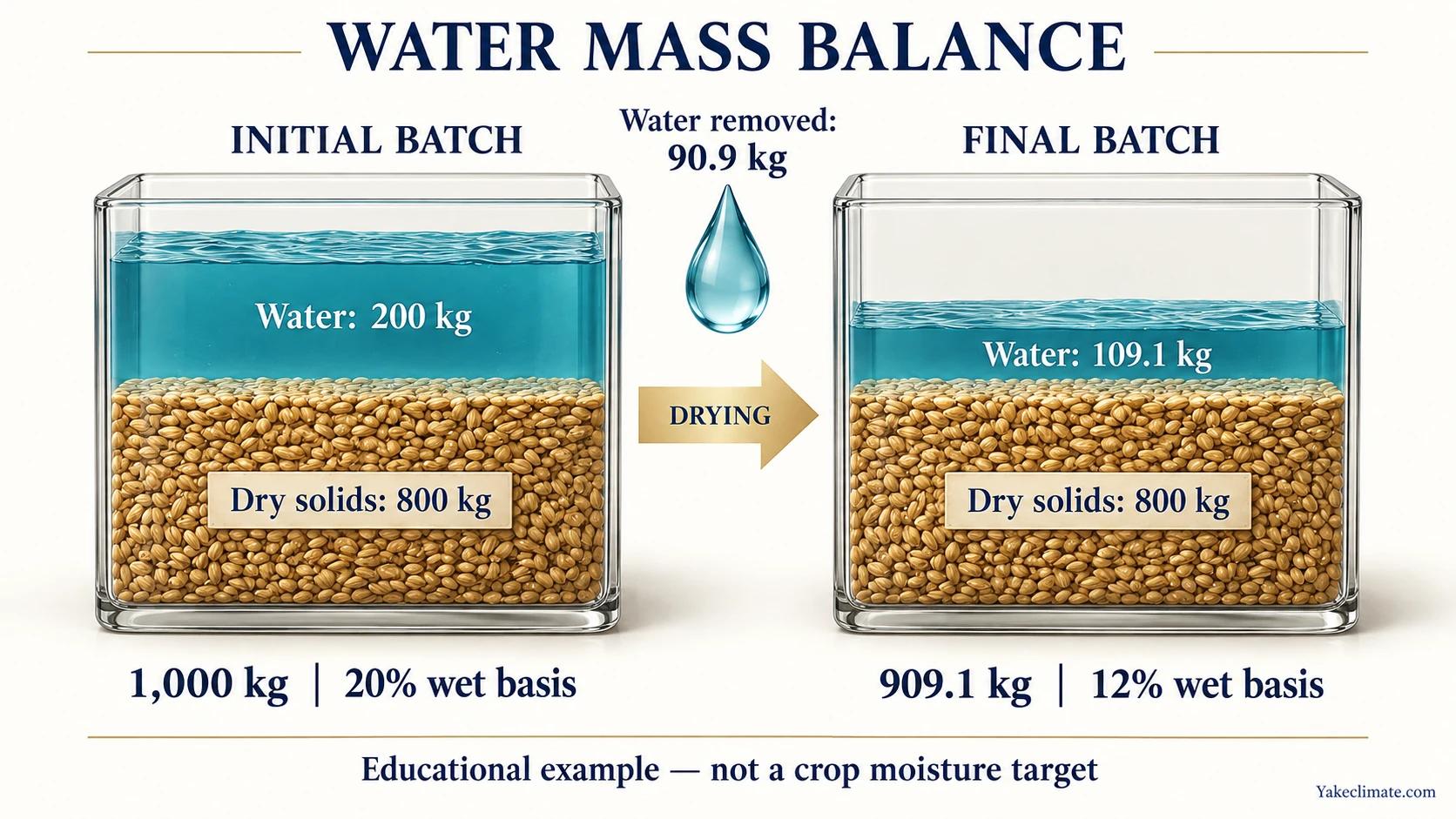
Dry solids = 1,000 x (1 - 0.20) = 800 kg
Final wet mass = 800 / (1 - 0.12) = 909.1 kg
Theoretical water removed = 1,000 - 909.1 = 90.9 kg
If that theoretical quantity were removed uniformly over ten hours, the simple average would be 9.09 kg/h.
This is a mass-balance example, not a recommended crop target, drying schedule, or equipment selection. Real drying is not uniform: free surface moisture can leave faster early in the cycle, while internal diffusion and equilibrium effects slow removal near the endpoint. System leakage, ventilation, product respiration, nonuniform initial moisture, and sampling uncertainty can also change the measured water balance.
4. The Theoretical Quantity Is Not the Drying Rate
FAO drying principles identify the main rate factors: grain moisture and temperature, air temperature and relative humidity, air velocity, and the equilibrium relationship between the material and surrounding air.
The air has two jobs:
- supply heat or conditions that allow moisture to move from the material;
- carry the released vapour away so the local air does not approach equilibrium too early.
A larger dehumidifier does not automatically solve poor product airflow. If dry air bypasses the grain bed, short-circuits to the return, or passes unevenly through trays, the room average may look dry while product moisture remains nonuniform.
Likewise, high air temperature may increase drying potential but can exceed quality, germination, or process limits. The crop or process owner must set the allowed product temperature and rate; the equipment team then designs within that boundary.
5. Equilibrium Moisture Content Sets a Practical Boundary
At a given air temperature and RH, a hygroscopic material tends toward an EMC. If the material is wetter than its equilibrium state, it tends to release water; if it is drier, it can regain water from the air.
EMC is specific to the commodity and condition. USDA Agricultural Research Service work on grain EMC measurement exists because accurate equilibrium data are important to drying and storage decisions. Do not use a generic curve for every grain or seed.
The practical project implications:
- the final air condition must be compatible with the required material endpoint;
- drying rate slows as the product approaches equilibrium;
- a room RH target alone does not guarantee final or uniform product moisture;
- storage and packaging air can reverse part of the drying result;
- the approved commodity model or measured isotherm should guide process design.
6. Decide What Part of the Process the Dehumidifier Serves
A mechanical dehumidifier can support different functions:
| Duty | What the unit does | Design consequence |
| Recirculated-air drying | Removes vapour from process air, returns drier air | Reduces dependence on outdoor dryness |
| Conditioned make-up air | Preconditions outdoor air before the drying zone | Needs outdoor design data |
| Room humidity control | Controls the space around trays, bins, or equipment | A separate fan drives product airflow |
| End-stage or low-temperature drying | Removes moisture when heat is limited | Desiccant may be required |
| Post-drying holding | Prevents regain while product waits | Storage air must match the endpoint |
These duties are not interchangeable. A room unit's airflow may not overcome grain-bed resistance. A process-air system needs fan pressure, ducting, and product-distribution design beyond a litres-per-day rating.
7. Refrigerant, Desiccant, and Ventilation Boundaries
Technology follows the product temperature limit, required air state, cycle time, and energy boundary. Catalogue capacity at a warm, humid condition cannot be treated as process capacity at a cooler end-of-cycle condition.
Desiccant becomes a candidate where process temperature is low, a lower dew point is required, or refrigerant performance at the end condition is insufficient. Regeneration energy and exhaust must be included.
8. Prepare the Project Data in Five Groups
1. Product and quality. Commodity and variety; food grain or planting seed; incoming contamination or foreign-material constraints; maximum product temperature; germination, colour, cracking, nutrition, or other quality limits; approved moisture test and sampling method.
2. Mass and moisture. Batch mass or hourly throughput; initial average and range with wet or dry basis; required final average and range; number and location of samples; theoretical water-removal calculation; any product mass change other than water.
3. Time and schedule. Allowed drying time; loading and unloading time; daily batches or continuous schedule; required recovery between batches; seasonal ambient conditions.
4. Air and equipment. Process-air temperature, RH, and dew point; airflow through the product and pressure loss; recirculation and make-up or exhaust fraction; heater and cooling capacity; current condensate or moisture-removal data; fan, filter, duct, and balancing arrangement.
5. Site and control. Room, bin, or tray dimensions and loading pattern; envelope leakage and door operation; power and heat source; drain and condensate management; sensors, control sequence, and alarms; cleaning, food-safety, and material-contact boundaries; required redundancy and maintenance access.
9. Measurement and Acceptance
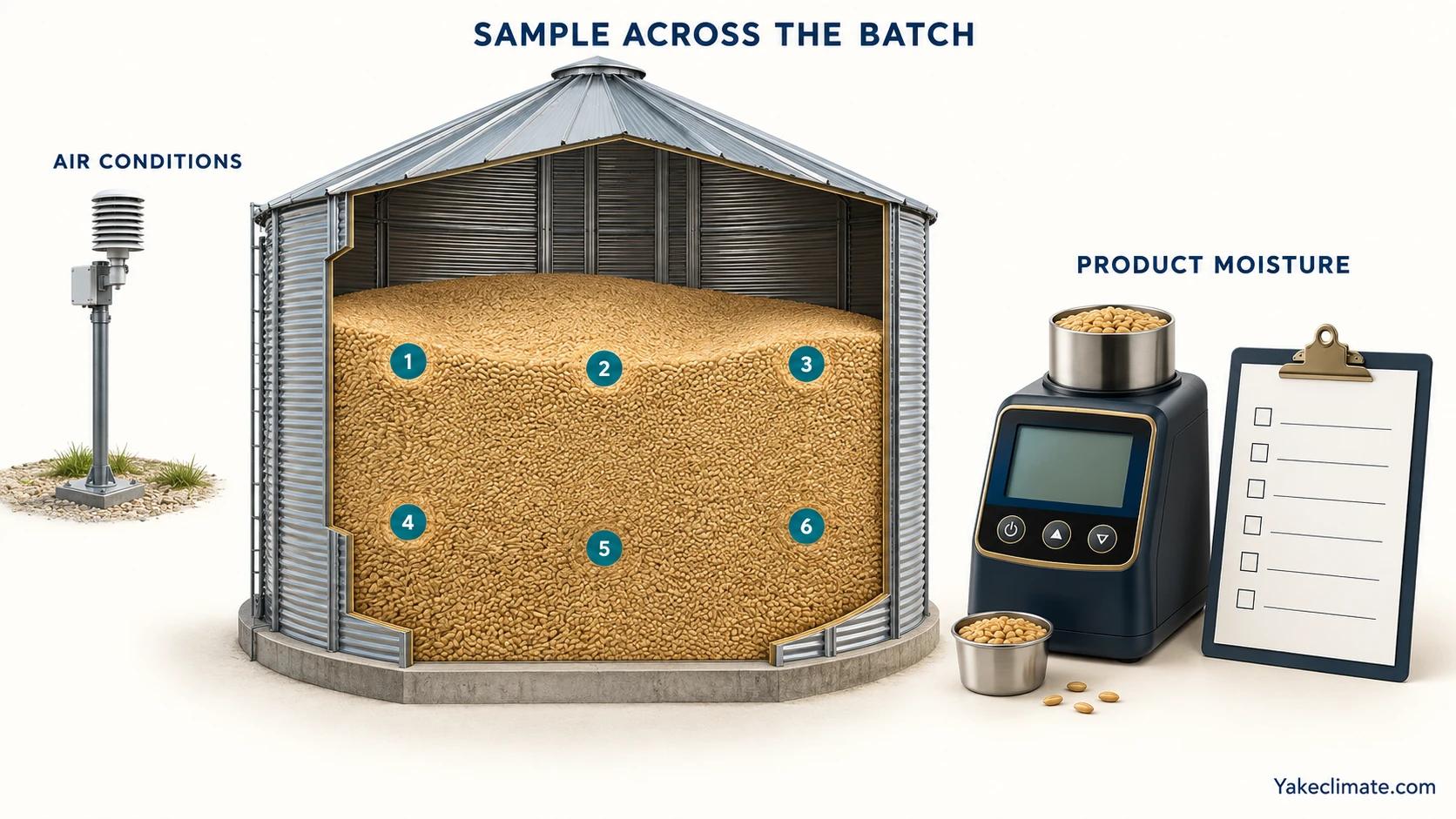
Drying acceptance should be based on representative product samples using the approved method. Air trends explain the process but do not replace product-moisture measurement.
A useful commissioning dataset includes:
- product moisture at defined locations and times;
- product temperature;
- supply and return air temperature, RH, or humidity ratio;
- airflow or fan operating point;
- dehumidifier, heater, and ventilation state;
- condensate collected;
- door and loading events;
- cycle energy where required.
Check distribution, not only the batch average. A correct average can hide overdried and underdried zones. The acceptance plan should define sample locations, measurement uncertainty, and allowable variation before the first trial.
10. Common Calculation Errors
- Using 8 percentage points as 8 % of batch mass. Moving from 20 % to 12 % wet basis does not mean removing 80 kg from a 1,000 kg batch; dry solids must be conserved, giving 90.9 kg in the educational example.
- Treating average kg/h as constant removal. Drying rate changes through the cycle, especially near equilibrium.
- Using air RH as the product endpoint. Product moisture must be sampled and measured.
- Ignoring moisture basis. Wet-basis and dry-basis percentages are different.
- Selecting by room volume. Product water, cycle time, process airflow, and entering-air condition govern the duty.
- Assuming condensate equals product water in every system. Ventilation can carry water away, and leakage or unmeasured drains can change the boundary.
11. Next Step for Equipment Review
Use the calculation to establish the theoretical batch water quantity, then provide the product, air, time, site, and quality data above. Industrial dehumidifier sizing inputs explains how to separate steady, peak, and recovery cases and compare performance at the actual condition.
The commodity endpoint, drying protocol, food-safety plan, and final process validation remain with the qualified crop or process project team.
12. Discussing a Project
Industrial Dehumidification for Complex Climate Applications
Yakeclimate designs and manufactures industrial dehumidification equipment for complex climate applications, with a focus on agriculture and energy projects.
We co-develop application-specific dehumidification equipment around the operating conditions, interfaces, and integration requirements of the wider project or system.
Explore agriculture humidity control or contact Yakeclimate with the product, mass, time, air, and site data from Section 8.
FAQ
Frequently Asked Questions
How do I calculate the theoretical water to remove?
State moisture on a wet or dry basis, conserve dry-solids mass, calculate final wet mass at the target, and subtract it from initial wet mass. The example above shows the wet-basis method.
Is the theoretical water quantity enough to select equipment?
No. The project also needs the air condition, process airflow and pressure, drying-rate profile, product temperature limit, cycle time, leakage, ventilation, and distribution layout.
Can I use room relative humidity as the product endpoint?
No. Air condition creates drying potential; the product's equilibrium relationship, internal moisture movement, and airflow distribution determine its response. Measure product moisture directly.
Is 12 % the right target for every crop?
No. The target depends on commodity, intended use, storage, market, and quality requirements. Planting seed can have additional viability constraints.
When should desiccant equipment be considered?
It becomes a candidate where process temperature is low, a lower dew point is required, or refrigerant performance at the end condition is insufficient. Regeneration energy and exhaust must be included.


