
Heating a winter greenhouse can reduce relative humidity, but it does not remove water from the air. Condensation risk is controlled only when the project manages both sides of the condition: the air’s dew point and the temperature of glazing, screens, structure, pipes and leaves. Water leaves through ventilation, condensate at a cooling or dehumidifying device, drainage, or adsorption with a regeneration exhaust—not through sensible heating alone.
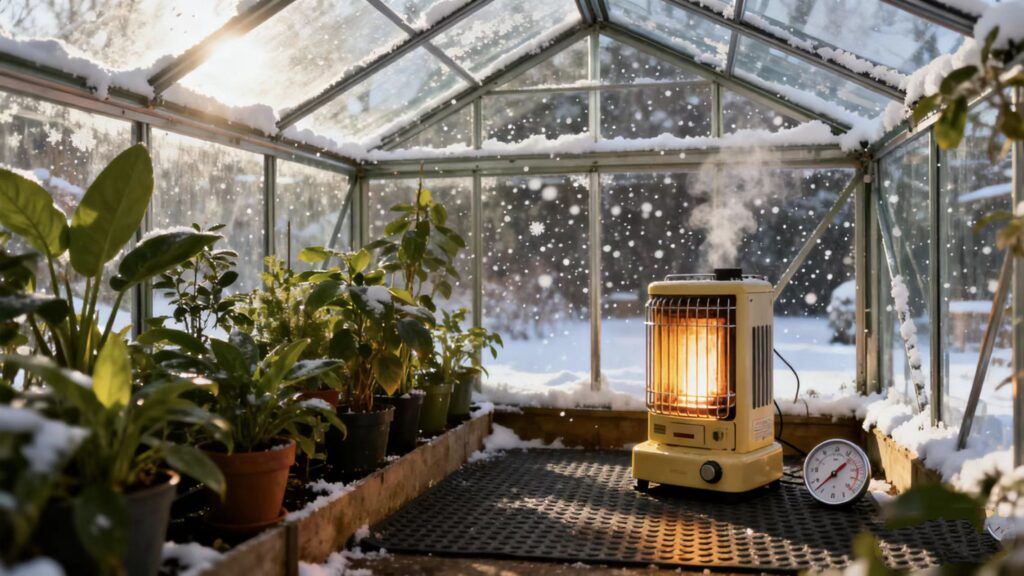
This distinction explains why a greenhouse can look better immediately after heating and still return to high RH or wet surfaces later in the night.
The winter moisture sequence
During winter, the greenhouse can follow this cycle:
- The crop, substrate, irrigation and wet surfaces add water vapour.
- Outdoor conditions cool glazing and other exposed surfaces.
- Air temperature falls after sunset or a heating-stage change.
- RH rises because the same water content is now at a lower temperature.
- A surface falls to or below the air’s dew point.
- Water condenses, even if the central sensor has not reached saturation.
- Heating raises air temperature and RH falls, but the water remains.
- Without removal, the cycle repeats when conditions cool again.
The engineering task is therefore to quantify moisture generation, keep vulnerable surfaces above dew point where practical, and remove enough water to prevent the air dew point from continually rising.
Why heating lowers RH but does not dehumidify
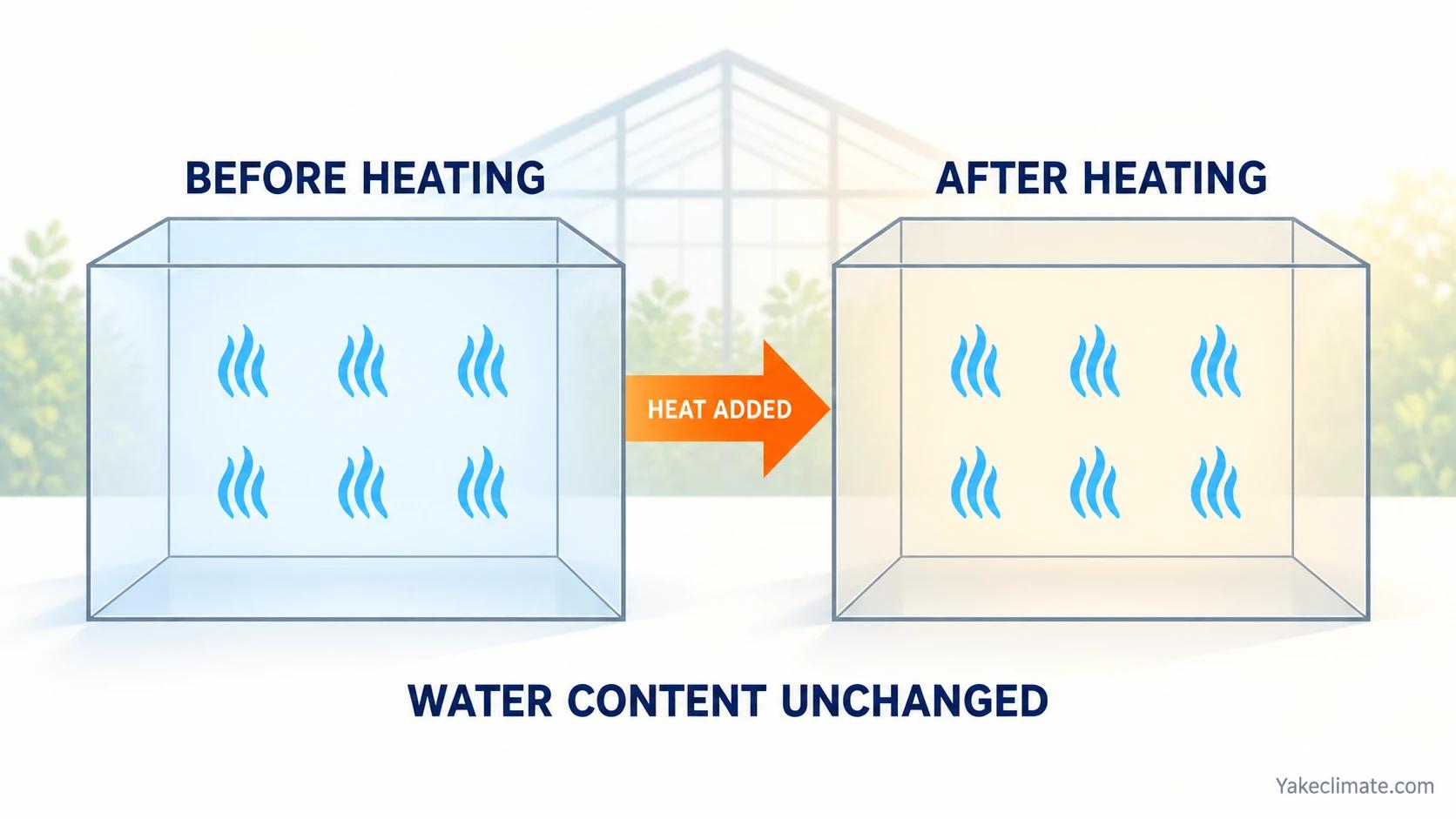
Relative humidity compares the water vapour present with saturation vapour pressure at that temperature. Warmer air has a higher saturation vapour pressure. If heating adds no water and removes no water, the humidity ratio remains essentially unchanged while RH falls.
Heating can:
- reduce immediate RH;
- raise a surface away from dew point;
- make cold incoming outdoor air able to absorb more moisture after it is heated;
- support crop and equipment temperature requirements.
Heating alone cannot:
- reduce the absolute amount of water in the greenhouse;
- dispose of crop transpiration or evaporation;
- stop RH rising again when the air cools;
Heating may evaporate existing condensate back into the air. It does not export that water from the greenhouse; an appropriate moisture-removal route is still needed.
If an operator watches only RH, heating can be mistaken for water removal. Trend dew point or humidity ratio with temperature and RH to see whether water content actually changes.
Condensation is a surface test
NIST describes dew point as the temperature at which condensation begins for air at constant pressure and water content. In practical terms:
Condensation risk exists when surface temperature is at or below air dew point.The surface can be colder than measured room air because glazing loses heat outdoors, a thermal bridge conducts heat away, or a screen creates poorly mixed layers. A leaf or pipe can therefore wet before the central RH sensor indicates a general room problem.
For each risk area, measure or estimate:
- representative air temperature and RH;
- calculated dew point;
- surface temperature;
- time spent with little or no margin;
- air movement and screen state;
- irrigation, lighting and equipment events.
Use the dew point calculator for the air state, then compare it with a representative surface measurement. A one-time handheld reading is useful for diagnosis, but continuous or repeated trends are stronger evidence for a recurring night problem.
Compare ventilation air by water content, not RH
Cold winter air often shows high relative humidity while containing little water. After that air enters and is heated, its RH can become low, giving it capacity to absorb greenhouse moisture before it is exhausted.
The relevant comparison is outdoor versus indoor humidity ratio or dew point. If outdoor air contains less water, ventilation can remove moisture:
Water removal by ventilation = dry-air mass flow × (indoor humidity ratio − outdoor humidity ratio)Ventilation also removes sensible heat and may remove enriched CO₂. The control decision must compare moisture-removal benefit with heating, CO₂ and crop consequences. The ventilation versus dehumidification guide develops that seasonal decision.
Four control actions and their limits
| Action | Changes air water content? | Main winter value | Main limit |
|---|---|---|---|
| Heating | No | Raises air and surface temperature; increases the surface-temperature margin above dew point when conditions hold | Water remains; RH can rise again as air cools |
| Internal circulation | No | Reduces stagnant zones and local cold/humid pockets | Does not export or condense water |
| Ventilation with heat | Yes, when outdoor air is drier | Uses low-moisture winter air | Heat/CO₂ loss and weather dependence |
| Mechanical dehumidification | Yes | Removes water while retaining greenhouse air | Capacity depends on entering condition; adds heat or needs regeneration |
These are complementary tools. Circulation improves distribution. Heating protects temperature and can increase surface margin. Ventilation or dehumidification provides the actual water sink.
Wageningen University & Research assessments of greenhouse heating and dehumidification compare several strategies and emphasize that no single route is best for every climate and operating condition. The choice depends on outdoor moisture, energy system, greenhouse design, crop strategy and control integration.
Screens can divide the climate
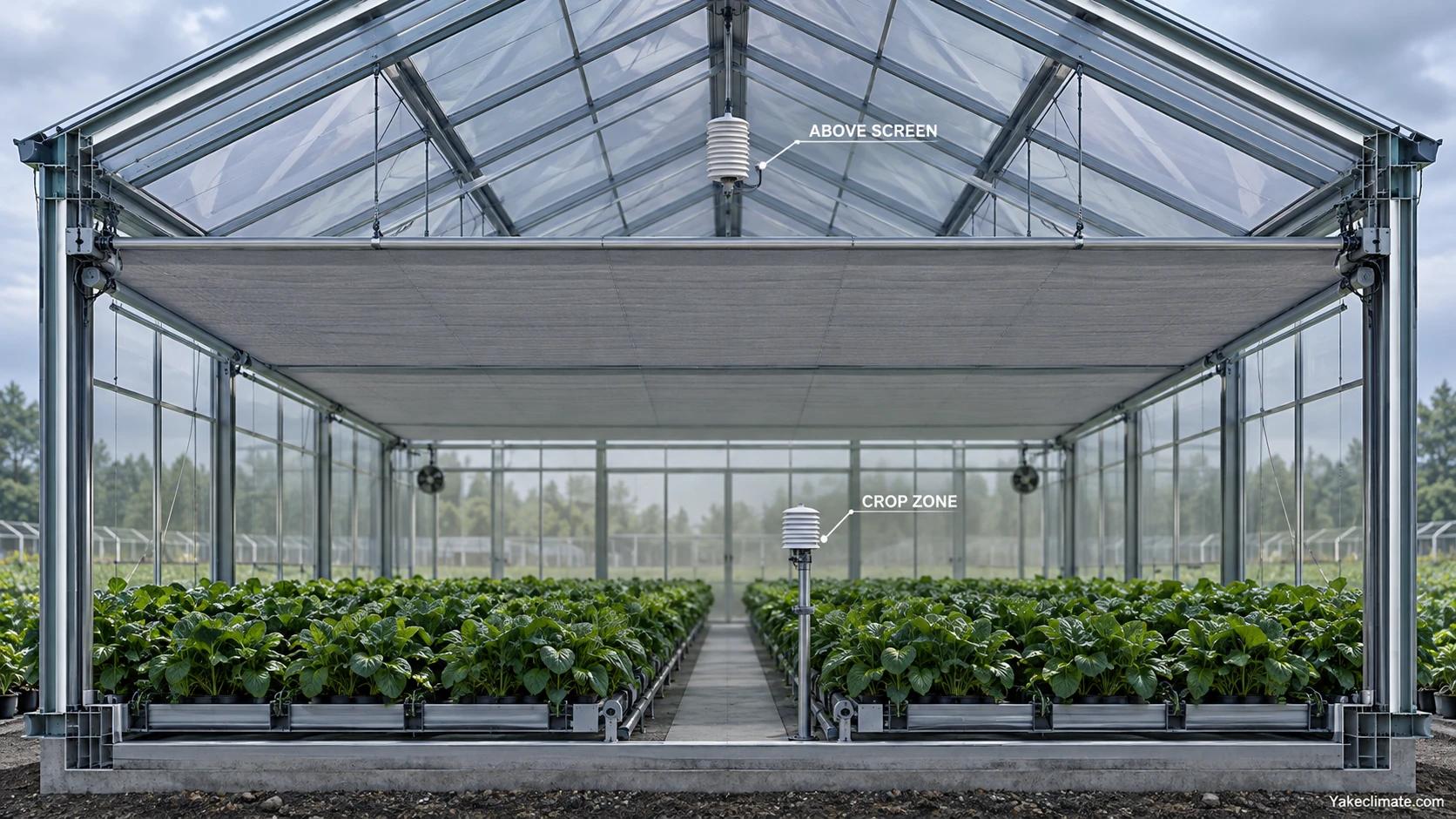
Thermal screens reduce heat loss, but they also change mixing and surface temperatures. The air above a closed screen can be colder than the crop zone; glazing may condense above it, while gaps or leakage create local flows. The screen itself can become a cold surface, and pockets with limited circulation can develop below it.
Include screen position in humidity trends. Do not assume that a sensor below the screen represents conditions above it or at the glazing. If a dehumidifier return and supply are both below a closed screen, the equipment may control the crop zone while leaving a separate moisture problem above. If air is intentionally exchanged across the screen, document the path and heat consequence.
A closed thermal screen divides the warm crop zone from the cooler roof space. Air may cross the material or bypass it through a gap; vapour can also diffuse or move through a wet textile. A screen with a favorable heat-loss result does not by itself prove a favorable humidity result. Log screen position, crop-zone temperature and humidity, roof-space conditions, and where water actually leaves the greenhouse before changing the opening sequence.
For a screen-specific method covering material tests, unintended gaps and a measured comparison of closed-screen venting, controlled opening and mechanical drying, see the greenhouse humidity under thermal screens guide. The winter decision here remains whether the chosen moisture route maintains crop temperature and surface conditions within the project constraints.
Night transitions are often the design case
The most demanding period may be the transition when:
- lights switch off and sensible heat falls;
- screens close;
- irrigation has recently added moisture;
- ventilation reduces;
- crop transpiration changes;
- surfaces cool faster than the room sensor.
Define the allowed response during that transition. If condensation must be avoided, the sequence may need an anticipatory action based on dew-point margin, not a late response after RH crosses an alarm.
An anticipatory sequence might coordinate irrigation cutoff, circulation, heat, screen movement, ventilation and dehumidification. The exact sequence belongs to the grower and greenhouse controls designer; the equipment supplier confirms device capabilities and operating boundaries.
When ventilation is the practical route
Ventilation with heating can be effective when:
- outdoor humidity ratio is reliably below the indoor target;
- heat supply and cost are acceptable;
- CO₂ loss is acceptable or enrichment is inactive;
- weather and pressure allow controlled air exchange;
- incoming air can be distributed without damaging cold drafts.
Measure or verify airflow. A vent position percentage is not automatically an airflow value because wind and pressure change the result.
USDA high-tunnel guidance describes ventilation and heating as central tools for controlling the protected environment. A sealed, mechanically controlled greenhouse needs a more project-specific balance, but the same physical boundary remains: moist air must be replaced or water must be condensed or adsorbed.
When mechanical dehumidification fits
Mechanical dehumidification becomes relevant when:
- outdoor air is not dry enough for the required period;
- ventilation heat or CO₂ loss is unacceptable;
- the greenhouse must remain relatively closed;
- condensation occurs during transitions when ventilation is constrained;
- predictable removal is needed independent of weather;
- measured moisture load exceeds latent removal from existing HVAC.
For a self-contained refrigerant unit that returns condenser heat to the greenhouse, dehumidification adds heat to the treated space. Other equipment arrangements can reject heat elsewhere. Include the actual heat path in the greenhouse balance rather than assuming every configuration behaves the same way.
Desiccant equipment can operate at lower temperatures and lower dew points but requires regeneration energy and a route for regeneration moisture. Technology choice follows the actual condition and target.
Winter project-input checklist
Before selecting equipment or changing logic, gather:
- Greenhouse zones, dimensions, glazing and screen layout.
- Crop, stage, density and approved day/night targets.
- Irrigation, drain and lighting schedules.
- Temperature/RH trends at representative crop and risk locations.
- Outdoor temperature and moisture trends.
- Glazing, screen, pipe or leaf-temperature measurements at problem times.
- Heating capacity and control stages.
- Ventilation path and verified or estimated airflow.
- CO₂ strategy and acceptable venting periods.
- Existing cooling/dehumidification states and condensate.
- Air-circulation layout and stagnant zones.
- Required recovery time, alarms and failure response.
Use industrial dehumidifier sizing inputs to translate this evidence into steady, peak and recovery cases.
Diagnostic workflow for recurring condensation
Step 1: Locate the surface and time. “High humidity” is too broad. Identify where water first appears and the operating transition around it.
Step 2: Compare surface temperature with dew point. This confirms whether the event is physically consistent with condensation and shows the available margin.
Step 3: Find the moisture source. Review irrigation, crop load, wet floors, outdoor air and prior condensate.
Step 4: Review the air path. Check screens, circulation, supply/return short-circuiting and sensor representativeness.
Step 5: Identify the water sink. Confirm whether ventilation, cooling condensate or dehumidification was actually removing water.
Step 6: Change one principal variable and trend again. Examples include sensor location, sequence timing, airflow path or equipment stage. Avoid changing every setpoint at once.
FAQ
Frequently Asked Questions
Does heating a greenhouse remove humidity?
Heating lowers relative humidity but does not remove water. Water content changes only when moist air is exhausted, water condenses and drains, or vapour is adsorbed and removed through regeneration.
Why does condensation form when greenhouse RH is below 100%?
A surface can be colder than the air. Condensation begins locally when that surface reaches the air’s dew point, even though room-average RH is below saturation.
Is winter outdoor air too humid to use for drying?
Not necessarily. Compare humidity ratio or dew point, not RH alone. Cold air at high RH can contain much less water than warm greenhouse air.
Should I heat, ventilate or dehumidify?
Heating protects temperature and surface margin; circulation reduces gradients; ventilation removes water when outdoor air is drier; dehumidification removes water independently of outdoor moisture. Most projects coordinate more than one action.
What condition should rate a greenhouse dehumidifier?
Use the entering-air temperature and humidity during the demanding night or transition case, plus moisture load and recovery time. Do not rely on a warmer catalogue rating alone.
Sources
- NIST: An assessment of formulas for calculating dew-point temperature — dew-point definition and calculation context.
- ASHRAE Handbook, Chapter 22: Humidifiers — humidity-ratio and airflow mass-balance framework.
- Wageningen University & Research: Heating and dehumidification in production greenhouses — greenhouse strategy comparison.
- USDA NRCS: Controlling the High Tunnel Environment — protected-crop ventilation and heating context.


