
1. Condensation Is a Contamination Route
Condensation is water that forms when a surface cools below the dew point of the air touching it. Dew point is the temperature at which air becomes saturated and water starts to condense.
In a food processing room, condensate on an overhead surface can reach exposed food, packaging or food-contact surfaces. Whether it is a contamination route depends on the surface, the process, the drip path and the facility’s controls. Map those conditions rather than treating every damp ceiling as the same hazard.
That reframing changes what humidity control is for in a food facility. It is not a comfort system. It is part of the hygiene design.
2. Two Requirements, Not One
Food facilities carry two distinct humidity-related requirements, and they are sometimes in tension.
Product and process requirements. Drying, coating, powder handling, chocolate work, bakery proofing and cooling, and ripening each have a humidity condition the process needs. These are usually expressed as relative humidity and are specific to the process.
Hygiene requirements. Identify overhead or adjacent drip paths to exposed food and food-contact surfaces, and set controls that match the facility’s product, cleaning method and food-safety plan. Where condensation is the mechanism, compare the local surface temperature with the dew point of the contacting air.
A specification that only addresses the first can pass every process check and still present a hygiene problem. The mechanism is set out in condensation risk and dew point and applies identically here: condensation occurs when a surface reaches the dew point of the air touching it, regardless of what the relative humidity reading says.
3. Map the Moisture Sources
Food-processing moisture loads vary by process and event. Include wet cleaning, open water, product release, people, infiltration and conditioned supply air where they apply; do not presume that one source dominates every plant.
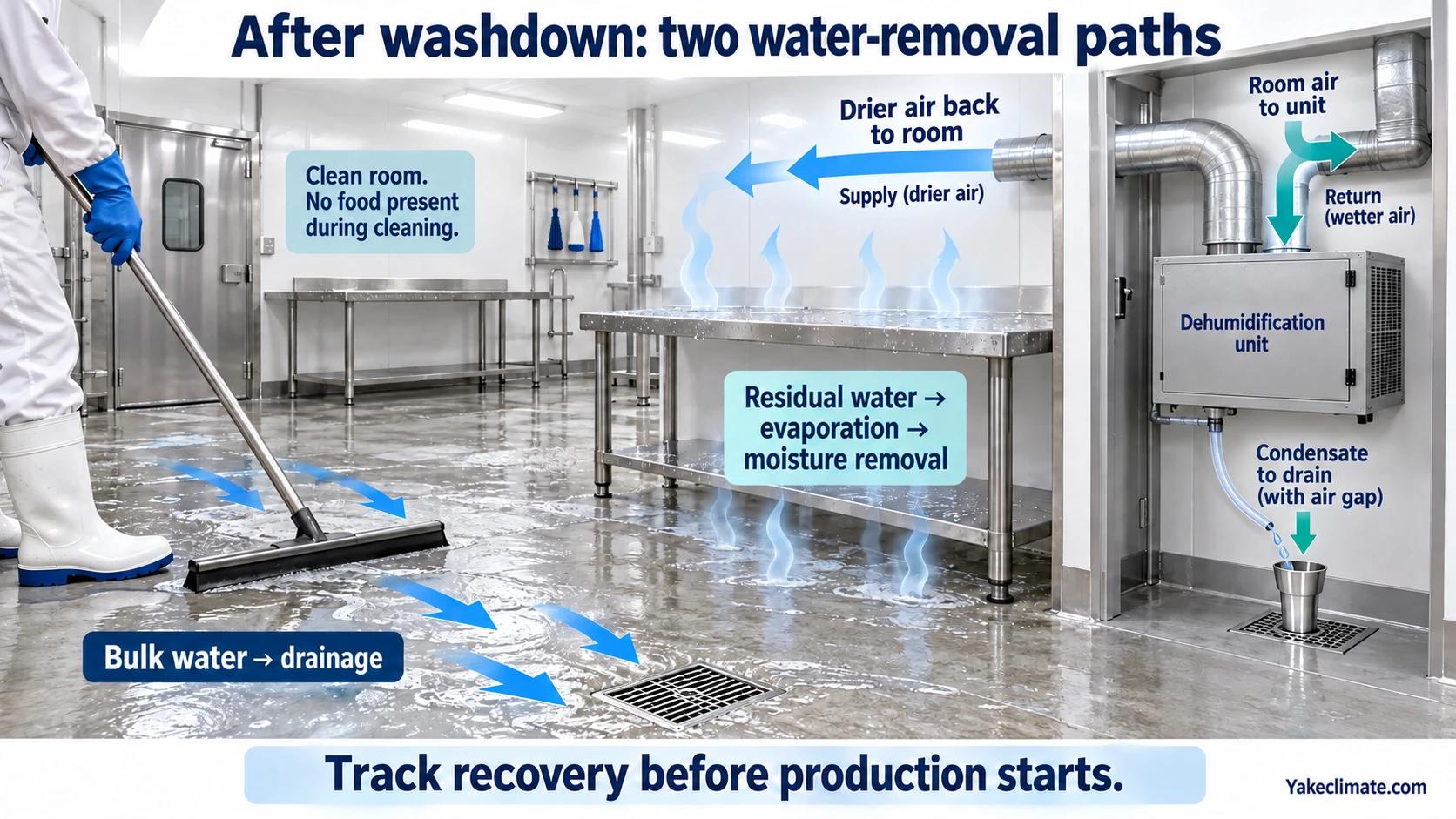
In a room that is washed down, the post-cleaning recovery window can be more demanding than steady production. Remove standing water first, estimate residual water that can evaporate, and compare the recovery period with the actual removal capacity under those air conditions. In another facility, cooking vapour, outdoor-air supply or product moisture may govern instead.
4. The Washdown Recovery Problem
Cleaning may leave water on multiple surfaces. After standing water is removed to drains, residual water can evaporate into the air; the load depends on the wet area, temperature, airflow and how much water remains.
Three things happen if it is not removed:
- Room dew point can rise if evaporation outpaces moisture removal; the magnitude depends on room volume, ventilation and dehumidification.
- A ceiling, pipe, fitting or other overhead surface may condense if it is below the dew point of the air touching it. Measure the relevant surface temperatures and check actual drip paths; there is no rule that all overhead surfaces are the coldest or condense first.
- If the accepted hygiene condition has not been restored before exposed production resumes, the food-safety team must assess the risk and the production decision. An equipment run-time estimate is not itself release approval.
A recovery sizing example
Illustrative water-balance screen: suppose 150 kg of water remains after cleaning and 60 kg is removed mechanically, leaving 90 kg on surfaces. If all 90 kg evaporated during a 1.5-hour recovery period, the average vapour release would be 60 kg/h. Actual evaporation can be lower or occur over a different period; this assumption does not establish required equipment capacity.
| Input | Value |
|---|---|
| Residual water after squeegeeing | 90 kg |
| Recovery window | 1.5 hours |
| Upper-bound average if all 90 kg evaporates in 1.5 h | 90 / 1.5 = 60 kg/h (illustrative only) |
| Equipment capacity at design conditions | Requires site water balance, recovery profile and verified performance |
Measure or estimate how much residual water actually evaporates, and include outdoor-air exchange, process moisture and any other removal paths. A measured condensate total records only what that device removed during the interval; it does not by itself equal total room load or prove that hygienic conditions were restored.
The relationship between evaporation rate and equipment capacity is set out in evaporation, drying rate and dehumidification load.
5. Zone Transitions Cause Product Condensation
The second condensation mechanism specific to food facilities involves product movement rather than the building.
Product held in a chilled room is at chilled temperature throughout. Moving it into a warmer packing or dispatch area exposes a cold surface to warmer, moister air. If the air's dew point exceeds the product's surface temperature, water condenses on the product itself.
Free water on a product or package can create a food-quality or contamination concern depending on the product, exposure and controls. It may affect labels or sealing; the food-safety and packaging teams must assess those effects rather than treating every condensation event as the same outcome.
Illustrative psychrometric check: a product surface at 4 °C moved into 20 °C air at 60% RH meets air with a dew point around 12 °C, so condensation is possible. A lower entering-air dew point than the product surface is one way to reduce that risk, subject to measurement uncertainty, exposure time and the product process. The example is not a universal 30% RH setpoint or a guaranteed dry-product outcome.
The controls available:
- When the air dew point exceeds a chilled product surface temperature, condensation can form. Review the transition air condition and the product temperature together. Options can include reducing the air dew point through a suitable latent-removal process, controlling air exchange, or using an approved product-tempering procedure. Cooling only removes water when it condenses and drains moisture; sensible cooling alone is not dehumidification.
- Reduce the temperature difference between the zones, where the process allows.
- Temper the product in an intermediate condition before full exposure.
- Minimise exposure time in the warmer zone.
The appropriate control route is a process decision. Measured product-surface temperature and transition-air dew point provide a starting point, but the target also depends on exposure time, measurement uncertainty and the facility’s product requirements.
6. Pressure and Zoning
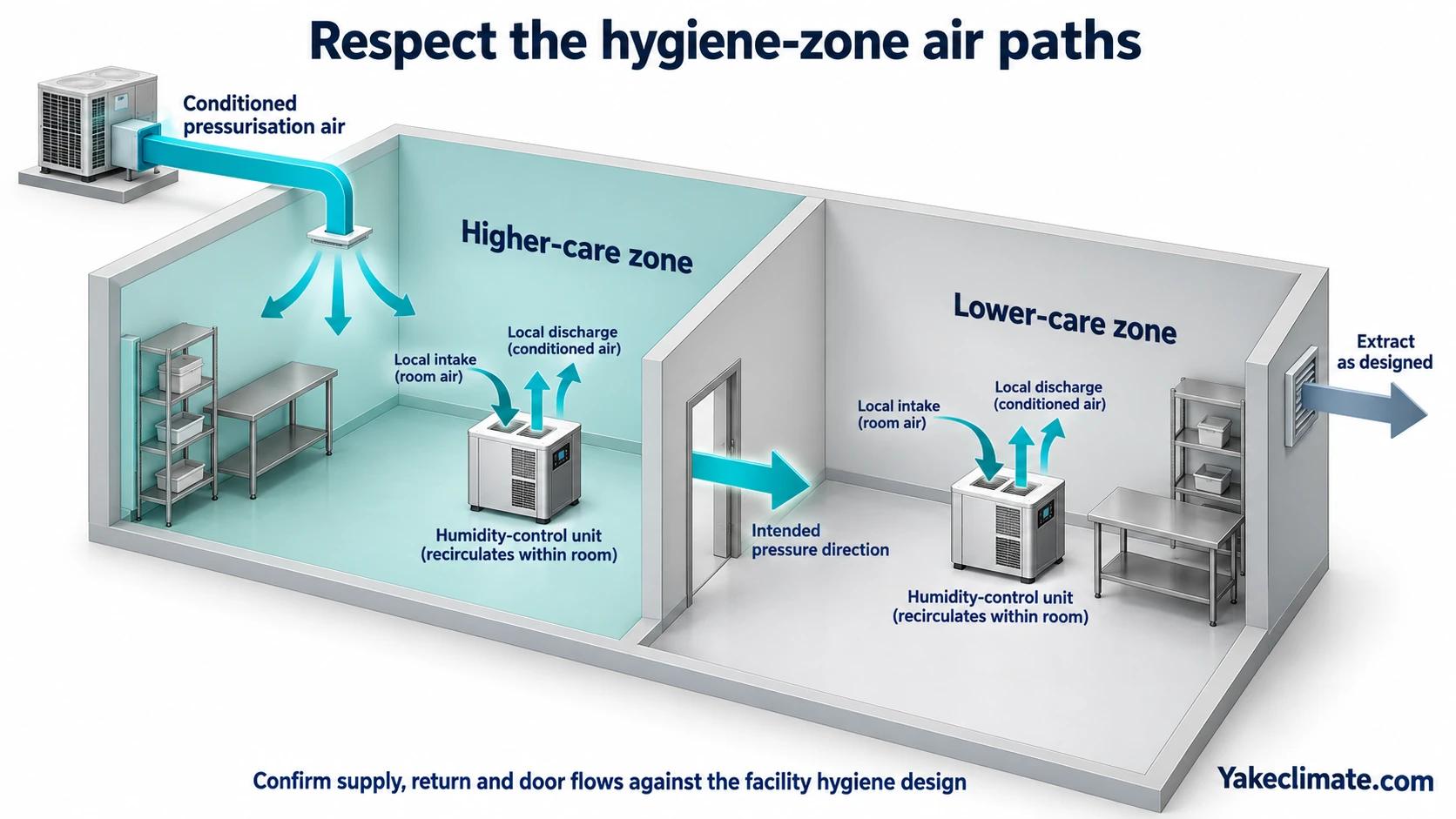
Some food facilities use pressure relationships to direct air from higher-care to lower-care areas, but the required pattern depends on the plant’s hazard analysis, process and ventilation design. Verify the intended direction for each zone; do not assume one positive-pressure rule applies throughout the facility.
This interacts with humidity control in ways that need to be resolved together:
- Pressurisation air is a moisture load. Air supplied to maintain positive pressure comes from somewhere, and if that source is unconditioned it carries its moisture with it.
- Dehumidification equipment moves air. Equipment drawing from or discharging across a zone boundary affects the pressure regime. Supply and return positions have to respect the zoning.
- Doorways exchange air. Every opening between zones at different conditions transfers both moisture and the pressure relationship.
- Recirculation between zones may not be permitted by the facility's hygiene design, which constrains where equipment can be located and how air can be routed.
The pressure regime is established by the facility's hygiene design, and the humidity equipment has to work within it rather than around it.
7. Ventilation and Dehumidification Do Different Jobs
Both are present in food facilities, for different reasons.
Ventilation and local extraction can remove process heat, vapour and contaminants and provide required outdoor or make-up air. Capture near a steam or cooking source may reduce the room load, but its effectiveness depends on hood geometry, airflow and the process.
Dehumidification removes moisture from a controlled air stream and can lower room dew point when its capacity and air paths match the load. Both refrigerant and desiccant performance depend on their entering-air conditions and configuration. Untreated outdoor ventilation may add moisture when its humidity ratio exceeds the room target; appropriately conditioned supply air may not.
Outdoor or make-up air can be a material moisture load, especially in a humid climate. Calculate process, wet-cleaning, infiltration and ventilation loads for the relevant operating modes before sizing the system. A battery-room ventilation design is not evidence for a food-zone hygiene or airflow requirement. If using an air-change rate in this calculation, state the airflow and room-volume basis; the rate alone does not determine the moisture load.
Assess source capture alongside room dehumidification and make-up air. Removing vapour near its source can reduce a room load, but compare the actual design, hygiene boundary, energy and maintenance costs before claiming a lower total cost.
8. Equipment in a Food Environment
Equipment installed in or serving food production areas faces requirements that do not apply elsewhere.
- Cleanability. Surfaces that can be cleaned, without ledges, crevices, or horizontal surfaces that collect debris. This applies to the equipment casing and to its installation, brackets, supports, and duct penetrations included.
- Materials. Appropriate for the environment, including resistance to the cleaning chemicals in use. Cleaning agents in food plants are frequently aggressive, and equipment specified for a general industrial environment may not tolerate them.
- Washdown rating. Where equipment is in a washdown area, its ingress protection must suit the cleaning method actually used, including any high-pressure application.
- Drainage and access. Standing water in or around equipment can create a hygiene concern. Check drain-pan design, stagnation risk, inspection access and cleaning method against the actual zone hygiene plan; a self-draining design may be required for a particular installation.
- Access for cleaning and inspection. Equipment that cannot be inspected cannot be verified as clean. This has to be secured at layout stage. The general point is made in commercial ceiling dehumidifiers, and the consequences are more serious here.
- Filtration. Filter class and location according to the zone's requirements, with changes possible without contaminating the space.
- Condensate routing. Where condensate discharges, and whether that route is acceptable within the facility's hygiene design.
- Noise, where it affects communication in production areas.
9. Verification and Records
Set measurement frequency, alarm handling and record retention from the site’s process, hazard analysis and verification plan, together with applicable rules. An audit trail helps the food-safety team investigate excursions; there is no universal monitoring frequency for every food area.
- Log temperature and RH at intervals suitable for the facility’s control and verification plan, and calculate dew point from calibrated measurements when useful. Continuous logging can reveal excursions that spot checks miss, but the required frequency and retention period come from the site’s process, hazard analysis and applicable rules.
- Measure surfaces relevant to each mapped condensation or drip path, including overhead equipment, pipes, refrigeration surfaces and product surfaces during zone transitions where they apply. Check the air dew point at those locations rather than assuming two surface types cover the whole facility.
- Where washdown is identified as a controlling event, capture the recovery period as well as production hours. In other facilities, a process release, weather-driven infiltration or product transition may be the more important condition to record.
- Record by zone, matching the facility's zoning rather than treating the building as one space.
- Retain records in a form that supports both internal review and external audit.
- Investigate observations. Where condensation is seen, record where and when. A pattern that correlates with washdown timing, weather, or a particular production run is diagnosable; an undated observation is not.
Humidity and condensation control sits within the facility's food safety plan. How these records are used within HACCP or an equivalent framework is determined by the facility's food safety team and the applicable regulatory requirements.
10. Information to Prepare
- Facility zones, their functions, and the hygiene classification of each.
- Product and process humidity requirements by zone.
- Temperatures held in each zone, and the transitions product makes between them.
- Washdown regime: frequency, duration, method, chemicals used, and the recovery window available.
- Water usage during cleaning, or condensate measured during recovery.
- Process moisture sources and existing local extraction.
- Ventilation rates and their basis; pressure relationships between zones.
- Site outdoor design conditions, summer and winter.
- Existing equipment: cooling, ventilation, extraction, any dehumidification.
- Observed condensation: location, timing, and correlation with washdown or weather.
- Hygiene requirements applying to equipment: materials, ingress protection, cleanability, filtration.
- Physical constraints: mounting positions, access, drain routes, power supply.
- Monitoring and record-keeping requirements the facility operates under.
11. Discussing a Project
Industrial Dehumidification for Complex Climate Applications
Yakeclimate designs and manufactures industrial dehumidification equipment for complex climate applications, with a focus on agriculture and energy projects.
We co-develop application-specific dehumidification equipment around the operating conditions, interfaces, and integration requirements of the wider project or system.
Food safety planning, hygiene zoning, HACCP, and regulatory compliance remain with the facility's food safety team and the applicable authorities. Our scope is the dehumidification equipment, its performance at the required conditions, and its ability to meet the hygiene and interface requirements those systems establish.
Explore industrial dehumidifiers, review desiccant rotor dehumidifiers, or contact Yakeclimate to review the operating conditions for your facility.
FAQ
Frequently Asked Questions
Why is ceiling condensation a food safety issue here but not elsewhere?
Condensate on an overhead surface may carry contamination onto exposed food or food-contact surfaces if it drips into the process. Map that actual path and the applicable hygiene controls. A room RH target alone cannot establish whether a particular surface will condense; check the local dew point and surface temperature.
How long does a room take to recover after washdown?
Recovery time depends on the initial water inventory, subsequent moisture release, air exchange and effective removal capacity under the recovery conditions. Condensate collected during recovery measures the water discharged by that device over the recorded interval. Use it as one input to a water balance, together with residual surface water, initial and final air moisture, ventilation or leakage, and removal by other equipment. It does not by itself equal the total recovery moisture load.
Why does chilled product sweat when moved to a warmer zone?
When the air dew point exceeds a chilled product surface temperature, condensation can form. Review the transition air condition and the product temperature together. Options can include reducing the air dew point through a suitable latent-removal process, controlling air exchange, or using an approved product-tempering procedure. Cooling only removes water when it condenses and drains moisture; sensible cooling alone is not dehumidification.
Can ventilation control humidity in a food facility?
Ventilation can remove moisture when the supplied outdoor air has a lower humidity ratio than the room air and the resulting heat load is acceptable. It can add moisture under other conditions. Evaluate outdoor design conditions and process loads together; local extraction can capture moisture near its source, while mechanical dehumidification may still be required.
What hygiene requirements apply to the equipment?
Check cleanability, chemical compatibility, ingress protection for the actual cleaning method, drainage, inspection access, filtration and condensate routing against the specific zone’s hygiene plan. Do not assume a general industrial dehumidifier meets food-zone requirements without verification.
What should the monitoring records cover?
Record temperature and RH at intervals suitable for the facility’s verification plan, derive dew point when useful, and measure the surface temperatures relevant to observed condensate or product transitions. Include cleaning recovery when it is part of the operating cycle. Record condensation by location and time so the team can test links with cleaning, weather or production events.
References
- US FDA Juice HACCP regulator training, 21 CFR 120.6(a)(5): juice processors must protect food, packaging and food-contact surfaces from adulteration by condensate, among other contaminants.
- Canadian Food Inspection Agency, preventive controls for condensation: identify where dripping condensate could contact unprotected food and control that pathway.
- Oklahoma State University FAPC, Strategies to Reduce Moisture Condensation in Food Facilities — FAPC-203
- ASHRAE Handbook—Refrigeration, food processing facility design


